South Korea Certificate Authority Market Size & Growth Rate (2026-2032)
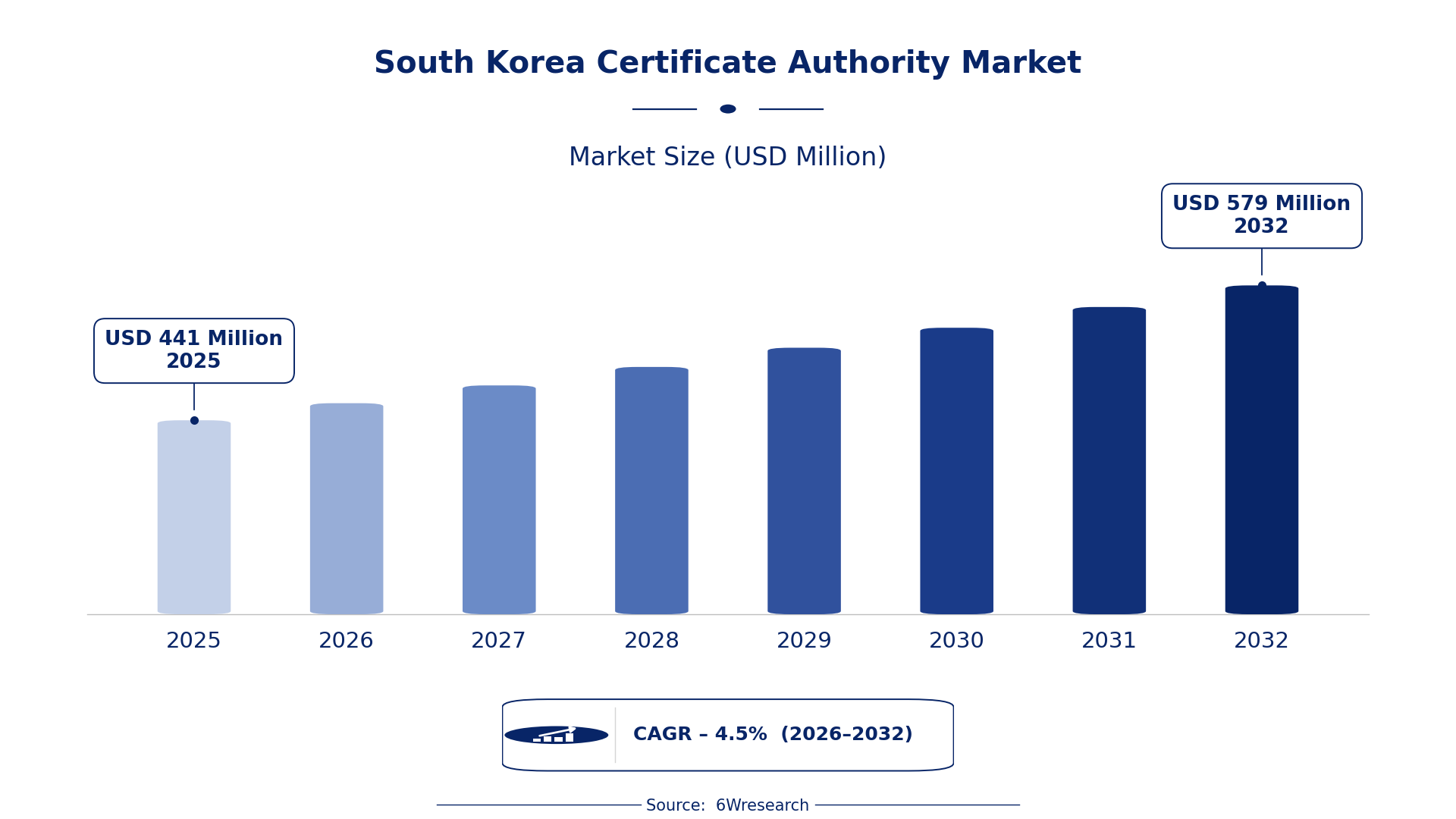
The South Korea Certificate Authority Market was estimated at USD 441 Million in 2025 and is projected to reach USD 579 Million by 2032, growing at a CAGR of 4.5% from 2026 to 2032.
South Korea Certificate Authority Market Synopsis
In South Korea, the drive towards digitalization has led to an increased reliance on Certificate Authorities (CAs) for online security. Businesses and individuals alike are seeking to authenticate their identities and secure their communications, thus amplifying the demand for digital certificates.
With key offerings including SSL/TLS certificates and document signing certificates, this market exhibits vibrant competition. The ongoing push for e-government services complements the market's growth, ensuring that reliable digital identity solutions are integral to South Korea’s digital transformation.
South Korea Certificate Authority Market Year-wise Growth Rate and Key Drivers
This graph illustrates the annual growth rates of the South Korea Certificate Authority Market from 2021 to 2032, highlighting a steady upward trajectory and projected expansion over the forecast period.
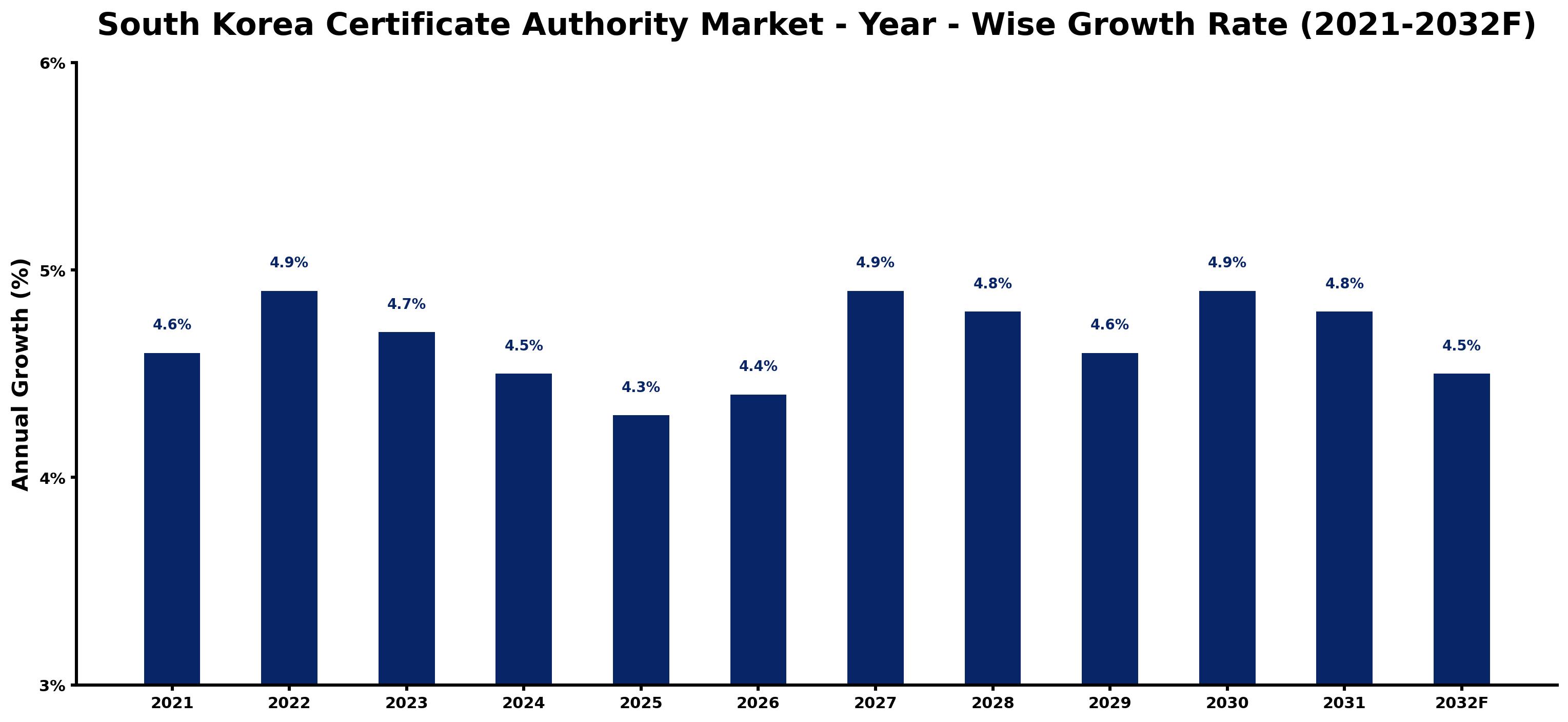
The table below presents the year‑wise growth rates along with the key drivers influencing the market
| Year | Growth Rate | Major Drivers |
| 2021 | 4.6% | Strengthening of KYC regulations by the Financial Services Commission. |
| 2022 | 4.9% | Increased demand for secure digital identities in e-commerce. |
| 2023 | 4.7% | Government push for digital rights management in media. |
| 2024 | 4.5% | Growth of telehealth services necessitating secure patient data sharing. |
| 2025 | 4.3% | Rise in remote work creating demand for digital certificates. |
| 2026 | 4.4% | Local fintech startups driving secure transaction innovations. |
| 2027 | 4.9% | Implementation of stricter data protection laws enhancing certification needs. |
| 2028 | 4.8% | Expanding mobile payment solutions requiring robust security certifications. |
| 2029 | 4.6% | Increased cybersecurity incidents prompting robust authentication measures. |
| 2030 | 4.9% | Growth of AI applications necessitating secure algorithms certification. |
| 2031 | 4.8% | Adoption of biometric technologies requiring foundational certificate services. |
| 2032 | 4.5% | Rise in smart contract usage boosting demand for verification. |
Note: Market size estimations and growth projections presented in this report are based on 6Wresearch's proprietary forecasting methodology, utilizing the latest available industry data, government publications, and primary research inputs.
South Korea Certificate Authority Market Key Takeaways
Below are some of the specific key takeaways from the market, including:
- The increasing focus on cybersecurity is driving demand for digital certificates across various sectors.
- Regulatory requirements are evolving, compelling CAs to enhance compliance and security measures.
- Emerging technologies like blockchain are beginning to influence the ways certificates are issued and managed.
- Investment opportunities are emerging for firms that can adapt to the growing demand for secure online transactions.
- The government is actively promoting Public Key Infrastructure (PKI) technology to strengthen digital security.
Evaluation of Restraints in South Korea Certificate Authority Market
The South Korea Certificate Authority market faces notable challenges due to intense competition among a limited number of players. Such competition often results in price wars, compromising profit margins for CAs. Additionally, with growing cyber threats, maintaining customer trust while ensuring high levels of security is paramount for CAs. Compliance with evolving regulations also demands that CAs continuously update their practices, adding operational complexity.
South Korea Certificate Authority Market Trends
A shift towards the adoption of advanced digital certificates is evident, as organizations recognize the critical role of cybersecurity in their operations. The rise of e-commerce and IoT devices necessitates trusted digital identities, propelling demand for diverse certificate types. on top of that, the integration of blockchain technology is gaining traction, promising enhanced security and transparency in certificate management.
South Korea Certificate Authority Market Opportunities
As South Korea embraces digital transactions and the digital economy expands, the Certificate Authority market is ripe with opportunities. Investors can focus on established CAs that prioritize compliance and offer innovative security solutions. The increasing importance placed on cybersecurity opens doors for new players and investment in infrastructure that supports secure online communications.
Government Initiatives in the South Korea Certificate Authority Market
The South Korean government is taking proactive steps to shape the Certificate Authority market through various initiatives and regulations. By emphasizing the importance of cybersecurity, public policies are designed to foster trust in digital transactions. The government’s commitment to enhancing the digital economy also translates to stricter guidelines for certificate issuance and management.
- A recent initiative by the Korea Internet & Security Agency (KISA) established new certification standards to enhance the integrity of digital transactions.
- Current efforts include a comprehensive regulatory review aimed at improving compliance protocols for CAs, now underway to address rising security concerns.
- Upcoming plans involve a public-private partnership to boost national digital infrastructure, anticipated to initiate by late 2026.
- The government is currently promoting PKI technology adoption across both public and private sectors to secure identity verification processes.
- An ongoing campaign is aimed at educating businesses about the benefits of utilizing digital certificates in their operations.
Future Insights of the South Korea Certificate Authority Market
As we look ahead to 2026-2032, the South Korea Certificate Authority market is expected to maintain its upward trajectory. The drive for secure online interactions, especially with increasing e-commerce and digital banking, is likely to solidify the demand for digital certificates. With a government increasingly focused on cybersecurity, businesses will be compelled to invest more heavily in authentication solutions. Those CAs that adapt swiftly to market needs and regulatory changes will find themselves in a strong position to thrive.
South Korea Certificate Authority Market Latest Developments
In the last 12-14 months, the South Korea Certificate Authority market has seen a flurry of activity aimed at enhancing security measures and expanding service offerings. The landscape is becoming more competitive as organizations seek cutting-edge solutions for digital identity verification.
- A new suite of advanced SSL/TLS certificates was launched in early 2025, aimed at businesses looking to bolster their online security.
- Current development includes an ongoing project focused on integrating AI technologies into certificate management processes, expected to improve efficiency by mid-2026.
- Upcoming initiatives are in place to establish partnerships between CAs and tech firms to explore blockchain for certificate issuance transparency, planned for late 2025.
- A notable partnership was formed in Q1 2025 between regional CAs to consolidate their services and expand market reach.
- A major certification upgrade process is currently underway, which will enhance the cryptographic algorithms used to secure digital certificates.
South Korea Certificate Authority Market - Key Attractiveness of the Report
- 10 Years of Market Numbers
- Historical Data Starting from 2022 to 2025
- Base Year: 2025
- Forecast Data until 2032
- Key Performance Indicators Impacting the Market
- Major Upcoming Developments and Projects
Key Highlights of the Report:
- South Korea Certificate Authority Market Outlook
- Market Size of South Korea Certificate Authority Market, 2025
- Forecast of South Korea Certificate Authority Market, 2032
- Historical Data and Forecast of South Korea Certificate Authority Revenues & Volume for the Period 2022-2032F
- South Korea Certificate Authority Market Trend Evolution
- South Korea Certificate Authority Market Drivers and Challenges
- South Korea Certificate Authority Price Trends
- South Korea Certificate Authority Porter's Five Forces
- South Korea Certificate Authority Industry Life Cycle
- Historical Data and Forecast of South Korea Certificate Authority Market Revenues & Volume By Component for the Period 2022-2032F
- Historical Data and Forecast of South Korea Certificate Authority Market Revenues & Volume By Certificate Types for the Period 2022-2032F
- Historical Data and Forecast of South Korea Certificate Authority Market Revenues & Volume By Services for the Period 2022-2032F
- Historical Data and Forecast of South Korea Certificate Authority Market Revenues & Volume By SSL Certification Validation Type for the Period 2022-2032F
- Historical Data and Forecast of South Korea Certificate Authority Market Revenues & Volume By Domain Validation for the Period 2022-2032F
- Historical Data and Forecast of South Korea Certificate Authority Market Revenues & Volume By Organization Validation for the Period 2022-2032F
- Historical Data and Forecast of South Korea Certificate Authority Market Revenues & Volume By Extended Validation for the Period 2022-2032F
- Historical Data and Forecast of South Korea Certificate Authority Market Revenues & Volume By Organization Size for the Period 2022-2032F
- Historical Data and Forecast of South Korea Certificate Authority Market Revenues & Volume By Large Enterprises for the Period 2022-2032F
- Historical Data and Forecast of South Korea Certificate Authority Market Revenues & Volume By SMEs for the Period 2022-2032F
- Historical Data and Forecast of South Korea Certificate Authority Market Revenues & Volume By Vertical for the Period 2022-2032F
- Historical Data and Forecast of South Korea Certificate Authority Market Revenues & Volume By BFSI for the Period 2022-2032F
- Historical Data and Forecast of South Korea Certificate Authority Market Revenues & Volume By Retail and eCommerce for the Period 2022-2032F
- Historical Data and Forecast of South Korea Certificate Authority Market Revenues & Volume By Government and Defense for the Period 2022-2032F
- Historical Data and Forecast of South Korea Certificate Authority Market Revenues & Volume By Healthcare and Life Sciences for the Period 2022-2032F
- Historical Data and Forecast of South Korea Certificate Authority Market Revenues & Volume By IT and Telecom for the Period 2022-2032F
- Historical Data and Forecast of South Korea Certificate Authority Market Revenues & Volume By Travel and Hospitality for the Period 2022-2032F
- Historical Data and Forecast of South Korea Certificate Authority Market Revenues & Volume By Education for the Period 2022-2032F
- Historical Data and Forecast of South Korea Certificate Authority Market Revenues & Volume By Other verticals (transportation and logistics, media and entertainment, and manufacturing) for the Period 2022-2032F
- South Korea Certificate Authority Import Export Trade Statistics
- Market Opportunity Assessment By Component
- Market Opportunity Assessment By SSL Certification Validation Type
- Market Opportunity Assessment By Organization Size
- Market Opportunity Assessment By Vertical
- South Korea Certificate Authority Top Companies Market Share
- South Korea Certificate Authority Competitive Benchmarking By Technical and Operational Parameters
- South Korea Certificate Authority Company Profiles
- South Korea Certificate Authority Key Strategic Recommendations






































