South Korea Chamotte Market Size, Share & Growth Rate
The South Korea Chamotte Market was estimated at USD 397 Million in 2025 and is projected to reach USD 544 Million by 2032, growing at a CAGR of 4.6% from 2026 to 2032. This growth is largely attributed to the expanding construction sector, which increasingly requires high-quality refractory materials for kiln linings and furnace applications. Additionally, the rising demand from the ceramics and glass industries further fuels market expansion, creating a robust environment for chamotte producers.
South Korea Chamotte Market Year-wise Growth Rate and Key Drivers
This graph highlights how the South Korea Chamotte Market has steadily grown over the years, supported by major growth factors.
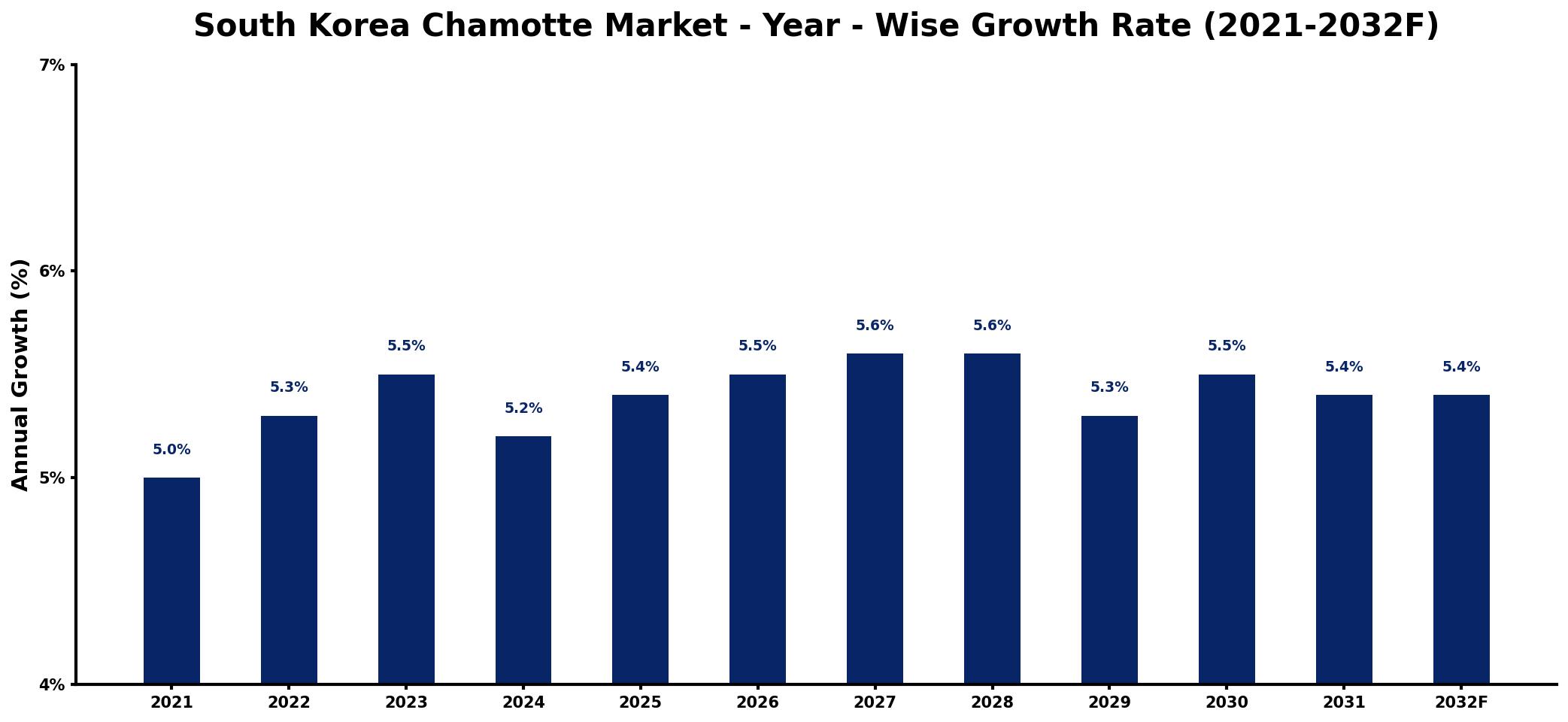
The table below presents the year‑wise growth rates along with the key drivers influencing the market
| Year | Growth Rate | Major Drivers |
| 2021 | 5.0% | Increased investment in construction projects |
| 2022 | 5.3% | Growing demand from ceramics industry |
| 2023 | 5.5% | Expansion of energy sector applications |
| 2024 | 5.2% | Rising popularity of eco-friendly materials |
| 2025 | 5.4% | Strengthening infrastructure development initiatives |
| 2026 | 5.5% | Increased exports to international markets |
| 2027 | 5.6% | Emerging technologies in manufacturing processes |
| 2028 | 5.6% | Higher consumer awareness of quality |
| 2029 | 5.3% | rising infrastructure development spending |
| 2030 | 5.5% | Increased production capacities of suppliers |
| 2031 | 5.4% | Expanding applications in industrial sectors |
| 2032 | 5.4% | Rising investments in research innovation |
Note: Market size estimations and growth projections presented in this report are based on 6Wresearch's proprietary forecasting methodology, utilizing the latest available industry data, government publications, and primary research inputs.
South Korea Chamotte Market Synopsis
In South Korea, the chamotte market is uniquely positioned, with a significant demand for high-alumina content materials that are crucial in high-temperature applications. The ongoing construction boom, coupled with stringent quality standards, is driving the requirement for premium chamotte across various industries.
Furthermore, technological advancements in manufacturing processes are enhancing product quality, which is essential for maintaining competitive advantage. As industries pivot toward sustainable practices, the adoption of eco-friendly production methods is becoming increasingly relevant in this market.
South Korea Chamotte Market Key Takeaways
- The market is experiencing steady growth, influenced by strong demand in construction and ceramics.
- Technological innovations in production are improving quality and efficiency.
- Sustainability initiatives are becoming a core focus for manufacturers.
- Fluctuations in demand from primary sectors present ongoing challenges.
- The government's supportive policies are fostering market growth and competitiveness.
Evaluation of Restraints in South Korea Chamotte Market
The South Korea Chamotte Market faces specific challenges that could impede its growth trajectory. Fluctuating demand from the steel and ceramics industries—critical consumers of chamotte—introduces uncertainty, making it difficult for manufacturers to predict production needs and manage inventory effectively. Additionally, the market contends with increasing competition from alternative materials and imports, which may threaten the market position of domestic producers. Environmental regulations aimed at reducing emissions also necessitate significant investments in cleaner production technologies, further complicating operational dynamics.
South Korea Chamotte Market Trends
Current trends in the South Korea Chamotte Market indicate a significant shift towards sustainable production practices. As industries grow increasingly eco-conscious, manufacturers are investing in technologies that lower carbon footprints and improve energy efficiency during production. Additionally, the rising popularity of innovative chamotte-based products is enhancing market appeal, particularly in high-temperature industrial applications. The alignment of these trends with government initiatives aimed at promoting infrastructure development is set to bolster the market further.
South Korea Chamotte Market Opportunities
The South Korea Chamotte Market presents substantial investment opportunities, particularly in sectors that utilize chamotte in manufacturing refractory materials, ceramics, and construction. Companies focused on chamotte mining and processing stand to benefit from the increasing domestic and international demand. Moreover, enterprises that develop advanced, sustainable chamotte products can capitalize on the growing emphasis on eco-friendly manufacturing processes. With construction and urbanization efforts on the rise, the prospects for growth remain promising.
Government Initiatives in the South Korea Chamotte Market
The South Korean government has proactively introduced various initiatives to stimulate growth in the chamotte sector. These policies encompass subsidies and financial incentives aimed at supporting manufacturers in the development and expansion of chamotte production capabilities. Furthermore, the government emphasizes research and development to enhance product quality and global competitiveness. Environmental regulations ensure that sustainability and safety standards are maintained, aligning with broader objectives of reducing industrial impacts on the environment.
Future Insights of the South Korea Chamotte Market
Looking forward to 2026-2032, the South Korea Chamotte Market is poised for continued growth. The construction industry's expansion and heightened demand for refractory materials in steel production are key drivers. Additionally, the government's commitment to infrastructure projects will likely further amplify the demand for chamotte products. Ongoing technological advancements in production processes promise enhanced product performance and quality. However, vigilance is necessary regarding fluctuations in raw material costs and evolving environmental regulations, which could influence market dynamics.
South Korea Chamotte Market Latest Developments (2025 - 2026)
Recent developments in the South Korea Chamotte Market indicate a growing focus on sustainability and efficiency. Manufacturers are adopting advanced production technologies to meet both domestic and international standards. Additionally, partnerships between industry players and research institutions are becoming more prevalent, aimed at fostering innovation in chamotte applications. This collaboration is expected to drive the development of new products that align with emerging market needs and environmental considerations.
South Korea Chamotte Market - Key Attractiveness of the Report
- 10 Years of Market Numbers
- Historical Data Starting from 2022 to 2025
- Base Year: 2025
- Forecast Data until 2032
- Key Performance Indicators Impacting the Market
- Major Upcoming Developments and Projects
Key Highlights of the Report:
- South Korea Chamotte Market Outlook
- Market Size of South Korea Chamotte Market, 2025
- Forecast of South Korea Chamotte Market, 2032
- Historical Data and Forecast of South Korea Chamotte Revenues & Volume for the Period 2022-2032F
- South Korea Chamotte Market Trend Evolution
- South Korea Chamotte Market Drivers and Challenges
- South Korea Chamotte Price Trends
- South Korea Chamotte Porter's Five Forces
- South Korea Chamotte Industry Life Cycle
- Historical Data and Forecast of South Korea Chamotte Market Revenues & Volume By Type for the Period 2022-2032F
- Historical Data and Forecast of South Korea Chamotte Market Revenues & Volume By Clinker for the Period 2022-2032F
- Historical Data and Forecast of South Korea Chamotte Market Revenues & Volume By Cement Clinker for the Period 2022-2032F
- Historical Data and Forecast of South Korea Chamotte Market Revenues & Volume By Application for the Period 2022-2032F
- Historical Data and Forecast of South Korea Chamotte Market Revenues & Volume By Cement for the Period 2022-2032F
- Historical Data and Forecast of South Korea Chamotte Market Revenues & Volume By Silicate Material for the Period 2022-2032F
- Historical Data and Forecast of South Korea Chamotte Market Revenues & Volume By Others for the Period 2022-2032F
- South Korea Chamotte Import Export Trade Statistics
- Market Opportunity Assessment By Type
- Market Opportunity Assessment By Application
- South Korea Chamotte Top Companies Market Share
- South Korea Chamotte Competitive Benchmarking By Technical and Operational Parameters
- South Korea Chamotte Company Profiles
- South Korea Chamotte Key Strategic Recommendations






































