South Korea Coated Fabric Market Size, Share & Growth Rate
The South Korea Coated Fabric Market was estimated at USD 330 Million in 2025 and is projected to reach USD 436 Million by 2032, growing at a CAGR of 4.1% from 2026 to 2032. This growth trajectory is primarily driven by increasing applications in the automotive sector, where durability and weather resistance are paramount. Additionally, the healthcare and marine industries are embracing coated fabrics for their superior performance and aesthetic qualities, further bolstering demand.
South Korea Coated Fabric Market Year-wise Growth Rate and Key Drivers
This graph highlights how the South Korea Coated Fabric Market has steadily grown over the years, supported by major growth factors.
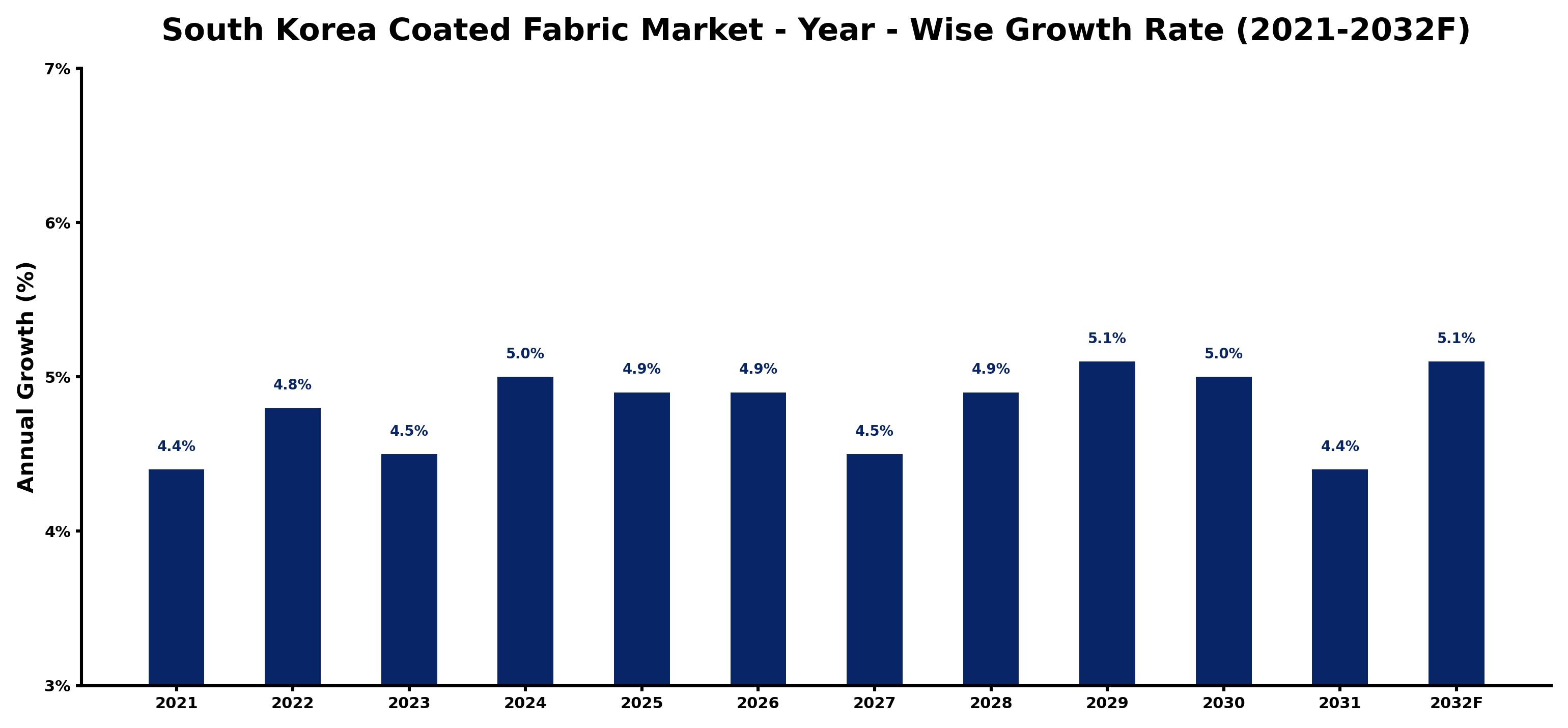
The table below presents the year‑wise growth rates along with the key drivers influencing the market
| Year | Growth Rate | Major Drivers |
| 2021 | 4.4% | Increasing adoption of advanced technologies |
| 2022 | 4.8% | Expansion of transportation and logistics networks |
| 2023 | 4.5% | Rapid growth in telecom and data center sectors |
| 2024 | 5.0% | Rapid growth in telecom and data center sectors |
| 2025 | 4.9% | Increasing adoption of advanced technologies |
| 2026 | 4.9% | Government infrastructure modernization initiatives |
| 2027 | 4.5% | Increasing smart city development projects |
| 2028 | 4.9% | Expansion of transportation and logistics networks |
| 2029 | 5.1% | Growing urbanization and commercial development |
| 2030 | 5.0% | Government infrastructure modernization initiatives |
| 2031 | 4.4% | Increasing smart city development projects |
| 2032 | 5.1% | Expansion of commercial construction activities |
Note - Market size estimations and growth projections presented in this report are based on 6Wresearch’s advanced forecasting approach, validated with industry datasets as of June 2026.
South Korea Coated Fabric Market Synopsis
The coated fabric market in South Korea is characterized by a rising demand for sustainable solutions, as both consumers and industries are increasingly focused on eco-friendly materials. This shift is prompting manufacturers to innovate in developing coatings that are not only durable but also environmentally responsible.
Moreover, the market is witnessing a heightened focus on customization, where textile manufacturers are tailoring coated fabrics to meet specific industry requirements. This trend is particularly evident in technical textiles, where specialized coatings enhance performance characteristics, thus attracting a broader client base.
South Korea Coated Fabric Market Key Takeaways
- The market is projected to reach USD 436 Million by 2032, highlighting significant growth opportunities.
- Automotive, healthcare, and marine applications are key sectors driving demand for coated fabrics.
- Innovation in eco-friendly coatings is becoming essential for maintaining competitiveness.
- Customization of textile solutions is on the rise, reflecting diverse industry needs.
- Government policies support sustainable practices and product quality standards in the textile sector.
Evaluation of Restraints in South Korea Coated Fabric Market
While the coated fabric market in South Korea is on an upward trajectory, several challenges could impede its growth. One significant restraint is the pressure on manufacturers to balance cost and quality, particularly when sourcing raw materials. As environmental concerns rise, companies face the dual challenge of meeting sustainability targets while adhering to stringent performance standards. Furthermore, the fast-paced evolution of technology in textile coatings requires ongoing investment in research and development, which can strain resources for smaller players.
South Korea Coated Fabric Market Trends
The coated fabric market in South Korea is experiencing several notable trends. A significant shift towards advanced textile technologies is enabling the creation of fabrics that not only perform exceptionally but also conform to modern sustainability standards. Additionally, the growing trend of smart textiles is paving the way for coatings embedded with electronic functionalities, offering added value across various applications. Furthermore, the rising popularity of outdoor and leisure activities is increasing the demand for coated fabrics in apparel and gear, enhancing their market potential.
South Korea Coated Fabric Market Opportunities
Opportunities in the South Korea coated fabric market are expanding as industries seek innovative solutions. The ongoing development of high-performance, environmentally friendly fabrics positions manufacturers to capture a growing segment of eco-conscious consumers. Additionally, the demand for coated fabrics in the healthcare sector, driven by heightened hygiene and safety standards, presents a promising area for growth. Collaborations with research institutions can foster innovation, enabling the development of cutting-edge textiles tailored to future market demands.
Government Initiatives in the South Korea Coated Fabric Market
Government policies in South Korea play a vital role in shaping the coated fabric market, with a strong emphasis on enhancing textile manufacturing capabilities and ensuring product safety. Initiatives aimed at promoting sustainable practices, including the adoption of eco-friendly materials and technologies, are prevalent. Furthermore, the government supports regulatory frameworks that facilitate compliance with safety standards, thus fostering consumer confidence in coated fabrics across various industries.
Future Insights of the South Korea Coated Fabric Market
Looking ahead to 2026-2032, the South Korea coated fabric market is poised for robust growth. As consumer awareness about sustainability increases, the demand for environmentally friendly coated fabrics will likely drive innovation. Additionally, advancements in coating technologies will allow manufacturers to produce fabrics that not only meet but exceed performance expectations. The convergence of new applications in healthcare and automotive sectors will further enhance market dynamics, positioning South Korea as a leader in coated fabric solutions.
South Korea Coated Fabric Market Latest Developments (May 2025 - June 2026)
Recent industry developments indicate a clear shift towards integrating advanced technologies in the production of coated fabrics. Innovations aimed at enhancing the aesthetic appeal and functional properties of fabrics are gaining traction. Furthermore, collaborations between textile manufacturers and tech companies are being observed, aimed at developing smart textiles that cater to the growing market for multifunctional applications. Increased focus on regulatory compliance and sustainability practices remains a consistent theme in industry conversations.
South Korea Coated Fabric Market - Key Attractiveness of the Report
- 10 Years of Market Numbers
- Historical Data Starting from 2022 to 2025
- Base Year: 2025
- Forecast Data until 2032
- Key Performance Indicators Impacting the Market
- Major Upcoming Developments and Projects
Key Highlights of the Report:
- South Korea Coated Fabric Market Outlook
- Market Size of South Korea Coated Fabric Market, 2025
- Forecast of South Korea Coated Fabric Market, 2032
- Historical Data and Forecast of South Korea Coated Fabric Revenues & Volume for the Period 2022-2032F
- South Korea Coated Fabric Market Trend Evolution
- South Korea Coated Fabric Market Drivers and Challenges
- South Korea Coated Fabric Price Trends
- South Korea Coated Fabric Porter's Five Forces
- South Korea Coated Fabric Industry Life Cycle
- Historical Data and Forecast of South Korea Coated Fabric Market Revenues & Volume By Product for the Period 2022-2032F
- Historical Data and Forecast of South Korea Coated Fabric Market Revenues & Volume By Polymer-coated Fabric for the Period 2022-2032F
- Historical Data and Forecast of South Korea Coated Fabric Market Revenues & Volume By Rubber-coated Fabric for the Period 2022-2032F
- Historical Data and Forecast of South Korea Coated Fabric Market Revenues & Volume By Fabric-backed Wall Coverings for the Period 2022-2032F
- Historical Data and Forecast of South Korea Coated Fabric Market Revenues & Volume By Application for the Period 2022-2032F
- Historical Data and Forecast of South Korea Coated Fabric Market Revenues & Volume By Transportation for the Period 2022-2032F
- Historical Data and Forecast of South Korea Coated Fabric Market Revenues & Volume By Protective Clothing for the Period 2022-2032F
- Historical Data and Forecast of South Korea Coated Fabric Market Revenues & Volume By Industrial for the Period 2022-2032F
- Historical Data and Forecast of South Korea Coated Fabric Market Revenues & Volume By Roofing, Awnings & Canopies for the Period 2022-2032F
- Historical Data and Forecast of South Korea Coated Fabric Market Revenues & Volume By Furniture & Seating for the Period 2022-2032F
- Historical Data and Forecast of South Korea Coated Fabric Market Revenues & Volume By Others for the Period 2022-2032F
- South Korea Coated Fabric Import Export Trade Statistics
- Market Opportunity Assessment By Product
- Market Opportunity Assessment By Application
- South Korea Coated Fabric Top Companies Market Share
- South Korea Coated Fabric Competitive Benchmarking By Technical and Operational Parameters
- South Korea Coated Fabric Company Profiles
- South Korea Coated Fabric Key Strategic Recommendations






































