South Korea Coaxial Cables Market Summary
The south korea coaxial cables market was estimated at USD 214 Million in 2025 and is projected to reach USD 291 Million by 2032, growing at a CAGR of 5.5% from 2026 to 2032.
South Korea Coaxial Cables Market Year-wise Growth Rate and Key Drivers
This graph highlights how the South Korea Coaxial Cables Market has steadily grown over the past five years, supported by major growth factors.
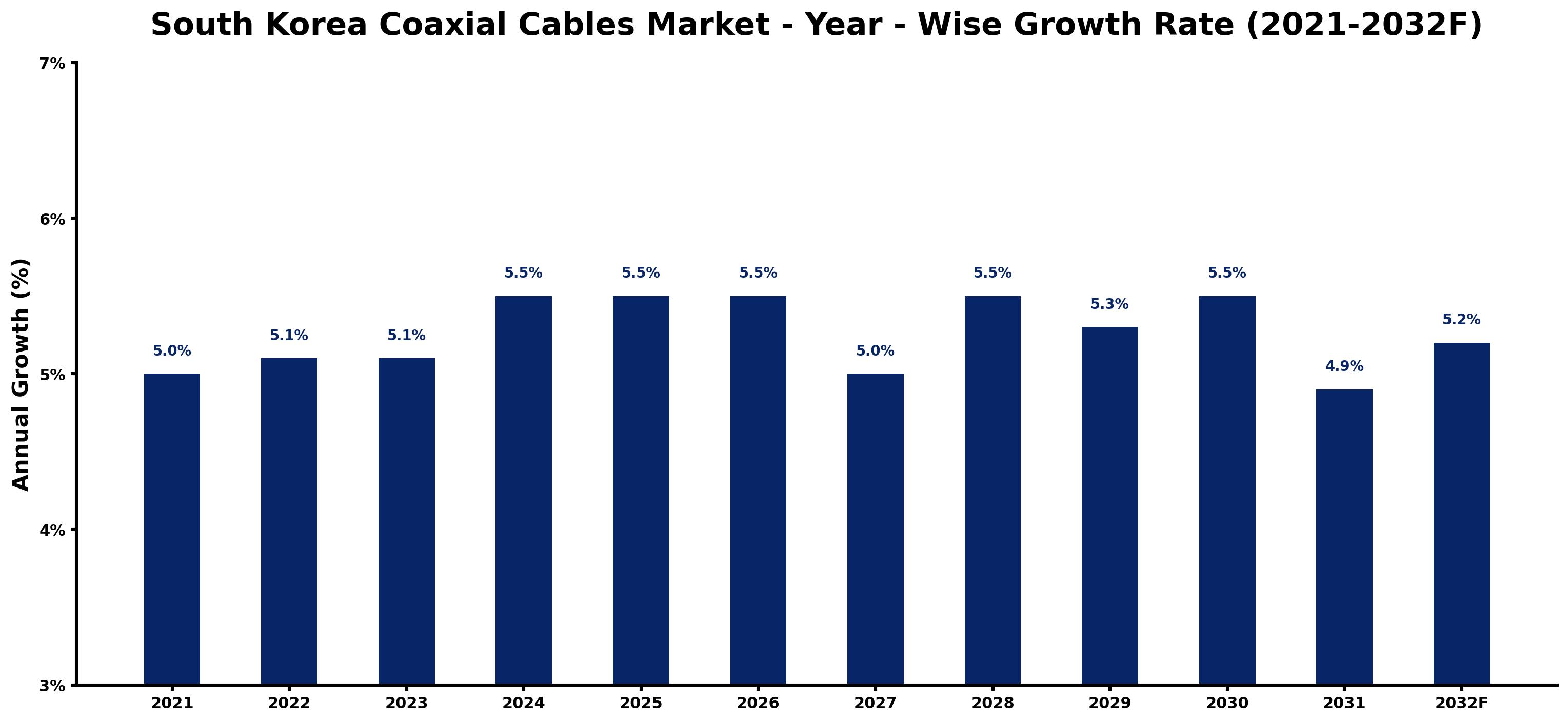
The table below presents the year wise growth rates along with the key drivers influencing the market
| Year | Growth Rate | Major Drivers |
| 2021 | 5.0% | Post-pandemic infrastructure investments boosted demand for reliable coaxial cable solutions. |
| 2022 | 5.1% | Emerging technologies in telecommunications increased reliance on high-performance coaxial cables. |
| 2023 | 5.1% | Legacy copper grid failures prompted a shift towards modern coaxial cable installations. |
| 2024 | 5.5% | Corporations focused on upgrading existing networks, enhancing coaxial cable usage significantly. |
| 2025 | 5.5% | The construction industry expanded, leading to higher coaxial cable requirements in projects. |
| 2026 | 5.5% | Technological advancements in broadband services created new standards for coaxial installations. |
| 2027 | 5.0% | Consumer electronics market growth spurred demand for high-quality coaxial cable products. |
| 2028 | 5.5% | Increasing digital content consumption necessitated improved coaxial infrastructure for providers. |
| 2029 | 5.3% | Smart city initiatives required advanced coaxial networks to support urban connectivity. |
| 2030 | 5.5% | The rise of IoT devices translated into an uptick in coaxial cable deployments. |
| 2031 | 4.9% | Renewable energy projects sought robust coaxial solutions for efficient power transmission. |
| 2032 | 5.2% | Local manufacturers optimized supply chains, reducing costs and improving coaxial cable availability. |
Note - Market size estimations and growth projections presented in this report are based on 6Wresearch's advanced forecasting approach, validated with industry datasets as of June 2026.
South Korea Coaxial Cables Market Synopsis
The South Korea Coaxial Cables Market is projected to reach 5.5% and witness significant growth during the forecast period (2026-2032). This growth is driven by the increasing demand from key sectors including telecommunications, broadcasting, and satellite communications. With a robust infrastructure and technological advancements, South Korea is poised to enhance its connectivity capabilities through innovative coaxial cable solutions.
South Korea Coaxial Cables Market Growth Drivers
Key factors driving the growth of the South Korea Coaxial Cables Market include:
- The escalating demand for high-speed data transmission is a significant growth driver. As various industries increasingly rely on fast and reliable internet, the need for high-quality coaxial cables becomes paramount.
- Advancements in 5G technology are transforming the telecommunications landscape. The rollout of 5G networks requires superior coaxial cable solutions that support enhanced performance and signal integrity.
- Government initiatives aimed at improving digital infrastructure are also influencing market growth. These initiatives often include funding for broadband expansion, which directly affects the demand for coaxial cables.
- The increasing adoption of Internet of Things (IoT) devices further stimulates demand for robust coaxial cables. As smart devices proliferate, the requirement for quality connectivity solutions becomes critical.
- The automotive sector is witnessing a trend toward enhanced connectivity, driving demand for specialized coaxial cables tailored for automotive applications.
South Korea Coaxial Cables Market Trends and Opportunities
The South Korea Coaxial Cables Market is characterized by several emerging trends that present lucrative opportunities:
- Manufacturers are focusing on developing coaxial cables with improved durability and flexibility. This trend aligns with the increasing demand for long-lasting and robust products that can withstand various environmental conditions.
- The emphasis on eco-friendly manufacturing practices is gaining traction. Producers are exploring sustainable materials and production methods, catering to environmentally-conscious consumers.
- Innovation in cable design and technology is a focal point for many manufacturers. Continuous investment in research and development allows for the introduction of advanced solutions that meet evolving industry standards.
- The growing need for reliable broadband services in residential and commercial sectors drives demand for high-performance coaxial cables, indicating a profitable market segment to explore.
- The expansion of the smart home market presents significant opportunities for coaxial cable manufacturers. As more consumers invest in smart home technology, the requirement for high-quality connectivity increases.
South Korea Coaxial Cables Market Challenges and Restraints
Despite the promising prospects, the South Korea Coaxial Cables Market faces several challenges:
- Intense competition among leading manufacturers creates pressure on pricing strategies and profit margins. Smaller companies may find it difficult to establish a foothold in such a competitive environment.
- Price volatility of raw materials, particularly copper, can affect production costs significantly. The fluctuation in material prices may force manufacturers to reconsider pricing or absorb costs to stay competitive.
- Rapid technological changes necessitate ongoing investment in innovation. Companies must continuously adapt to emerging technologies to remain relevant and meet customer demands.
- Regulatory compliance is essential but can be complex. Companies must navigate varying standards and policies, which can hinder market entry and product development timelines.
- Shifts in consumer preferences towards digital services may lead to a reassessment of existing product ranges, requiring agility in product development to keep pace with market needs.
South Korea Coaxial Cables Market Government Investment and Initiatives
The South Korean government plays a vital role in shaping the Coaxial Cables Market through strategic investment and policy initiatives. Key actions include:
- Investment in digital infrastructure has been a priority, reflecting the government's commitment to enhancing connectivity across urban and rural areas. This funding supports broadband projects that necessitate high-quality coaxial cables.
- The Korean Agency for Technology and Standards (KATS) oversees the establishment of quality standards for coaxial cables, which helps maintain safety and performance benchmarks in the industry.
- The Fair Trade Commission (FTC) is actively involved in ensuring fair competition within the market, preventing anti-competitive practices that could stifle innovation and consumer choice.
- Support for research and development initiatives in the coaxial cable industry is provided by the Ministry of Science and ICT, encouraging innovation that aligns with national technological objectives.
- Policies aimed at consumer protection are implemented to ensure that products meet safety and reliability standards, thereby fostering trust in locally manufactured coaxial cables.
South Korea Coaxial Cables Market Latest Developments (May 2025 - June 2026)
Recent developments in the South Korea Coaxial Cables Market highlight a focus on innovation and technological advancements. Research initiatives have intensified as manufacturers strive to improve product performance and environmental sustainability. Additionally, the continued expansion of 5G networks and smart city projects has catalyzed investment in new coaxial cable technologies. Industry stakeholders are also adapting to regulatory changes that emphasize quality standards, with an increasing emphasis on developing products that align with consumer preferences for sustainability.
South Korea Coaxial Cables Market - Key Attractiveness of the Report
- 10 Years of Market Numbers
- Historical Data Starting from 2022 to 2025
- Base Year: 2025
- Forecast Data until 2032
- Key Performance Indicators Impacting the Market
- Major Upcoming Developments and Projects
Key Highlights of the Report:
- South Korea Coaxial Cables Market Outlook
- Market Size of South Korea Coaxial Cables Market, 2025
- Forecast of South Korea Coaxial Cables Market, 2032F
- Historical Data and Forecast of South Korea Coaxial Cables Revenues & Volume for the Period 2022-2032F
- South Korea Coaxial Cables Market Trend Evolution
- South Korea Coaxial Cables Market Drivers and Challenges
- South Korea Coaxial Cables Price Trends
- South Korea Coaxial Cables Porter's Five Forces
- South Korea Coaxial Cables Industry Life Cycle
- Historical Data and Forecast of South Korea Coaxial Cables Market Revenues & Volume By Types for the Period 2022-2032F
- Historical Data and Forecast of South Korea Coaxial Cables Market Revenues & Volume By Hard-line Cable for the Period 2022-2032F
- Historical Data and Forecast of South Korea Coaxial Cables Market Revenues & Volume By Triaxial Cable for the Period 2022-2032F
- Historical Data and Forecast of South Korea Coaxial Cables Market Revenues & Volume By Twin Axial Cable for the Period 2022-2032F
- Historical Data and Forecast of South Korea Coaxial Cables Market Revenues & Volume By Applications for the Period 2022-2032F
- Historical Data and Forecast of South Korea Coaxial Cables Market Revenues & Volume By Internet Data Transfer for the Period 2022-2032F
- Historical Data and Forecast of South Korea Coaxial Cables Market Revenues & Volume By Video Distribution for the Period 2022-2032F
- Historical Data and Forecast of South Korea Coaxial Cables Market Revenues & Volume By Radio Distribution Frequency Transfer for the Period 2022-2032F
- Historical Data and Forecast of South Korea Coaxial Cables Market Revenues & Volume By Others for the Period 2022-2032F
- Historical Data and Forecast of South Korea Coaxial Cables Market Revenues & Volume By End-users for the Period 2022-2032F
- Historical Data and Forecast of South Korea Coaxial Cables Market Revenues & Volume By Cable Television Industry for the Period 2022-2032F
- Historical Data and Forecast of South Korea Coaxial Cables Market Revenues & Volume By Military and Aerospace for the Period 2022-2032F
- Historical Data and Forecast of South Korea Coaxial Cables Market Revenues & Volume By Internet Service Providers for the Period 2022-2032F
- Historical Data and Forecast of South Korea Coaxial Cables Market Revenues & Volume By Telephone Network Operators for the Period 2022-2032F
- Historical Data and Forecast of South Korea Coaxial Cables Market Revenues & Volume By Communication Equipment Manufactures for the Period 2022-2032F
- South Korea Coaxial Cables Import Export Trade Statistics
- Market Opportunity Assessment By Types
- Market Opportunity Assessment By Applications
- Market Opportunity Assessment By End-users
- South Korea Coaxial Cables Top Companies Market Share
- South Korea Coaxial Cables Competitive Benchmarking By Technical and Operational Parameters
- South Korea Coaxial Cables Company Profiles
- South Korea Coaxial Cables Key Strategic Recommendations






































