South Korea Commercial Boiler Market Size, Share & Growth Rate
The South Korea Commercial Boiler Market was estimated at USD 854 Million in 2025 and is projected to reach USD 1245 Million by 2032, growing at a CAGR of 5.5% from 2026 to 2032. This promising trajectory is fueled by the increasing demand for energy-efficient heating solutions across various sectors, coupled with stringent emission regulations that compel businesses to adopt cleaner technologies. As commercial facilities strive for enhanced operational efficiency and compliance with evolving regulatory frameworks, the boiler market is set to experience robust growth.
South Korea Commercial Boiler Market Year-wise Growth Rate and Key Drivers
This graph highlights how the South Korea Commercial Boiler Market has steadily grown over the years, supported by major growth factors.
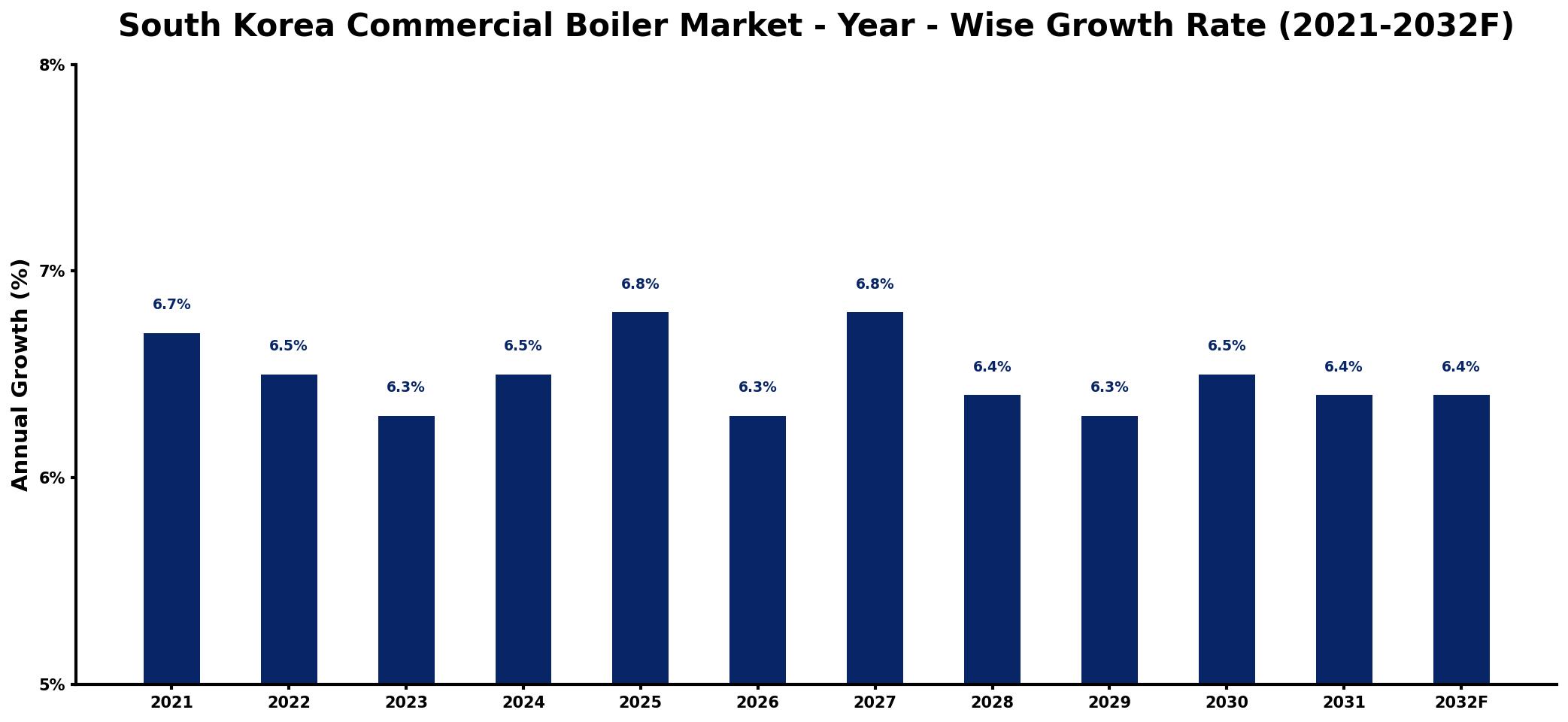
The table below presents the year‑wise growth rates along with the key drivers influencing the market
| Year | Growth Rate | Major Drivers |
| 2021 | 6.7% | Rising energy efficiency regulations |
| 2022 | 6.5% | Increased industrial production activities |
| 2023 | 6.3% | Growing demand for sustainable solutions |
| 2024 | 6.5% | Expansion in construction projects |
| 2025 | 6.8% | Investments in renewable energy sources |
| 2026 | 6.3% | Advancements in technology integration |
| 2027 | 6.8% | Boost in infrastructure development initiatives |
| 2028 | 6.4% | Higher consumer awareness on emissions |
| 2029 | 6.3% | Strengthening of energy security policies |
| 2030 | 6.5% | Growing focus on operational efficiency |
| 2031 | 6.4% | Increased funding for energy projects |
| 2032 | 6.4% | Rising demand for heat applications |
Note: Market size estimations and growth projections presented in this report are based on 6Wresearch's proprietary forecasting methodology, utilizing the latest available industry data, government publications, and primary research inputs.
South Korea Commercial Boiler Market Synopsis
As South Korea prioritizes sustainability, the commercial boiler market is witnessing significant advancements, particularly in energy efficiency and emission control technologies. Current industry trends indicate a heightened focus on integrating smart controls and innovative combustion technologies, which are essential for optimizing system performance.
Moreover, industries such as healthcare, hospitality, and manufacturing are increasingly adopting modern boilers for not just heating but also for hot water and process heating needs. This shift towards multifunctional heating systems is transforming the competitive landscape, pushing manufacturers to innovate continuously.
South Korea Commercial Boiler Market Key Takeaways
- The market is expected to grow significantly, reflecting a broader trend towards energy efficiency in commercial buildings.
- Technological innovations in combustion and smart controls are driving the next generation of boiler solutions.
- Adherence to stringent emission regulations is a major influence on market dynamics.
- There is a notable push for sustainable practices, particularly in sectors like healthcare and hospitality.
- Government incentives play a crucial role in promoting the adoption of high-efficiency boiler systems.
Evaluation of Restraints in South Korea Commercial Boiler Market
Despite the promising growth prospects, the South Korea Commercial Boiler Market faces certain constraints that could impact its trajectory. One of the primary challenges is the need for manufacturers to enhance boiler efficiency and reliability consistently. Fluctuating energy costs also present a concern, as they affect operational budgets for businesses relying on boiler systems. Additionally, ensuring compliance with ever-evolving emission standards requires continuous investment in technology and innovation. This dual pressure to innovate while controlling costs can pose significant challenges for boiler manufacturers in the region.
South Korea Commercial Boiler Market Trends
Current trends in the South Korea Commercial Boiler Market are heavily influenced by a shift towards environmentally friendly technologies. The integration of IoT and smart controls is becoming increasingly prevalent, allowing for improved monitoring and energy management. Furthermore, there is a growing preference for modular boiler systems, which offer scalability and flexibility for commercial buildings. As sustainability becomes a core focus, manufacturers are also investing in advanced materials and designs that optimize heat transfer and reduce emissions.
South Korea Commercial Boiler Market Opportunities
The future of the South Korea Commercial Boiler Market is ripe with opportunities, particularly as businesses seek to reduce their carbon footprints. Investment in energy-efficient boilers can yield significant long-term savings, aligning with both corporate sustainability goals and regulatory mandates. Additionally, as the government continues to introduce supportive policies and incentives, there is potential for accelerated adoption of high-efficiency heating solutions. This environment presents a lucrative opportunity for market players who can innovate and meet the demands for advanced boiler technologies.
Government Initiatives in the South Korea Commercial Boiler Market
The South Korean government has been proactive in shaping the commercial boiler landscape through various initiatives aimed at energy efficiency and emissions reduction. Policies are in place to encourage the installation of high-efficiency boilers, complemented by stringent emissions standards that mandate compliance. Additionally, the government provides incentives and subsidies to promote energy-efficient systems, ensuring that businesses are supported in their transition towards greener technologies. These initiatives are critical in driving the adoption of innovative boiler solutions across the commercial sector.
Future Insights of the South Korea Commercial Boiler Market
Looking ahead to 2026-2032, the South Korea Commercial Boiler Market is poised for substantial growth, bolstered by ongoing technological advancements and a steadfast commitment to sustainability. As businesses increasingly recognize the cost savings associated with energy-efficient solutions, demand for modern boiler systems is expected to surge. Furthermore, the integration of smart technology and real-time monitoring will play a pivotal role in enhancing operational efficiency. Overall, the market outlook is optimistic, with ample room for innovation and expansion in the coming years.
South Korea Commercial Boiler Market Latest Developments (2025 - 2026)
Recent developments in the South Korea Commercial Boiler Market indicate a shift towards innovative technologies aimed at increasing energy efficiency and reducing emissions. Manufacturers are increasingly collaborating with technology providers to integrate smart controls into boiler systems. Additionally, there is a marked emphasis on developing modular and scalable solutions that cater to the evolving demands of commercial spaces. As the government strengthens its focus on compliance and safety standards, manufacturers are gearing up to meet these requirements with enhanced product offerings.
South Korea Commercial Boiler Market - Key Attractiveness of the Report
- 10 Years of Market Numbers
- Historical Data Starting from 2022 to 2025
- Base Year: 2025
- Forecast Data until 2032
- Key Performance Indicators Impacting the Market
- Major Upcoming Developments and Projects
Key Highlights of the Report:
- South Korea Commercial Boiler Market Outlook
- Market Size of South Korea Commercial Boiler Market, 2025
- Forecast of South Korea Commercial Boiler Market, 2032
- Historical Data and Forecast of South Korea Commercial Boiler Revenues & Volume for the Period 2022-2032F
- South Korea Commercial Boiler Market Trend Evolution
- South Korea Commercial Boiler Market Drivers and Challenges
- South Korea Commercial Boiler Price Trends
- South Korea Commercial Boiler Porter's Five Forces
- South Korea Commercial Boiler Industry Life Cycle
- Historical Data and Forecast of South Korea Commercial Boiler Market Revenues & Volume By Fuel Type for the Period 2022-2032F
- Historical Data and Forecast of South Korea Commercial Boiler Market Revenues & Volume By Natural Gas for the Period 2022-2032F
- Historical Data and Forecast of South Korea Commercial Boiler Market Revenues & Volume By Oil for the Period 2022-2032F
- Historical Data and Forecast of South Korea Commercial Boiler Market Revenues & Volume By Coal for the Period 2022-2032F
- Historical Data and Forecast of South Korea Commercial Boiler Market Revenues & Volume By Others for the Period 2022-2032F
- Historical Data and Forecast of South Korea Commercial Boiler Market Revenues & Volume By Technology for the Period 2022-2032F
- Historical Data and Forecast of South Korea Commercial Boiler Market Revenues & Volume By Condensing for the Period 2022-2032F
- Historical Data and Forecast of South Korea Commercial Boiler Market Revenues & Volume By Non-Condensing for the Period 2022-2032F
- Historical Data and Forecast of South Korea Commercial Boiler Market Revenues & Volume By Capacity for the Period 2022-2032F
- Historical Data and Forecast of South Korea Commercial Boiler Market Revenues & Volume By Less than 10 MMBtu/hr for the Period 2022-2032F
- Historical Data and Forecast of South Korea Commercial Boiler Market Revenues & Volume By 10-50 MMBtu/hr for the Period 2022-2032F
- Historical Data and Forecast of South Korea Commercial Boiler Market Revenues & Volume By Others for the Period 2022-2032F
- Historical Data and Forecast of South Korea Commercial Boiler Market Revenues & Volume By End User for the Period 2022-2032F
- Historical Data and Forecast of South Korea Commercial Boiler Market Revenues & Volume By Offices for the Period 2022-2032F
- Historical Data and Forecast of South Korea Commercial Boiler Market Revenues & Volume By Hospitals for the Period 2022-2032F
- Historical Data and Forecast of South Korea Commercial Boiler Market Revenues & Volume By Educational Institutions for the Period 2022-2032F
- Historical Data and Forecast of South Korea Commercial Boiler Market Revenues & Volume By Lodging for the Period 2022-2032F
- Historical Data and Forecast of South Korea Commercial Boiler Market Revenues & Volume By Others for the Period 2022-2032F
- South Korea Commercial Boiler Import Export Trade Statistics
- Market Opportunity Assessment By Fuel Type
- Market Opportunity Assessment By Technology
- Market Opportunity Assessment By Capacity
- Market Opportunity Assessment By End User
- South Korea Commercial Boiler Top Companies Market Share
- South Korea Commercial Boiler Competitive Benchmarking By Technical and Operational Parameters
- South Korea Commercial Boiler Company Profiles
- South Korea Commercial Boiler Key Strategic Recommendations






































