South Korea Community Cloud Market Size & Growth Rate (2026-2032)
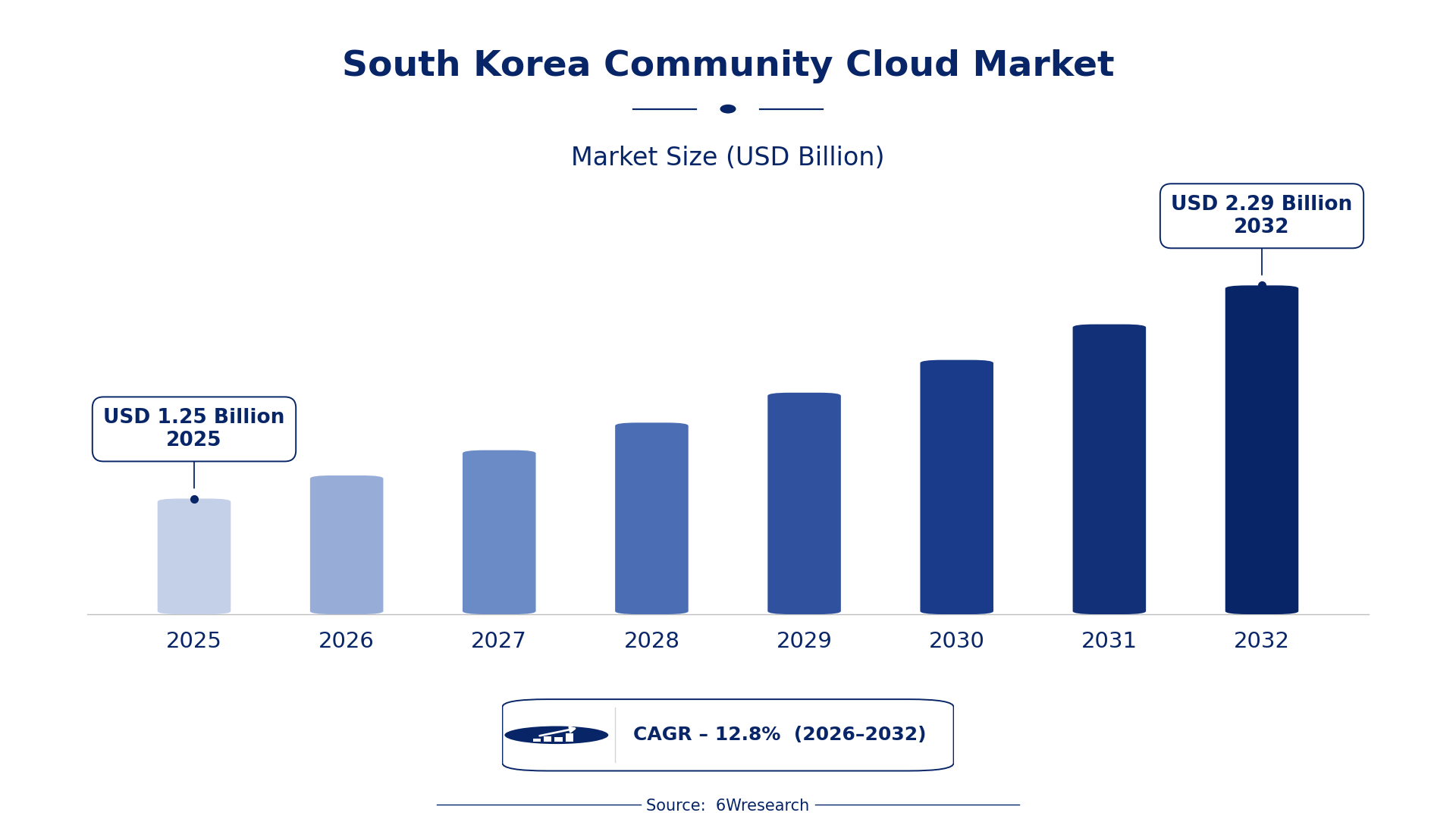
The South Korea Community Cloud Market was estimated at USD 1250 Million in 2025 and is projected to reach USD 2287 Million by 2032, growing at a CAGR of 12.8% from 2026 to 2032.
South Korea Community Cloud Market Synopsis
The South Korea Community Cloud Market is on an upward trajectory, fueled by the growing inclination of sectors such as healthcare, finance, and government towards cloud-based solutions. Organizations recognize the value in shared infrastructure that not only enhances cost efficiency but also meets strict compliance standards.
As digital transformation becomes a priority, community clouds are tailored to address the unique needs of specific industries. This focus on customization, alongside advancements in technologies like AI and blockchain, positions the market for sustained growth in the coming years.
South Korea Community Cloud Market Year-wise Growth Rate and Key Drivers
This graph illustrates the annual growth rates of the South Korea Community Cloud Market from 2021 to 2032, highlighting a steady upward trajectory and projected expansion over the forecast period.
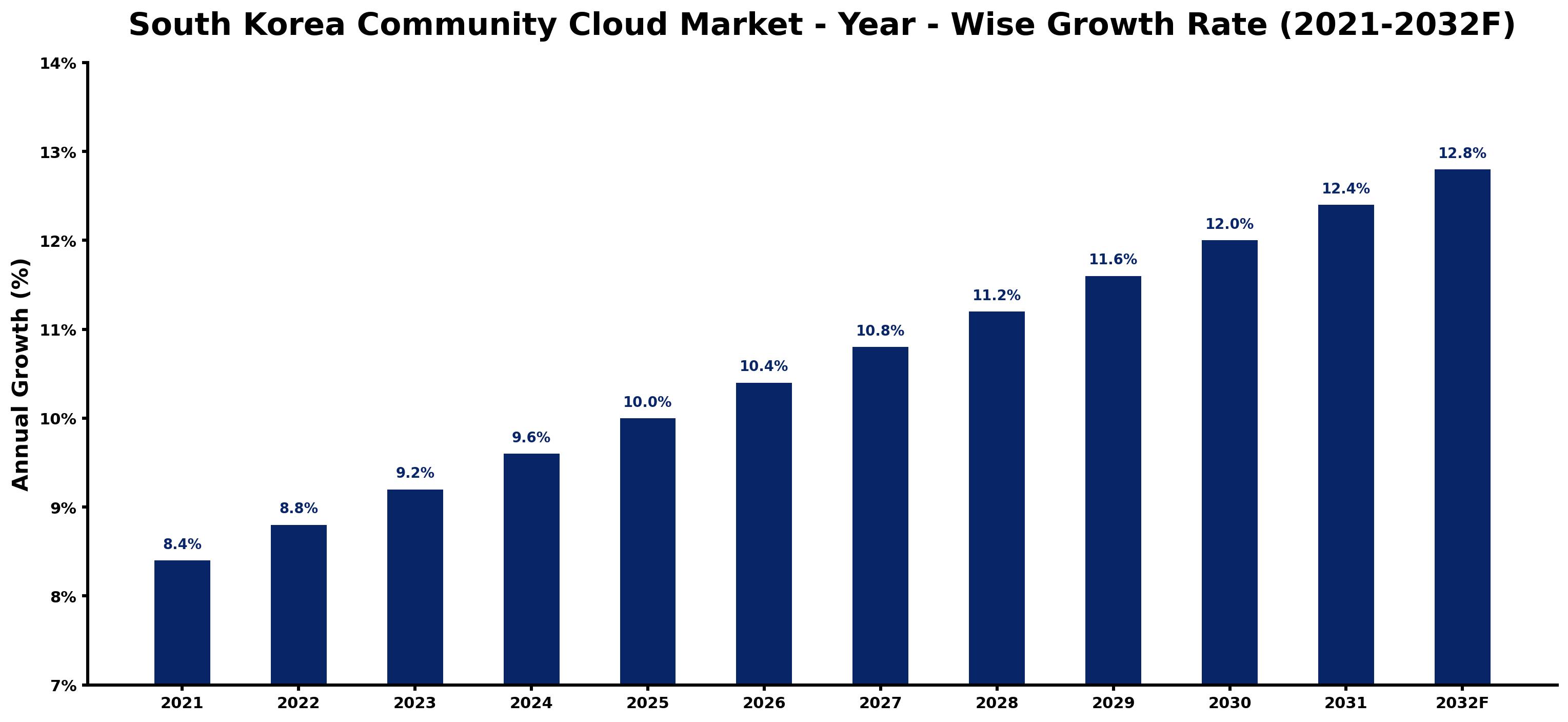
The table below presents the year‑wise growth rates along with the key drivers influencing the market
| Year | Growth Rate | Major Drivers |
| 2021 | 8.4% | Increased localization policy encouraging domestic cloud service adoption. |
| 2022 | 8.8% | Popularity of collaborative platforms boosting community cloud usage. |
| 2023 | 9.2% | Government funding for innovation in cloud computing technologies. |
| 2024 | 9.6% | Shift towards hybrid cloud models among South Korean businesses. |
| 2025 | 10.0% | Regulatory incentives for small and medium enterprises to adopt cloud. |
| 2026 | 10.4% | Higher adoption of IoT solutions driving community cloud demand. |
| 2027 | 10.8% | Growing focus on data sovereignty influencing cloud provider selection. |
| 2028 | 11.2% | Emergence of AI-driven applications leveraging community cloud infrastructures. |
| 2029 | 11.6% | Rising entrepreneurial activity leading to increased cloud service subscriptions. |
| 2030 | 12.0% | Enhanced connectivity infrastructure facilitating community cloud access. |
| 2031 | 12.4% | Surge in remote work culture intensifying community cloud reliance. |
| 2032 | 12.8% | Increased investment in sustainability initiatives driving cloud solutions. |
Note: Market size estimations and growth projections presented in this report are based on 6Wresearch's proprietary forecasting methodology, utilizing the latest available industry data, government publications, and primary research inputs.
South Korea Community Cloud Market Key Takeaways
Below are some of the specific key takeaways from the market, including:
- The community cloud model offers specialized infrastructure tailored to specific regulatory requirements.
- Adoption rates are being propelled by the need for enhanced data privacy and compliance.
- Collaborations among service providers are increasingly common to deliver industry-specific solutions.
- Integration of advanced technologies like AI is enhancing the capabilities of community cloud platforms.
- Government initiatives are actively promoting the digital transformation of public and private sectors.
Evaluation of Restraints in South Korea Community Cloud Market
Despite the promising growth, the South Korea Community Cloud Market faces several limitations. A primary concern is the stringent data privacy and security regulations that organizations must navigate. Compliance can be particularly challenging for businesses handling sensitive information. on top of that, there is a general lack of awareness about the benefits of community cloud solutions, which may hinder adoption rates. Organizations must overcome these barriers by increasing educational efforts and providing strong technical support to ensure effective integration and performance.
South Korea Community Cloud Market Trends
An increasing demand for secure, collaborative cloud solutions is shaping the South Korea Community Cloud Market. Industries are gravitating toward platforms that promise data protection while facilitating efficient resource sharing. Additionally, as organizations become more aware of the advantages of community clouds, including cost savings and enhanced data management, we are likely to see a shift in the competitive dynamics of the market.
South Korea Community Cloud Market Opportunities
The market presents numerous opportunities for growth and investment, particularly in sectors that prioritize data security and compliance. As organizations seek tailored solutions, cloud service providers can capitalize on the demand by developing specialized offerings that cater to specific industry needs. on top of that, the ongoing integration of advanced technologies, such as AI and blockchain, opens doors for innovation and improved service delivery.
Government Initiatives in the South Korea Community Cloud Market
Government policy plays a crucial role in shaping the South Korea Community Cloud Market, with various initiatives aimed at fostering a supportive environment for cloud services. The focus on digital transformation in public institutions demonstrates the government’s commitment to enhancing competitiveness and encouraging innovation.
- A recently completed Cloud Computing Promotion Act aims to create a favorable regulatory environment for cloud service providers.
- Current initiatives include the establishment of the Korea Internet & Security Agency (KISA), which supports secure cloud service development.
- Planned public-private partnerships are expected to enhance infrastructure capabilities and expand access to cloud services by 2028.
- The Cloud First policy promotes prioritizing cloud solutions in the IT procurement strategies of public institutions.
- Ongoing programs focus on improving data protection standards across government and industry sectors.
Future Insights of the South Korea Community Cloud Market
Looking ahead to 2026-2032, the South Korea Community Cloud Market is likely to experience substantial growth driven by the increasing adoption of cloud services across various sectors. As businesses continue to prioritize secure and scalable solutions, community clouds will be increasingly seen as a viable option. The ongoing commitment from the government and the integration of emerging technologies will further fuel market expansion, making it an attractive sector for investment and innovation.
South Korea Community Cloud Market Latest Developments
Recent activity in the South Korea Community Cloud Market indicates a vibrant environment of innovation and collaboration. Organizations are actively seeking to enhance their cloud capabilities, driven by both regulatory demands and operational efficiencies. This trend is reflected in various developments over the past year.
- A major technology vendor launched a new suite of community cloud services in early 2025, aimed at healthcare organizations.
- An ongoing partnership between cloud service providers and educational institutions is focused on developing tailored training programs for cloud adoption, which began in Q2 2025.
- A recent government initiative to upgrade national digital infrastructure is currently underway, expected to enhance cloud service delivery by mid-2026.
- Upcoming is a planned rollout of a standardized compliance framework designed to simplify regulatory adherence for community cloud users by late 2026.
South Korea Community Cloud Market - Key Attractiveness of the Report
- 10 Years of Market Numbers
- Historical Data Starting from 2022 to 2025
- Base Year: 2025
- Forecast Data until 2032
- Key Performance Indicators Impacting the Market
- Major Upcoming Developments and Projects
Key Highlights of the Report:
- South Korea Community Cloud Market Outlook
- Market Size of South Korea Community Cloud Market, 2025
- Forecast of South Korea Community Cloud Market, 2032
- Historical Data and Forecast of South Korea Community Cloud Revenues & Volume for the Period 2022-2032F
- South Korea Community Cloud Market Trend Evolution
- South Korea Community Cloud Market Drivers and Challenges
- South Korea Community Cloud Price Trends
- South Korea Community Cloud Porter's Five Forces
- South Korea Community Cloud Industry Life Cycle
- Historical Data and Forecast of South Korea Community Cloud Market Revenues & Volume By Components for the Period 2022-2032F
- Historical Data and Forecast of South Korea Community Cloud Market Revenues & Volume By Server for the Period 2022-2032F
- Historical Data and Forecast of South Korea Community Cloud Market Revenues & Volume By Storage Devices for the Period 2022-2032F
- Historical Data and Forecast of South Korea Community Cloud Market Revenues & Volume By Network Equipments for the Period 2022-2032F
- Historical Data and Forecast of South Korea Community Cloud Market Revenues & Volume By Verticals for the Period 2022-2032F
- Historical Data and Forecast of South Korea Community Cloud Market Revenues & Volume By Healthcare for the Period 2022-2032F
- Historical Data and Forecast of South Korea Community Cloud Market Revenues & Volume By Finance for the Period 2022-2032F
- Historical Data and Forecast of South Korea Community Cloud Market Revenues & Volume By Government for the Period 2022-2032F
- Historical Data and Forecast of South Korea Community Cloud Market Revenues & Volume By Transport and Logistics for the Period 2022-2032F
- Historical Data and Forecast of South Korea Community Cloud Market Revenues & Volume By Gaming for the Period 2022-2032F
- Historical Data and Forecast of South Korea Community Cloud Market Revenues & Volume By Education for the Period 2022-2032F
- South Korea Community Cloud Import Export Trade Statistics
- Market Opportunity Assessment By Components
- Market Opportunity Assessment By Verticals
- South Korea Community Cloud Top Companies Market Share
- South Korea Community Cloud Competitive Benchmarking By Technical and Operational Parameters
- South Korea Community Cloud Company Profiles
- South Korea Community Cloud Key Strategic Recommendations






































