South Korea Computer Graphics Market Size & Growth Rate (2026-2032)
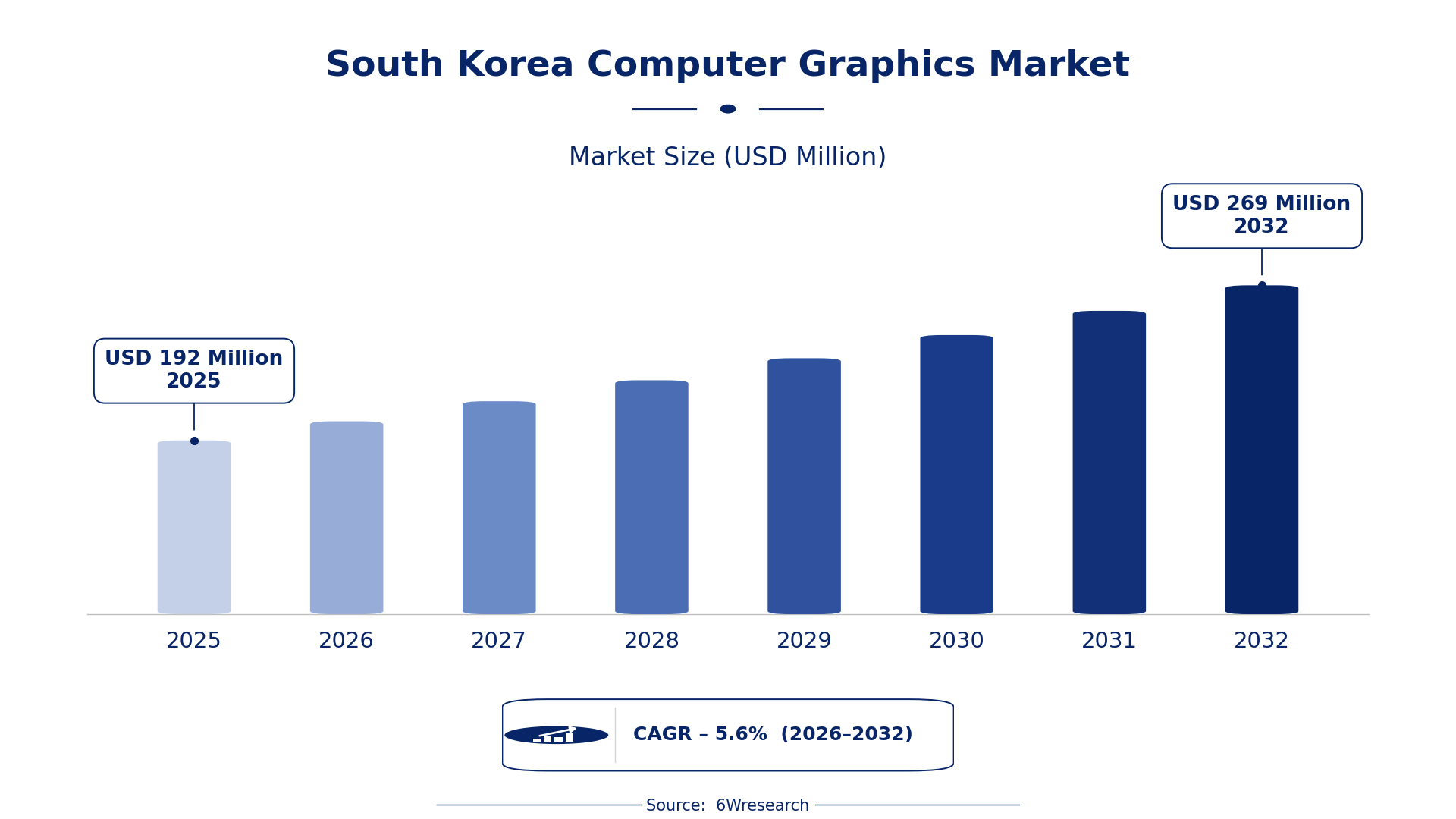
The South Korea Computer Graphics Market was estimated at USD 192 Million in 2025 and is projected to reach USD 269 Million by 2032, growing at a CAGR of 5.6% from 2026 to 2032.
South Korea Computer Graphics Market Synopsis
The South Korea Computer Graphics Market is currently experiencing a surge, driven by increasing demand for high-quality visual content across various sectors. With advancements in GPU technology and software tools, industries from gaming to virtual reality are enhancing user engagement and creativity.
The market's growth is not merely a result of technological improvements; it's also fueled by cultural trends favoring immersive entertainment. As consumers gravitate towards richer visual experiences, companies are compelled to innovate, pushing the boundaries of what's possible in graphics technology.
South Korea Computer Graphics Market Year-wise Growth Rate and Key Drivers
This graph illustrates the annual growth rates of the South Korea Computer Graphics Market from 2021 to 2032, highlighting a steady upward trajectory and projected expansion over the forecast period.
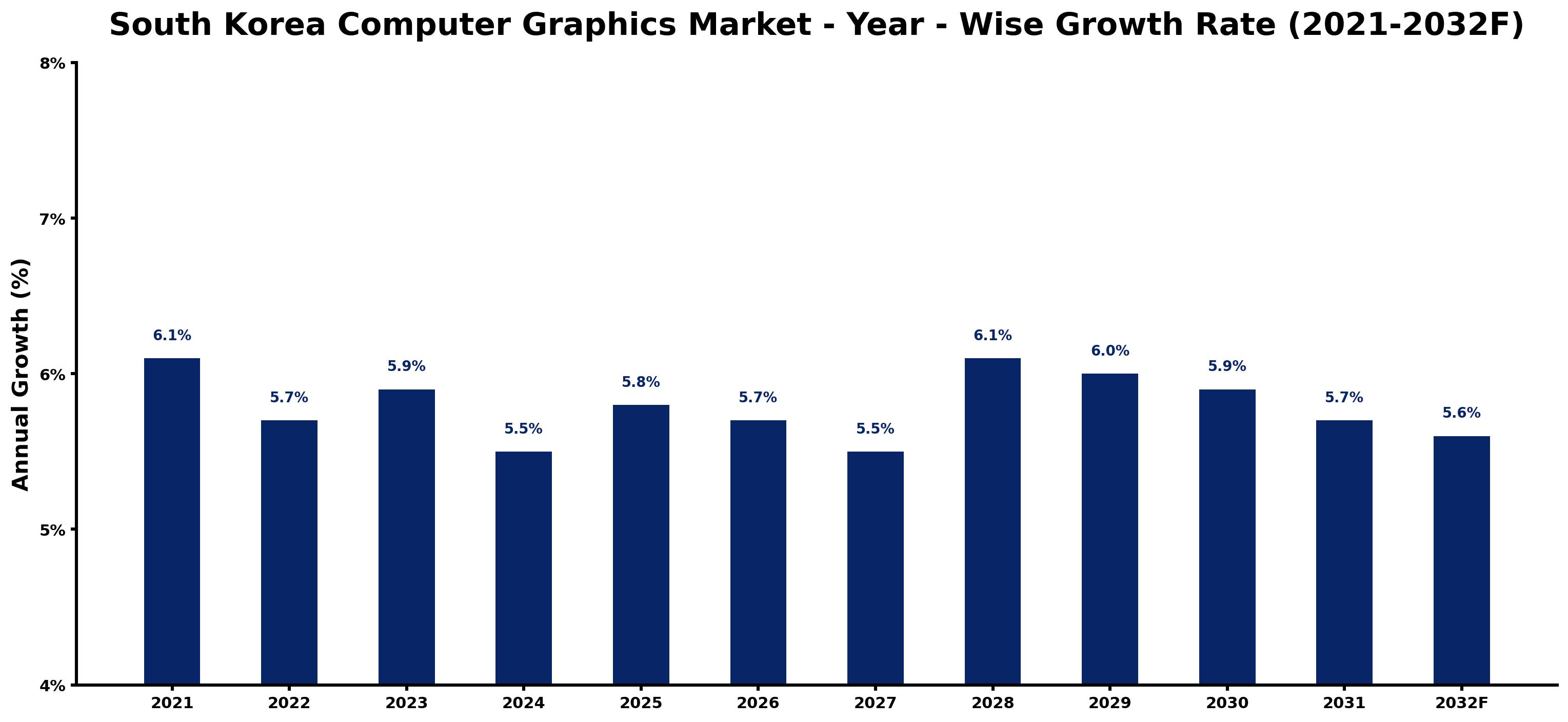
The table below presents the year‑wise growth rates along with the key drivers influencing the market
| Year | Growth Rate | Major Drivers |
| 2021 | 6.1% | Increased demand for gaming graphics among youth demographics. |
| 2022 | 5.7% | Government funding for digital content creation initiatives. |
| 2023 | 5.9% | Surge in domestic e-sports tournaments boosts tech usage. |
| 2024 | 5.5% | Rise of 5G technology enhancing graphics streaming experience. |
| 2025 | 5.8% | Local film industry’s growth drives CGI production needs. |
| 2026 | 5.7% | Emergence of AI-driven tools for graphic design. |
| 2027 | 5.5% | Popularity of K-dramas increasing visual effects demand. |
| 2028 | 6.1% | Investment in smart city projects requiring advanced simulations. |
| 2029 | 6.0% | Growing interest in animated content among streaming services. |
| 2030 | 5.9% | Collaborations with global gaming firms elevate CG standards. |
| 2031 | 5.7% | Cultural emphasis on digital artistry in youth education. |
| 2032 | 5.6% | Regional demand for immersive experiences in advertising sectors. |
Note: Market size estimations and growth projections presented in this report are based on 6Wresearch's proprietary forecasting methodology, utilizing the latest available industry data, government publications, and primary research inputs.
South Korea Computer Graphics Market Key Takeaways
Below are some of the specific key takeaways from the market, including:
- The market is projected to grow significantly, reaching USD 269 Million by 2032.
- GPU advancements are crucial for improving real-time rendering capabilities.
- Growing consumer demand for immersive gaming experiences is reshaping content creation.
- South Korea's entertainment sector is a major driver of graphics technology adoption.
- Government initiatives are fostering innovation and talent development in the graphics industry.
Evaluation of Restraints in South Korea Computer Graphics Market
The South Korea Computer Graphics Market faces several constraints that can hinder its growth. One prominent challenge is the rapid evolution of GPU technologies. As developers strive for real-time rendering and virtual reality applications, keeping up with hardware compatibility and software optimization becomes increasingly complex. Additionally, the gaming industry's shifting trends necessitate constant innovation in rendering pipelines, which can be resource-intensive for companies.
South Korea Computer Graphics Market Trends
Several trends are currently shaping the South Korea Computer Graphics Market. The rise of virtual reality and augmented reality applications is compelling companies to adopt more sophisticated graphics solutions. on top of that, the integration of AI in graphics rendering is streamlining production processes and enhancing visual quality. User-generated content is also gaining traction, pushing developers to create tools that empower consumers to produce high-quality graphics easily.
South Korea Computer Graphics Market Opportunities
Opportunities abound in the South Korea Computer Graphics Market, particularly in sectors like education and healthcare. The use of graphics for simulation and training in medical fields is expanding. on top of that, as educational institutions increasingly adopt immersive technologies, the demand for advanced graphics solutions will continue to rise. Companies that can offer tailored solutions for these niches stand to gain a competitive edge.
Government Initiatives in the South Korea Computer Graphics Market
The South Korean government is actively involved in shaping the Computer Graphics Market through various initiatives aimed at promoting growth in the digital content sector. These policies prioritize innovation in animation, gaming, and VR content creation, ultimately enhancing the overall competitiveness of the industry.
- A recently completed initiative aimed to provide funding support for local animation studios, fostering creativity and production capabilities.
- A current program focuses on enhancing digital infrastructure to support VR content creators, ensuring they have access to the latest technologies.
- Plans are underway for a public-private partnership that aims to boost talent development in graphic design and related fields by 2027.
- Ongoing support for gaming companies through tax incentives is designed to spur innovation and growth within the sector.
- The government is also working on a regulatory framework to streamline the approval process for digital content projects, expected to roll out in late 2025.
Future Insights of the South Korea Computer Graphics Market
Looking ahead to 2026-2032, the South Korea Computer Graphics Market is set for substantial growth. The continued advancements in GPU technology and the expansion of virtual reality applications will likely drive demand. Additionally, as the entertainment industry evolves, companies that adapt to consumer preferences for immersive experiences will thrive. The intersection of graphics technology with emerging fields such as AI and machine learning will also unlock new possibilities for innovation.
South Korea Computer Graphics Market Latest Developments
In the past year, the South Korea Computer Graphics Market has witnessed several noteworthy developments. Industry players are increasingly collaborating on projects that enhance the quality and accessibility of graphics technologies, aligning with the market's growth trajectory.
- A major technology vendor launched a new line of GPUs specifically designed for VR applications in Q3 2025, enhancing real-time rendering capabilities.
- A leading regional operator is currently expanding its graphics software suite, aimed at improving user engagement for online gaming platforms, with an expected completion in early 2026.
- An initiative that began in mid-2025 focuses on integrating AI into graphics production processes, enhancing efficiency and output quality.
- A planned rollout of a cloud-based graphics rendering service is expected to begin in late 2026, promising to reduce costs for small developers.
- A recent partnership between educational institutions and graphics firms aims to develop specialized training programs for future graphic designers, slated to start in early 2026.
South Korea Computer Graphics Market - Key Attractiveness of the Report
- 10 Years of Market Numbers
- Historical Data Starting from 2022 to 2025
- Base Year: 2025
- Forecast Data until 2032
- Key Performance Indicators Impacting the Market
- Major Upcoming Developments and Projects
Key Highlights of the Report:
- South Korea Computer Graphics Market Outlook
- Market Size of South Korea Computer Graphics Market, 2025
- Forecast of South Korea Computer Graphics Market, 2032
- Historical Data and Forecast of South Korea Computer Graphics Revenues & Volume for the Period 2022-2032F
- South Korea Computer Graphics Market Trend Evolution
- South Korea Computer Graphics Market Drivers and Challenges
- South Korea Computer Graphics Price Trends
- South Korea Computer Graphics Porter's Five Forces
- South Korea Computer Graphics Industry Life Cycle
- Historical Data and Forecast of South Korea Computer Graphics Market Revenues & Volume By Software for the Period 2022-2032F
- Historical Data and Forecast of South Korea Computer Graphics Market Revenues & Volume By CAD/CAM for the Period 2022-2032F
- Historical Data and Forecast of South Korea Computer Graphics Market Revenues & Volume By Visualization/Simulation for the Period 2022-2032F
- Historical Data and Forecast of South Korea Computer Graphics Market Revenues & Volume By Digital video for the Period 2022-2032F
- Historical Data and Forecast of South Korea Computer Graphics Market Revenues & Volume By Imaging for the Period 2022-2032F
- Historical Data and Forecast of South Korea Computer Graphics Market Revenues & Volume By Modeling/Animation for the Period 2022-2032F
- Historical Data and Forecast of South Korea Computer Graphics Market Revenues & Volume By End-User for the Period 2022-2032F
- Historical Data and Forecast of South Korea Computer Graphics Market Revenues & Volume By Enterprise for the Period 2022-2032F
- Historical Data and Forecast of South Korea Computer Graphics Market Revenues & Volume By SMB Worldwide Forecasts & Analysis 2022-2032F for the Period 2022-2032F
- Historical Data and Forecast of South Korea Computer Graphics Market Revenues & Volume By Service for the Period 2022-2032F
- Historical Data and Forecast of South Korea Computer Graphics Market Revenues & Volume By Consulting for the Period 2022-2032F
- Historical Data and Forecast of South Korea Computer Graphics Market Revenues & Volume By Training & Support for the Period 2022-2032F
- Historical Data and Forecast of South Korea Computer Graphics Market Revenues & Volume By Integration for the Period 2022-2032F
- Historical Data and Forecast of South Korea Computer Graphics Market Revenues & Volume By Verticals for the Period 2022-2032F
- Historical Data and Forecast of South Korea Computer Graphics Market Revenues & Volume By Aerospace and defense for the Period 2022-2032F
- Historical Data and Forecast of South Korea Computer Graphics Market Revenues & Volume By Automobile for the Period 2022-2032F
- Historical Data and Forecast of South Korea Computer Graphics Market Revenues & Volume By Entertainment and Advertising for the Period 2022-2032F
- Historical Data and Forecast of South Korea Computer Graphics Market Revenues & Volume By Academia and Education for the Period 2022-2032F
- Historical Data and Forecast of South Korea Computer Graphics Market Revenues & Volume By Healthcare for the Period 2022-2032F
- Historical Data and Forecast of South Korea Computer Graphics Market Revenues & Volume By Manufacturing for the Period 2022-2032F
- Historical Data and Forecast of South Korea Computer Graphics Market Revenues & Volume By Architecture, Building and Construction for the Period 2022-2032F
- Historical Data and Forecast of South Korea Computer Graphics Market Revenues & Volume By Others for the Period 2022-2032F
- South Korea Computer Graphics Import Export Trade Statistics
- Market Opportunity Assessment By Software
- Market Opportunity Assessment By End-User
- Market Opportunity Assessment By Service
- Market Opportunity Assessment By Verticals
- South Korea Computer Graphics Top Companies Market Share
- South Korea Computer Graphics Competitive Benchmarking By Technical and Operational Parameters
- South Korea Computer Graphics Company Profiles
- South Korea Computer Graphics Key Strategic Recommendations






































