South Korea Construction and Mining Equipment Market Size, Share & Growth Rate
The South Korea Construction and Mining Equipment Market was estimated at USD 853 Million in 2025 and is projected to reach USD 1214 Million by 2032, growing at a CAGR of 5.2% from 2026 to 2032. This growth trajectory is largely driven by a surge in infrastructure development and mining projects across the nation, prompted by urbanization and the government's commitment to enhance public works. Additionally, the integration of advanced machinery and automation technologies is further stimulating demand, as businesses seek to improve efficiency and sustainability in their operations.
South Korea Construction and Mining Equipment Market Year-wise Growth Rate and Key Drivers
This graph highlights how the South Korea Construction and Mining Equipment Market has steadily grown over the years, supported by major growth factors.
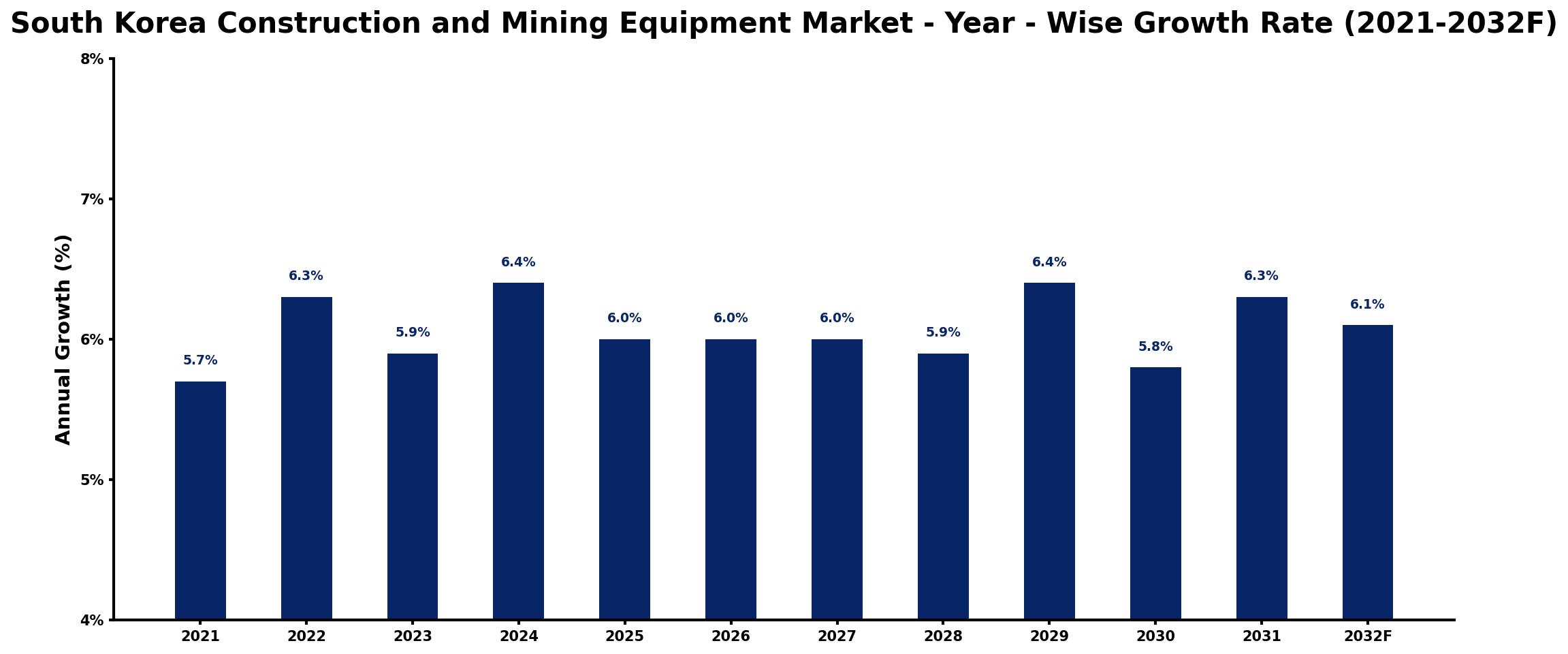
The table below presents the year‑wise growth rates along with the key drivers influencing the market
| Year | Growth Rate | Major Drivers |
| 2021 | 5.7% | increased infrastructure investments nationwide |
| 2022 | 6.3% | growing urban development projects demand |
| 2023 | 5.9% | growing automotive sector requirements |
| 2024 | 6.4% | expansion of renewable energy initiatives |
| 2025 | 6.0% | enhanced public transportation projects funding |
| 2026 | 6.0% | increased foreign direct investments influx |
| 2027 | 6.0% | growing residential housing market needs |
| 2028 | 5.9% | strengthened industrial production expansion plans |
| 2029 | 6.4% | boosted logistics and distribution networks |
| 2030 | 5.8% | growing demand for sustainable solutions |
| 2031 | 6.3% | increased government infrastructure spending |
| 2032 | 6.1% | rising infrastructure development spending |
Note: Market size estimations and growth projections presented in this report are based on 6Wresearch's proprietary forecasting methodology, utilizing the latest available industry data, government publications, and primary research inputs.
South Korea Construction and Mining Equipment Market Synopsis
Technological innovation is currently the strongest force shaping the South Korea Construction and Mining Equipment Market. As companies invest in state-of-the-art machinery and automation, they are gaining a competitive edge, enabling them to meet increasing project demands with enhanced productivity. This emphasis on technology aligns with national goals for improving safety and operational efficiency in construction and mining sectors.
Another significant trend is the growing focus on sustainability and emissions reduction. As environmental regulations tighten, companies are under pressure to adopt greener practices. This need is catalyzing advancements in electrified equipment solutions and encouraging the development of smart construction technologies that minimize environmental impact.
South Korea Construction and Mining Equipment Market Key Takeaways
- The market is poised for growth due to rising construction and mining activities.
- Technological advancements, including automation and smart technologies, are reshaping operations.
- Regulatory pressures are driving investments in sustainable equipment solutions.
- Strong government policies support innovation and safety in the equipment sector.
- Aftermarket services are increasingly recognized as vital to enhancing productivity.
Evaluation of Restraints in South Korea Construction and Mining Equipment Market
Despite its robust growth outlook, the South Korea Construction and Mining Equipment Market faces certain restraints. Key among these is the challenge of optimizing equipment performance while ensuring operator safety and compliance with stringent regulatory standards. Additionally, the complexity of integrating new technologies into existing operations can hinder some companies from fully leveraging advancements. Equipment manufacturers must consistently innovate to address these limitations and meet the evolving demands of a competitive landscape.
South Korea Construction and Mining Equipment Market Trends
Currently, trends such as the adoption of Industry 4.0 practices are becoming increasingly prevalent, as construction and mining firms leverage data analytics and IoT to enhance operational decision-making. Moreover, the rise of autonomous equipment is creating new operational paradigms, offering the potential for significant productivity improvements while reducing workforce-related risks. As these trends gain traction, they are set to redefine the competitive landscape of the market.
South Korea Construction and Mining Equipment Market Opportunities
The market presents numerous growth opportunities, especially for companies that prioritize innovation in sustainable technologies. With government incentives promoting research into autonomous mining technologies and emission reduction strategies, businesses that invest in these areas can expect to capture significant market share. Additionally, expanding infrastructure projects tied to the nations urbanization efforts are expected to provide a steady stream of demand for advanced construction machinery.
Government Initiatives in the South Korea Construction and Mining Equipment Market
The South Korean government has instituted a range of policies aimed at bolstering safety standards and enhancing technological innovation within the construction and mining equipment sectors. Regulations mandate rigorous equipment certification processes and operator training requirements, ensuring compliance with safety protocols. Additionally, public spending initiatives focusing on infrastructure development underscore the government's commitment to advancing this market through strategic investments and research incentives.
Future Insights of the South Korea Construction and Mining Equipment Market
Looking ahead, the South Korea Construction and Mining Equipment Market is likely to experience transformative changes driven by continued advancements in technology and sustainability practices. Between 2026 and 2032, the integration of autonomous and electrified equipment will redefine operational efficiencies. Additionally, as regulatory frameworks evolve to support innovation, companies willing to adapt and invest in cutting-edge technologies will stand to benefit the most from this ongoing evolution.
South Korea Construction and Mining Equipment Market Latest Developments (2025 - 2026)
Recent industry developments indicate a strong push towards automation and smart technologies within the South Korea construction and mining sectors. Companies are increasingly collaborating with tech firms to integrate advanced data analytics and IoT solutions into their operations. Additionally, emphasis on workforce training programs has intensified, with firms seeking to bolster skills in response to the growing complexity of modern machinery.
South Korea Construction and Mining Equipment Market - Key Attractiveness of the Report
- 10 Years of Market Numbers
- Historical Data Starting from 2022 to 2025
- Base Year: 2025
- Forecast Data until 2032
- Key Performance Indicators Impacting the Market
- Major Upcoming Developments and Projects
Key Highlights of the Report:
- South Korea Construction and Mining Equipment Market Outlook
- Market Size of South Korea Construction and Mining Equipment Market, 2025
- Forecast of South Korea Construction and Mining Equipment Market, 2032
- Historical Data and Forecast of South Korea Construction and Mining Equipment Revenues & Volume for the Period 2022-2032F
- South Korea Construction and Mining Equipment Market Trend Evolution
- South Korea Construction and Mining Equipment Market Drivers and Challenges
- South Korea Construction and Mining Equipment Price Trends
- South Korea Construction and Mining Equipment Porter's Five Forces
- South Korea Construction and Mining Equipment Industry Life Cycle
- Historical Data and Forecast of South Korea Construction and Mining Equipment Market Revenues & Volume By Product Type for the Period 2022-2032F
- Historical Data and Forecast of South Korea Construction and Mining Equipment Market Revenues & Volume By Loaders for the Period 2022-2032F
- Historical Data and Forecast of South Korea Construction and Mining Equipment Market Revenues & Volume By Dozers for the Period 2022-2032F
- Historical Data and Forecast of South Korea Construction and Mining Equipment Market Revenues & Volume By Excavators for the Period 2022-2032F
- Historical Data and Forecast of South Korea Construction and Mining Equipment Market Revenues & Volume By Crushing for the Period 2022-2032F
- Historical Data and Forecast of South Korea Construction and Mining Equipment Market Revenues & Volume By Pulverizing & Screening Equipment for the Period 2022-2032F
- Historical Data and Forecast of South Korea Construction and Mining Equipment Market Revenues & Volume By Others for the Period 2022-2032F
- Historical Data and Forecast of South Korea Construction and Mining Equipment Market Revenues & Volume By Application for the Period 2022-2032F
- Historical Data and Forecast of South Korea Construction and Mining Equipment Market Revenues & Volume By Infrastructure for the Period 2022-2032F
- Historical Data and Forecast of South Korea Construction and Mining Equipment Market Revenues & Volume By Mineral Mining for the Period 2022-2032F
- Historical Data and Forecast of South Korea Construction and Mining Equipment Market Revenues & Volume By Residential Building for the Period 2022-2032F
- Historical Data and Forecast of South Korea Construction and Mining Equipment Market Revenues & Volume By Metal Mining for the Period 2022-2032F
- Historical Data and Forecast of South Korea Construction and Mining Equipment Market Revenues & Volume By Others for the Period 2022-2032F
- South Korea Construction and Mining Equipment Import Export Trade Statistics
- Market Opportunity Assessment By Product Type
- Market Opportunity Assessment By Application
- South Korea Construction and Mining Equipment Top Companies Market Share
- South Korea Construction and Mining Equipment Competitive Benchmarking By Technical and Operational Parameters
- South Korea Construction and Mining Equipment Company Profiles
- South Korea Construction and Mining Equipment Key Strategic Recommendations






































