South Korea Contactless Payment Market Size & Growth Rate (2026-2032)
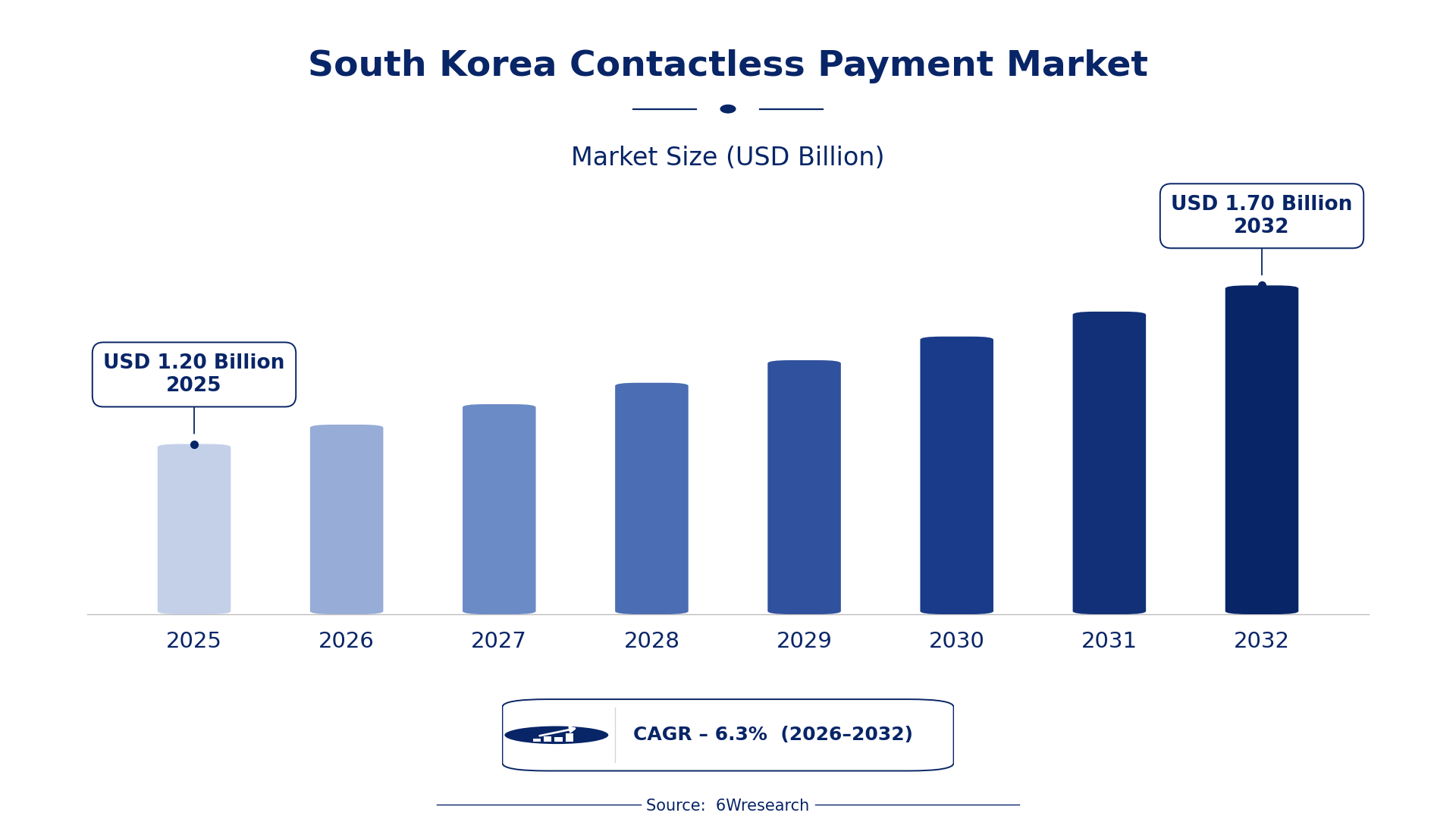
The South Korea Contactless Payment Market was estimated at USD 1195 Million in 2025 and is projected to reach USD 1696 Million by 2032, growing at a CAGR of 6.3% from 2026 to 2032.
South Korea Contactless Payment Market Synopsis
As of now, South Korea stands at the forefront of the contactless payment revolution, with a rapidly expanding ecosystem that caters to consumer demand for speed and security. The prevalence of NFC-enabled cards, mobile wallets, and wearable devices is reshaping everyday transactions, making cashless payments not just a trend, but a standard practice.
Consumer adoption is driven by a combination of technological advancements and a cultural shift towards digital convenience. As more merchants invest in upgrading their infrastructure, the market is set to grow significantly, reflecting the shifting preferences in how consumers engage with payment systems.
South Korea Contactless Payment Market Year-wise Growth Rate and Key Drivers
This graph illustrates the annual growth rates of the South Korea Contactless Payment Market from 2021 to 2032, highlighting a steady upward trajectory and projected expansion over the forecast period.
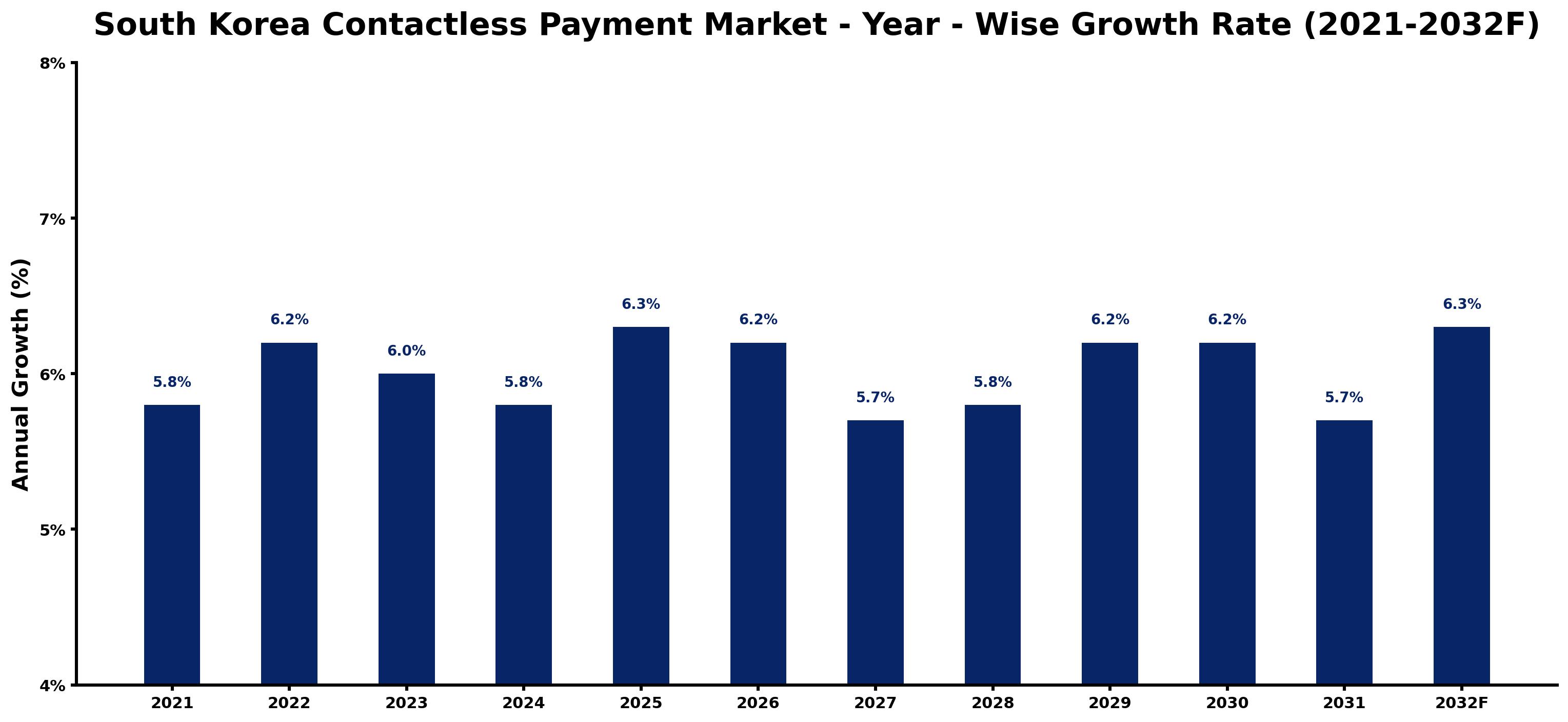
The table below presents the year‑wise growth rates along with the key drivers influencing the market
| Year | Growth Rate | Major Drivers |
| 2021 | 5.8% | Increase in smartphone penetration among consumers |
| 2022 | 6.2% | Adoption of QR code payments by local merchants |
| 2023 | 6.0% | Government initiatives for cashless transactions promotion |
| 2024 | 5.8% | Growth of fintech startups enhancing payment technologies |
| 2025 | 6.3% | Surge in e-commerce fueling contactless payment usage |
| 2026 | 6.2% | Partnerships between tech firms and banks advanced solutions |
| 2027 | 5.7% | Rise in health-conscious consumers preferring no-contact payments |
| 2028 | 5.8% | Increased digital wallet adoption among millennials |
| 2029 | 6.2% | Support from Financial Services Commission for innovation |
| 2030 | 6.2% | Enhanced security features attracting wary consumers |
| 2031 | 5.7% | Integration of contactless payments in public transportation |
| 2032 | 6.3% | New regulations promoting financial technology advancements |
Note: Market size estimations and growth projections presented in this report are based on 6Wresearch's proprietary forecasting methodology, utilizing the latest available industry data, government publications, and primary research inputs.
South Korea Contactless Payment Market Key Takeaways
Below are some of the specific key takeaways from the market, including:
- Increased consumer preference for digital payment methods is reshaping transaction dynamics.
- Technological advancements in NFC and mobile wallet solutions are driving rapid adoption.
- Merchants are expanding their infrastructure to support a cashless society.
- Regulatory frameworks are fostering innovation while ensuring transaction security.
- Collaboration among payment service providers, retailers, and financial institutions is essential for market growth.
Evaluation of Restraints in South Korea Contactless Payment Market
Despite its promising trajectory, the South Korea Contactless Payment Market faces notable hurdles. One primary concern is the challenge of ensuring transaction security, which is critical for consumer trust. The complexities of interoperability among different payment systems can also hinder widespread adoption. Additionally, the regulatory landscape requires ongoing adaptation, compelling companies to stay agile in their compliance efforts while innovating to meet consumer demands.
South Korea Contactless Payment Market Trends
Several trends are currently influencing the South Korea Contactless Payment Market. The integration of biometric authentication methods is gaining traction as consumers seek enhanced security. on top of that, the emergence of mobile wallets that incorporate loyalty programs and personalized offers is providing added value to users. As the hospitality and transportation sectors embrace these technologies, the demand for contactless solutions is expected to surge.
South Korea Contactless Payment Market Opportunities
Opportunities abound for stakeholders in this market. The increasing focus on enhancing consumer experiences opens avenues for innovative payment solutions that prioritize convenience and security. Investments in infrastructure to support contactless payments in less urbanized areas could also yield substantial returns. Additionally, fostering partnerships between tech firms and financial institutions can accelerate the development of next-generation payment solutions.
Government Initiatives in the South Korea Contactless Payment Market
Government policies in South Korea are actively shaping the contactless payment market, focusing on security, efficiency, and the promotion of financial technology. These initiatives are critical in establishing a framework that supports growth while ensuring consumer protection. As the government prioritizes cashless transactions, their involvement is vital for fostering a conducive environment for innovation.
- A regulatory framework introduced in 2025 mandating enhanced security measures for digital payments.
- An ongoing national digital infrastructure upgrade program aimed at improving transaction speeds and security.
- A planned public-private initiative expected to incentivize the adoption of contactless payment technologies by 2027.
- Incentives for small and medium enterprises to integrate contactless payment solutions into their operations.
Future Insights of the South Korea Contactless Payment Market
Looking ahead to 2026-2032, the South Korea Contactless Payment Market is set for notable advancements. The integration of advanced technologies such as AI and machine learning will enhance payment security and user experience. As more consumers become comfortable with digital transactions, the demand for innovative payment solutions will only grow. Continued collaboration among stakeholders will be key to unlocking the market's full potential.
South Korea Contactless Payment Market Latest Developments
Recent activity in the South Korea Contactless Payment Market has highlighted an increasing commitment to enhancing user experience and security. Over the past year, several initiatives have emerged that underscore the sector's dynamism and potential for growth. These developments reflect the industry's responsiveness to evolving consumer needs and technological advancements.
- A partnership between major financial institutions to develop a unified digital wallet solution, launched in early 2025 and completed by late 2025.
- An initiative that began in mid-2025, focusing on the rollout of contactless payment terminals across urban public transportation systems.
- A rollout expected to begin in the second half of 2026, aimed at integrating biometric payment options into existing systems.
- Ongoing collaborations among retailers to enhance loyalty programs within mobile wallet applications, initiated in early 2025 and still active.
South Korea Contactless Payment Market - Key Attractiveness of the Report
- 10 Years of Market Numbers
- Historical Data Starting from 2022 to 2025
- Base Year: 2025
- Forecast Data until 2032
- Key Performance Indicators Impacting the Market
- Major Upcoming Developments and Projects
Key Highlights of the Report:
- South Korea Contactless Payment Market Outlook
- Market Size of South Korea Contactless Payment Market, 2025
- Forecast of South Korea Contactless Payment Market, 2032
- Historical Data and Forecast of South Korea Contactless Payment Revenues & Volume for the Period 2022-2032F
- South Korea Contactless Payment Market Trend Evolution
- South Korea Contactless Payment Market Drivers and Challenges
- South Korea Contactless Payment Price Trends
- South Korea Contactless Payment Porter's Five Forces
- South Korea Contactless Payment Industry Life Cycle
- Historical Data and Forecast of South Korea Contactless Payment Market Revenues & Volume By Component for the Period 2022-2032F
- Historical Data and Forecast of South Korea Contactless Payment Market Revenues & Volume By Hardware for the Period 2022-2032F
- Historical Data and Forecast of South Korea Contactless Payment Market Revenues & Volume By Solutions for the Period 2022-2032F
- Historical Data and Forecast of South Korea Contactless Payment Market Revenues & Volume By Services for the Period 2022-2032F
- Historical Data and Forecast of South Korea Contactless Payment Market Revenues & Volume By Vertical for the Period 2022-2032F
- Historical Data and Forecast of South Korea Contactless Payment Market Revenues & Volume By Retail for the Period 2022-2032F
- Historical Data and Forecast of South Korea Contactless Payment Market Revenues & Volume By Hospitality for the Period 2022-2032F
- Historical Data and Forecast of South Korea Contactless Payment Market Revenues & Volume By Healthcare for the Period 2022-2032F
- Historical Data and Forecast of South Korea Contactless Payment Market Revenues & Volume By Energy and Utilities for the Period 2022-2032F
- Historical Data and Forecast of South Korea Contactless Payment Market Revenues & Volume By Transportation and Logistics for the Period 2022-2032F
- Historical Data and Forecast of South Korea Contactless Payment Market Revenues & Volume By BFSI for the Period 2022-2032F
- Historical Data and Forecast of South Korea Contactless Payment Market Revenues & Volume By Others (Government, telecommunications, and education) for the Period 2022-2032F
- South Korea Contactless Payment Import Export Trade Statistics
- Market Opportunity Assessment By Component
- Market Opportunity Assessment By Vertical
- South Korea Contactless Payment Top Companies Market Share
- South Korea Contactless Payment Competitive Benchmarking By Technical and Operational Parameters
- South Korea Contactless Payment Company Profiles
- South Korea Contactless Payment Key Strategic Recommendations






































