South Korea Container Orchestration Market Size & Growth Rate (2026-2032)
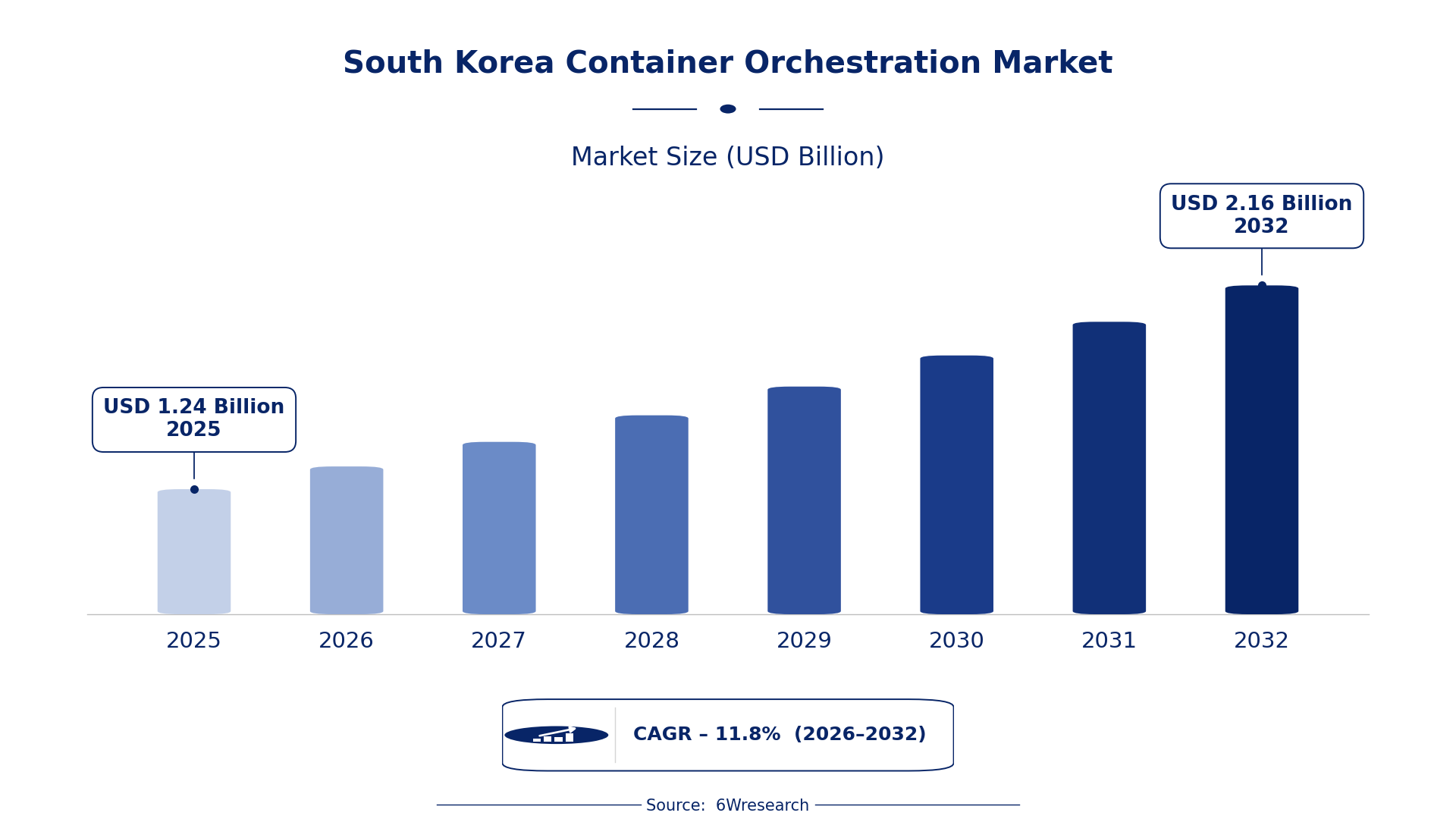
The South Korea Container Orchestration Market was estimated at USD 1244 Million in 2025 and is projected to reach USD 2156 Million by 2032, growing at a CAGR of 11.8% from 2026 to 2032.
South Korea Container Orchestration Market Synopsis
The most influential factor currently shaping the South Korea Container Orchestration Market is the surge in Kubernetes adoption. As organizations increasingly recognize the benefits of containerized applications, Kubernetes emerges as a leading choice for orchestration, driving transformative changes across various sectors.
This trend is fueled by the pressing need for efficiency in application deployment and management. Companies are increasingly integrating multi-cloud strategies and embracing DevOps practices, leading to a streamlined approach to software delivery that enhances overall operational agility.
South Korea Container Orchestration Market Year-wise Growth Rate and Key Drivers
This graph illustrates the annual growth rates of the South Korea Container Orchestration Market from 2021 to 2032, highlighting a steady upward trajectory and projected expansion over the forecast period.
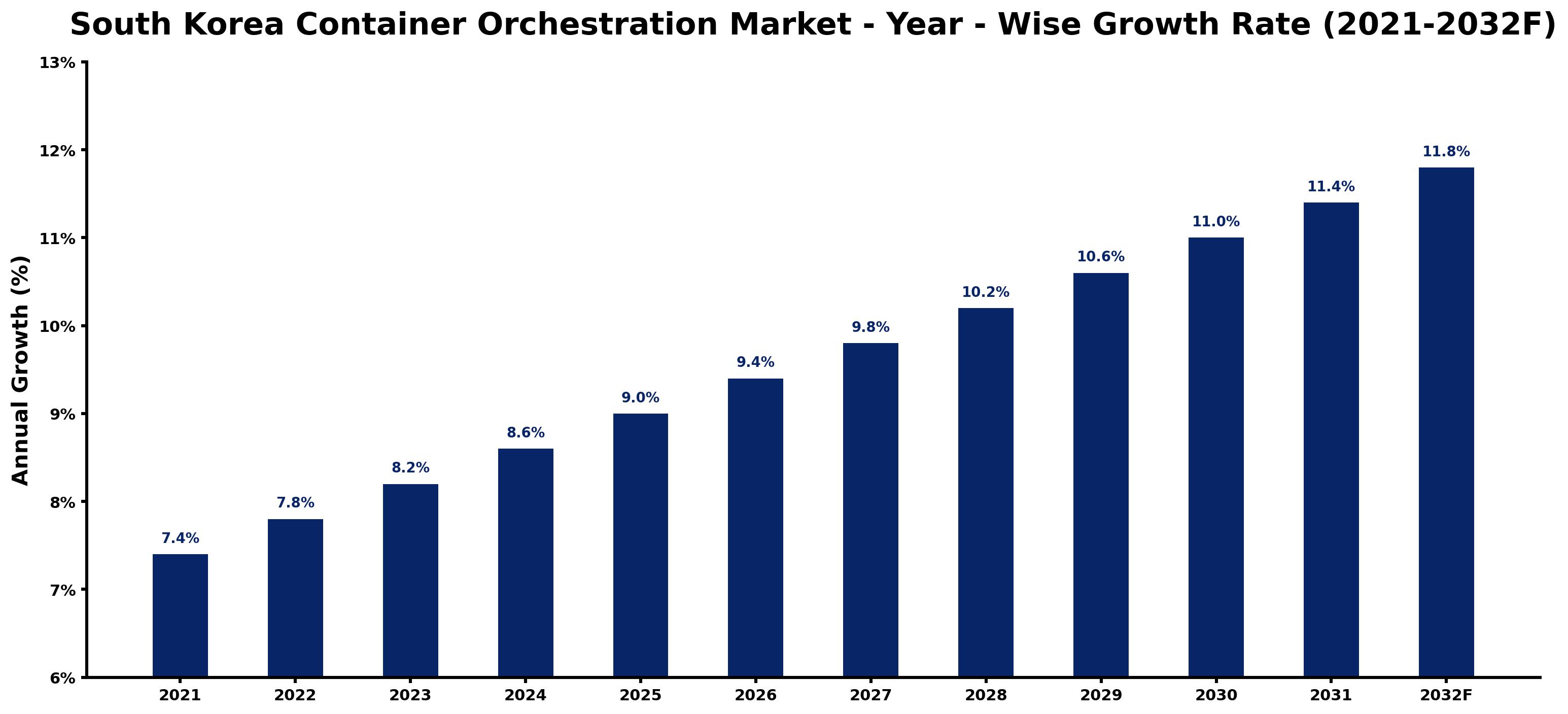
The table below presents the year‑wise growth rates along with the key drivers influencing the market
| Year | Growth Rate | Major Drivers |
| 2021 | 7.4% | Increased investment in hybrid cloud solutions by local firms. |
| 2022 | 7.8% | Demand from South Korea's gaming industry for scalable infrastructure. |
| 2023 | 8.2% | Adoption of container orchestration by fintech sector regulations. |
| 2024 | 8.6% | Growth of AI-driven services requiring optimized deployment. |
| 2025 | 9.0% | Support from Ministry of Science for cloud-native applications. |
| 2026 | 9.4% | Rising enterprise interest in DevOps automation practices. |
| 2027 | 9.8% | Local startups gaining traction with containerized deployment strategies. |
| 2028 | 10.2% | Increased cybersecurity mandates enhancing orchestration solutions demand. |
| 2029 | 10.6% | New educational programs focusing on cloud technology skills. |
| 2030 | 11.0% | Corporate transition to remote work bolstering container service needs. |
| 2031 | 11.4% | Growing regulatory compliance necessitating efficient orchestration tools. |
| 2032 | 11.8% | Emergence of smart factory initiatives leveraging container technologies. |
Note: Market size estimations and growth projections presented in this report are based on 6Wresearch's proprietary forecasting methodology, utilizing the latest available industry data, government publications, and primary research inputs.
South Korea Container Orchestration Market Key Takeaways
Below are some of the specific key takeaways from the market, including:
- Kubernetes adoption is rapidly increasing among South Korean enterprises, with a notable focus on scalability and management.
- Multi-cloud strategies are becoming commonplace as organizations seek flexibility and risk mitigation.
- Integration of DevOps practices is revolutionizing the software development lifecycle in container orchestration.
- Technological advancements are enhancing the effectiveness of orchestration tools, promoting wider adoption.
- Organizations face challenges in managing microservices architecture and ensuring interoperability across hybrid environments.
Evaluation of Restraints in South Korea Container Orchestration Market
Despite its rapid growth, the South Korea Container Orchestration Market grapples with several restraints. A significant barrier is the complexity associated with managing microservices architecture, which can hinder seamless application deployment. Organizations often find it difficult to ensure workload scalability and reliability, particularly in hybrid cloud environments. This complexity can lead to increased operational costs and resource allocation challenges, ultimately stalling the adoption of innovative orchestration solutions.
South Korea Container Orchestration Market Trends
The current trends in the South Korea Container Orchestration Market reflect a clear shift towards automation and enhanced operational efficiency. Companies are increasingly focusing on the development of advanced Kubernetes management solutions to simplify the orchestration process. on top of that, the integration of artificial intelligence and machine learning into orchestration tools is gaining traction, enabling predictive analytics for workload management.
Another notable trend is the rise of container security measures as organizations prioritize safeguarding their applications. With the increasing sophistication of cyber threats, businesses are investing in robust security protocols to protect their containerized environments.
South Korea Container Orchestration Market Opportunities
The potential for growth in the South Korea Container Orchestration Market is substantial. As organizations continue to adopt cloud-native architectures, there is a growing demand for orchestration solutions that support scalability and flexibility. The increasing interest in hybrid cloud environments creates opportunities for vendors to innovate and provide tailored solutions that meet specific business needs. Additionally, the rising emphasis on automation in deployment processes presents fertile ground for investment and development.
Government Initiatives in the South Korea Container Orchestration Market
Government policies in South Korea are increasingly geared towards fostering a conducive environment for the growth of the container orchestration market. These initiatives aim to enhance cloud computing capabilities, ensure application deployment efficiency, and improve container management practices. By establishing regulatory frameworks and standards, the government is encouraging the adoption of container orchestration technologies, which is vital for maintaining competitive advantage in the digital economy.
- A recently completed initiative focused on setting standards for orchestration platforms, aiming to streamline deployment processes across industries.
- Current efforts include an ongoing program to support the development of scalable cloud applications, enhancing the market's infrastructure.
- Planned initiatives include a public-private partnership aimed at expanding access to container orchestration technologies by 2028.
- A regulatory framework introduced in 2025 mandates security measures for container environments, promoting safer deployment practices.
- Ongoing incentives are in place to encourage companies to adopt innovative orchestration solutions, facilitating compliance with IT regulations.
Future Insights of the South Korea Container Orchestration Market
Looking ahead to 2026-2032, the South Korea Container Orchestration Market is expected to continue its upward trajectory. The increasing complexity of application environments will drive demand for more sophisticated orchestration tools. As businesses prioritize operational efficiency and agility, the integration of advanced analytics and AI capabilities into orchestration platforms will become a defining factor. Organizations that adapt quickly to these emerging technologies are likely to gain a competitive edge in the market.
South Korea Container Orchestration Market Latest Developments
In the past year, the South Korea Container Orchestration Market has witnessed several noteworthy developments that signal its dynamic evolution. With organizations actively seeking to optimize their deployment strategies, the focus on Kubernetes and other orchestration tools has intensified. Companies are rolling out new features and enhancements to meet the growing demands of their users.
- A leading technology vendor launched a new version of its container orchestration platform in early 2025, enhancing integration capabilities with legacy systems.
- An initiative that began in mid-2025 and remains underway focuses on building a community-driven repository for best practices in container management.
- A major regional operator is expected to roll out a public cloud service with built-in orchestration tools by late 2026, targeting SMEs.
- In Q3 2025, a collaboration between tech firms was announced to develop cross-platform orchestration solutions, aimed at enhancing interoperability.
- A new training program for developers on container orchestration best practices is currently ongoing, aimed at improving skills in the workforce.
South Korea Container Orchestration Market - Key Attractiveness of the Report
- 10 Years of Market Numbers
- Historical Data Starting from 2022 to 2025
- Base Year: 2025
- Forecast Data until 2032
- Key Performance Indicators Impacting the Market
- Major Upcoming Developments and Projects
Key Highlights of the Report:
- South Korea Container Orchestration Market Outlook
- Market Size of South Korea Container Orchestration Market, 2025
- Forecast of South Korea Container Orchestration Market, 2032
- Historical Data and Forecast of South Korea Container Orchestration Revenues & Volume for the Period 2022-2032F
- South Korea Container Orchestration Market Trend Evolution
- South Korea Container Orchestration Market Drivers and Challenges
- South Korea Container Orchestration Price Trends
- South Korea Container Orchestration Porter's Five Forces
- South Korea Container Orchestration Industry Life Cycle
- Historical Data and Forecast of South Korea Container Orchestration Market Revenues & Volume By Component for the Period 2022-2032F
- Historical Data and Forecast of South Korea Container Orchestration Market Revenues & Volume By Platform for the Period 2022-2032F
- Historical Data and Forecast of South Korea Container Orchestration Market Revenues & Volume By Services for the Period 2022-2032F
- Historical Data and Forecast of South Korea Container Orchestration Market Revenues & Volume By Vertical for the Period 2022-2032F
- Historical Data and Forecast of South Korea Container Orchestration Market Revenues & Volume By Telecommunications and IT for the Period 2022-2032F
- Historical Data and Forecast of South Korea Container Orchestration Market Revenues & Volume By BFSI for the Period 2022-2032F
- Historical Data and Forecast of South Korea Container Orchestration Market Revenues & Volume By Government and Public Sector for the Period 2022-2032F
- Historical Data and Forecast of South Korea Container Orchestration Market Revenues & Volume By Healthcare for the Period 2022-2032F
- Historical Data and Forecast of South Korea Container Orchestration Market Revenues & Volume By Retail and Consumer Goods for the Period 2022-2032F
- Historical Data and Forecast of South Korea Container Orchestration Market Revenues & Volume By Manufacturing for the Period 2022-2032F
- Historical Data and Forecast of South Korea Container Orchestration Market Revenues & Volume By Others for the Period 2022-2032F
- Historical Data and Forecast of South Korea Container Orchestration Market Revenues & Volume By Organization Size for the Period 2022-2032F
- Historical Data and Forecast of South Korea Container Orchestration Market Revenues & Volume By Large Enterprises for the Period 2022-2032F
- Historical Data and Forecast of South Korea Container Orchestration Market Revenues & Volume By SMEs for the Period 2022-2032F
- South Korea Container Orchestration Import Export Trade Statistics
- Market Opportunity Assessment By Component
- Market Opportunity Assessment By Vertical
- Market Opportunity Assessment By Organization Size
- South Korea Container Orchestration Top Companies Market Share
- South Korea Container Orchestration Competitive Benchmarking By Technical and Operational Parameters
- South Korea Container Orchestration Company Profiles
- South Korea Container Orchestration Key Strategic Recommendations































