South Korea Container Security Market Size & Growth Rate (2026-2032)
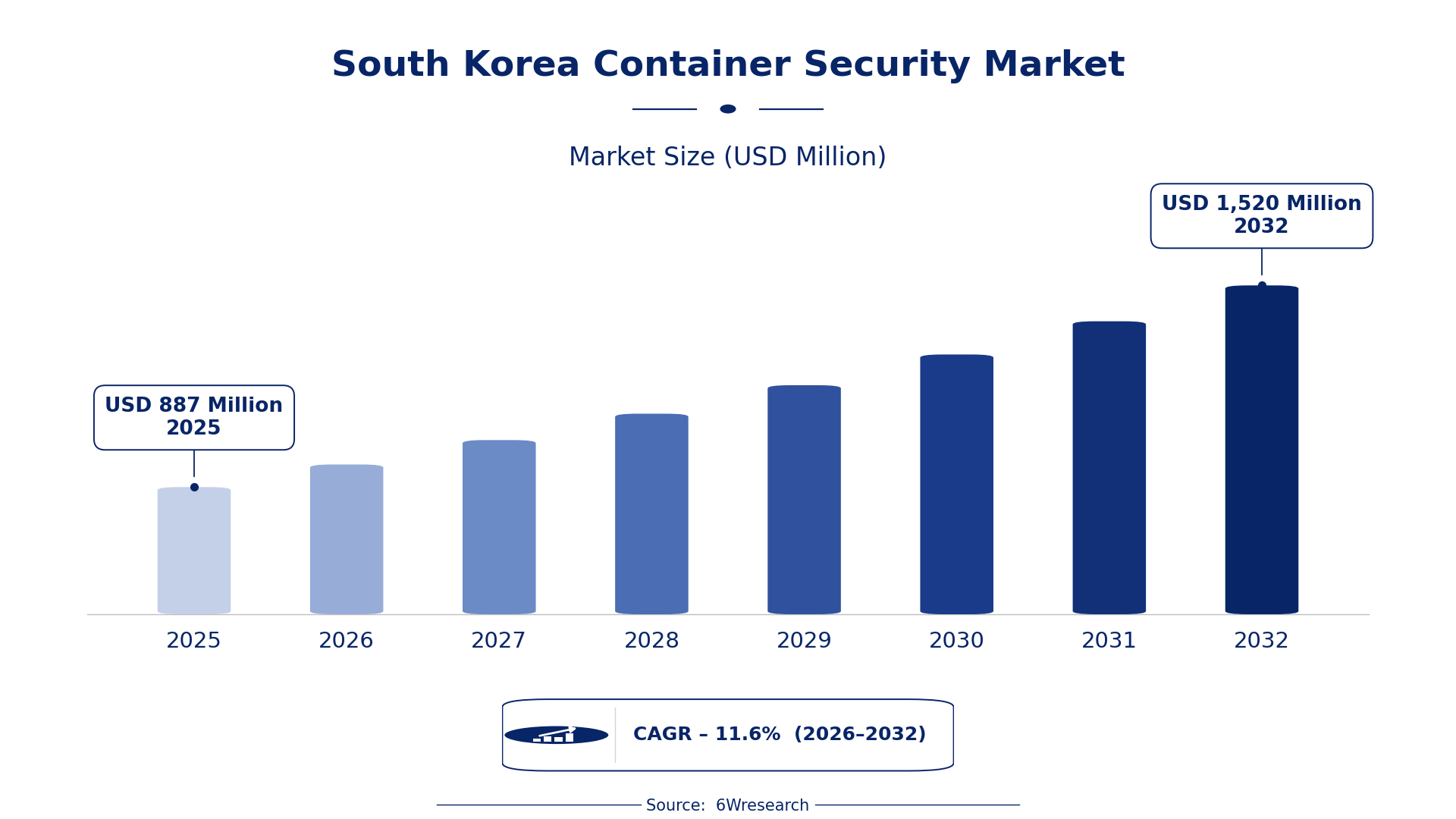
The South Korea Container Security Market was estimated at USD 887 Million in 2025 and is projected to reach USD 1520 Million by 2032, growing at a CAGR of 11.6% from 2026 to 2032.
South Korea Container Security Market Synopsis
The South Korea Container Security Market is currently witnessing substantial growth, driven by a strong demand for securing containerized applications and data. As organizations increasingly adopt containerization within their IT infrastructures, the need for effective security measures has escalated.
Looking ahead, the market is poised for significant advancements in technology and methodology. Companies are prioritizing innovations in runtime protection and vulnerability scanning to safeguard their assets, reflecting an evolving landscape that necessitates vigilance against emerging cyber threats.
South Korea Container Security Market Year-wise Growth Rate and Key Drivers
This graph illustrates the annual growth rates of the South Korea Container Security Market from 2021 to 2032, highlighting a steady upward trajectory and projected expansion over the forecast period.
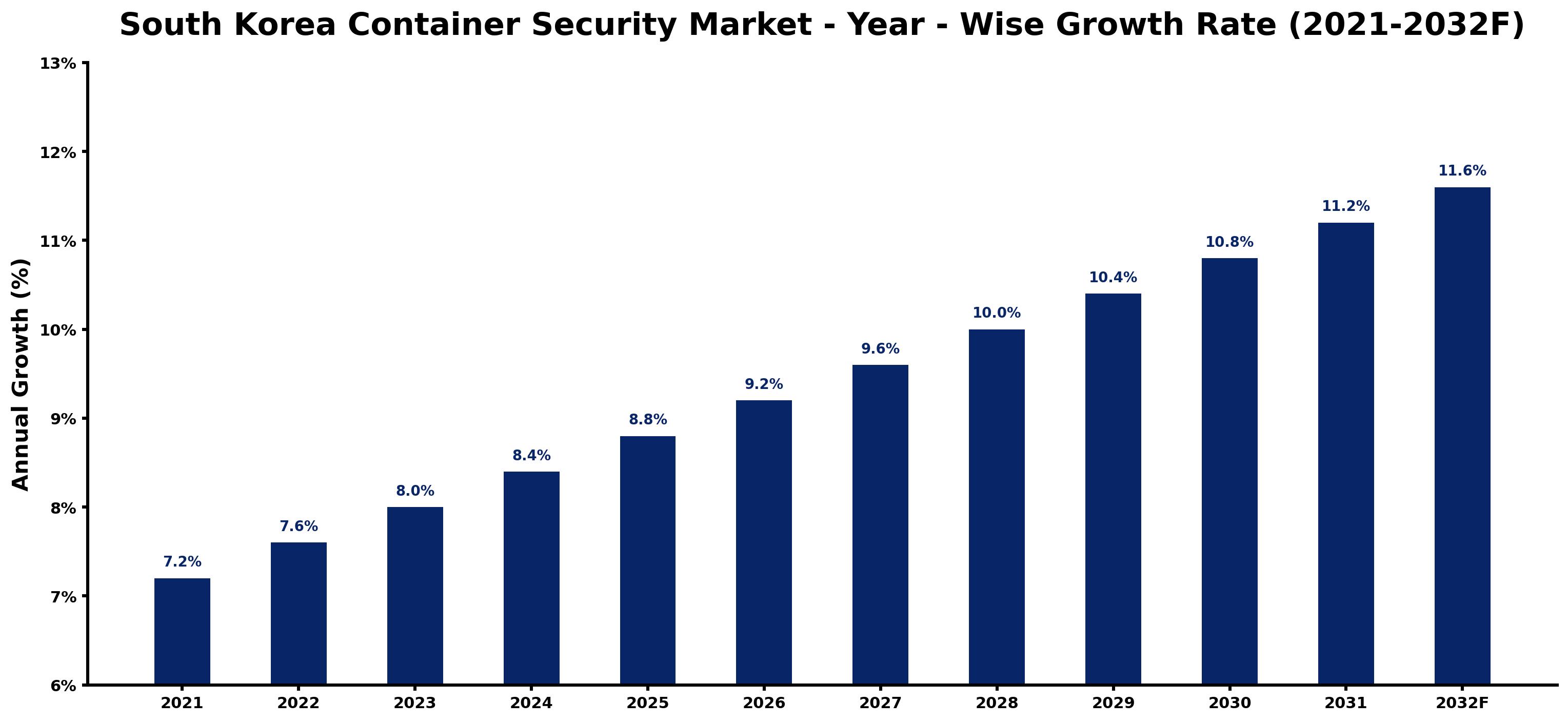
The table below presents the year‑wise growth rates along with the key drivers influencing the market
| Year | Growth Rate | Major Drivers |
| 2021 | 7.2% | Increased regulations by Korea Customs Service on container security |
| 2022 | 7.6% | Investment in advanced screening technologies for cargo inspections |
| 2023 | 8.0% | Rising concerns over port security amid global trade tensions |
| 2024 | 8.4% | Implementation of SMART Port initiative enhancing security measures |
| 2025 | 8.8% | Emerging cybersecurity threats driving demand for container defenses |
| 2026 | 9.2% | Collaboration between government and private sector on container safety |
| 2027 | 9.6% | Increased international maritime security standards adoption in Korea |
| 2028 | 10.0% | Growing e-commerce leading to higher container shipping volumes |
| 2029 | 10.4% | Government incentives for technology upgrades in container security |
| 2030 | 10.8% | Development of AI-driven monitoring systems for cargo security |
| 2031 | 11.2% | Surge in cross-border trade boosting container security priorities |
| 2032 | 11.6% | Enhanced inspection protocols due to supply chain vulnerabilities |
Note: Market size estimations and growth projections presented in this report are based on 6Wresearch's proprietary forecasting methodology, utilizing the latest available industry data, government publications, and primary research inputs.
South Korea Container Security Market Key Takeaways
Below are some of the specific key takeaways from the market, including:
- The increasing adoption of containerization is a major driver for security solutions in South Korea.
- Innovative security measures are being developed to address vulnerabilities and protect sensitive data.
- Compliance with stringent data protection regulations remains a critical concern for businesses.
- Partnerships between security vendors and DevOps teams are essential for effective container security implementation.
- The market presents significant growth opportunities for providers of container security solutions through continuous innovation.
Evaluation of Restraints in South Korea Container Security Market
The South Korea Container Security Market faces several notable restraints. One primary challenge is the rapid evolution of cyber threats, making it increasingly difficult for organizations to secure their containerized environments adequately. Businesses are also grappling with the complexity of ensuring compliance with a multitude of data protection regulations, which can impede the swift deployment of security solutions. on top of that, container image vulnerabilities require ongoing attention, demanding resources and expertise that can strain smaller organizations. To remain competitive, security vendors must continually innovate and provide comprehensive solutions that align with the unique needs of businesses operating in this space.
South Korea Container Security Market Trends
Recent trends show an upward trajectory in the demand for advanced container security features. Companies are increasingly focusing on real-time threat detection and automated vulnerability management to safeguard their applications. on top of that, the integration of artificial intelligence and machine learning in security solutions is gaining traction, enhancing the capability to predict and mitigate risks before they manifest. As containerization becomes more prevalent, partnerships between security vendors and development teams are also becoming critical for implementing effective security strategies throughout the container lifecycle.
South Korea Container Security Market Opportunities
Opportunities in the South Korea Container Security Market are abundant, particularly for those willing to invest in innovation. The shift towards microservices architecture is driving demand for specialized container security tools. Additionally, organizations are seeking solutions that not only secure their containers but also enhance compliance with evolving regulations. The potential for service providers to collaborate with enterprises on tailored security solutions creates avenues for growth. on top of that, as awareness around the importance of container security deepens, there is a clear opening for educational initiatives that equip businesses with the knowledge to implement effective practices.
Government Initiatives in the South Korea Container Security Market
Government policies in South Korea are actively shaping the container security market through various initiatives aimed at enhancing cybersecurity and data protection. These regulatory frameworks emphasize best practices and are critical in promoting the adoption of advanced container security solutions. As the government pushes for digital transformation, adherence to stringent security standards becomes non-negotiable for businesses aiming to thrive.
- A national cybersecurity strategy launched in early 2023 focuses on enhancing the security of digital infrastructures, including containerized applications.
- Ongoing workshops and training programs are being conducted to educate IT professionals on container security protocols and compliance measures.
- A regulatory framework established in 2024 mandates that organizations implement specific vulnerability management practices for container security.
- Planned initiatives are set to incentivize the adoption of container security solutions among small and medium-sized enterprises by 2025.
Future Insights of the South Korea Container Security Market
From 2026 to 2032, the South Korea Container Security Market is expected to evolve significantly, driven by ongoing advancements in technology and regulatory requirements. As organizations increasingly rely on containerized applications, the urgency for robust security solutions will intensify. Companies that prioritize comprehensive security strategies and foster collaboration with technology partners will likely capture a larger share of this growing market. Innovations in artificial intelligence, automated security measures, and enhanced compliance frameworks are anticipated to define the future trajectory of container security.
South Korea Container Security Market Latest Developments
In the past year, the South Korea Container Security Market has experienced noteworthy developments, with an emphasis on enhancing security capabilities to counteract sophisticated cyber threats. The industry is seeing a surge in partnerships aimed at delivering innovative solutions tailored for containerized environments.
- A leading regional operator launched an advanced container security platform in early 2023, integrating real-time monitoring and automated threat detection capabilities.
- An initiative that began in mid-2023 focuses on developing industry-specific security standards for container applications, with participation from various stakeholders.
- A collaboration between a major technology vendor and a government agency is currently underway, aimed at establishing a framework for compliance and best practices in container security.
- Upcoming in 2024, a new certification program for container security professionals is expected to bolster expertise in the industry.
South Korea Container Security Market - Key Attractiveness of the Report
- 10 Years of Market Numbers
- Historical Data Starting from 2022 to 2025
- Base Year: 2025
- Forecast Data until 2032
- Key Performance Indicators Impacting the Market
- Major Upcoming Developments and Projects
Key Highlights of the Report:
- South Korea Container Security Market Outlook
- Market Size of South Korea Container Security Market, 2025
- Forecast of South Korea Container Security Market, 2032
- Historical Data and Forecast of South Korea Container Security Revenues & Volume for the Period 2022-2032F
- South Korea Container Security Market Trend Evolution
- South Korea Container Security Market Drivers and Challenges
- South Korea Container Security Price Trends
- South Korea Container Security Porter's Five Forces
- South Korea Container Security Industry Life Cycle
- Historical Data and Forecast of South Korea Container Security Market Revenues & Volume By Component for the Period 2022-2032F
- Historical Data and Forecast of South Korea Container Security Market Revenues & Volume By Container Security Products for the Period 2022-2032F
- Historical Data and Forecast of South Korea Container Security Market Revenues & Volume By Services (Professional, Managed) for the Period 2022-2032F
- Historical Data and Forecast of South Korea Container Security Market Revenues & Volume By Deployment Type for the Period 2022-2032F
- Historical Data and Forecast of South Korea Container Security Market Revenues & Volume By Cloud for the Period 2022-2032F
- Historical Data and Forecast of South Korea Container Security Market Revenues & Volume By On-premises for the Period 2022-2032F
- Historical Data and Forecast of South Korea Container Security Market Revenues & Volume By Vertical for the Period 2022-2032F
- Historical Data and Forecast of South Korea Container Security Market Revenues & Volume By BFSI for the Period 2022-2032F
- Historical Data and Forecast of South Korea Container Security Market Revenues & Volume By Retail for the Period 2022-2032F
- Historical Data and Forecast of South Korea Container Security Market Revenues & Volume By Government for the Period 2022-2032F
- Historical Data and Forecast of South Korea Container Security Market Revenues & Volume By Healthcare for the Period 2022-2032F
- South Korea Container Security Import Export Trade Statistics
- Market Opportunity Assessment By Component
- Market Opportunity Assessment By Deployment Type
- Market Opportunity Assessment By Vertical
- South Korea Container Security Top Companies Market Share
- South Korea Container Security Competitive Benchmarking By Technical and Operational Parameters
- South Korea Container Security Company Profiles
- South Korea Container Security Key Strategic Recommendations






































