South Korea Containers as a Service Market Size & Growth Rate (2026-2032)
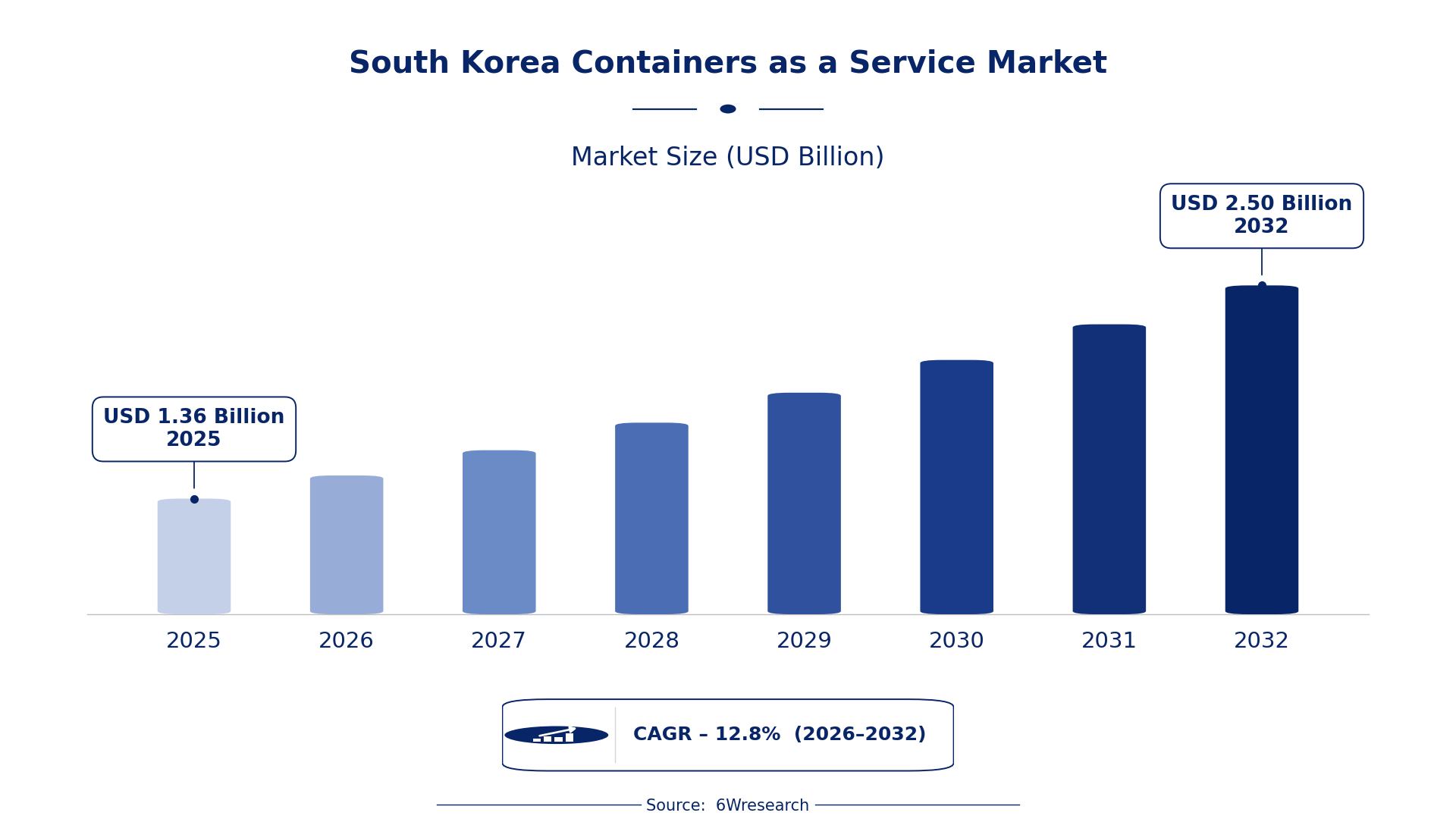
The South Korea Containers as a Service Market was estimated at USD 1364 Million in 2025 and is projected to reach USD 2496 Million by 2032, growing at a CAGR of 12.8% from 2026 to 2032.
South Korea Containers as a Service Market Synopsis
The South Korea Containers as a Service market is witnessing a surge driven by heightened demand for efficient application deployment and management solutions. As organizations increasingly embrace cloud environments, the need for streamlined container orchestration becomes critical.
With major shifts towards hybrid and multi-cloud strategies, businesses are seeking cost-effective and scalable solutions. The drive towards containerization is not just a trend but a vital component of digital transformation efforts across industries.
South Korea Containers as a Service Market Year-wise Growth Rate and Key Drivers
This graph illustrates the annual growth rates of the South Korea Containers as a Service Market from 2021 to 2032, highlighting a steady upward trajectory and projected expansion over the forecast period.
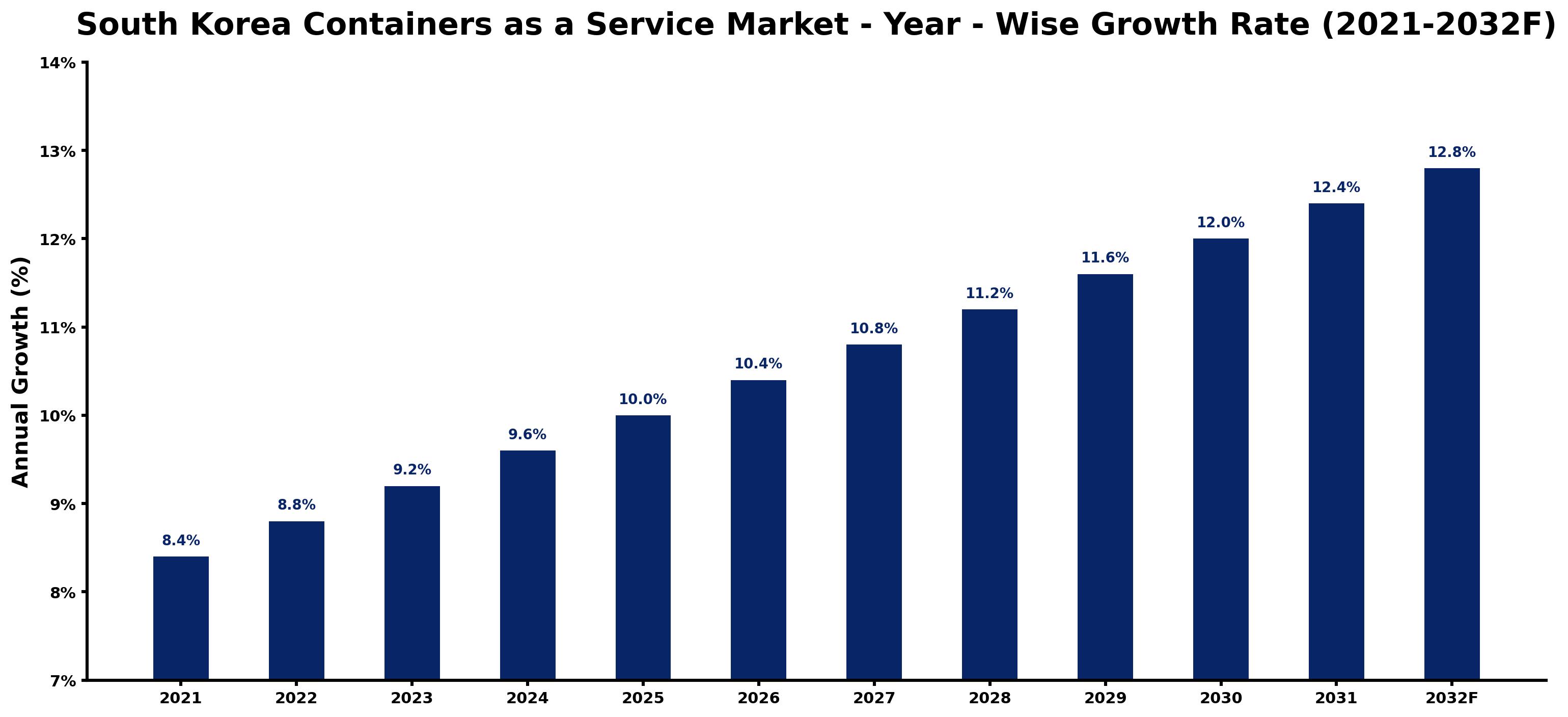
The table below presents the year‑wise growth rates along with the key drivers influencing the market
| Year | Growth Rate | Major Drivers |
| 2021 | 8.4% | Surge in mobile gaming driving cloud deployment needs. |
| 2022 | 8.8% | Increased remote work boosting demand for scalable infrastructure. |
| 2023 | 9.2% | Rise of AI startups necessitating flexible computing solutions. |
| 2024 | 9.6% | E-commerce boom amplifying microservices architecture requirements. |
| 2025 | 10.0% | Government incentives for tech startups enhancing cloud utilization. |
| 2026 | 10.4% | Growing cybersecurity regulations driving container security adoption. |
| 2027 | 10.8% | Local tech firms embracing DevOps methodologies for efficiency. |
| 2028 | 11.2% | Increased investment in digital healthcare solutions demands containers. |
| 2029 | 11.6% | Innovations in edge computing stimulating container ecosystem expansion. |
| 2030 | 12.0% | Rising interest in green IT practices promoting efficiency. |
| 2031 | 12.4% | Growing use of IoT devices requiring agile container solutions. |
| 2032 | 12.8% | Emphasis on regulatory compliance accelerating container platform uptake. |
Note: Market size estimations and growth projections presented in this report are based on 6Wresearch's proprietary forecasting methodology, utilizing the latest available industry data, government publications, and primary research inputs.
South Korea Containers as a Service Market Key Takeaways
Below are some of the specific key takeaways from the market, including:
- Containerization is revolutionizing cloud computing, enhancing developer productivity.
- Demand for seamless application deployment is pushing innovation in CaaS offerings.
- Cost efficiency remains a driving factor for enterprise adoption of container services.
- Risks associated with vendor lock-in and compliance are ongoing concerns for businesses.
- Government policies are fostering a conducive environment for CaaS market growth.
Evaluation of Restraints in South Korea Containers as a Service Market
Despite the positive trajectory, several restraints are impacting the South Korea Containers as a Service market. Key among these are the risks of vendor lock-in, which can limit flexibility and hinder optimal deployment strategies. Ensuring compatibility across multi-cloud environments remains a significant challenge, as enterprises strive for workload portability. Additionally, navigating data residency requirements and regulatory compliance can complicate the adoption process. Service providers need to address these issues head-on to unlock the market's full potential.
South Korea Containers as a Service Market Trends
The market is currently shaped by several prominent trends. A notable shift is the increased integration of Kubernetes in CaaS solutions, enhancing orchestration capabilities. Companies are also adopting hybrid cloud strategies to leverage the strengths of both public and private clouds. The emergence of serverless architectures is influencing how developers approach container deployment. on top of that, the focus on automation and AI-driven management tools is streamlining operations, making it easier for enterprises to scale efficiently.
South Korea Containers as a Service Market Opportunities
Significant opportunities lie ahead for stakeholders in the South Korea Containers as a Service market. The growing demand for agile software delivery models is paving the way for innovative CaaS solutions. Enterprises are increasingly willing to invest in container-based services to improve operational efficiency and reduce time-to-market. on top of that, the rising trend of edge computing presents new avenues for CaaS providers to explore, allowing businesses to deploy applications closer to data sources and enhance performance.
Government Initiatives in the South Korea Containers as a Service Market
Government initiatives are playing a crucial role in shaping the South Korea Containers as a Service market. With a focus on enhancing cloud computing capabilities, policies are being developed to promote security, scalability, and data migration in container services. This regulatory framework is essential for fostering innovation and ensuring compliance with IT governance.
- A national cloud security policy launched in early 2025 aims to establish stringent security protocols for CaaS platforms.
- Currently, a program encouraging the adoption of container-based services is underway, providing financial incentives for businesses.
- A planned initiative expected to roll out by 2027 will focus on improving IT infrastructure to support scalable application deployment.
- Ongoing regulations address data residency issues, helping companies navigate compliance in a multi-cloud environment.
Future Insights of the South Korea Containers as a Service Market
Looking ahead to 2026-2032, the South Korea Containers as a Service market is set to expand significantly. As enterprises continue to prioritize digital transformation, the shift towards containerization will only intensify. Innovations in service delivery, coupled with increased government support, will drive market growth. The emphasis on automation and AI integration will further enhance operational efficiencies, positioning the CaaS market as a cornerstone of cloud computing in South Korea.
South Korea Containers as a Service Market Latest Developments
Recent developments in the South Korea Containers as a Service market illustrate a dynamic sector responding to evolving technology demands. Over the last year, several noteworthy advancements have taken place, signaling a clear direction towards innovation and efficiency in container management.
- A leading technology vendor launched an upgraded CaaS platform in early 2025, enhancing security and scalability features.
- Currently, a collaborative initiative among major cloud providers is focusing on establishing best practices for Kubernetes deployment.
- A strategic partnership between software developers and cloud service providers is underway, aimed at creating more intuitive management tools for container orchestration.
- By mid-2026, a new training program for IT professionals is expected to launch, focusing on container management skills.
South Korea Containers as a Service Market - Key Attractiveness of the Report
- 10 Years of Market Numbers
- Historical Data Starting from 2022 to 2025
- Base Year: 2025
- Forecast Data until 2032
- Key Performance Indicators Impacting the Market
- Major Upcoming Developments and Projects
Key Highlights of the Report:
- South Korea Containers as a Service Market Outlook
- Market Size of South Korea Containers as a Service Market, 2025
- Forecast of South Korea Containers as a Service Market, 2032
- Historical Data and Forecast of South Korea Containers as a Service Revenues & Volume for the Period 2022-2032F
- South Korea Containers as a Service Market Trend Evolution
- South Korea Containers as a Service Market Drivers and Challenges
- South Korea Containers as a Service Price Trends
- South Korea Containers as a Service Porter's Five Forces
- South Korea Containers as a Service Industry Life Cycle
- Historical Data and Forecast of South Korea Containers as a Service Market Revenues & Volume By Service Type for the Period 2022-2032F
- Historical Data and Forecast of South Korea Containers as a Service Market Revenues & Volume By Management & Orchestration for the Period 2022-2032F
- Historical Data and Forecast of South Korea Containers as a Service Market Revenues & Volume By Security for the Period 2022-2032F
- Historical Data and Forecast of South Korea Containers as a Service Market Revenues & Volume By Monitoring and Analytics for the Period 2022-2032F
- Historical Data and Forecast of South Korea Containers as a Service Market Revenues & Volume By Storage and Networking for the Period 2022-2032F
- Historical Data and Forecast of South Korea Containers as a Service Market Revenues & Volume By Continuous Integration and Continuous Deployment (CI/CD) for the Period 2022-2032F
- Historical Data and Forecast of South Korea Containers as a Service Market Revenues & Volume By Training and Consulting for the Period 2022-2032F
- Historical Data and Forecast of South Korea Containers as a Service Market Revenues & Volume By Support and Maintenance for the Period 2022-2032F
- Historical Data and Forecast of South Korea Containers as a Service Market Revenues & Volume By Deployment Model for the Period 2022-2032F
- Historical Data and Forecast of South Korea Containers as a Service Market Revenues & Volume By Public Cloud for the Period 2022-2032F
- Historical Data and Forecast of South Korea Containers as a Service Market Revenues & Volume By Private Cloud for the Period 2022-2032F
- Historical Data and Forecast of South Korea Containers as a Service Market Revenues & Volume By Hybrid Cloud for the Period 2022-2032F
- Historical Data and Forecast of South Korea Containers as a Service Market Revenues & Volume By Organization Size for the Period 2022-2032F
- Historical Data and Forecast of South Korea Containers as a Service Market Revenues & Volume By Small and Medium-Sized Enterprises (SMEs) for the Period 2022-2032F
- Historical Data and Forecast of South Korea Containers as a Service Market Revenues & Volume By Large Enterprises for the Period 2022-2032F
- Historical Data and Forecast of South Korea Containers as a Service Market Revenues & Volume By Vertical for the Period 2022-2032F
- Historical Data and Forecast of South Korea Containers as a Service Market Revenues & Volume By Retail and Consumer Goods for the Period 2022-2032F
- Historical Data and Forecast of South Korea Containers as a Service Market Revenues & Volume By Manufacturing for the Period 2022-2032F
- Historical Data and Forecast of South Korea Containers as a Service Market Revenues & Volume By Media, Entertainment and Gaming for the Period 2022-2032F
- Historical Data and Forecast of South Korea Containers as a Service Market Revenues & Volume By IT and Telecommunications for the Period 2022-2032F
- Historical Data and Forecast of South Korea Containers as a Service Market Revenues & Volume By Healthcare for the Period 2022-2032F
- Historical Data and Forecast of South Korea Containers as a Service Market Revenues & Volume By BFSI for the Period 2022-2032F
- Historical Data and Forecast of South Korea Containers as a Service Market Revenues & Volume By Transportation & Logistics for the Period 2022-2032F
- South Korea Containers as a Service Import Export Trade Statistics
- Market Opportunity Assessment By Service Type
- Market Opportunity Assessment By Deployment Model
- Market Opportunity Assessment By Organization Size
- Market Opportunity Assessment By Vertical
- South Korea Containers as a Service Top Companies Market Share
- South Korea Containers as a Service Competitive Benchmarking By Technical and Operational Parameters
- South Korea Containers as a Service Company Profiles
- South Korea Containers as a Service Key Strategic Recommendations






































