South Korea Content Delivery Network Market Size & Growth Rate (2026-2032)
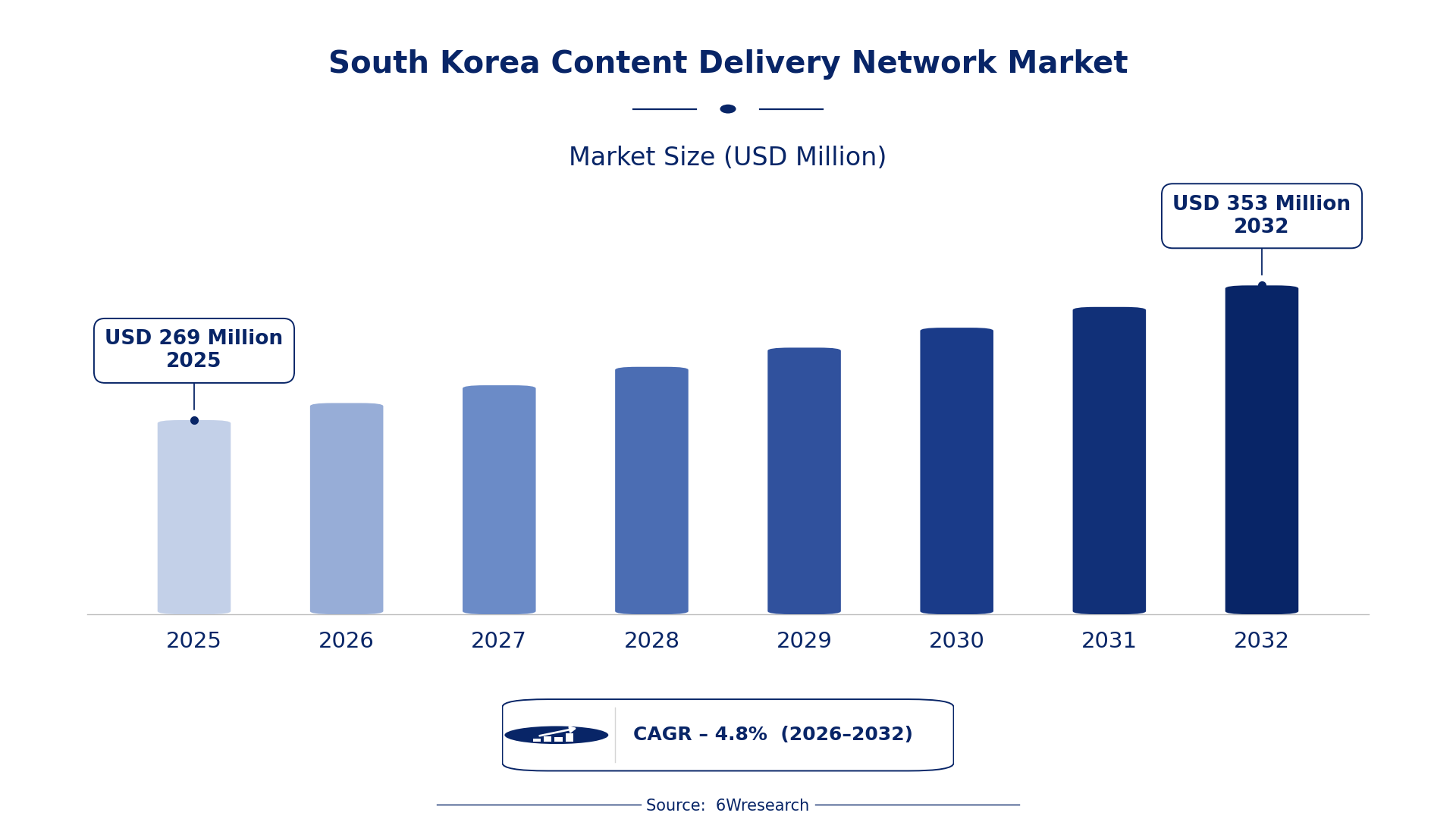
The South Korea Content Delivery Network Market was estimated at USD 269 Million in 2025 and is projected to reach USD 353 Million by 2032, growing at a CAGR of 4.8% from 2026 to 2032.
South Korea Content Delivery Network Market Synopsis
The South Korea Content Delivery Network Market has experienced robust growth, driven by a surge in online content consumption and the need for faster content delivery solutions. As demand escalates, the market is now shifting towards more advanced technologies, including edge computing and enhanced security measures.
Looking ahead, the integration of artificial intelligence and machine learning within CDN frameworks is set to redefine performance benchmarks. This evolving technological landscape presents both challenges and opportunities, compelling providers to adapt swiftly to remain competitive.
South Korea Content Delivery Network Market Year-wise Growth Rate and Key Drivers
This graph illustrates the annual growth rates of the South Korea Content Delivery Network Market from 2021 to 2032, highlighting a steady upward trajectory and projected expansion over the forecast period.
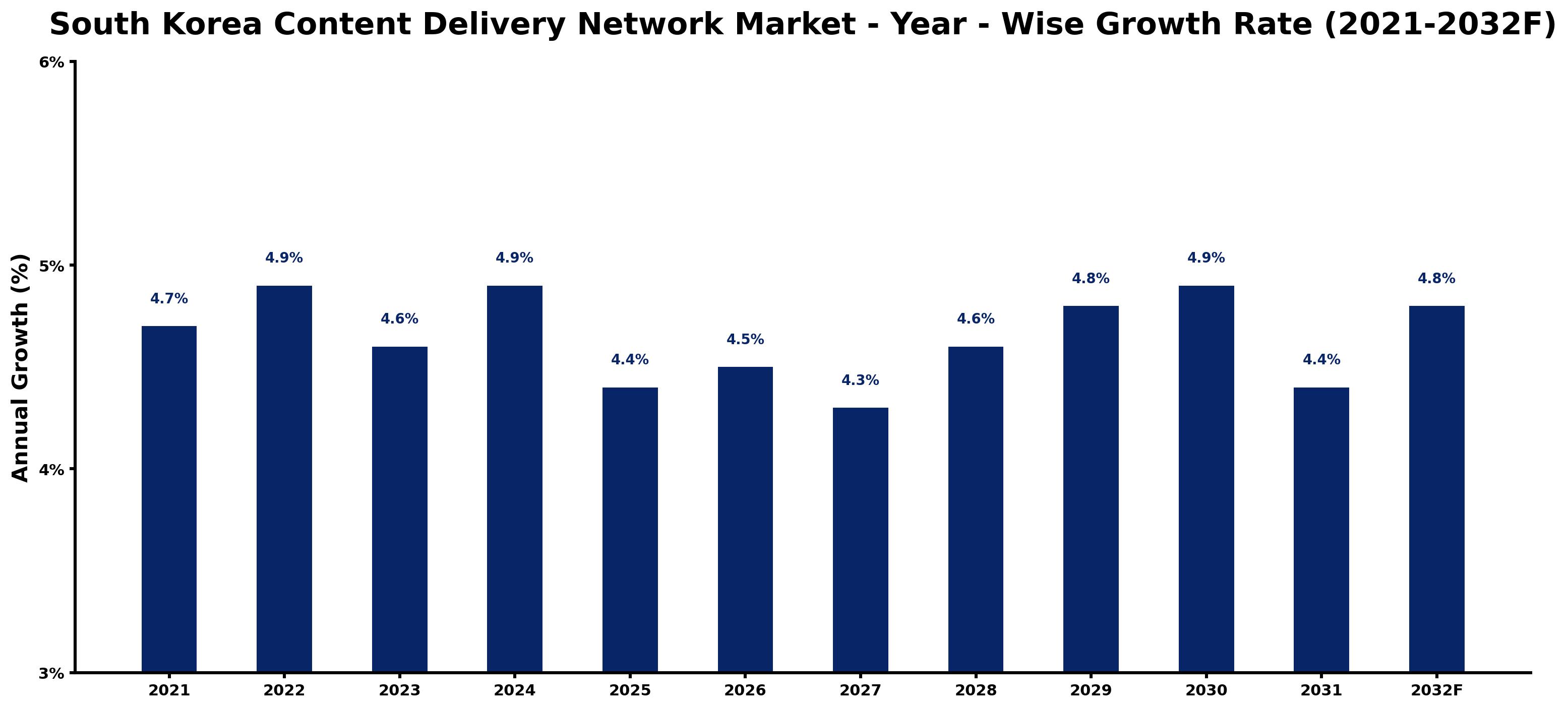
The table below presents the year‑wise growth rates along with the key drivers influencing the market
| Year | Growth Rate | Major Drivers |
| 2021 | 4.7% | Government's 5G rollout enhances digital content delivery speed. |
| 2022 | 4.9% | Surge in e-sports events boosts live streaming demand. |
| 2023 | 4.6% | Increased smartphone penetration elevates mobile content access. |
| 2024 | 4.9% | Rising use of augmented reality in entertainment sectors. |
| 2025 | 4.4% | Local businesses shift to digital platforms for content distribution. |
| 2026 | 4.5% | Emergence of AI-driven content personalization increases user engagement. |
| 2027 | 4.3% | Strong growth in online educational platforms fuels bandwidth needs. |
| 2028 | 4.6% | Demand for high-quality video content rises with 4K adoption. |
| 2029 | 4.8% | Regulatory support for digital infrastructure enhances service accessibility. |
| 2030 | 4.9% | Increase in remote work drives business video streaming requirements. |
| 2031 | 4.4% | Enhancements in cloud computing boost CDN demand for enterprises. |
| 2032 | 4.8% | Expanding influencer culture necessitates robust content delivery solutions. |
Note: Market size estimations and growth projections presented in this report are based on 6Wresearch's proprietary forecasting methodology, utilizing the latest available industry data, government publications, and primary research inputs.
South Korea Content Delivery Network Market Key Takeaways
Below are some of the specific key takeaways from the market, including:
- Growing demand for online content is propelling CDN adoption across various sectors.
- Technological advancements are enhancing CDN performance and security features.
- Challenges in network reliability and cybersecurity continue to impact service providers.
- Edge computing capabilities are becoming crucial for optimizing content delivery.
- Government policies are supporting CDN development through regulatory frameworks.
Evaluation of Restraints in South Korea Content Delivery Network Market
Despite the promising growth trajectory, the South Korea Content Delivery Network Market faces several constraints. Network reliability and scalability remain significant concerns, particularly as internet traffic continues to rise. Providers are challenged to maintain high performance while ensuring robust cybersecurity measures against evolving threats. These factors can hinder operational efficiency and customer satisfaction, forcing companies to innovate continuously.
South Korea Content Delivery Network Market Trends
Recent trends highlight the increasing focus on edge computing as a strategy to enhance content delivery speeds and reduce latency. Additionally, there is a noticeable shift towards integrating advanced security protocols, especially in response to rising cyber threats. Providers are also investing in dynamic content caching solutions to improve user experiences across diverse applications, including streaming and online gaming.
South Korea Content Delivery Network Market Opportunities
The market presents substantial growth opportunities, particularly in sectors like e-commerce, education, and entertainment, where high-quality content delivery is paramount. Investment in artificial intelligence and machine learning technologies is on track to further enhance service offerings. Additionally, partnerships with telecommunication firms can expand reach and service capabilities, addressing the growing need for efficient content distribution networks.
Government Initiatives in the South Korea Content Delivery Network Market
Government initiatives are crucial in shaping the South Korea Content Delivery Network Market. The regulatory environment is focused on enhancing internet infrastructure and ensuring compliance with digital media standards. These policies encourage innovation and adoption of CDN technologies, aligning with national objectives for improved connectivity and digital content distribution.
- A regulatory framework introduced in 2025 mandates enhanced security protocols for CDN services.
- A national digital infrastructure upgrade program is currently underway to improve broadband access and performance.
- Incentives for CDN technology adoption were launched in early 2025, aimed at improving website loading speeds.
- Upcoming initiatives planned for 2026 will focus on expanding telecom infrastructure to support CDN deployment.
Future Insights of the South Korea Content Delivery Network Market
From 2026 to 2032, the South Korea Content Delivery Network Market is expected to evolve significantly. The integration of cutting-edge technologies will not only improve delivery speed but also enhance security measures against cyber threats. As online consumption continues to rise, providers that prioritize innovation and adaptability will be well-positioned to capture market share and drive future growth.
South Korea Content Delivery Network Market Latest Developments
Recent months have seen a flurry of activity in the South Korea Content Delivery Network Market, reflecting a commitment to enhancing service offerings and infrastructure. Providers are investing heavily in new technologies to meet the rising demands of consumers and businesses alike.
- A major technology vendor launched an upgraded CDN platform in Q2 2025, featuring enhanced security and performance metrics.
- An ongoing initiative began in early 2025 to integrate AI-driven analytics into CDN services for improved user experience.
- A partnership between leading CDN providers and telecommunications firms was announced in early 2025 to expand service reach.
- Upcoming plans for a nationwide CDN service expansion are set to begin in late 2026, targeting underserved regions.
South Korea Content Delivery Network Market - Key Attractiveness of the Report
- 10 Years of Market Numbers
- Historical Data Starting from 2022 to 2025
- Base Year: 2025
- Forecast Data until 2032
- Key Performance Indicators Impacting the Market
- Major Upcoming Developments and Projects
Key Highlights of the Report:
- South Korea Content Delivery Network Market Outlook
- Market Size of South Korea Content Delivery Network Market, 2025
- Forecast of South Korea Content Delivery Network Market, 2032
- Historical Data and Forecast of South Korea Content Delivery Network Revenues & Volume for the Period 2022-2032F
- South Korea Content Delivery Network Market Trend Evolution
- South Korea Content Delivery Network Market Drivers and Challenges
- South Korea Content Delivery Network Price Trends
- South Korea Content Delivery Network Porter's Five Forces
- South Korea Content Delivery Network Industry Life Cycle
- Historical Data and Forecast of South Korea Content Delivery Network Market Revenues & Volume By Component for the Period 2022-2032F
- Historical Data and Forecast of South Korea Content Delivery Network Market Revenues & Volume By Solutions for the Period 2022-2032F
- Historical Data and Forecast of South Korea Content Delivery Network Market Revenues & Volume By Services for the Period 2022-2032F
- Historical Data and Forecast of South Korea Content Delivery Network Market Revenues & Volume By Content Type for the Period 2022-2032F
- Historical Data and Forecast of South Korea Content Delivery Network Market Revenues & Volume By Static for the Period 2022-2032F
- Historical Data and Forecast of South Korea Content Delivery Network Market Revenues & Volume By Dynamic for the Period 2022-2032F
- Historical Data and Forecast of South Korea Content Delivery Network Market Revenues & Volume By Solution for the Period 2022-2032F
- Historical Data and Forecast of South Korea Content Delivery Network Market Revenues & Volume By Web Performance Optimization for the Period 2022-2032F
- Historical Data and Forecast of South Korea Content Delivery Network Market Revenues & Volume By Media Delivery for the Period 2022-2032F
- Historical Data and Forecast of South Korea Content Delivery Network Market Revenues & Volume By Cloud Security for the Period 2022-2032F
- Historical Data and Forecast of South Korea Content Delivery Network Market Revenues & Volume By Application Area for the Period 2022-2032F
- Historical Data and Forecast of South Korea Content Delivery Network Market Revenues & Volume By Media and Entertainment for the Period 2022-2032F
- Historical Data and Forecast of South Korea Content Delivery Network Market Revenues & Volume By Video Streaming for the Period 2022-2032F
- Historical Data and Forecast of South Korea Content Delivery Network Market Revenues & Volume By OTT Platform for the Period 2022-2032F
- Historical Data and Forecast of South Korea Content Delivery Network Market Revenues & Volume By Online Gaming for the Period 2022-2032F
- Historical Data and Forecast of South Korea Content Delivery Network Market Revenues & Volume By Retail and eCommerce for the Period 2022-2032F
- Historical Data and Forecast of South Korea Content Delivery Network Market Revenues & Volume By eLearning for the Period 2022-2032F
- Historical Data and Forecast of South Korea Content Delivery Network Market Revenues & Volume By Healthcare for the Period 2022-2032F
- Historical Data and Forecast of South Korea Content Delivery Network Market Revenues & Volume By Provider Type for the Period 2022-2032F
- Historical Data and Forecast of South Korea Content Delivery Network Market Revenues & Volume By Traditional CDN for the Period 2022-2032F
- Historical Data and Forecast of South Korea Content Delivery Network Market Revenues & Volume By Telco CDN for the Period 2022-2032F
- Historical Data and Forecast of South Korea Content Delivery Network Market Revenues & Volume By Cloud CDN for the Period 2022-2032F
- Historical Data and Forecast of South Korea Content Delivery Network Market Revenues & Volume By P2P CDN for the Period 2022-2032F
- Historical Data and Forecast of South Korea Content Delivery Network Market Revenues & Volume By Others for the Period 2022-2032F
- South Korea Content Delivery Network Import Export Trade Statistics
- Market Opportunity Assessment By Component
- Market Opportunity Assessment By Content Type
- Market Opportunity Assessment By Solution
- Market Opportunity Assessment By Application Area
- Market Opportunity Assessment By Provider Type
- South Korea Content Delivery Network Top Companies Market Share
- South Korea Content Delivery Network Competitive Benchmarking By Technical and Operational Parameters
- South Korea Content Delivery Network Company Profiles
- South Korea Content Delivery Network Key Strategic Recommendations






































