South Korea Cutting Equipment Market Size, Share & Growth Rate
The South Korea Cutting Equipment Market was estimated at USD 250 Million in 2025 and is projected to reach USD 350 Million by 2032, growing at a CAGR of 4.9% from 2026 to 2032. This growth trajectory is primarily driven by increasing demand for precision and efficiency in industries such as metal fabrication and automotive manufacturing. Additionally, technological advancements in cutting equipment continue to enhance operational performance and product quality, fueling further adoption across sectors.
South Korea Cutting Equipment Market Year-wise Growth Rate and Key Drivers
This graph highlights how the South Korea Cutting Equipment Market has steadily grown over the years, supported by major growth factors.
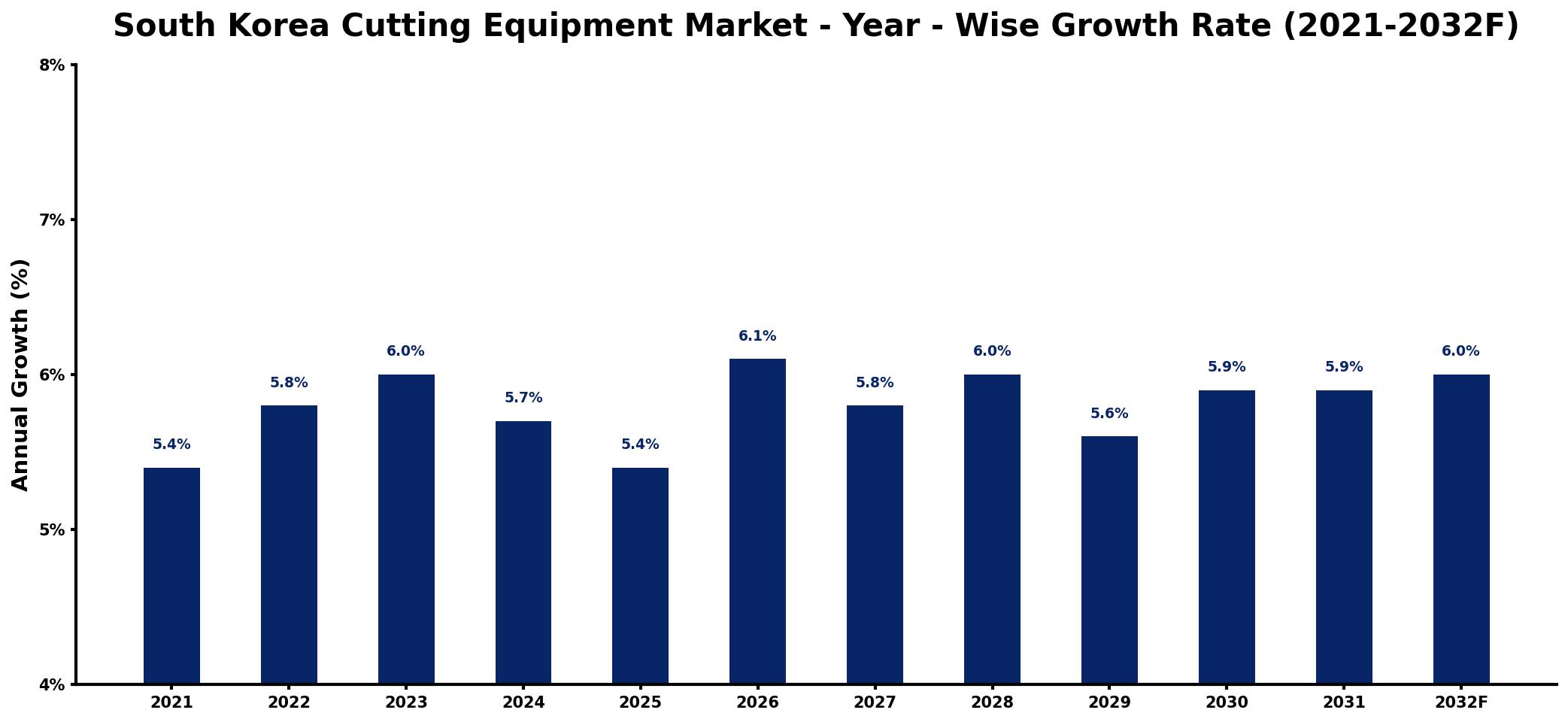
The table below presents the year‑wise growth rates along with the key drivers influencing the market
| Year | Growth Rate | Major Drivers |
| 2021 | 5.4% | Rising demand from manufacturing sectors |
| 2022 | 5.8% | Increased investments in automation technologies |
| 2023 | 6.0% | increased production capacity utilization |
| 2024 | 5.7% | Expansion of renewable energy initiatives |
| 2025 | 5.4% | Surge in consumer electronics production |
| 2026 | 6.1% | Boost in automotive manufacturing output |
| 2027 | 5.8% | Development of advanced materials applications |
| 2028 | 6.0% | Growth in medical device production |
| 2029 | 5.6% | Increase in aerospace industry activities |
| 2030 | 5.9% | Rising emphasis on precision engineering |
| 2031 | 5.9% | expanding healthcare application demand |
| 2032 | 6.0% | Increased focus on sustainable practices |
Note: Market size estimations and growth projections presented in this report are based on 6Wresearch's proprietary forecasting methodology, utilizing the latest available industry data, government publications, and primary research inputs.
South Korea Cutting Equipment Market Synopsis
The South Korea Cutting Equipment Market has witnessed robust momentum in recent years, driven largely by an expanding manufacturing sector that demands cutting-edge solutions. As industries adopt more sophisticated equipment, the focus is shifting towards advanced technologies such as CNC automation and multi-material cutting capabilities.
Looking ahead, the market is poised for substantial growth as companies aim to optimize production efficiency and reduce waste. The integration of automation into cutting processes stands out as a key trend, setting the stage for a competitive landscape that emphasizes not only speed but also precision and adaptability.
South Korea Cutting Equipment Market Key Takeaways
- The market is projected to grow from USD 250 Million in 2025 to USD 350 Million by 2032.
- Technological advancements are crucial, focusing on CNC automation and multi-material capabilities.
- Industries like automotive, aerospace, and metal fabrication are leading the demand for cutting solutions.
- Government regulations emphasize safety and efficiency, impacting design and operational standards.
- Companies need to innovate to meet complex cutting demands and enhance product quality.
Evaluation of Restraints in South Korea Cutting Equipment Market
Despite the promising growth, the South Korea Cutting Equipment Market faces notable restraints. The increasing complexity of design geometries demands cutting solutions that achieve high precision without incurring excessive material waste. Additionally, many manufacturers are challenged to effectively integrate automated systems within their existing workflows. This necessitates a continual push for innovation, particularly in laser and plasma cutting technologies. Companies must also navigate the competitive landscape effectively, ensuring they meet the evolving needs of various industries while maintaining operational efficiency.
South Korea Cutting Equipment Market Trends
Current trends highlight a strong shift towards smart manufacturing practices, driven by the need for enhanced automation and precision in cutting processes. The adoption of Industry 4.0 principles is evident, with a focus on data analytics and IoT integration within cutting machinery. These innovations enable real-time monitoring and adjustments, optimizing production workflows and minimizing downtime.
Emerging technologies, particularly in laser and plasma cutting, are also setting new benchmarks in terms of speed and accuracy. The market is moving towards solutions that can handle diverse materials and thicknesses, catering to an increasingly varied range of industrial applications.
South Korea Cutting Equipment Market Opportunities
Significant opportunities lie in expanding the capabilities of cutting equipment to address the diverse needs of various sectors. Investment in R&D to develop innovative solutions will be pivotal, particularly those that enhance CNC integration and reduce waste. Collaborations with key industries such as automotive and aerospace can yield substantial advancements, while government incentives for adopting cutting-edge technologies will further catalyze growth.
Government Initiatives in the South Korea Cutting Equipment Market
The South Korean government plays a vital role in shaping the cutting equipment market through regulations and initiatives focused on industrial safety and efficiency. Policies are designed to enhance workplace ergonomics and promote the adoption of advanced technologies. These regulations ensure that manufacturers adhere to stringent safety standards and invest in proper training for machine operators, thereby fostering a more capable workforce and efficient production environments.
Future Insights of the South Korea Cutting Equipment Market
Looking forward to the period between 2026 and 2032, the South Korea Cutting Equipment Market is expected to witness transformative changes. The continuous push towards automation and smart manufacturing will redefine industry standards. As the demand for sustainability and efficiency intensifies, cutting technologies that optimize resource use and minimize waste will become increasingly crucial. Overall, the market is heading towards a future characterized by enhanced flexibility, responsiveness, and technological integration.
South Korea Cutting Equipment Market Latest Developments (2025 - 2026)
Recent developments in the South Korea Cutting Equipment Market indicate a growing emphasis on automation and precision. Major advancements in laser cutting technologies have been particularly notable, with suppliers enhancing their offerings to meet the heightened demand for multi-material capabilities. Additionally, there is a significant focus on integrating AI and IoT solutions to further optimize manufacturing processes and minimize operational downtimes. These trends suggest that the market is evolving rapidly to embrace next-generation solutions that address both current and future industry needs.
South Korea Cutting Equipment Market - Key Attractiveness of the Report
- 10 Years of Market Numbers
- Historical Data Starting from 2022 to 2025
- Base Year: 2025
- Forecast Data until 2032
- Key Performance Indicators Impacting the Market
- Major Upcoming Developments and Projects
Key Highlights of the Report:
- South Korea Cutting Equipment Market Outlook
- Market Size of South Korea Cutting Equipment Market, 2025
- Forecast of South Korea Cutting Equipment Market, 2032
- Historical Data and Forecast of South Korea Cutting Equipment Revenues & Volume for the Period 2022-2032F
- South Korea Cutting Equipment Market Trend Evolution
- South Korea Cutting Equipment Market Drivers and Challenges
- South Korea Cutting Equipment Price Trends
- South Korea Cutting Equipment Porter's Five Forces
- South Korea Cutting Equipment Industry Life Cycle
- Historical Data and Forecast of South Korea Cutting Equipment Market Revenues & Volume By Equipment Type for the Period 2022-2032F
- Historical Data and Forecast of South Korea Cutting Equipment Market Revenues & Volume By Manual for the Period 2022-2032F
- Historical Data and Forecast of South Korea Cutting Equipment Market Revenues & Volume By Mechanized for the Period 2022-2032F
- Historical Data and Forecast of South Korea Cutting Equipment Market Revenues & Volume By Cutting Technology for the Period 2022-2032F
- Historical Data and Forecast of South Korea Cutting Equipment Market Revenues & Volume By Plasma cutting for the Period 2022-2032F
- Historical Data and Forecast of South Korea Cutting Equipment Market Revenues & Volume By Oxy-fuel cutting for the Period 2022-2032F
- Historical Data and Forecast of South Korea Cutting Equipment Market Revenues & Volume By Laser cutting for the Period 2022-2032F
- Historical Data and Forecast of South Korea Cutting Equipment Market Revenues & Volume By Waterjet cutting for the Period 2022-2032F
- Historical Data and Forecast of South Korea Cutting Equipment Market Revenues & Volume By Carbon arc cutting for the Period 2022-2032F
- Historical Data and Forecast of South Korea Cutting Equipment Market Revenues & Volume By End Use Industry for the Period 2022-2032F
- Historical Data and Forecast of South Korea Cutting Equipment Market Revenues & Volume By Construction for the Period 2022-2032F
- Historical Data and Forecast of South Korea Cutting Equipment Market Revenues & Volume By Heavy metal fabrication for the Period 2022-2032F
- Historical Data and Forecast of South Korea Cutting Equipment Market Revenues & Volume By Shipbuilding & offshore for the Period 2022-2032F
- Historical Data and Forecast of South Korea Cutting Equipment Market Revenues & Volume By Automotive for the Period 2022-2032F
- Historical Data and Forecast of South Korea Cutting Equipment Market Revenues & Volume By Others for the Period 2022-2032F
- Historical Data and Forecast of South Korea Cutting Equipment Market Revenues & Volume By Type for the Period 2022-2032F
- Historical Data and Forecast of South Korea Cutting Equipment Market Revenues & Volume By Equipment for the Period 2022-2032F
- Historical Data and Forecast of South Korea Cutting Equipment Market Revenues & Volume By Consumables/Accessories for the Period 2022-2032F
- South Korea Cutting Equipment Import Export Trade Statistics
- Market Opportunity Assessment By Equipment Type
- Market Opportunity Assessment By Cutting Technology
- Market Opportunity Assessment By End Use Industry
- Market Opportunity Assessment By Type
- South Korea Cutting Equipment Top Companies Market Share
- South Korea Cutting Equipment Competitive Benchmarking By Technical and Operational Parameters
- South Korea Cutting Equipment Company Profiles
- South Korea Cutting Equipment Key Strategic Recommendations






































