South Korea Data Center Automation Market Size & Growth Rate (2026-2032)
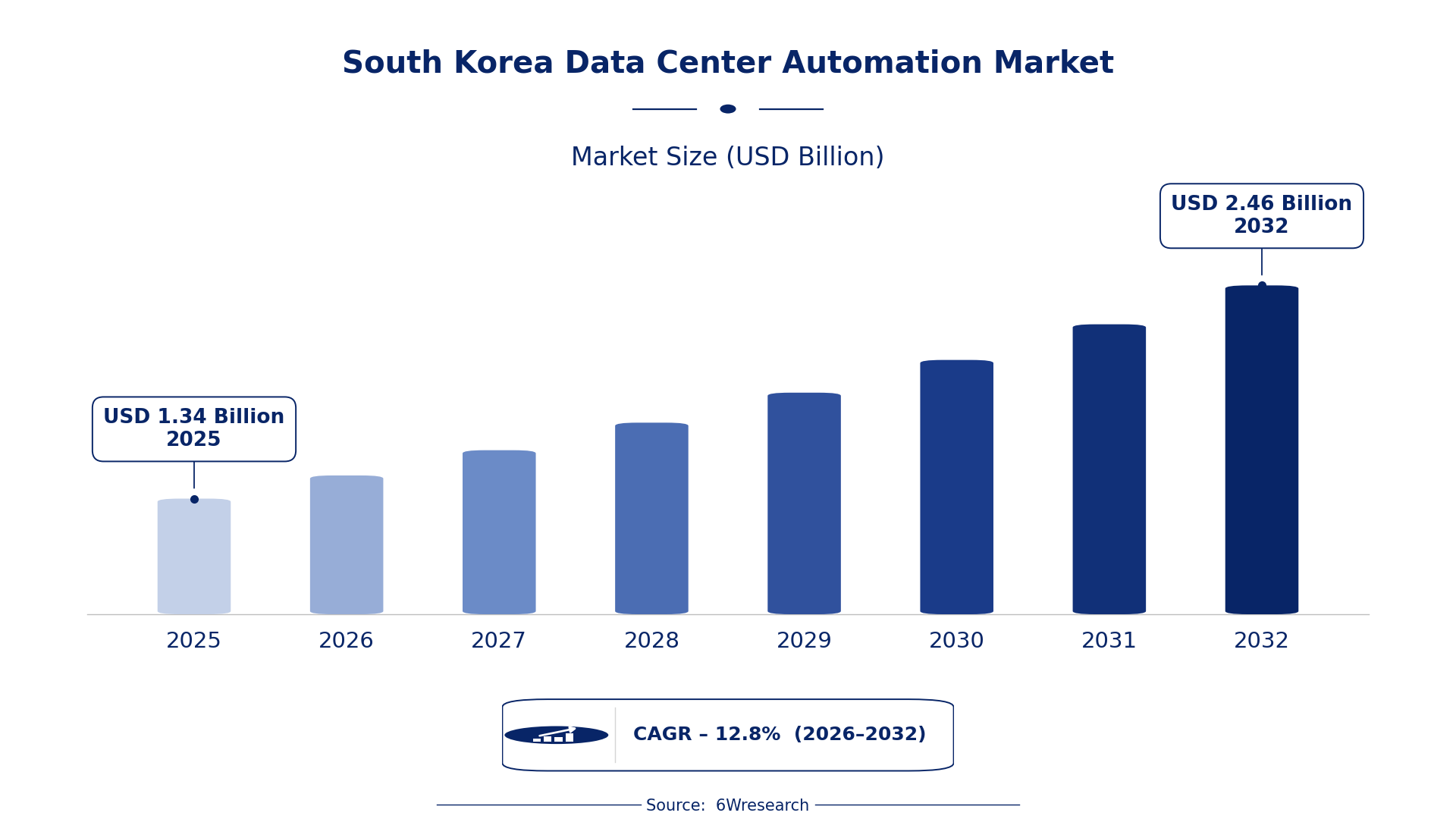
The South Korea Data Center Automation Market was estimated at USD 1345 Million in 2025 and is projected to reach USD 2461 Million by 2032, growing at a CAGR of 12.8% from 2026 to 2032.
South Korea Data Center Automation Market Synopsis
The South Korean market for data center automation is witnessing a dynamic shift as businesses increasingly adopt solutions to streamline their IT operations. The integration of AI-driven technologies and orchestration platforms is at the forefront, helping organizations achieve greater efficiency and scalability.
With the demand for seamless operational workflows rising, companies are turning to automation to enhance their service delivery. The push towards hyperconverged infrastructure deployments is also shaping how data centers are managed, allowing for more agile and cost-effective solutions in a competitive environment.
South Korea Data Center Automation Market Year-wise Growth Rate and Key Drivers
This graph illustrates the annual growth rates of the South Korea Data Center Automation Market from 2021 to 2032, highlighting a steady upward trajectory and projected expansion over the forecast period.
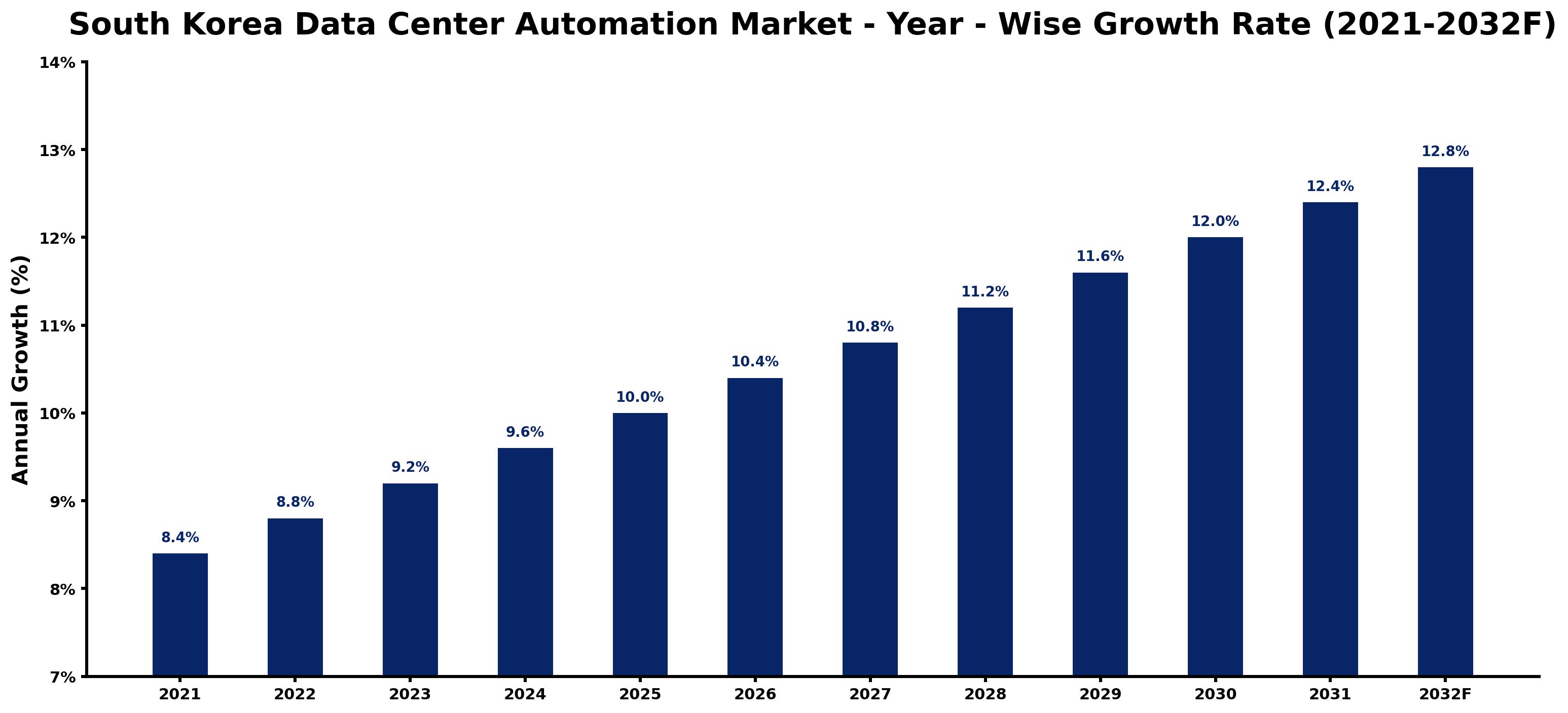
The table below presents the year‑wise growth rates along with the key drivers influencing the market
| Year | Growth Rate | Major Drivers |
| 2021 | 8.4% | Increased demand for cloud services among Korean startups. |
| 2022 | 8.8% | Government's Green New Deal promoting smart data centers. |
| 2023 | 9.2% | Rise in AI adoption driving automation in data centers. |
| 2024 | 9.6% | New data privacy regulations boosting security automation requirements. |
| 2025 | 10.0% | Growing investment in 5G infrastructure enhanced data processing needs. |
| 2026 | 10.4% | Diverse industries transitioning to digital infrastructure solutions. |
| 2027 | 10.8% | Emergence of IoT applications increasing data traffic volumes. |
| 2028 | 11.2% | Government initiatives promoting energy-efficient data center operations. |
| 2029 | 11.6% | Collaboration with tech giants enhancing automation technology offerings. |
| 2030 | 12.0% | Strong focus on sustainability in corporate tech strategies. |
| 2031 | 12.4% | Rising cyber threats necessitating advanced data center security. |
| 2032 | 12.8% | Growing research initiatives on data center efficiency improvements. |
Note: Market size estimations and growth projections presented in this report are based on 6Wresearch's proprietary forecasting methodology, utilizing the latest available industry data, government publications, and primary research inputs.
South Korea Data Center Automation Market Key Takeaways
Below are some of the specific key takeaways from the market, including:
- The market is heavily influenced by the growing demand for operational efficiency and reduced management overhead.
- AI technologies are becoming central to the automation solutions being adopted by data centers.
- Integration challenges with legacy systems remain a significant hurdle for many organizations.
- Collaboration between automation solution providers and enterprise IT teams is essential for successful implementation.
- Government initiatives are increasingly focusing on standards and certifications for automation tools.
Evaluation of Restraints in South Korea Data Center Automation Market
Despite the promising growth trajectory, the South Korea Data Center Automation Market faces several constraints that can impede progress. One major barrier is the integration of legacy systems with modern automation tools. Organizations are often burdened with outdated infrastructure that complicates the deployment of new technologies. Additionally, the orchestration of heterogeneous IT environments presents a complex challenge, as many firms struggle to unify diverse systems under a single automation framework. Finally, there is a notable skills gap in IT automation and DevOps practices, which limits the ability of organizations to fully embrace automation solutions.
South Korea Data Center Automation Market Trends
Current trends in the South Korea Data Center Automation Market point towards an increased reliance on AI-driven automation tools. Companies are leveraging machine learning algorithms to enhance their operational workflows and predictive maintenance capabilities. The integration of DevOps practices within automation frameworks is also gaining traction, allowing for faster deployment cycles and improved collaboration between development and operations teams. on top of that, the shift towards hyperconverged infrastructure is enabling organizations to achieve greater scalability and flexibility in their data center operations.
South Korea Data Center Automation Market Opportunities
Investment opportunities abound within the South Korea Data Center Automation Market, particularly as organizations look to modernize their IT infrastructure. Companies that offer innovative AI-driven automation solutions stand to gain significantly. Additionally, firms that focus on developing tools that facilitate the integration of legacy systems with new automation technologies will be well-positioned to capture market share. The rising trend of cloud-native deployments also presents a chance for service providers to align their offerings with the growing demand for Infrastructure as Code (IaC) solutions.
Government Initiatives in the South Korea Data Center Automation Market
Government policies in South Korea are playing a crucial role in shaping the Data Center Automation Market. There is a clear focus on enhancing operational efficiency and establishing standards for automation technologies. These regulations not only promote the adoption of innovative solutions but also ensure that businesses comply with best practices in IT service management. The government's commitment to improving the reliability of data center operations is evident through its various initiatives aimed at fostering automation across sectors.
- A regulatory framework introduced in 2025 mandating standards for automation system integration.
- A national initiative launched in early 2025 to optimize workflow processes in data centers.
- Ongoing efforts to enhance data center reliability through incentives for deploying automated processes.
- Planned public-private partnerships expected to focus on expanding IT infrastructure capabilities by 2027.
Future Insights of the South Korea Data Center Automation Market
Looking ahead to 2026-2032, the South Korea Data Center Automation Market is expected to continue its growth trajectory as businesses increasingly prioritize efficiency and agility. The adoption of AI and machine learning will likely accelerate, driving innovations in automation solutions. As organizations expand their cloud capabilities, the demand for integrated automation tools that can manage hybrid and multi-cloud environments will rise. This trend will necessitate ongoing collaboration between technology providers and enterprises to adapt to the evolving needs of the market.
South Korea Data Center Automation Market Latest Developments
Recent months have seen notable activity in the South Korea Data Center Automation Market, characterized by advancements in automation technologies and strategic partnerships. Companies are increasingly focusing on enhancing their service offerings to meet the growing demand for streamlined IT operations.
- A leading technology vendor launched a new AI-based automation tool aimed at improving data center efficiency, with rollout completed in early 2025.
- Several organizations have initiated pilot programs to integrate hyperconverged infrastructure into their existing data centers, currently underway as of mid-2025.
- In late 2025, a regional operator announced plans to expand its automation services, targeting small and medium-sized enterprises.
- A collaboration between major cloud service providers was initiated in early 2025 to develop shared automation standards for data centers.
South Korea Data Center Automation Market - Key Attractiveness of the Report
- 10 Years of Market Numbers
- Historical Data Starting from 2022 to 2025
- Base Year: 2025
- Forecast Data until 2032
- Key Performance Indicators Impacting the Market
- Major Upcoming Developments and Projects
Key Highlights of the Report:
- South Korea Data Center Automation Market Outlook
- Market Size of South Korea Data Center Automation Market, 2025
- Forecast of South Korea Data Center Automation Market, 2032
- Historical Data and Forecast of South Korea Data Center Automation Revenues & Volume for the Period 2022-2032F
- South Korea Data Center Automation Market Trend Evolution
- South Korea Data Center Automation Market Drivers and Challenges
- South Korea Data Center Automation Price Trends
- South Korea Data Center Automation Porter's Five Forces
- South Korea Data Center Automation Industry Life Cycle
- Historical Data and Forecast of South Korea Data Center Automation Market Revenues & Volume By Solution for the Period 2022-2032F
- Historical Data and Forecast of South Korea Data Center Automation Market Revenues & Volume By Network automation for the Period 2022-2032F
- Historical Data and Forecast of South Korea Data Center Automation Market Revenues & Volume By Server automation for the Period 2022-2032F
- Historical Data and Forecast of South Korea Data Center Automation Market Revenues & Volume By Storage automation for the Period 2022-2032F
- Historical Data and Forecast of South Korea Data Center Automation Market Revenues & Volume By Services for the Period 2022-2032F
- Historical Data and Forecast of South Korea Data Center Automation Market Revenues & Volume By Consulting service for the Period 2022-2032F
- Historical Data and Forecast of South Korea Data Center Automation Market Revenues & Volume By Installation and support services for the Period 2022-2032F
- Historical Data and Forecast of South Korea Data Center Automation Market Revenues & Volume By Support Services for the Period 2022-2032F
- Historical Data and Forecast of South Korea Data Center Automation Market Revenues & Volume By End-User for the Period 2022-2032F
- Historical Data and Forecast of South Korea Data Center Automation Market Revenues & Volume By Enterprises for the Period 2022-2032F
- Historical Data and Forecast of South Korea Data Center Automation Market Revenues & Volume By Cloud service providers for the Period 2022-2032F
- Historical Data and Forecast of South Korea Data Center Automation Market Revenues & Volume By Colocation service providers for the Period 2022-2032F
- Historical Data and Forecast of South Korea Data Center Automation Market Revenues & Volume By Vertical for the Period 2022-2032F
- Historical Data and Forecast of South Korea Data Center Automation Market Revenues & Volume By Telecom and Information Technology (IT) for the Period 2022-2032F
- Historical Data and Forecast of South Korea Data Center Automation Market Revenues & Volume By Banking, Financial Services and Insurance (BFSI) for the Period 2022-2032F
- Historical Data and Forecast of South Korea Data Center Automation Market Revenues & Volume By Media and Entertainment for the Period 2022-2032F
- Historical Data and Forecast of South Korea Data Center Automation Market Revenues & Volume By Public Sector for the Period 2022-2032F
- Historical Data and Forecast of South Korea Data Center Automation Market Revenues & Volume By Healthcare for the Period 2022-2032F
- Historical Data and Forecast of South Korea Data Center Automation Market Revenues & Volume By Manufacturing for the Period 2022-2032F
- Historical Data and Forecast of South Korea Data Center Automation Market Revenues & Volume By Retail for the Period 2022-2032F
- Historical Data and Forecast of South Korea Data Center Automation Market Revenues & Volume By Other vertical for the Period 2022-2032F
- South Korea Data Center Automation Import Export Trade Statistics
- Market Opportunity Assessment By Solution
- Market Opportunity Assessment By Services
- Market Opportunity Assessment By End-User
- Market Opportunity Assessment By Vertical
- South Korea Data Center Automation Top Companies Market Share
- South Korea Data Center Automation Competitive Benchmarking By Technical and Operational Parameters
- South Korea Data Center Automation Company Profiles
- South Korea Data Center Automation Key Strategic Recommendations






































