South Korea Data Center Networking Market Size & Growth Rate (2026-2032)
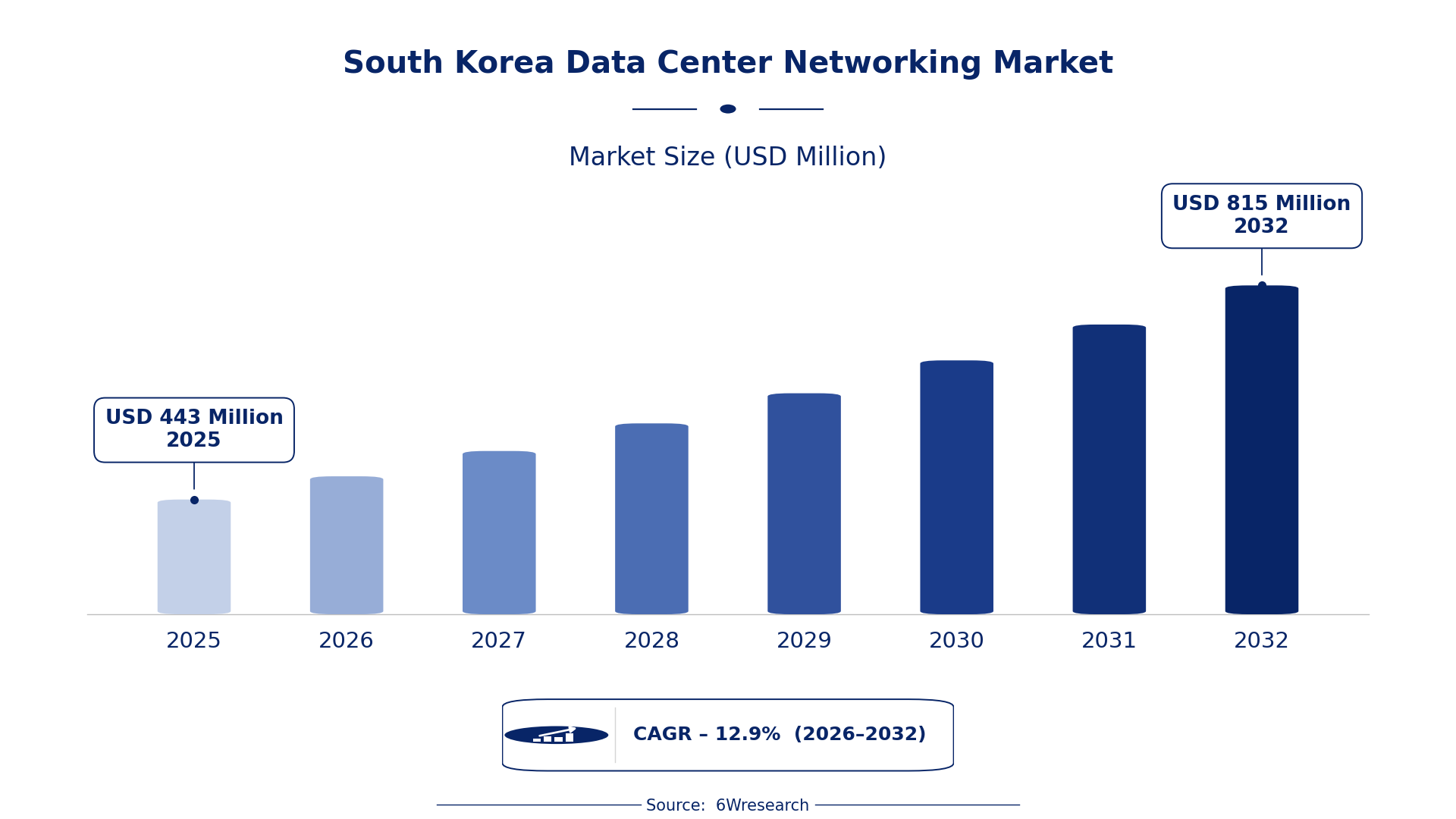
The South Korea Data Center Networking Market was estimated at USD 443 Million in 2025 and is projected to reach USD 815 Million by 2032, growing at a CAGR of 12.9% from 2026 to 2032.
South Korea Data Center Networking Market Synopsis
As enterprises in South Korea increasingly shift to cloud-based services, the demand for high-performance data center networking solutions has surged. The integration of Ethernet fabrics and software-defined networking (SDN) technologies is critical for businesses aiming to enhance operational efficiency and manage growing data volumes.
With the rapid expansion of digital services, there is a pressing need for scalable networking infrastructures that can accommodate increased traffic while minimizing latency. This is driving innovation and competitive strategies among networking vendors, who are focusing on interoperability and enhanced performance to meet the evolving needs of their clients.
South Korea Data Center Networking Market Year-wise Growth Rate and Key Drivers
This graph illustrates the annual growth rates of the South Korea Data Center Networking Market from 2021 to 2032, highlighting a steady upward trajectory and projected expansion over the forecast period.
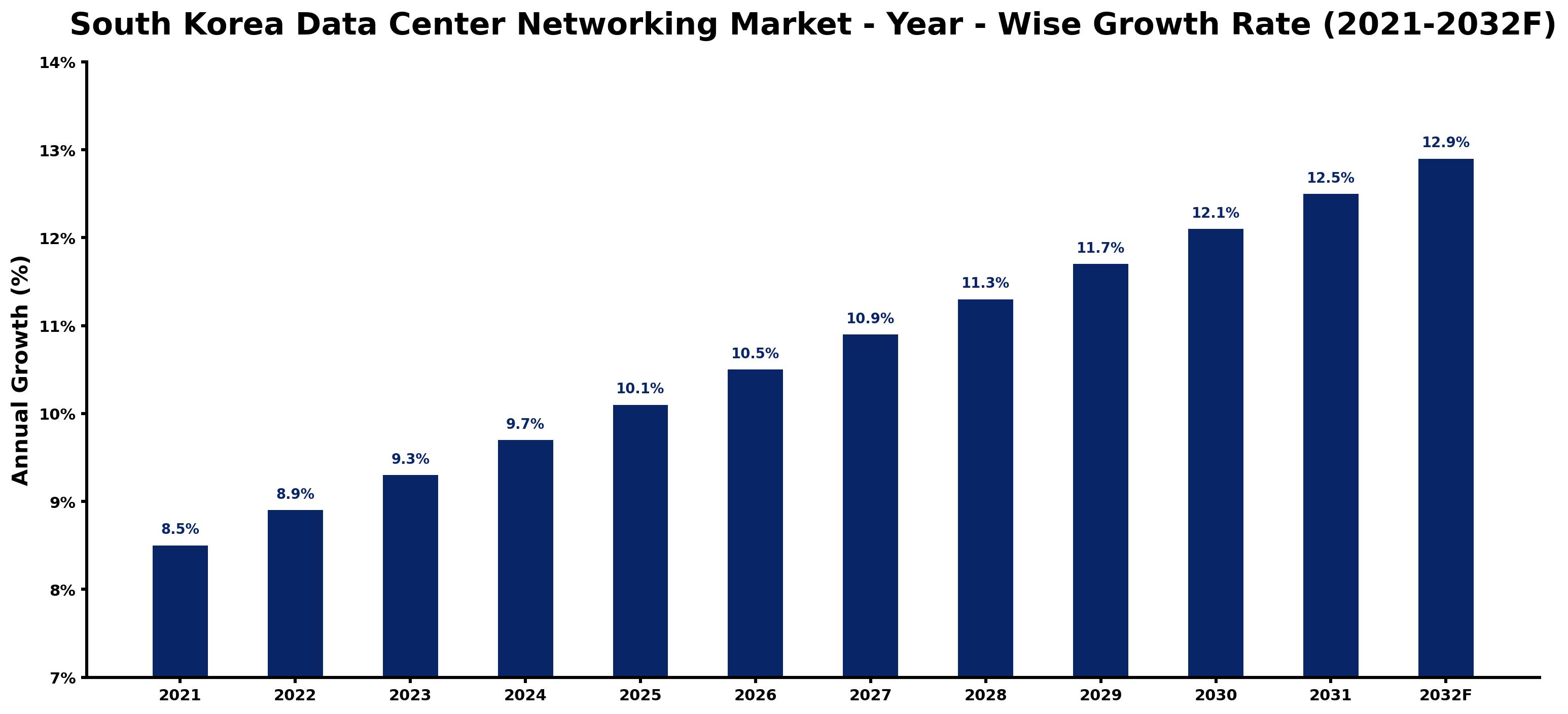
The table below presents the year‑wise growth rates along with the key drivers influencing the market
| Year | Growth Rate | Major Drivers |
| 2021 | 8.5% | Increased 5G rollouts enhancing network performance capabilities. |
| 2022 | 8.9% | Government plans to boost digital infrastructure funding. |
| 2023 | 9.3% | Surge in remote work boosting data center workloads. |
| 2024 | 9.7% | Emerging tech startups driving demand for scalable solutions. |
| 2025 | 10.1% | Local policies promoting smart factory automation integration. |
| 2026 | 10.5% | Strong investments in data privacy compliance regulations. |
| 2027 | 10.9% | Cultural growth in gaming driving server demand. |
| 2028 | 11.3% | Rise of hybrid work models increasing connectivity needs. |
| 2029 | 11.7% | Local fintech innovations requiring enhanced networking solutions. |
| 2030 | 12.1% | Focus on smart city projects fueling data connectivity. |
| 2031 | 12.5% | Growing adoption of IoT devices demanding data processing. |
| 2032 | 12.9% | Increased cybersecurity threats necessitating robust network upgrades. |
Note: Market size estimations and growth projections presented in this report are based on 6Wresearch's proprietary forecasting methodology, utilizing the latest available industry data, government publications, and primary research inputs.
South Korea Data Center Networking Market Key Takeaways
Below are some of the specific key takeaways from the market, including:
- The market is experiencing a significant shift towards SDN and network virtualization technologies.
- Growing cloud adoption among enterprises is a primary driver of demand for advanced networking solutions.
- Challenges such as network scalability and latency management remain prominent in high-traffic environments.
- Collaboration with telecom operators is essential for vendors to enhance service delivery and user experience.
- Government initiatives are increasingly focusing on improving network infrastructure and regulatory standards.
Evaluation of Restraints in South Korea Data Center Networking Market
Despite the positive growth trajectory, several restraints hinder the progress of the South Korea Data Center Networking Market. The primary challenge lies in achieving scalability to meet the dynamic demands of cloud services. Additionally, managing latency and packet loss in environments with heavy traffic is a significant concern. Networking vendors must also address interoperability issues to ensure that different technologies can work cohesively across various data center infrastructures. These challenges necessitate continuous innovation in SDN solutions and active partnerships with telecom providers to create agile networking architectures that optimize performance.
South Korea Data Center Networking Market Trends
Several trends are shaping the South Korea Data Center Networking Market. The move towards automation and orchestration in networking solutions is gaining traction as businesses seek to improve efficiency and reduce operational costs. Additionally, the rise of edge computing and 5G technology is influencing networking strategies, prompting organizations to rethink their infrastructure to support real-time data processing. The focus on sustainability is also driving innovations aimed at reducing energy consumption and enhancing overall environmental impact.
South Korea Data Center Networking Market Opportunities
Investment opportunities within the South Korea Data Center Networking Market are abundant. As enterprises continue to digitize operations, there is a strong demand for solutions that can facilitate seamless connectivity and data management. Vendors can capitalize on this trend by developing more efficient networking technologies that align with the growing cloud landscape. on top of that, partnering with cloud service providers to offer integrated solutions presents a lucrative avenue for growth. The shift towards hybrid cloud environments also opens doors for innovative service offerings that enhance flexibility and scalability.
Government Initiatives in the South Korea Data Center Networking Market
Government policy in South Korea is increasingly focused on enhancing network performance and establishing standards for data center infrastructures. These policies are pivotal in shaping the market, as they provide a framework for technological advancements and regulatory compliance. The government's emphasis on high-speed networking technologies and efficient data transmission is vital for fostering a competitive environment in the data center networking sector.
- A regulatory framework introduced in 2025 mandates interoperability standards for networking equipment, promoting a more cohesive infrastructure.
- A national digital infrastructure upgrade program is currently underway, aimed at improving network performance across various sectors.
- Recently launched initiatives focus on enhancing data transmission efficiency through the deployment of next-gen networking technologies.
- A planned public-private initiative seeks to expand access to telecom infrastructure by 2028, facilitating better connectivity for businesses.
Future Insights of the South Korea Data Center Networking Market
Looking ahead to 2026-2032, the South Korea Data Center Networking Market is expected to evolve significantly. The continued emphasis on digital transformation across industries will likely drive demand for advanced networking solutions. As cloud services become more prevalent, organizations will prioritize investments in scalable and resilient networking architectures. The integration of artificial intelligence and machine learning into networking solutions is also anticipated to enhance operational efficiencies and user experience. Consequently, vendors that can innovate and adapt to these changes will be well-positioned for success.
South Korea Data Center Networking Market Latest Developments
Over the past 12-14 months, the South Korea Data Center Networking Market has witnessed a flurry of activity as companies strive to enhance their networking capabilities. The push for digitalization has prompted many organizations to explore new technologies that can support their evolving data needs. As a result, networking vendors are increasingly launching solutions that cater to these demands, paving the way for a competitive environment.
- A major technology vendor announced an expansion of its SDN product line in early 2025, aimed at enhancing network agility for enterprise clients.
- An initiative that began in mid-2025 focuses on the deployment of 5G-enabled networking solutions to bolster connectivity in urban areas.
- Currently ongoing partnerships between telecom operators and data center providers are enhancing service offerings and improving user experiences.
- A rollout of next-generation Ethernet fabrics is planned for late 2026, designed to optimize data throughput and reduce latency.
South Korea Data Center Networking Market - Key Attractiveness of the Report
- 10 Years of Market Numbers
- Historical Data Starting from 2022 to 2025
- Base Year: 2025
- Forecast Data until 2032
- Key Performance Indicators Impacting the Market
- Major Upcoming Developments and Projects
Key Highlights of the Report:
- South Korea Data Center Networking Market Outlook
- Market Size of South Korea Data Center Networking Market, 2025
- Forecast of South Korea Data Center Networking Market, 2032
- Historical Data and Forecast of South Korea Data Center Networking Revenues & Volume for the Period 2022-2032F
- South Korea Data Center Networking Market Trend Evolution
- South Korea Data Center Networking Market Drivers and Challenges
- South Korea Data Center Networking Price Trends
- South Korea Data Center Networking Porter's Five Forces
- South Korea Data Center Networking Industry Life Cycle
- Historical Data and Forecast of South Korea Data Center Networking Market Revenues & Volume By Component for the Period 2022-2032F
- Historical Data and Forecast of South Korea Data Center Networking Market Revenues & Volume By Solution for the Period 2022-2032F
- Historical Data and Forecast of South Korea Data Center Networking Market Revenues & Volume By Services for the Period 2022-2032F
- Historical Data and Forecast of South Korea Data Center Networking Market Revenues & Volume By End User for the Period 2022-2032F
- Historical Data and Forecast of South Korea Data Center Networking Market Revenues & Volume By IT and telecom for the Period 2022-2032F
- Historical Data and Forecast of South Korea Data Center Networking Market Revenues & Volume By Retail for the Period 2022-2032F
- Historical Data and Forecast of South Korea Data Center Networking Market Revenues & Volume By BFSI for the Period 2022-2032F
- Historical Data and Forecast of South Korea Data Center Networking Market Revenues & Volume By Public sector and utilities for the Period 2022-2032F
- Historical Data and Forecast of South Korea Data Center Networking Market Revenues & Volume By Energy for the Period 2022-2032F
- Historical Data and Forecast of South Korea Data Center Networking Market Revenues & Volume By Manufacturing for the Period 2022-2032F
- Historical Data and Forecast of South Korea Data Center Networking Market Revenues & Volume By Healthcare for the Period 2022-2032F
- Historical Data and Forecast of South Korea Data Center Networking Market Revenues & Volume By Others for the Period 2022-2032F
- South Korea Data Center Networking Import Export Trade Statistics
- Market Opportunity Assessment By Component
- Market Opportunity Assessment By End User
- South Korea Data Center Networking Top Companies Market Share
- South Korea Data Center Networking Competitive Benchmarking By Technical and Operational Parameters
- South Korea Data Center Networking Company Profiles
- South Korea Data Center Networking Key Strategic Recommendations






































