South Korea Data Classification Market Size & Growth Rate (2026-2032)
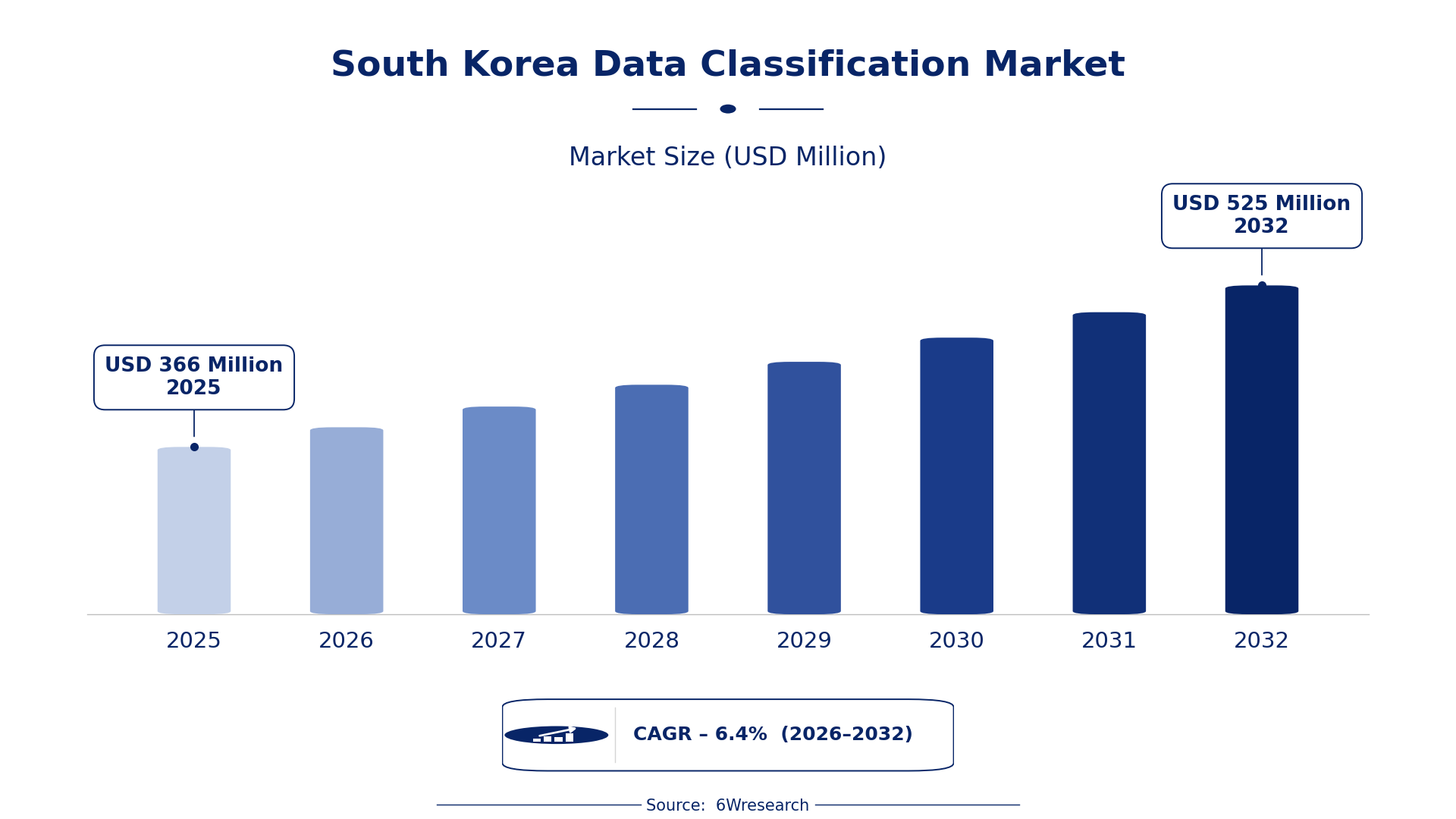
The South Korea Data Classification Market was estimated at USD 366 Million in 2025 and is projected to reach USD 525 Million by 2032, growing at a CAGR of 6.4% from 2026 to 2032.
South Korea Data Classification Market Synopsis
As organizations in South Korea increasingly recognize the importance of data governance, the demand for effective data classification solutions is surging. Enterprises are adopting these tools to manage sensitive information and comply with strict regulatory requirements, ensuring both data protection and integrity.
Automated tagging and metadata management are becoming essential components of data classification strategies. Companies are leveraging advanced technologies to enhance data visibility, streamline operations, and improve their overall data management frameworks, driving growth in this market.
South Korea Data Classification Market Year-wise Growth Rate and Key Drivers
This graph illustrates the annual growth rates of the South Korea Data Classification Market from 2021 to 2032, highlighting a steady upward trajectory and projected expansion over the forecast period.
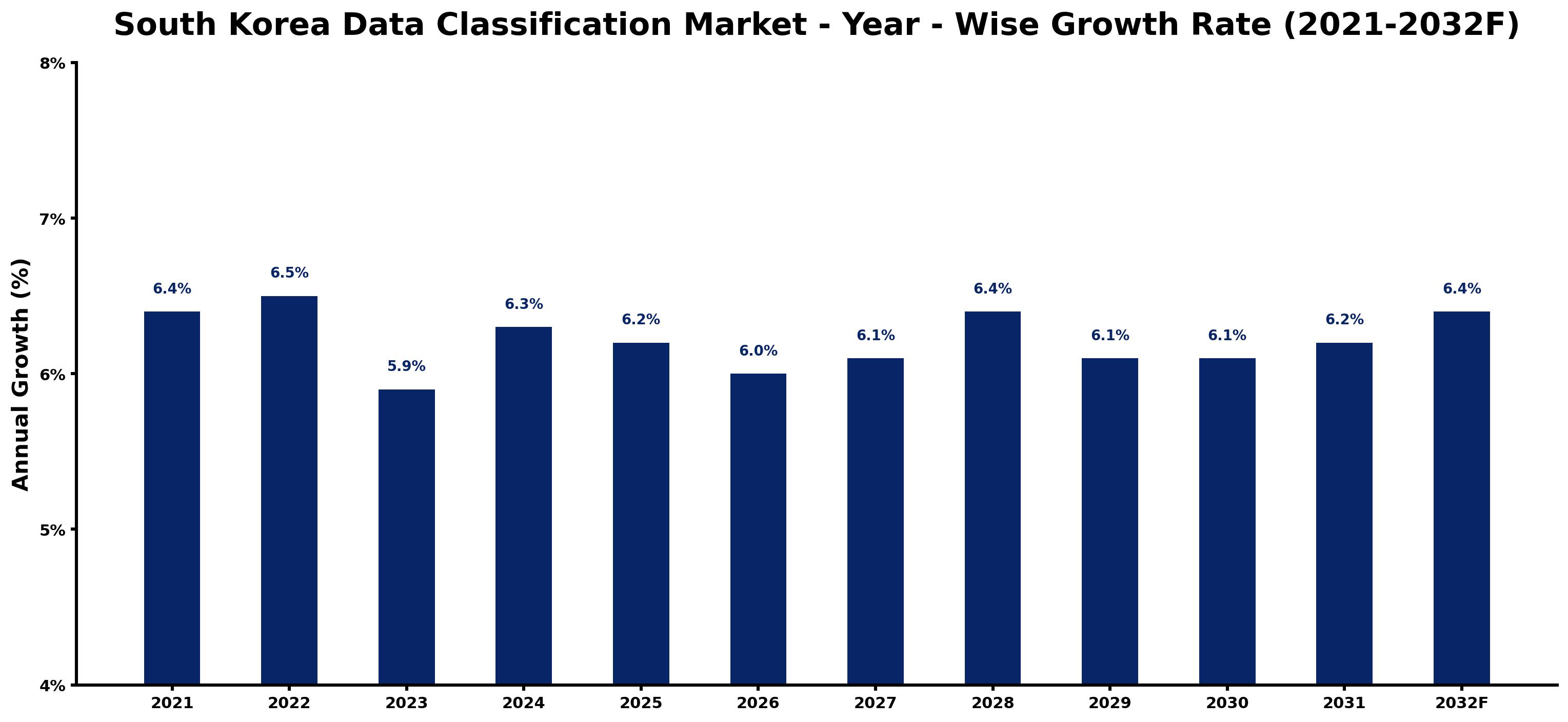
The table below presents the year‑wise growth rates along with the key drivers influencing the market
| Year | Growth Rate | Major Drivers |
| 2021 | 6.4% | Implementation of the Personal Information Protection Act. |
| 2022 | 6.5% | Rise in cybersecurity threats pushing compliance for companies. |
| 2023 | 5.9% | Government investment in smart city data management projects. |
| 2024 | 6.3% | Increased demand for data privacy solutions in enterprises. |
| 2025 | 6.2% | Growth in e-commerce requiring stricter data handling practices. |
| 2026 | 6.0% | Launch of public initiatives fostering digital information governance. |
| 2027 | 6.1% | Emergence of AI-driven data analytics tools for businesses. |
| 2028 | 6.4% | Enhanced regulatory scrutiny on personal data usage compliance. |
| 2029 | 6.1% | Corporate governance reforms demanding higher data classification standards. |
| 2030 | 6.1% | Integration of machine learning improving data processing efficiency. |
| 2031 | 6.2% | Expanding cloud services boosting data classification adoption. |
| 2032 | 6.4% | Strengthening international data transfer regulations impacting companies. |
Note: Market size estimations and growth projections presented in this report are based on 6Wresearch's proprietary forecasting methodology, utilizing the latest available industry data, government publications, and primary research inputs.
South Korea Data Classification Market Key Takeaways
Below are some of the specific key takeaways from the market, including:
- The rising focus on regulatory compliance is fueling the adoption of data classification solutions across various sectors.
- Technological advancements are leading to improved automated tagging and metadata management capabilities.
- Organizations face challenges in ensuring classification consistency across diverse data sources.
- AI-driven algorithms are being developed to enhance the efficiency of data classification processes.
- Collaboration between classification solution providers and data governance teams is critical for effective implementation.
Evaluation of Restraints in South Korea Data Classification Market
The South Korea Data Classification Market faces notable challenges that hinder its potential. One key limitation is the difficulty in automating metadata tagging for sensitive data discovery, which remains a complex task due to varied data formats and sources. Additionally, organizations struggle with ensuring classification consistency, often leading to data silos and compliance risks. The integration of classification tools with existing data loss prevention solutions further complicates the landscape, necessitating innovative approaches from solution providers.
South Korea Data Classification Market Trends
A significant trend in the South Korea Data Classification Market is the increasing incorporation of artificial intelligence into classification tools. These AI-driven solutions are enhancing accuracy and efficiency in identifying sensitive data across vast datasets. on top of that, there is a growing emphasis on aligning data classification strategies with comprehensive data governance frameworks, enabling organizations to mitigate risks while improving data management practices.
Another emerging trend is the push for stronger integration of data classification with cybersecurity initiatives. As cyber threats escalate, businesses recognize that effective data classification is integral to safeguarding sensitive information and ensuring regulatory compliance.
South Korea Data Classification Market Opportunities
The South Korea Data Classification Market presents a variety of growth opportunities for solution providers. With increased investment in digital transformation initiatives, companies are eager to enhance their data management capabilities. This creates a ripe environment for innovative classification solutions that address specific regulatory and operational needs.
on top of that, as enterprises expand their cloud services, the demand for cloud-compatible data classification tools is on the rise. This shift offers significant avenues for development and investment, particularly in areas that ensure data protection and compliance in cloud environments.
Government Initiatives in the South Korea Data Classification Market
Government policies in South Korea are shaping the data classification market by emphasizing data privacy and compliance with regulatory frameworks. The increasing focus on information governance and security regulations has led to enhanced scrutiny of data handling practices, encouraging organizations to adopt effective classification methodologies.
- A recent initiative launched in 2023 introduced updated guidelines for data protection, mandating stricter compliance with data classification practices across all sectors.
- Currently, the government is rolling out training programs aimed at enhancing data management skills among public sector employees, focusing on effective data classification techniques.
- A planned regulatory framework expected to be finalized by 2025 will establish standardized classification protocols for sensitive data across various industries.
- Ongoing discussions about a national cybersecurity strategy include provisions for improved data classification as a foundational element of information security.
- Incentives are being developed to encourage small and medium enterprises to invest in data classification tools, enhancing overall compliance and governance efforts.
Future Insights of the South Korea Data Classification Market
Looking ahead to 2026-2032, the South Korea Data Classification Market is expected to experience robust growth driven by technological innovation and regulatory pressures. As organizations continue to prioritize data governance and compliance, the integration of advanced classification tools will be crucial. on top of that, the demand for scalable and adaptable solutions will likely rise as businesses evolve their data management strategies, setting the stage for a dynamic market environment.
South Korea Data Classification Market Latest Developments
In the past year, the South Korea Data Classification Market has witnessed several significant developments, reflecting both challenges and advancements within the sector. Organizations are increasingly investing in new technologies to enhance their data classification capabilities, aligning with evolving regulatory requirements and internal governance standards.
- A leading technology vendor initiated a comprehensive upgrade of its data classification platform in early 2023, adding AI-enhanced features for automated tagging and sensitive data discovery.
- A partnership announced in mid-2023 between a major data governance firm and a cybersecurity provider focuses on integrating data classification tools with existing security measures to boost compliance.
- A new training program aimed at IT professionals started in Q1 2023, offering insights into best practices in data classification and governance.
- Ongoing R&D efforts by various firms are centered on creating innovative solutions to tackle the complexities of integrating classification tools with data loss prevention systems.
- A rollout expected to begin in late 2024 will introduce a national certification program for data classification professionals, aiming to standardize expertise in the field.
South Korea Data Classification Market - Key Attractiveness of the Report
- 10 Years of Market Numbers
- Historical Data Starting from 2022 to 2025
- Base Year: 2025
- Forecast Data until 2032
- Key Performance Indicators Impacting the Market
- Major Upcoming Developments and Projects
Key Highlights of the Report:
- South Korea Data Classification Market Outlook
- Market Size of South Korea Data Classification Market, 2025
- Forecast of South Korea Data Classification Market, 2032
- Historical Data and Forecast of South Korea Data Classification Revenues & Volume for the Period 2022-2032F
- South Korea Data Classification Market Trend Evolution
- South Korea Data Classification Market Drivers and Challenges
- South Korea Data Classification Price Trends
- South Korea Data Classification Porter's Five Forces
- South Korea Data Classification Industry Life Cycle
- Historical Data and Forecast of South Korea Data Classification Market Revenues & Volume By Component for the Period 2022-2032F
- Historical Data and Forecast of South Korea Data Classification Market Revenues & Volume By Solutions (Standalone and Integrated) for the Period 2022-2032F
- Historical Data and Forecast of South Korea Data Classification Market Revenues & Volume By Services for the Period 2022-2032F
- Historical Data and Forecast of South Korea Data Classification Market Revenues & Volume By Application for the Period 2022-2032F
- Historical Data and Forecast of South Korea Data Classification Market Revenues & Volume By Access Control for the Period 2022-2032F
- Historical Data and Forecast of South Korea Data Classification Market Revenues & Volume By GRC for the Period 2022-2032F
- Historical Data and Forecast of South Korea Data Classification Market Revenues & Volume By Web for the Period 2022-2032F
- Historical Data and Forecast of South Korea Data Classification Market Revenues & Volume By Mobile & Email Protection for the Period 2022-2032F
- Historical Data and Forecast of South Korea Data Classification Market Revenues & Volume By Centralized Management for the Period 2022-2032F
- Historical Data and Forecast of South Korea Data Classification Market Revenues & Volume By Methodology for the Period 2022-2032F
- Historical Data and Forecast of South Korea Data Classification Market Revenues & Volume By Content-based Classification for the Period 2022-2032F
- Historical Data and Forecast of South Korea Data Classification Market Revenues & Volume By Context-based Classification for the Period 2022-2032F
- Historical Data and Forecast of South Korea Data Classification Market Revenues & Volume By User-based Classification for the Period 2022-2032F
- Historical Data and Forecast of South Korea Data Classification Market Revenues & Volume By Vertical for the Period 2022-2032F
- Historical Data and Forecast of South Korea Data Classification Market Revenues & Volume By BFSI for the Period 2022-2032F
- Historical Data and Forecast of South Korea Data Classification Market Revenues & Volume By Healthcare and Lifesciences for the Period 2022-2032F
- Historical Data and Forecast of South Korea Data Classification Market Revenues & Volume By Government and Defense for the Period 2022-2032F
- Historical Data and Forecast of South Korea Data Classification Market Revenues & Volume By Education for the Period 2022-2032F
- Historical Data and Forecast of South Korea Data Classification Market Revenues & Volume By Telecom for the Period 2022-2032F
- Historical Data and Forecast of South Korea Data Classification Market Revenues & Volume By Media and Entertainment for the Period 2022-2032F
- Historical Data and Forecast of South Korea Data Classification Market Revenues & Volume By Others (Retail and Ecommerce, Manufacturing, and Energy and Utilities) for the Period 2022-2032F
- South Korea Data Classification Import Export Trade Statistics
- Market Opportunity Assessment By Component
- Market Opportunity Assessment By Application
- Market Opportunity Assessment By Methodology
- Market Opportunity Assessment By Vertical
- South Korea Data Classification Top Companies Market Share
- South Korea Data Classification Competitive Benchmarking By Technical and Operational Parameters
- South Korea Data Classification Company Profiles
- South Korea Data Classification Key Strategic Recommendations






































