South Korea Data Masking Market Size & Growth Rate (2026-2032)
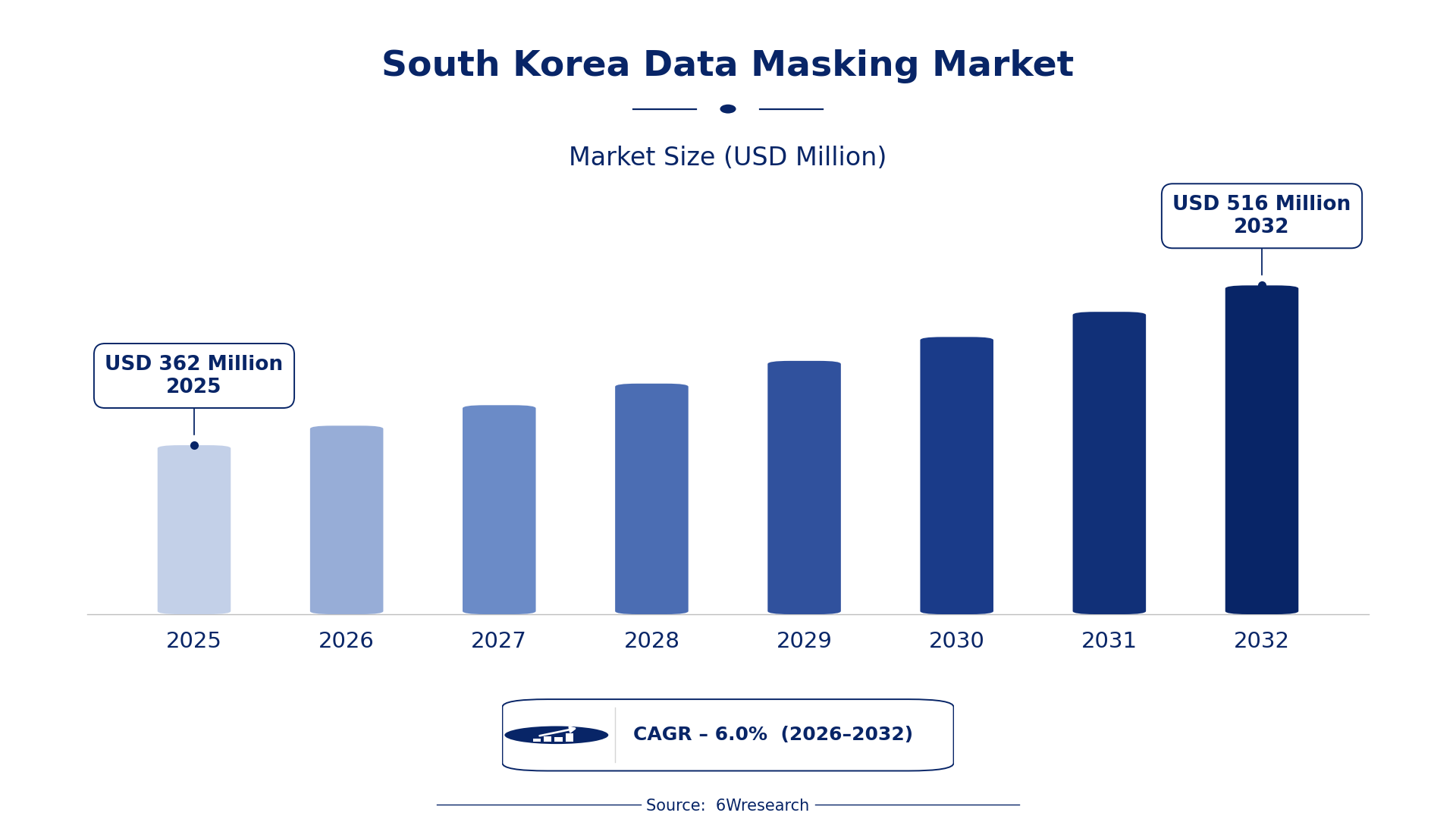
The South Korea Data Masking Market was estimated at USD 362 Million in 2025 and is projected to reach USD 516 Million by 2032, growing at a CAGR of 6.0% from 2026 to 2032.
South Korea Data Masking Market Synopsis
In South Korea, the demand for data masking solutions is increasingly driven by stringent regulations surrounding data privacy. Enterprises recognize the necessity of safeguarding sensitive information, particularly during testing and development phases, where real data can expose vulnerabilities. Companies are not just adopting these solutions for compliance; they are embedding them into their operational frameworks to foster innovation without compromising security.
The growth trajectory of the South Korea Data Masking Market reflects a broader trend towards data-centric strategies. Organizations are now seeking advanced masking techniques like tokenization and dynamic masking, aimed at mitigating the risks associated with data breaches. This strategic alignment between business objectives and regulatory requirements is pivotal for enterprises looking to harness their data responsibly.
South Korea Data Masking Market Year-wise Growth Rate and Key Drivers
This graph illustrates the annual growth rates of the South Korea Data Masking Market from 2021 to 2032, highlighting a steady upward trajectory and projected expansion over the forecast period.
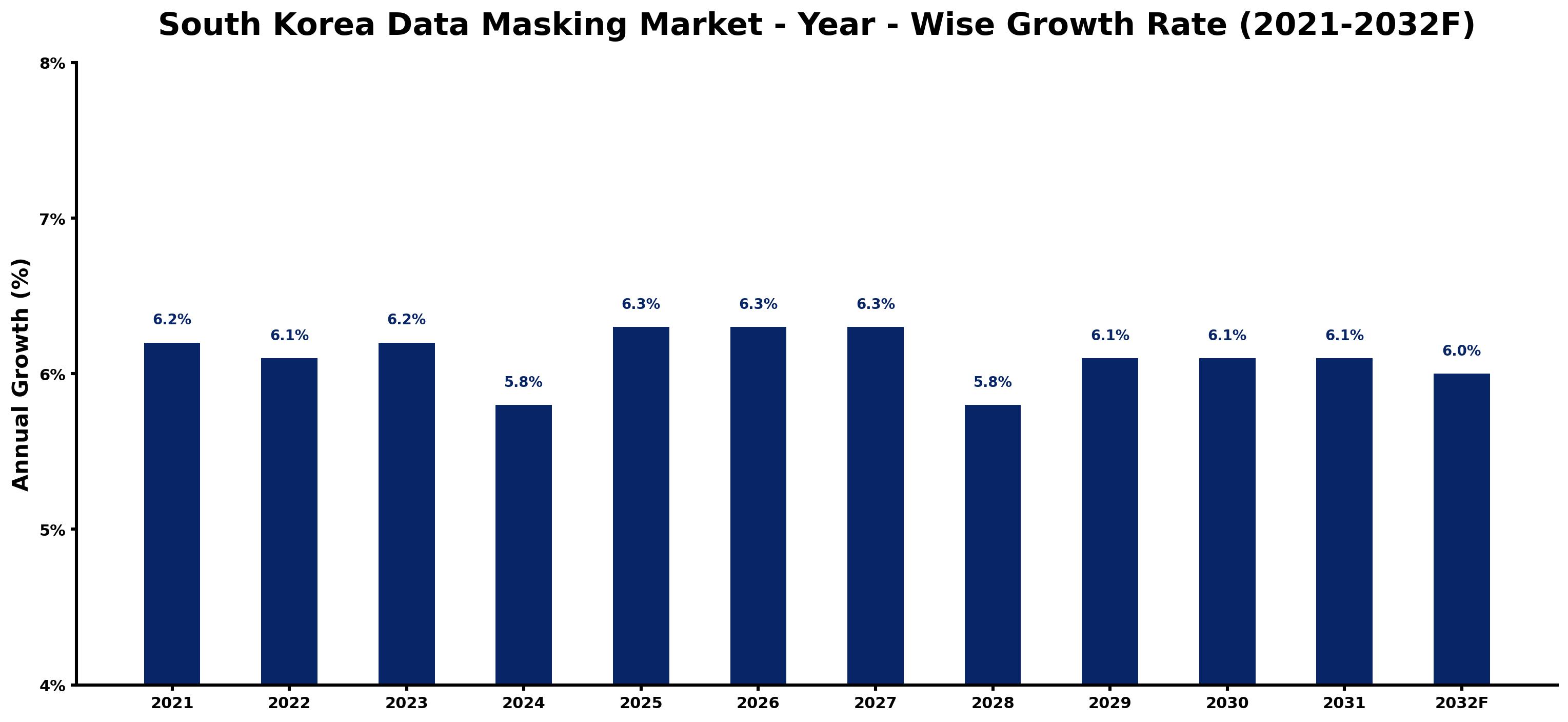
The table below presents the year‑wise growth rates along with the key drivers influencing the market
| Year | Growth Rate | Major Drivers |
| 2021 | 6.2% | KISA promotes data privacy initiatives for businesses. |
| 2022 | 6.1% | Government incentives boost investment in cybersecurity solutions. |
| 2023 | 6.2% | Growing adoption of digital health solutions requires data protection. |
| 2024 | 5.8% | Increased remote work drives need for secure data masking. |
| 2025 | 6.3% | Rise of AI technologies intensifies focus on data security. |
| 2026 | 6.3% | Local compliance mandates push firms towards data masking tools. |
| 2027 | 6.3% | Surge in data breaches heightens demand for masking technologies. |
| 2028 | 5.8% | Tech startups prioritize user data confidentiality strategies. |
| 2029 | 6.1% | Smart city projects necessitate robust data privacy measures. |
| 2030 | 6.1% | Increased public awareness amplifies demand for data privacy solutions. |
| 2031 | 6.1% | Digital transformation initiatives fuel need for data protection. |
| 2032 | 6.0% | Emergence of blockchain technology requires enhanced data masking. |
Note: Market size estimations and growth projections presented in this report are based on 6Wresearch's proprietary forecasting methodology, utilizing the latest available industry data, government publications, and primary research inputs.
South Korea Data Masking Market Key Takeaways
Below are some of the specific key takeaways from the market, including:
- The market is expected to grow significantly as regulatory scrutiny intensifies.
- Advanced masking techniques are gaining traction among organizations for protecting data integrity.
- Businesses are prioritizing compliance with GDPR and local data protection laws.
- Integration of data masking solutions into everyday operations enhances security without hindering productivity.
- Investment in innovative masking solutions is crucial for businesses to mitigate data privacy risks.
Evaluation of Restraints in South Korea Data Masking Market
The South Korea Data Masking Market faces distinct challenges, particularly in balancing data privacy with the demands for analytics and application testing. As companies aim to leverage data-driven insights, they must also ensure that masked datasets retain their fidelity. This tension complicates the implementation of masking solutions, especially given the evolving landscape of data protection regulations, which require continuous adaptation and innovation.
South Korea Data Masking Market Trends
A notable trend within the South Korea Data Masking Market is the shift toward automated and real-time data masking solutions. Organizations are adopting dynamic masking techniques to enable secure access to sensitive data without exposing it in its original form. Additionally, there is a growing emphasis on integration with existing data management frameworks to enhance operational efficiency while maintaining compliance.
South Korea Data Masking Market Opportunities
The landscape offers several growth opportunities, particularly for vendors who can provide innovative solutions tailored to specific industry needs. The health and financial sectors stand out, as these industries are under increasing pressure to ensure data privacy. on top of that, partnerships with regulatory bodies can help standardize best practices, enabling companies to adopt data masking solutions with confidence and clarity.
Government Initiatives in the South Korea Data Masking Market
Government policies significantly shape the South Korea Data Masking Market, reflecting a commitment to data protection and privacy. The regulatory landscape emphasizes compliance with data anonymization standards, influencing how organizations implement data masking solutions. Strong public-sector priorities surrounding data security are critical, particularly as businesses navigate complex regulatory environments.
- A regulatory framework introduced in 2025 mandated enhanced data masking techniques to bolster data privacy in sensitive sectors.
- An ongoing initiative supports the certification of data masking tools, ensuring compliance with national data protection standards.
- The government is currently developing a national strategy for data privacy that includes incentives for businesses adopting advanced data masking technologies.
- A planned public-private partnership aims to enhance collaboration on data protection measures expected to launch in 2027.
Future Insights of the South Korea Data Masking Market
From 2026 to 2032, the South Korea Data Masking Market is set to experience a transformation driven by technological advancements and regulatory changes. Companies will increasingly invest in adaptive masking solutions that can seamlessly integrate with their existing IT infrastructure. As data privacy concerns continue to mount, the emphasis on sophisticated masking techniques will grow, providing a fertile ground for innovation and competitive advantage.
South Korea Data Masking Market Latest Developments
Over the past 12 months, the South Korea Data Masking Market has seen notable advancements, particularly in the development of more efficient masking technologies. Organizations are actively exploring partnerships to enhance their data protection strategies, responding to the increasing demand for compliance and security. This trend indicates a proactive approach to data management, highlighting the sector's responsiveness to evolving challenges.
- A new dynamic data masking solution was launched in Q2 2025, enhancing real-time data access while maintaining privacy.
- In early 2025, a major technology vendor announced an upgrade to its masking tools, focusing on better integration with cloud platforms.
- Currently underway is an initiative to implement a nationwide data privacy awareness program targeting businesses across multiple sectors.
- A rollout of enhanced compliance frameworks is expected to begin in early 2026, focusing on aligning industry standards with governmental policies.
South Korea Data Masking Market - Key Attractiveness of the Report
- 10 Years of Market Numbers
- Historical Data Starting from 2022 to 2025
- Base Year: 2025
- Forecast Data until 2032
- Key Performance Indicators Impacting the Market
- Major Upcoming Developments and Projects
Key Highlights of the Report:
- South Korea Data Masking Market Outlook
- Market Size of South Korea Data Masking Market, 2025
- Forecast of South Korea Data Masking Market, 2032
- Historical Data and Forecast of South Korea Data Masking Revenues & Volume for the Period 2022-2032F
- South Korea Data Masking Market Trend Evolution
- South Korea Data Masking Market Drivers and Challenges
- South Korea Data Masking Price Trends
- South Korea Data Masking Porter's Five Forces
- South Korea Data Masking Industry Life Cycle
- Historical Data and Forecast of South Korea Data Masking Market Revenues & Volume By Data Masking Type for the Period 2022-2032F
- Historical Data and Forecast of South Korea Data Masking Market Revenues & Volume By Static for the Period 2022-2032F
- Historical Data and Forecast of South Korea Data Masking Market Revenues & Volume By Dynamic for the Period 2022-2032F
- Historical Data and Forecast of South Korea Data Masking Market Revenues & Volume By Component for the Period 2022-2032F
- Historical Data and Forecast of South Korea Data Masking Market Revenues & Volume By Software for the Period 2022-2032F
- Historical Data and Forecast of South Korea Data Masking Market Revenues & Volume By Services for the Period 2022-2032F
- Historical Data and Forecast of South Korea Data Masking Market Revenues & Volume By Business Function for the Period 2022-2032F
- Historical Data and Forecast of South Korea Data Masking Market Revenues & Volume By Finance for the Period 2022-2032F
- Historical Data and Forecast of South Korea Data Masking Market Revenues & Volume By Marketing & Sales for the Period 2022-2032F
- Historical Data and Forecast of South Korea Data Masking Market Revenues & Volume By Operations for the Period 2022-2032F
- Historical Data and Forecast of South Korea Data Masking Market Revenues & Volume By Legal for the Period 2022-2032F
- Historical Data and Forecast of South Korea Data Masking Market Revenues & Volume By Organization Size for the Period 2022-2032F
- Historical Data and Forecast of South Korea Data Masking Market Revenues & Volume By Small and Medium-sized Enterprises (SMEs) for the Period 2022-2032F
- Historical Data and Forecast of South Korea Data Masking Market Revenues & Volume By Large enterprises for the Period 2022-2032F
- Historical Data and Forecast of South Korea Data Masking Market Revenues & Volume By Deployment Type for the Period 2022-2032F
- Historical Data and Forecast of South Korea Data Masking Market Revenues & Volume By On-premises for the Period 2022-2032F
- Historical Data and Forecast of South Korea Data Masking Market Revenues & Volume By Cloud for the Period 2022-2032F
- Historical Data and Forecast of South Korea Data Masking Market Revenues & Volume By Vertical for the Period 2022-2032F
- Historical Data and Forecast of South Korea Data Masking Market Revenues & Volume By BFSI for the Period 2022-2032F
- Historical Data and Forecast of South Korea Data Masking Market Revenues & Volume By Healthcare and life sciences for the Period 2022-2032F
- Historical Data and Forecast of South Korea Data Masking Market Revenues & Volume By Retail and eCommerce for the Period 2022-2032F
- Historical Data and Forecast of South Korea Data Masking Market Revenues & Volume By Telecommunications and IT for the Period 2022-2032F
- Historical Data and Forecast of South Korea Data Masking Market Revenues & Volume By Government and defense for the Period 2022-2032F
- Historical Data and Forecast of South Korea Data Masking Market Revenues & Volume By Media and entertainment for the Period 2022-2032F
- Historical Data and Forecast of South Korea Data Masking Market Revenues & Volume By Manufacturing for the Period 2022-2032F
- South Korea Data Masking Import Export Trade Statistics
- Market Opportunity Assessment By Data Masking Type
- Market Opportunity Assessment By Component
- Market Opportunity Assessment By Business Function
- Market Opportunity Assessment By Organization Size
- Market Opportunity Assessment By Deployment Type
- Market Opportunity Assessment By Vertical
- South Korea Data Masking Top Companies Market Share
- South Korea Data Masking Competitive Benchmarking By Technical and Operational Parameters
- South Korea Data Masking Company Profiles
- South Korea Data Masking Key Strategic Recommendations






































