South Korea Data Protection Market Size & Growth Rate (2026-2032)
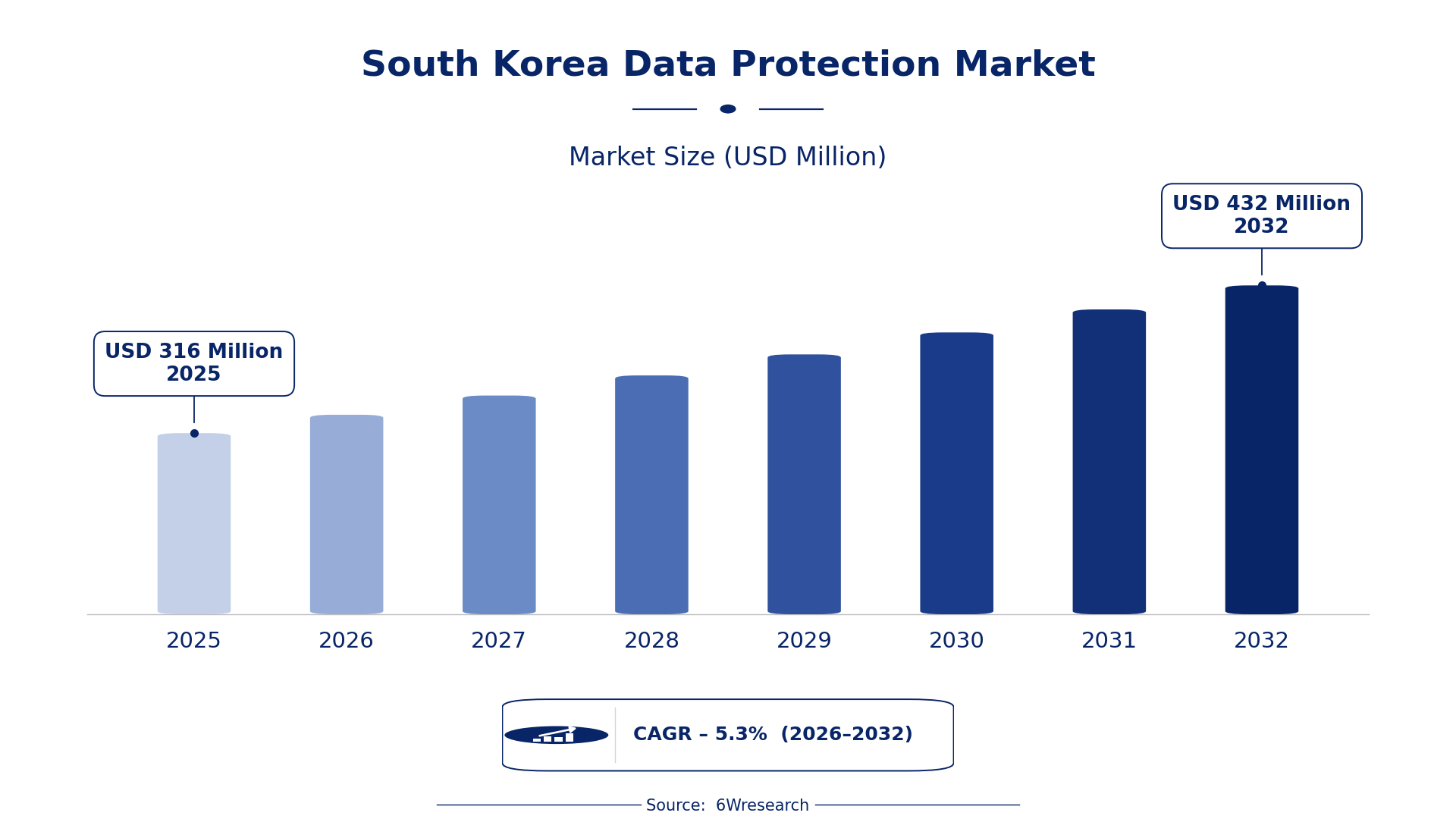
The South Korea Data Protection Market was estimated at USD 316 Million in 2025 and is projected to reach USD 432 Million by 2032, growing at a CAGR of 5.3% from 2026 to 2032.
South Korea Data Protection Market Synopsis
As organizations in South Korea increasingly confront the reality of data breaches, there has been a noticeable uptick in investments towards comprehensive data protection measures. This growing urgency comes alongside heightened regulatory scrutiny, pushing firms to prioritize compliance and data security.
Looking forward, the market is set to continue its upward trajectory, driven by the proliferation of cloud technologies and mobile devices. Companies are not merely responding to immediate threats but are also proactively enhancing their cybersecurity frameworks to safeguard sensitive information.
South Korea Data Protection Market Year-wise Growth Rate and Key Drivers
This graph illustrates the annual growth rates of the South Korea Data Protection Market from 2021 to 2032, highlighting a steady upward trajectory and projected expansion over the forecast period.
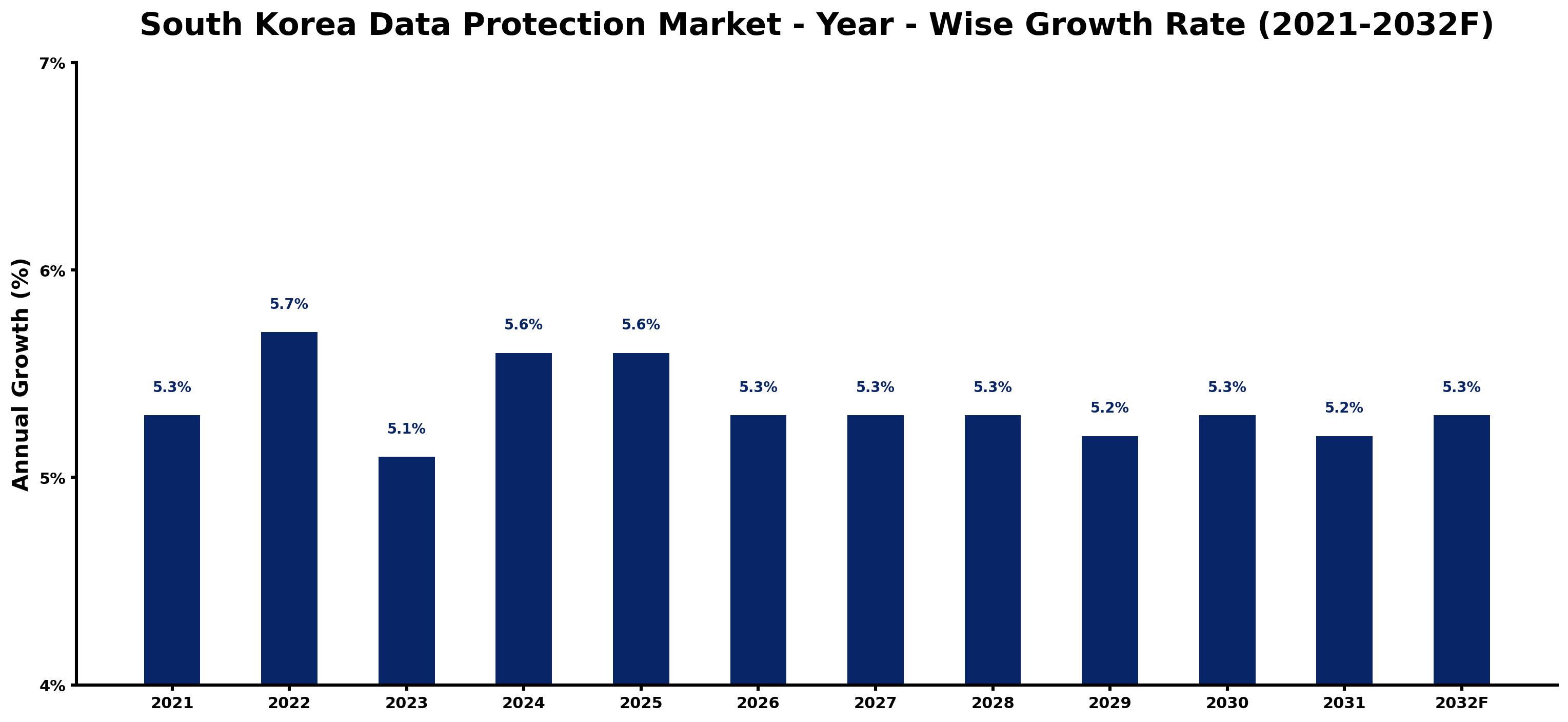
The table below presents the year‑wise growth rates along with the key drivers influencing the market
| Year | Growth Rate | Major Drivers |
| 2021 | 5.3% | Personal Information Protection Act enforcement boosts compliance demand. |
| 2022 | 5.7% | Increased cyber threats drive investment in data security. |
| 2023 | 5.1% | Growing adoption of digital identities enhances privacy protection needs. |
| 2024 | 5.6% | Government initiatives promote data localization requirements. |
| 2025 | 5.6% | Rising awareness of data breaches strengthens consumer trust efforts. |
| 2026 | 5.3% | Increased cloud service uptake demands stronger data protection measures. |
| 2027 | 5.3% | Regulatory changes mandate stricter data handling procedures in firms. |
| 2028 | 5.3% | Corporate governance reforms emphasize data security accountability. |
| 2029 | 5.2% | Telehealth expansion necessitates enhanced patient data safeguards. |
| 2030 | 5.3% | AI advancements create need for secure data usage frameworks. |
| 2031 | 5.2% | Rise in e-commerce increases customer data protection focus. |
| 2032 | 5.3% | Public sector digital transformation requires robust data governance. |
Note: Market size estimations and growth projections presented in this report are based on 6Wresearch's proprietary forecasting methodology, utilizing the latest available industry data, government publications, and primary research inputs.
South Korea Data Protection Market Key Takeaways
Below are some of the specific key takeaways from the market, including:
- Investment in data encryption and secure backup solutions is critical for compliance with the Personal Information Protection Act (PIPA).
- The ongoing shift to cloud computing heightens the urgency for effective data protection strategies.
- Data loss prevention (DLP) solutions are becoming increasingly vital as organizations strive to protect sensitive information.
- Regulatory frameworks are evolving, necessitating continuous updates to data protection measures.
- Workforce training on data security remains essential to counter sophisticated cyber threats.
Evaluation of Restraints in South Korea Data Protection Market
The South Korea Data Protection Market faces real challenges that hinder its growth. Organizations must navigate an fast-changing landscape of sophisticated cyber threats. Compliance demands, particularly under the PIPA, impose significant operational burdens. Ensuring data security while maintaining usability is a persistent tension, requiring that firms consistently invest in new technologies and employee training.
South Korea Data Protection Market Trends
A few key trends are emerging within the South Korea Data Protection Market. First, the increasing adoption of artificial intelligence in data protection solutions is reshaping how organizations detect and respond to threats. Secondly, the focus on data privacy is leading firms to explore advanced encryption technologies. Finally, regulatory compliance efforts are prompting companies to integrate data protection measures into their overall cybersecurity strategies, ensuring a more unified approach.
South Korea Data Protection Market Opportunities
There are ample opportunities for growth in this market. As businesses expand their cloud infrastructure, the demand for scalable data protection solutions will soar. on top of that, the rise of the Internet of Things (IoT) creates additional challenges and necessitates innovative protection measures. Companies that can offer specialized solutions for niche markets, such as healthcare and finance, are likely to find a receptive audience.
Government Initiatives in the South Korea Data Protection Market
Government policies are crucial for shaping the South Korea Data Protection Market. The emphasis on personal data protection aligns closely with global standards, compelling organizations to adopt robust security protocols. Recent efforts have focused on enhancing collaboration between industry players and government bodies to bolster data security measures.
- A national initiative launched in 2025 aimed at enhancing cybersecurity frameworks among SMEs, focusing on compliance with PIPA.
- Ongoing workshops and training programs developed by the Ministry of Science and ICT to educate businesses on data protection practices.
- A planned regulatory review in 2026 to address emerging technologies and their implications for personal data security.
- Collaborative partnerships between government agencies and tech firms to develop advanced data protection technologies, currently underway.
Future Insights of the South Korea Data Protection Market
From 2026 to 2032, the South Korea Data Protection Market is likely to witness continuous evolution. Companies will increasingly adopt a risk-based approach to data protection, factoring in not just compliance but also the reputational impact of data breaches. Additionally, advancements in AI and machine learning are set to revolutionize how organizations monitor and protect sensitive information, marking a shift from reactive to proactive data security management.
South Korea Data Protection Market Latest Developments
In the last 12 months, the South Korea Data Protection Market has seen notable advancements. With regulations tightening, businesses are compelled to accelerate their data protection initiatives. Partnerships between technology providers and industry players are becoming more common as they seek to enhance security measures.
- A major technology vendor rolled out an advanced data encryption solution in Q1 2025, significantly enhancing data security for financial institutions.
- An ongoing collaboration began in mid-2025 between government agencies and private enterprises to create a comprehensive cybersecurity training program.
- A cloud service provider announced plans in late 2025 to introduce new DLP tools tailored for SMEs, set to launch by the end of 2026.
- A consortium of tech companies is currently working on an initiative aimed at establishing a unified standard for data protection practices across industries.
South Korea Data Protection Market - Key Attractiveness of the Report
- 10 Years of Market Numbers
- Historical Data Starting from 2022 to 2025
- Base Year: 2025
- Forecast Data until 2032
- Key Performance Indicators Impacting the Market
- Major Upcoming Developments and Projects
Key Highlights of the Report:
- South Korea Data Protection Market Outlook
- Market Size of South Korea Data Protection Market, 2025
- Forecast of South Korea Data Protection Market, 2032
- Historical Data and Forecast of South Korea Data Protection Revenues & Volume for the Period 2022-2032F
- South Korea Data Protection Market Trend Evolution
- South Korea Data Protection Market Drivers and Challenges
- South Korea Data Protection Price Trends
- South Korea Data Protection Porter's Five Forces
- South Korea Data Protection Industry Life Cycle
- Historical Data and Forecast of South Korea Data Protection Market Revenues & Volume By Component for the Period 2022-2032F
- Historical Data and Forecast of South Korea Data Protection Market Revenues & Volume By Solutions for the Period 2022-2032F
- Historical Data and Forecast of South Korea Data Protection Market Revenues & Volume By Services (Professional Services and Managed Services) for the Period 2022-2032F
- Historical Data and Forecast of South Korea Data Protection Market Revenues & Volume By Deployment Mode for the Period 2022-2032F
- Historical Data and Forecast of South Korea Data Protection Market Revenues & Volume By On-premises for the Period 2022-2032F
- Historical Data and Forecast of South Korea Data Protection Market Revenues & Volume By Cloud for the Period 2022-2032F
- Historical Data and Forecast of South Korea Data Protection Market Revenues & Volume By Industry Vertical for the Period 2022-2032F
- Historical Data and Forecast of South Korea Data Protection Market Revenues & Volume By Government and defense for the Period 2022-2032F
- Historical Data and Forecast of South Korea Data Protection Market Revenues & Volume By Banking, Financial Services, and Insurance (BFSI) for the Period 2022-2032F
- Historical Data and Forecast of South Korea Data Protection Market Revenues & Volume By Healthcare for the Period 2022-2032F
- Historical Data and Forecast of South Korea Data Protection Market Revenues & Volume By IT and telecom for the Period 2022-2032F
- Historical Data and Forecast of South Korea Data Protection Market Revenues & Volume By Consumer goods and retail for the Period 2022-2032F
- Historical Data and Forecast of South Korea Data Protection Market Revenues & Volume By Education for the Period 2022-2032F
- Historical Data and Forecast of South Korea Data Protection Market Revenues & Volume By Media and entertainment for the Period 2022-2032F
- Historical Data and Forecast of South Korea Data Protection Market Revenues & Volume By Organization Size Large Enterprises for the Period 2022-2032F
- Historical Data and Forecast of South Korea Data Protection Market Revenues & Volume By SMEs for the Period 2022-2032F
- Historical Data and Forecast of South Korea Data Protection Market Revenues & Volume By Large Enterprises for the Period 2022-2032F
- South Korea Data Protection Import Export Trade Statistics
- Market Opportunity Assessment By Component
- Market Opportunity Assessment By Deployment Mode
- Market Opportunity Assessment By Industry Vertical
- Market Opportunity Assessment By Organization Size Large Enterprises
- South Korea Data Protection Top Companies Market Share
- South Korea Data Protection Competitive Benchmarking By Technical and Operational Parameters
- South Korea Data Protection Company Profiles
- South Korea Data Protection Key Strategic Recommendations






































