South Korea Database Security Market Size & Growth Rate (2026-2032)
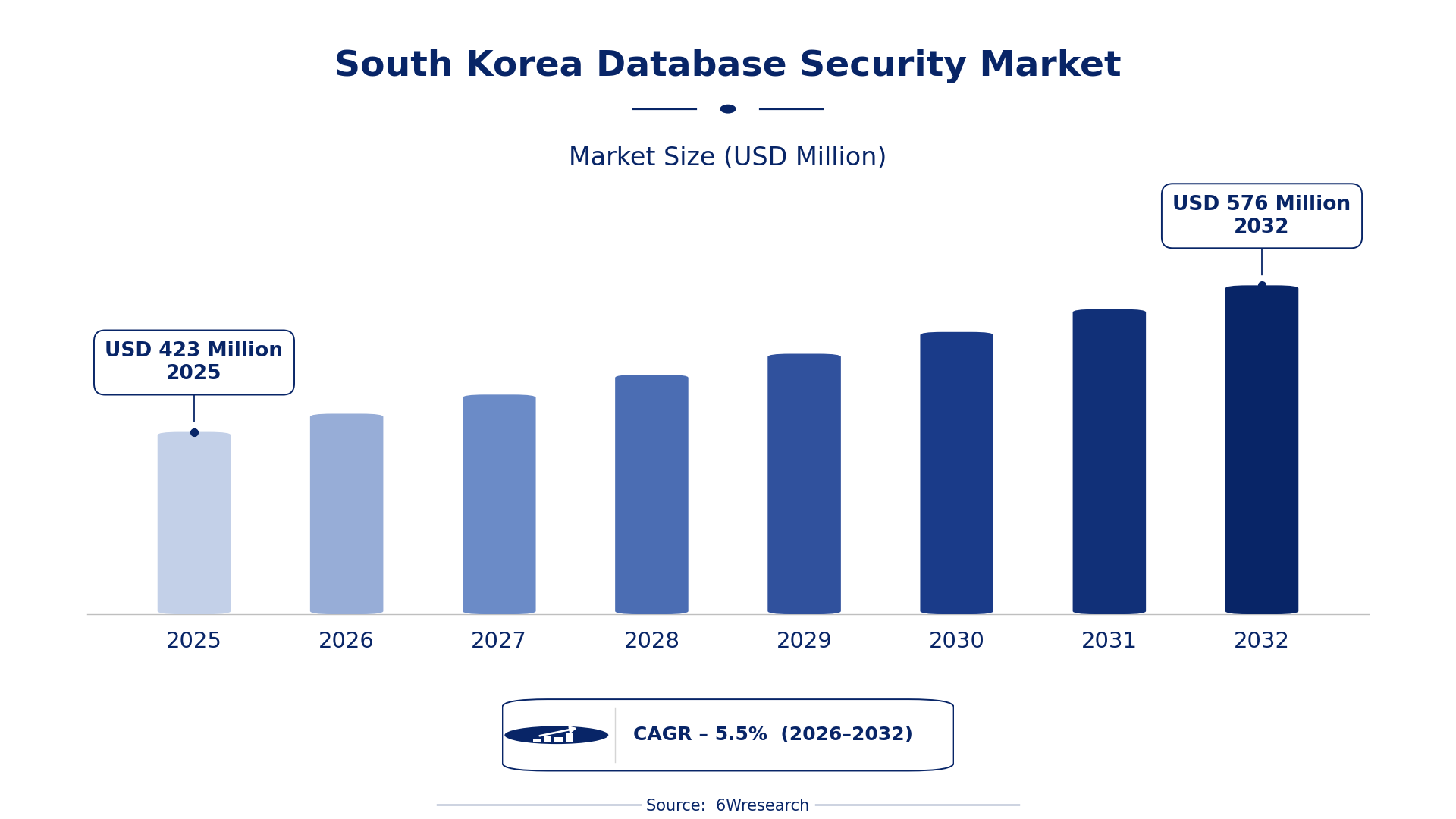
The South Korea Database Security Market was estimated at USD 423 Million in 2025 and is projected to reach USD 576 Million by 2032, growing at a CAGR of 5.5% from 2026 to 2032.
South Korea Database Security Market Synopsis
In South Korea, database security has become a critical focus for organizations as cyber threats escalate. With an increasing reliance on digital technologies, businesses are compelled to bolster their defenses against unauthorized access and data breaches, particularly as compliance demands grow more stringent.
The integration of advanced solutions such as database firewalls, activity monitoring, and vulnerability management is not just beneficial, but essential. As companies expand their IT infrastructures, the complexity of safeguarding critical databases against both internal and external threats has grown, driving the need for comprehensive security measures.
South Korea Database Security Market Year-wise Growth Rate and Key Drivers
This graph illustrates the annual growth rates of the South Korea Database Security Market from 2021 to 2032, highlighting a steady upward trajectory and projected expansion over the forecast period.
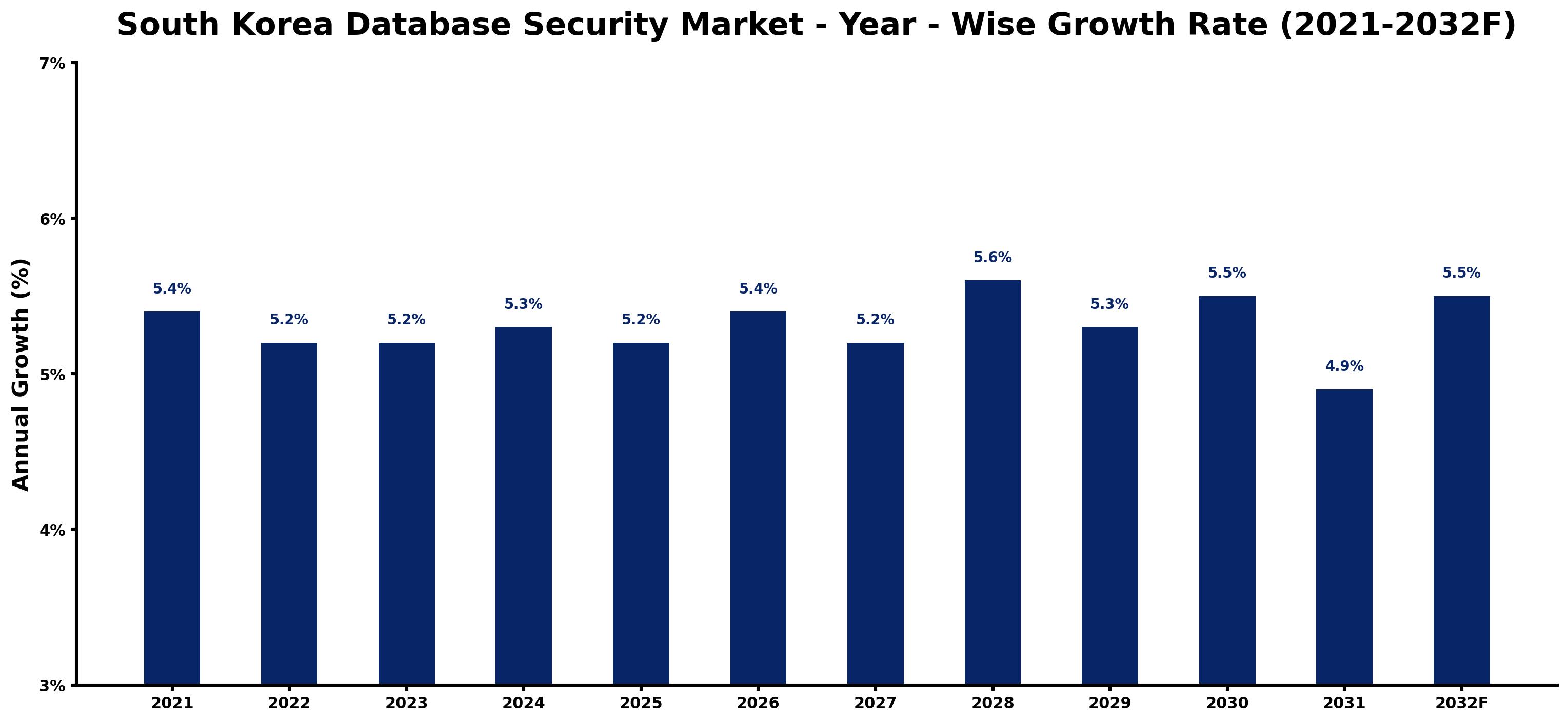
The table below presents the year‑wise growth rates along with the key drivers influencing the market
| Year | Growth Rate | Major Drivers |
| 2021 | 5.4% | Strengthened Korea's Personal Information Protection Act enforcement. |
| 2022 | 5.2% | Increased cyberattack frequency prompted urgent security upgrades. |
| 2023 | 5.2% | Local enterprises enhancing data privacy compliance measures. |
| 2024 | 5.3% | Government subsidies for cybersecurity initiatives encouraged investment. |
| 2025 | 5.2% | Growing fintech sector intensifies database security requirements. |
| 2026 | 5.4% | Rising adoption of AI in security solutions enhances demand. |
| 2027 | 5.2% | Public sector initiatives prioritize digital data protection improvements. |
| 2028 | 5.6% | Emergence of smart factory technologies drives data risk awareness. |
| 2029 | 5.3% | Rising global cyber threats increase local defense strategies. |
| 2030 | 5.5% | Participation in international cybersecurity frameworks boosts local practices. |
| 2031 | 4.9% | Implementation of industry-specific security standards by regulators. |
| 2032 | 5.5% | Continued focus on data localization fuels security solution growth. |
Note: Market size estimations and growth projections presented in this report are based on 6Wresearch's proprietary forecasting methodology, utilizing the latest available industry data, government publications, and primary research inputs.
South Korea Database Security Market Key Takeaways
Below are some of the specific key takeaways from the market, including:
- The market is witnessing a strong upward trend, propelled by rising cyber threats and regulatory compliance requirements.
- Companies are increasingly adopting integrated security solutions that encompass real-time monitoring and threat detection.
- Regulatory frameworks such as the Personal Information Protection Act (PIPA) are influencing security practices across sectors.
- Hybrid cloud environments are complicating database security, necessitating advanced management solutions.
- Investment in database encryption and access controls is on the rise as businesses prioritize data confidentiality.
Evaluation of Restraints in South Korea Database Security Market
Despite its growth, the South Korea Database Security Market encounters notable restraints. One primary challenge is the rapidly evolving landscape of cybersecurity threats, which requires organizations to continuously adapt their security protocols. Compliance with regulations like PIPA can be burdensome, especially for smaller enterprises lacking the resources to implement robust security measures. Additionally, the complexity of managing security across diverse environments—including on-premises and cloud-based databases—complicates matters further. Organizations need solutions that provide not only protection but also seamless integration and monitoring capabilities to effectively mitigate risks.
South Korea Database Security Market Trends
Several trends are emerging within the South Korea Database Security Market. First, there is a clear shift towards the adoption of artificial intelligence (AI) and machine learning (ML) technologies, which enhance threat detection and response times. on top of that, companies are focusing on implementing zero-trust security frameworks, which require strict identity verification for every user, whether inside or outside the organization. The growing trend of remote work is also prompting organizations to rethink their database security strategies, ensuring that data remains protected even when accessed from various locations.
South Korea Database Security Market Opportunities
As organizations in South Korea prioritize database security, numerous opportunities are emerging for growth and investment. The increasing focus on regulatory compliance provides a fertile ground for innovative security solutions. on top of that, the rise of cloud adoption opens avenues for vendors to offer specialized security services tailored to hybrid and multi-cloud environments. Companies that develop user-friendly, scalable solutions with real-time capabilities will find significant demand as businesses seek to enhance their security posture.
Government Initiatives in the South Korea Database Security Market
The South Korean government plays a crucial role in shaping the database security framework through various initiatives aimed at bolstering cybersecurity. With a focus on increasing resilience against cyber threats, these policies emphasize advanced security technologies and compliance with rigorous standards. The regulatory environment prioritizes data integrity and protection, setting the stage for heightened security measures across industries.
- A regulatory framework was introduced in 2025 mandating regular audits to enhance database security standards across sectors.
- Current initiatives are underway promoting the adoption of intrusion detection systems within government agencies to safeguard sensitive information.
- There is a planned public-private partnership aimed at developing advanced cybersecurity infrastructure, expected to launch in late 2026.
- The government has initiated a cybersecurity awareness campaign targeting small and medium-sized enterprises to improve their security practices, currently in progress.
- A national cybersecurity strategy has been established to strengthen collaboration among public sector entities and private companies, set for implementation in 2027.
Future Insights of the South Korea Database Security Market
Looking ahead to 2026-2032, the South Korea Database Security Market is expected to continue its growth trajectory driven by increasing cyber threats and regulatory pressures. Businesses will likely invest more in advanced encryption methods and comprehensive access controls as they strive to protect sensitive data. on top of that, the integration of AI and ML in security solutions will enhance the ability to detect and respond to threats in real-time. Companies that can pivot quickly in response to new regulations and emerging threats will hold a competitive edge in this dynamic environment.
South Korea Database Security Market Latest Developments
In the past year, the South Korea Database Security Market has witnessed a surge in activity as organizations prioritize strengthening their defenses against cyberattacks. New technologies and strategic partnerships are shaping the market, with a clear focus on enhancing data protection methods. The trend towards cloud migration has driven innovations in security solutions tailored for diverse environments, reflecting the need for adaptable and scalable protection measures.
- A major technology vendor launched a new cloud-native database security solution in early 2025, designed to cater to the growing demand for cloud security.
- Ongoing partnerships among cybersecurity firms have resulted in the development of integrated solutions that offer real-time threat detection and automated response capabilities.
- A service upgrade expected to be completed by mid-2026 will enhance existing database firewalls with advanced AI capabilities for improved threat management.
- A new public-private initiative, currently underway, aims to develop a unified database security framework for small and medium-sized enterprises, set to conclude by late 2025.
- An upcoming cybersecurity competition planned for 2027 will encourage innovation in database protection strategies among local startups and tech firms.
South Korea Database Security Market - Key Attractiveness of the Report
- 10 Years of Market Numbers
- Historical Data Starting from 2022 to 2025
- Base Year: 2025
- Forecast Data until 2032
- Key Performance Indicators Impacting the Market
- Major Upcoming Developments and Projects
Key Highlights of the Report:
- South Korea Database Security Market Outlook
- Market Size of South Korea Database Security Market, 2025
- Forecast of South Korea Database Security Market, 2032
- Historical Data and Forecast of South Korea Database Security Revenues & Volume for the Period 2022-2032F
- South Korea Database Security Market Trend Evolution
- South Korea Database Security Market Drivers and Challenges
- South Korea Database Security Price Trends
- South Korea Database Security Porter's Five Forces
- South Korea Database Security Industry Life Cycle
- Historical Data and Forecast of South Korea Database Security Market Revenues & Volume By Component for the Period 2022-2032F
- Historical Data and Forecast of South Korea Database Security Market Revenues & Volume By Solution for the Period 2022-2032F
- Historical Data and Forecast of South Korea Database Security Market Revenues & Volume By Services for the Period 2022-2032F
- Historical Data and Forecast of South Korea Database Security Market Revenues & Volume By Business function for the Period 2022-2032F
- Historical Data and Forecast of South Korea Database Security Market Revenues & Volume By Marketing for the Period 2022-2032F
- Historical Data and Forecast of South Korea Database Security Market Revenues & Volume By sales for the Period 2022-2032F
- Historical Data and Forecast of South Korea Database Security Market Revenues & Volume By finance for the Period 2022-2032F
- Historical Data and Forecast of South Korea Database Security Market Revenues & Volume By operations for the Period 2022-2032F
- Historical Data and Forecast of South Korea Database Security Market Revenues & Volume By Organization Size for the Period 2022-2032F
- Historical Data and Forecast of South Korea Database Security Market Revenues & Volume By Large Enterprises for the Period 2022-2032F
- Historical Data and Forecast of South Korea Database Security Market Revenues & Volume By SMEs for the Period 2022-2032F
- Historical Data and Forecast of South Korea Database Security Market Revenues & Volume By Deployment Mode for the Period 2022-2032F
- Historical Data and Forecast of South Korea Database Security Market Revenues & Volume By Cloud for the Period 2022-2032F
- Historical Data and Forecast of South Korea Database Security Market Revenues & Volume By On-premises for the Period 2022-2032F
- Historical Data and Forecast of South Korea Database Security Market Revenues & Volume By Vertical for the Period 2022-2032F
- Historical Data and Forecast of South Korea Database Security Market Revenues & Volume By Banking, Financial Services, And Insurance for the Period 2022-2032F
- Historical Data and Forecast of South Korea Database Security Market Revenues & Volume By Telecommunication and IT for the Period 2022-2032F
- Historical Data and Forecast of South Korea Database Security Market Revenues & Volume By Government and Defense for the Period 2022-2032F
- Historical Data and Forecast of South Korea Database Security Market Revenues & Volume By Manufacturing for the Period 2022-2032F
- Historical Data and Forecast of South Korea Database Security Market Revenues & Volume By Healthcare and life sciences for the Period 2022-2032F
- Historical Data and Forecast of South Korea Database Security Market Revenues & Volume By Retail and Ecommerce for the Period 2022-2032F
- Historical Data and Forecast of South Korea Database Security Market Revenues & Volume By Energy and Utilities for the Period 2022-2032F
- South Korea Database Security Import Export Trade Statistics
- Market Opportunity Assessment By Component
- Market Opportunity Assessment By Business function
- Market Opportunity Assessment By Organization Size
- Market Opportunity Assessment By Deployment Mode
- Market Opportunity Assessment By Vertical
- South Korea Database Security Top Companies Market Share
- South Korea Database Security Competitive Benchmarking By Technical and Operational Parameters
- South Korea Database Security Company Profiles
- South Korea Database Security Key Strategic Recommendations






































