South Korea Decorative tile Market Summary
The south korea decorative tile market was estimated at USD 194 Million in 2025 and is projected to reach USD 259 Million by 2032, growing at a CAGR of 4.8% from 2026 to 2032.
South Korea Decorative tile Market Year-wise Growth Rate and Key Drivers
This graph highlights how the South Korea Decorative tile Market has steadily grown over the past five years, supported by major growth factors.
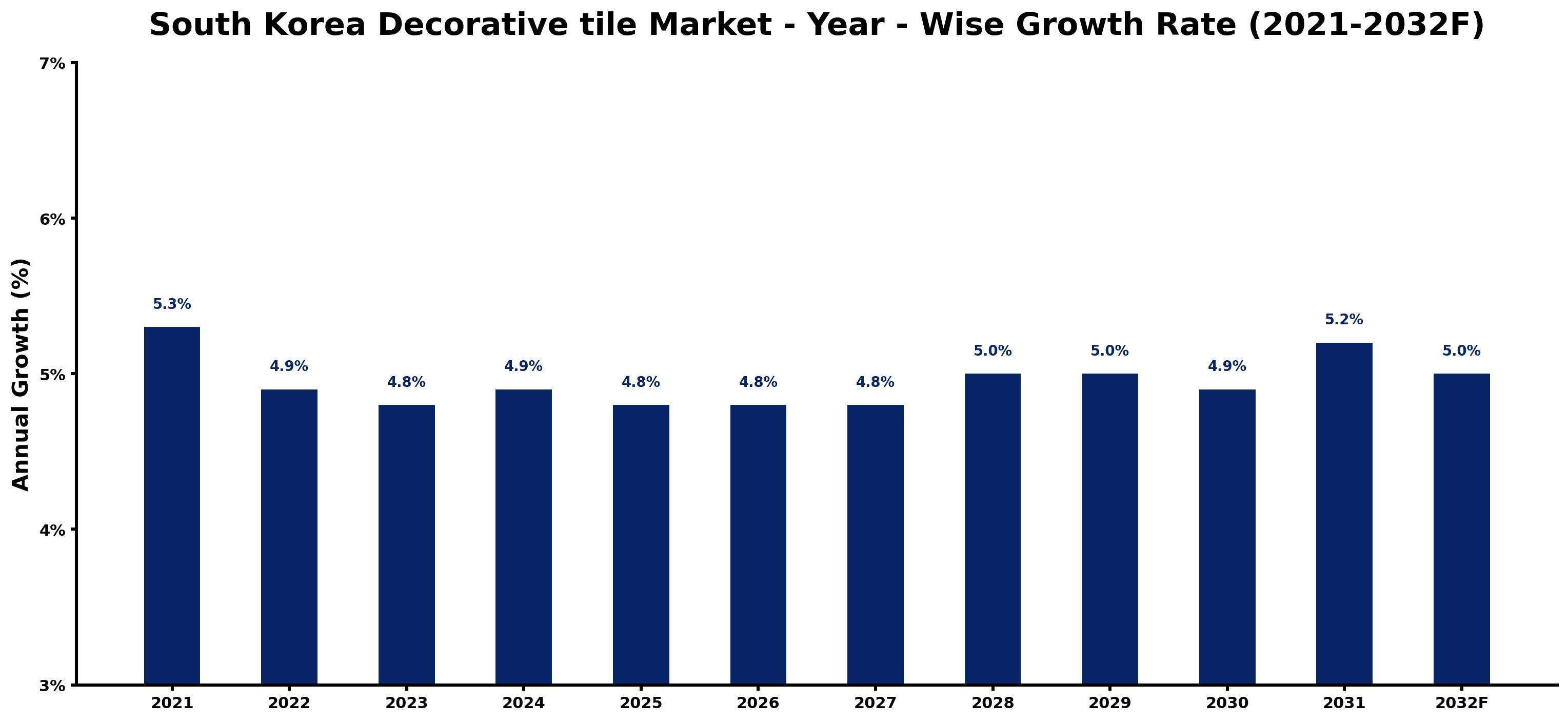
The table below presents the year wise growth rates along with the key drivers influencing the market
| Year | Growth Rate | Major Drivers |
| 2021 | 5.3% | Post-lockdown retail projects rejuvenate interest in home improvement and aesthetics. |
| 2022 | 4.9% | Urbanization trends lead to more residential and commercial construction projects nationwide. |
| 2023 | 4.8% | A heightened focus on sustainability influences tile designs towards eco-friendly materials. |
| 2024 | 4.9% | Consumer preferences shift towards luxurious finishes, increasing demand for premium decorative tiles. |
| 2025 | 4.8% | Availability of advanced manufacturing technologies enhances customization options for consumers. |
| 2026 | 4.8% | Architectural innovations encourage unique tile installations, boosting market diversity and creativity. |
| 2027 | 4.8% | Expanding middle-class disposable income supports broader tile purchasing behavior and trends. |
| 2028 | 5.0% | Increased collaboration between designers and tile manufacturers elevates market offerings substantially. |
| 2029 | 5.0% | Growing interest in DIY home renovations fuels retail tile sales in various demographics. |
| 2030 | 4.9% | Digitalization of retail allows consumers to explore vast tile selections conveniently online. |
| 2031 | 5.2% | Sustainability certifications become crucial, influencing consumer choices towards environmentally friendly tiles. |
| 2032 | 5.0% | Market consolidation among leading manufacturers streamlines supply chains, enhancing overall efficiency. |
Note - Market size estimations and growth projections presented in this report are based on 6Wresearch's advanced forecasting approach, validated with industry datasets as of June 2026.
South Korea Decorative tile Market Synopsis
The South Korea Decorative tile Market is projected to reach 4.8% and witness significant growth during the forecast period (2026-2032). This growth is driven by a variety of factors, including rising urbanization, increasing disposable incomes, and a heightened focus on home renovation projects. As South Korean consumers become more discerning about their interior design choices, the demand for decorative tiles has risen, leading to a dynamic market landscape.
South Korea Decorative tile Market Growth Drivers
The South Korea decorative tile market is underpinned by several influencing factors:
- Urbanization continues to accelerate, with more individuals seeking stylish and functional interior design solutions for their living spaces.
- The rise in disposable income enables a larger segment of the population to invest in high-quality decorative tiles, enhancing home aesthetics.
- An increasing trend in home renovation projects encourages homeowners to explore decorative tiles as a means to improve their living environments.
- Consumer preferences are shifting towards unique, personalized designs, further propelling demand for customizable decorative tiles.
- Innovations in manufacturing technology are contributing to a wider range of available tile options, catering to diverse stylistic preferences.
South Korea Decorative tile Market Trends and Opportunities
A notable trend within the South Korea decorative tile market is the growing emphasis on eco-friendly and sustainable products. As consumers become increasingly aware of environmental issues, there is a notable shift in purchasing behaviors.
- Demand for tiles made from recycled materials is on the rise, aligning product offerings with environmentally conscious consumer preferences.
- Low volatile organic compound (VOC) emissions tiles are becoming more appealing to health-conscious consumers, thus expanding the market.
- Digital printing technologies are enabling the production of intricate and personalized designs, which cater to the desire for uniqueness in home décor.
- The focus on aesthetic appeal means that decorative tiles are being sought not just for functional use but as integral elements of interior beauty.
- Collaboration with local designers allows for the creation of exclusive tile designs that resonate with South Korean culture and tastes.
South Korea Decorative tile Market Challenges and Restraints
Despite the growth potential, the South Korea decorative tile market faces several challenges that impact its dynamics:
- Intense competition from domestic and international manufacturers can lead to pressure on pricing and profit margins, complicating the market landscape.
- Fluctuations in raw material prices can alter production costs, potentially leading to unpredictable pricing strategies across the market.
- Rapid changes in consumer preferences and design trends necessitate constant innovation, which can be resource-intensive for manufacturers.
- Companies must adhere to stringent quality standards and regulatory requirements, posing additional compliance costs and operational hurdles.
- The overall economic conditions and construction activity strongly influence market demand, making the sector vulnerable to economic downturns.
South Korea Decorative tile Market Government Investment and Initiatives
The South Korean government is actively involved in regulating and fostering the growth of the decorative tile market through various policies and initiatives:
- Policies aimed at promoting sustainable development encourage manufacturers to adopt environmentally friendly practices in production.
- Investment in research and development is prioritized to drive innovation within the tile manufacturing sector, aligning with global sustainability trends.
- The government has established regulations to ensure consumer safety in terms of product quality and harmful substance usage in tiles.
- Incentives for businesses that prioritize eco-friendly products are being introduced to stimulate market growth while promoting environmental responsibility.
- Support for fair competition frameworks facilitates a level playing field for all manufacturers and distributors in the decorative tile market.
South Korea Decorative tile Market Latest Developments (May 2025 - June 2026)
The South Korea decorative tile market is witnessing several notable developments that are shaping its future direction:
- New product launches featuring innovative designs and sustainable materials are increasingly common as manufacturers respond to consumer demand.
- Advancements in manufacturing techniques, including digital printing, have enhanced the potential for customization and design versatility in tile offerings.
- Collaborative efforts between manufacturers and local designers have produced unique product lines that reflect contemporary aesthetics and cultural relevance.
- There is a rise in online platforms for tile sales, allowing consumers greater access to a diverse range of decorative tile options.
- The emphasis on eco-friendly products has prompted numerous companies to revamp their product ranges, focusing on sustainability without compromising design quality.
South Korea Decorative tile Market Future Outlook
Looking ahead, the South Korea decorative tile market is poised for continued growth, driven by demographic shifts and evolving consumer preferences:
- Urbanization trends are expected to persist, leading to ongoing demand for aesthetically pleasing interior design solutions in homes and commercial spaces.
- Rising disposable incomes will likely enable consumers to spend more on high-quality decorative tiles as part of their renovation projects.
- Innovative design capabilities will empower manufacturers to respond effectively to rapid shifts in consumer preferences, providing opportunities for differentiation.
- The growing trend towards sustainability is anticipated to influence consumers to prioritize eco-friendly materials in their purchasing decisions.
- Overall, technological advancements will facilitate the introduction of novel tile options, further diversifying the market landscape.
South Korea Decorative tile Market - Key Attractiveness of the Report
- 10 Years of Market Numbers
- Historical Data Starting from 2022 to 2025
- Base Year: 2025
- Forecast Data until 2032
- Key Performance Indicators Impacting the Market
- Major Upcoming Developments and Projects
Key Highlights of the Report:
- South Korea Decorative tile Market Outlook
- Market Size of South Korea Decorative tile Market, 2025
- Forecast of South Korea Decorative tile Market, 2032F
- Historical Data and Forecast of South Korea Decorative tile Revenues & Volume for the Period 2022-2032F
- South Korea Decorative tile Market Trend Evolution
- South Korea Decorative tile Market Drivers and Challenges
- South Korea Decorative tile Price Trends
- South Korea Decorative tile Porter's Five Forces
- South Korea Decorative tile Industry Life Cycle
- Historical Data and Forecast of South Korea Decorative tile Market Revenues & Volume By Type for the Period 2022-2032F
- Historical Data and Forecast of South Korea Decorative tile Market Revenues & Volume By Ceramic Wall Tiles for the Period 2022-2032F
- Historical Data and Forecast of South Korea Decorative tile Market Revenues & Volume By Vinyl Wall Tiles for the Period 2022-2032F
- Historical Data and Forecast of South Korea Decorative tile Market Revenues & Volume By Stone Wall Tiles for the Period 2022-2032F
- Historical Data and Forecast of South Korea Decorative tile Market Revenues & Volume By Other Types for the Period 2022-2032F
- Historical Data and Forecast of South Korea Decorative tile Market Revenues & Volume By End-users for the Period 2022-2032F
- Historical Data and Forecast of South Korea Decorative tile Market Revenues & Volume By Residential for the Period 2022-2032F
- Historical Data and Forecast of South Korea Decorative tile Market Revenues & Volume By Commercial for the Period 2022-2032F
- Historical Data and Forecast of South Korea Decorative tile Market Revenues & Volume By Application for the Period 2022-2032F
- Historical Data and Forecast of South Korea Decorative tile Market Revenues & Volume By Flooring for the Period 2022-2032F
- Historical Data and Forecast of South Korea Decorative tile Market Revenues & Volume By Wall Coverings for the Period 2022-2032F
- Historical Data and Forecast of South Korea Decorative tile Market Revenues & Volume By Other Applications for the Period 2022-2032F
- South Korea Decorative tile Import Export Trade Statistics
- Market Opportunity Assessment By Type
- Market Opportunity Assessment By End-users
- Market Opportunity Assessment By Application
- South Korea Decorative tile Top Companies Market Share
- South Korea Decorative tile Competitive Benchmarking By Technical and Operational Parameters
- South Korea Decorative tile Company Profiles
- South Korea Decorative tile Key Strategic Recommendations






































