South Korea DevOps Market Size & Growth Rate (2026-2032)
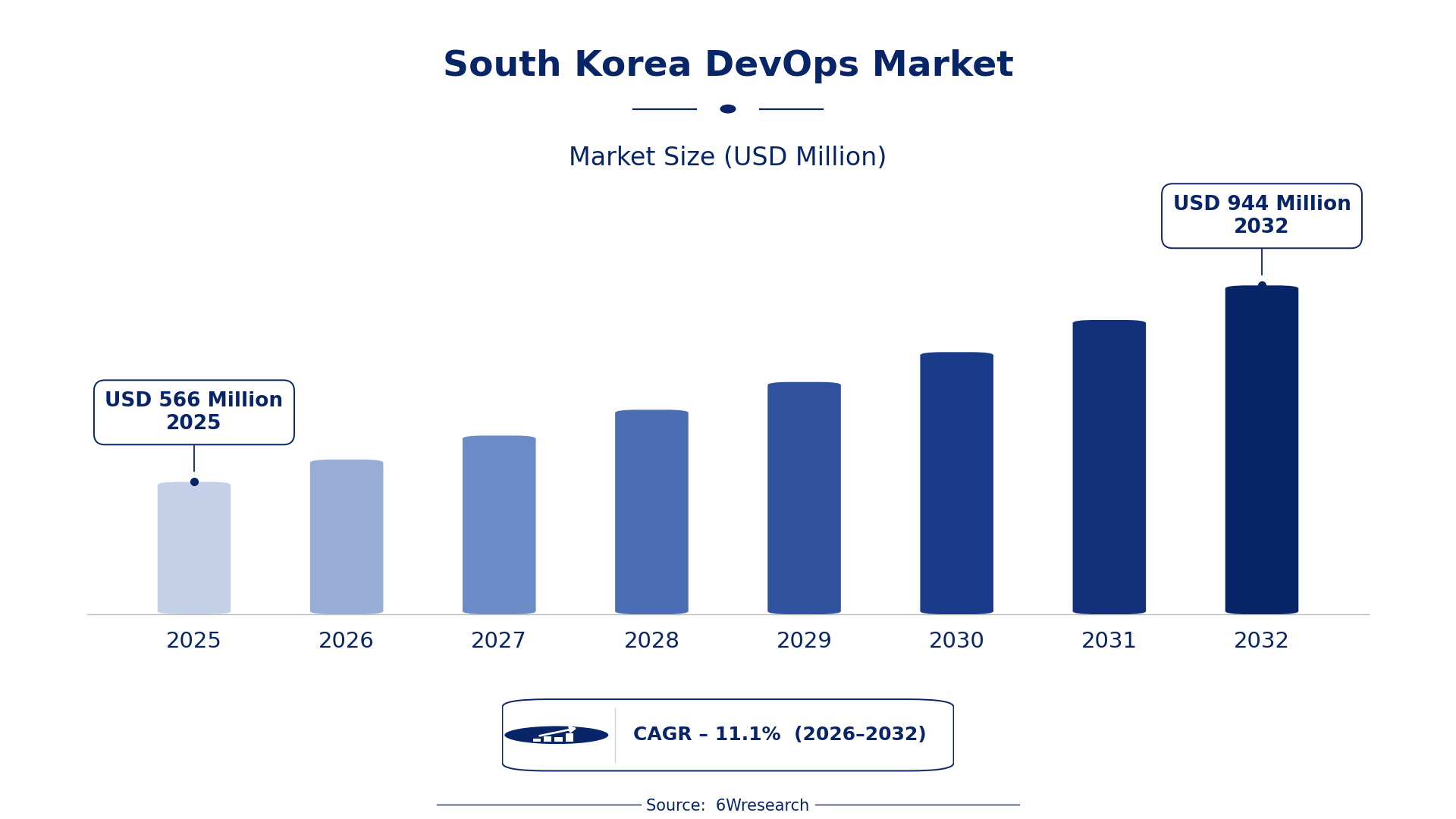
The South Korea DevOps Market was estimated at USD 566 Million in 2025 and is projected to reach USD 944 Million by 2032, growing at a CAGR of 11.1% from 2026 to 2032.
South Korea DevOps Market Synopsis
The South Korea DevOps market is currently experiencing a noteworthy upswing, driven by an increasing shift towards agile methodologies and cloud technologies. As organizations strive for efficiency and automation, the momentum is building, setting the stage for a transformative period ahead.
Looking forward, the market is positioned for sustained growth as more enterprises realize the competitive edge offered by DevOps practices. With the government actively fostering a digital economy, the landscape is ripe for innovation and expansion, aligning perfectly with global trends in software development.
South Korea DevOps Market Year-wise Growth Rate and Key Drivers
This graph illustrates the annual growth rates of the South Korea DevOps Market from 2021 to 2032, highlighting a steady upward trajectory and projected expansion over the forecast period.
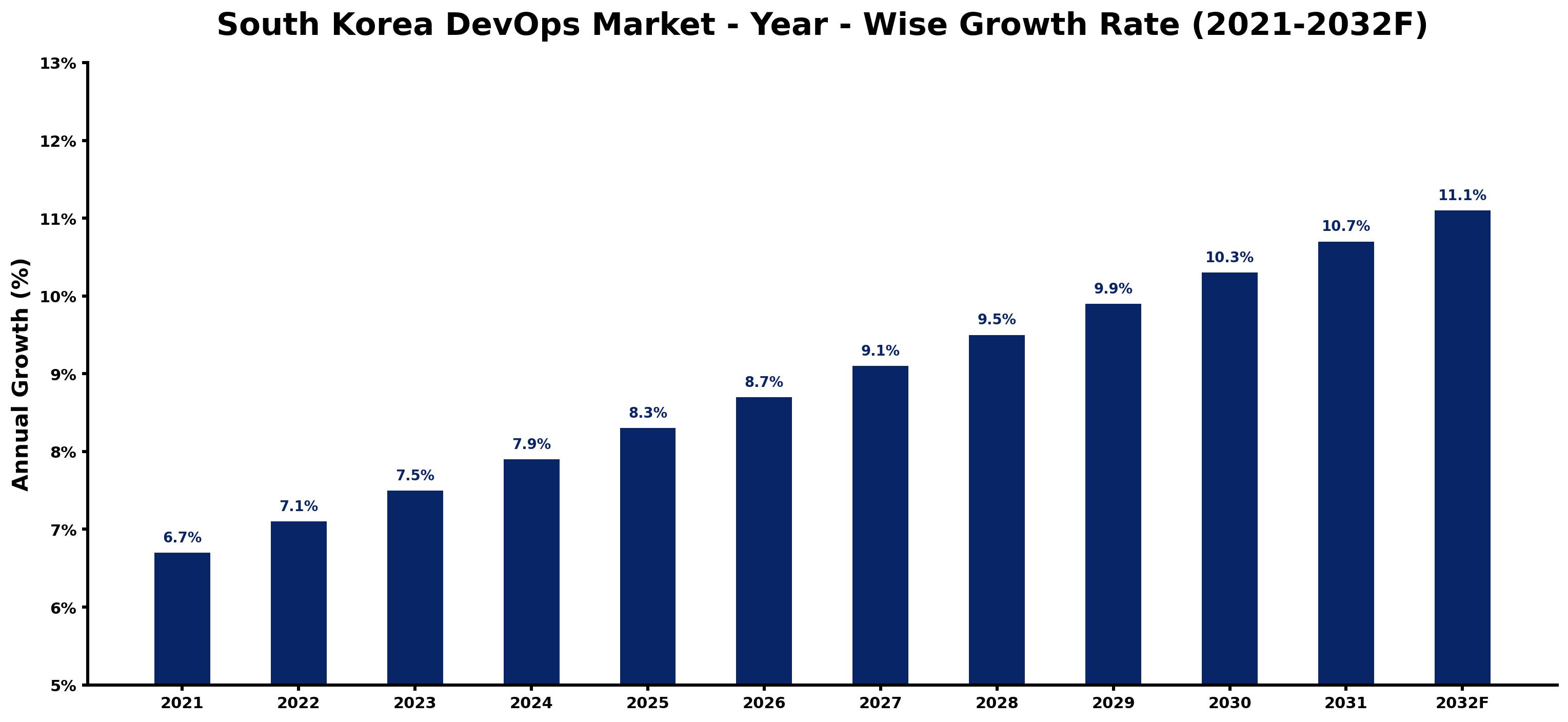
The table below presents the year‑wise growth rates along with the key drivers influencing the market
| Year | Growth Rate | Major Drivers |
| 2021 | 6.7% | Rise of remote work driving software collaboration needs. |
| 2022 | 7.1% | Government-backed initiatives for cloud adoption in enterprises. |
| 2023 | 7.5% | Increase in start-ups focusing on digital transformation services. |
| 2024 | 7.9% | Growing emphasis on cybersecurity within DevOps practices. |
| 2025 | 8.3% | Investment in AI tools enhancing software deployment efficiency. |
| 2026 | 8.7% | Local regulations favoring rapid software delivery frameworks. |
| 2027 | 9.1% | Corporate shift towards hybrid cloud infrastructures boosting DevOps. |
| 2028 | 9.5% | Educational programs promoting DevOps skills among graduates. |
| 2029 | 9.9% | Surge in IoT deployments requiring integrated DevOps solutions. |
| 2030 | 10.3% | Strategic partnerships between tech giants and local SMEs. |
| 2031 | 10.7% | Emergence of blockchain technologies influencing application development. |
| 2032 | 11.1% | Focus on sustainability driving eco-friendly software practices. |
Note: Market size estimations and growth projections presented in this report are based on 6Wresearch's proprietary forecasting methodology, utilizing the latest available industry data, government publications, and primary research inputs.
South Korea DevOps Market Key Takeaways
Below are some of the specific key takeaways from the market, including:
- The growing adoption of cloud technologies is a primary driver of DevOps practices in South Korea.
- Organizations are increasingly prioritizing automation to enhance efficiency in software development processes.
- Government initiatives are pivotal in promoting digital transformation across various sectors.
- There is a rising emphasis on security within DevOps practices as companies focus on protecting sensitive data.
- Investment opportunities are abundant, particularly in local service providers and automation tools.
Evaluation of Restraints in South Korea DevOps Market
Despite its growth potential, the South Korea DevOps market faces several challenges. Cultural resistance within traditional corporate structures can impede the adoption of new methodologies. on top of that, a shortage of skilled professionals familiar with DevOps practices poses a significant barrier. Concerns regarding data security and compliance also linger, as organizations navigate the complexities of integrating legacy systems with modern tools. Addressing these constraints will require a multifaceted approach that emphasizes employee training, a culture of innovation, and stringent security protocols.
South Korea DevOps Market Trends
The demand for efficient software development processes is pushing South Korean companies to adopt DevOps practices more widely. Collaboration between development and operations teams is becoming essential, leading to improved workflows and faster delivery of products. Cloud-based solutions are gaining traction, as they provide the flexibility needed to support these initiatives. Additionally, a heightened focus on security in DevOps practices is emerging, ensuring that applications and data remain protected amidst rapid technological change.
South Korea DevOps Market Opportunities
As the South Korea DevOps market evolves, several investment opportunities are emerging. The increasing implementation of DevOps practices presents a demand for tools and services that enhance the DevOps lifecycle. Investing in local service providers, particularly those specializing in automation and cloud computing, can yield significant returns. Partnerships with South Korean enterprises looking to modernize their operations can also create avenues for growth. Overall, the market environment is conducive to innovation and expansion.
Government Initiatives in the South Korea DevOps Market
The South Korean government is actively shaping the DevOps market through various initiatives aimed at fostering digital transformation and innovation. With policies that prioritize technological advancement, there is a clear focus on enhancing productivity and competitiveness across industries. These initiatives are crucial for creating a supportive ecosystem that facilitates the adoption of DevOps practices.
- A recently launched "Digital New Deal" initiative seeks to drive digital transformation by integrating technologies like DevOps across sectors.
- Current support and funding programs are underway to upskill the workforce in DevOps methodologies, addressing the talent gap.
- Incentives for companies implementing DevOps practices are currently being offered to enhance productivity and innovation.
- A planned public-private partnership aimed at expanding digital infrastructure is expected to roll out by 2026.
Future Insights of the South Korea DevOps Market
The outlook for the South Korea DevOps market from 2026 to 2032 is optimistic. As businesses increasingly recognize the need for digital transformation, the demand for DevOps tools and services is likely to rise sharply. Companies are expected to continue prioritizing operational efficiency and speed-to-market, fueling further adoption of DevOps practices. With government support for technological advancement, the market is set to thrive, presenting ample opportunities for both vendors and service providers.
South Korea DevOps Market Latest Developments
In the past year, the South Korea DevOps market has seen a flurry of activity, indicating a strong commitment to technological advancement. Companies are actively seeking to enhance their operational capabilities through the implementation of innovative DevOps practices. This momentum is expected to continue as organizations strive to keep pace with global trends.
- A major technology vendor launched a new cloud-based DevOps platform in early 2025, aimed at streamlining software development processes.
- In Q1 2025, a leading regional operator initiated an extensive training program for employees to upskill in DevOps methodologies, which remains ongoing.
- An automation tool focused on improving deployment efficiency is set to be rolled out in mid-2026, targeting local enterprises.
- By late 2025, a collaboration between local tech startups is expected to enhance security measures within DevOps practices across various sectors.
South Korea DevOps Market - Key Attractiveness of the Report
- 10 Years of Market Numbers
- Historical Data Starting from 2022 to 2025
- Base Year: 2025
- Forecast Data until 2032
- Key Performance Indicators Impacting the Market
- Major Upcoming Developments and Projects
Key Highlights of the Report:
- South Korea DevOps Market Outlook
- Market Size of South Korea DevOps Market, 2025
- Forecast of South Korea DevOps Market, 2032
- Historical Data and Forecast of South Korea DevOps Revenues & Volume for the Period 2022-2032F
- South Korea DevOps Market Trend Evolution
- South Korea DevOps Market Drivers and Challenges
- South Korea DevOps Price Trends
- South Korea DevOps Porter's Five Forces
- South Korea DevOps Industry Life Cycle
- Historical Data and Forecast of South Korea DevOps Market Revenues & Volume By Type for the Period 2022-2032F
- Historical Data and Forecast of South Korea DevOps Market Revenues & Volume By Solutions for the Period 2022-2032F
- Historical Data and Forecast of South Korea DevOps Market Revenues & Volume By Services for the Period 2022-2032F
- Historical Data and Forecast of South Korea DevOps Market Revenues & Volume By Vertical for the Period 2022-2032F
- Historical Data and Forecast of South Korea DevOps Market Revenues & Volume By Telecommunications for the Period 2022-2032F
- Historical Data and Forecast of South Korea DevOps Market Revenues & Volume By IT and ITeS for the Period 2022-2032F
- Historical Data and Forecast of South Korea DevOps Market Revenues & Volume By Retail and Consumer Goods for the Period 2022-2032F
- Historical Data and Forecast of South Korea DevOps Market Revenues & Volume By Media and Entertainment for the Period 2022-2032F
- Historical Data and Forecast of South Korea DevOps Market Revenues & Volume By Government and Public Sector for the Period 2022-2032F
- Historical Data and Forecast of South Korea DevOps Market Revenues & Volume By Manufacturing for the Period 2022-2032F
- Historical Data and Forecast of South Korea DevOps Market Revenues & Volume By Healthcare and Life Sciences for the Period 2022-2032F
- Historical Data and Forecast of South Korea DevOps Market Revenues & Volume By Education for the Period 2022-2032F
- Historical Data and Forecast of South Korea DevOps Market Revenues & Volume By Deployment Model for the Period 2022-2032F
- Historical Data and Forecast of South Korea DevOps Market Revenues & Volume By Public for the Period 2022-2032F
- Historical Data and Forecast of South Korea DevOps Market Revenues & Volume By Private for the Period 2022-2032F
- Historical Data and Forecast of South Korea DevOps Market Revenues & Volume By Organization Size for the Period 2022-2032F
- Historical Data and Forecast of South Korea DevOps Market Revenues & Volume By SMEs for the Period 2022-2032F
- Historical Data and Forecast of South Korea DevOps Market Revenues & Volume By Large enterprises for the Period 2022-2032F
- South Korea DevOps Import Export Trade Statistics
- Market Opportunity Assessment By Type
- Market Opportunity Assessment By Vertical
- Market Opportunity Assessment By Deployment Model
- Market Opportunity Assessment By Organization Size
- South Korea DevOps Top Companies Market Share
- South Korea DevOps Competitive Benchmarking By Technical and Operational Parameters
- South Korea DevOps Company Profiles
- South Korea DevOps Key Strategic Recommendations






































