South Korea Digital Education Market Size & Growth Rate (2026-2032)
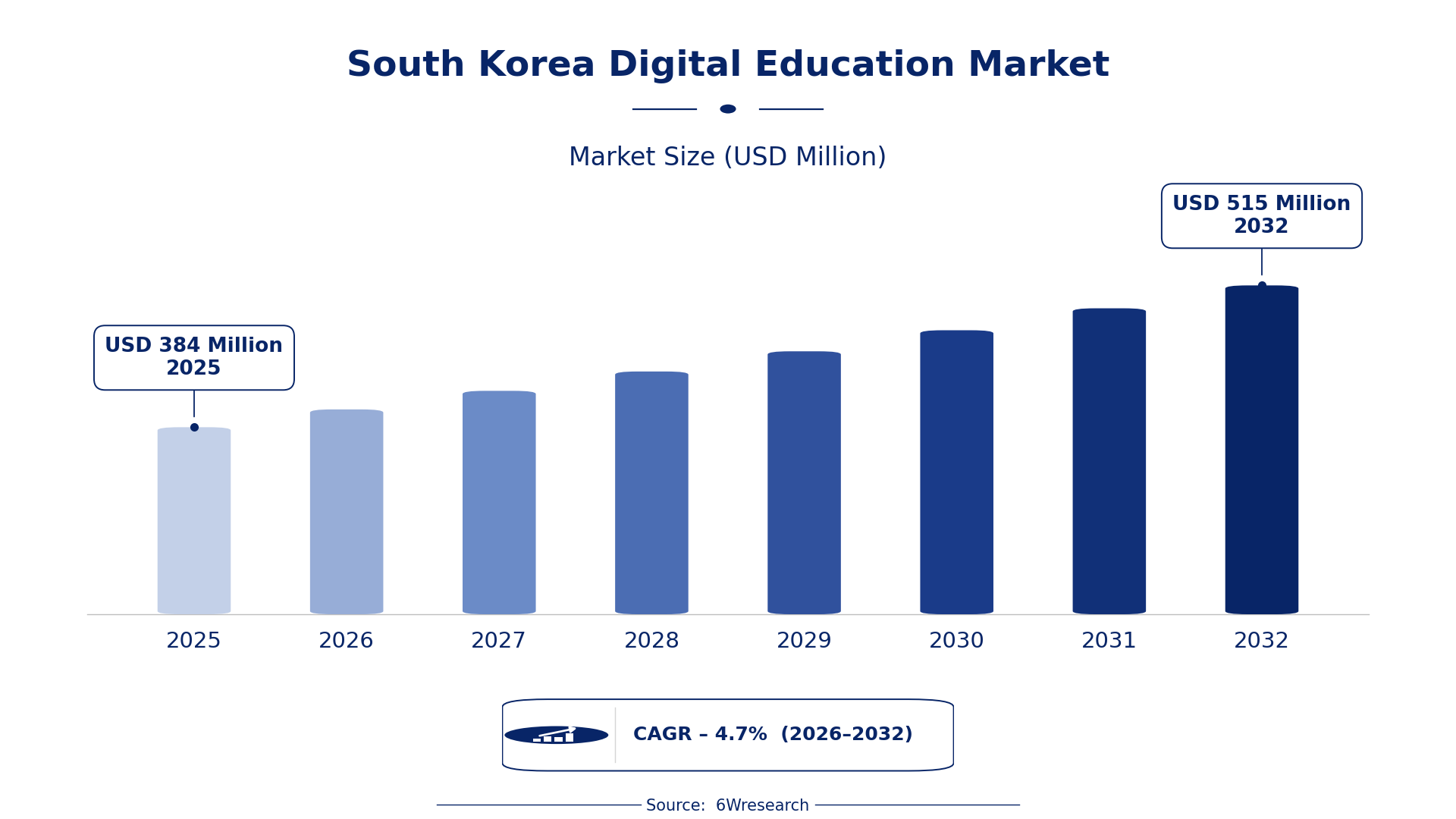
The South Korea Digital Education Market was estimated at USD 384 Million in 2025 and is projected to reach USD 515 Million by 2032, growing at a CAGR of 4.7% from 2026 to 2032.
South Korea Digital Education Market Synopsis
The demand for digital education in South Korea has surged as educational institutions increasingly adopt technology-driven solutions. Online courses, virtual classrooms, and interactive learning tools are becoming central to academic and corporate training environments, enhancing both accessibility and engagement.
Government initiatives aimed at promoting digital literacy are key to this market's expansion. The emphasis on personalized learning experiences is also pushing educational providers to innovate and integrate digital tools, thereby meeting diverse learning needs across various demographics.
South Korea Digital Education Market Year-wise Growth Rate and Key Drivers
This graph illustrates the annual growth rates of the South Korea Digital Education Market from 2021 to 2032, highlighting a steady upward trajectory and projected expansion over the forecast period.
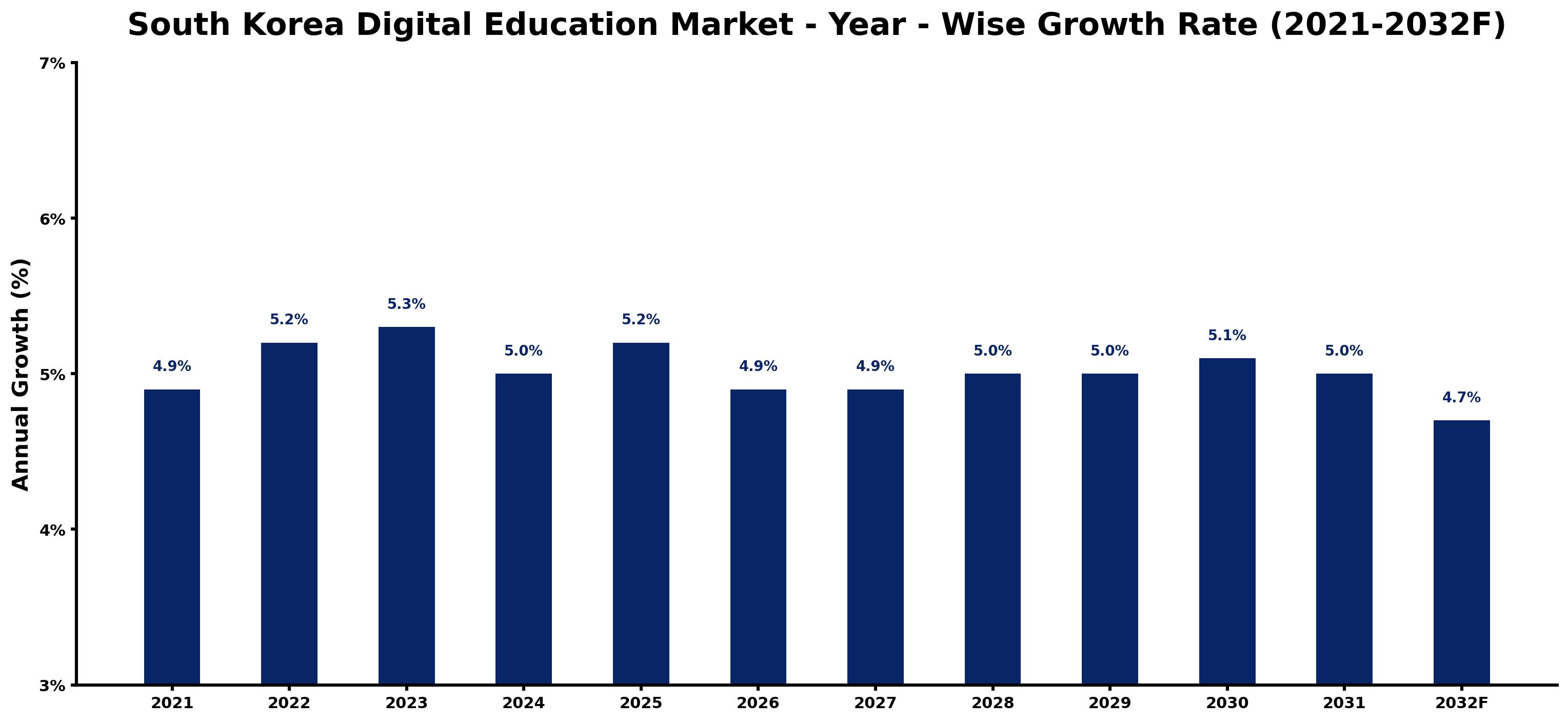
The table below presents the year‑wise growth rates along with the key drivers influencing the market
| Year | Growth Rate | Major Drivers |
| 2021 | 4.9% | Ministry of Education promoting remote learning policies. |
| 2022 | 5.2% | Growing digital literacy among South Korean students. |
| 2023 | 5.3% | Increased popularity of mobile learning applications. |
| 2024 | 5.0% | Subsidies for educational technology in national curriculum. |
| 2025 | 5.2% | Corporate partnerships enhancing digital education resources. |
| 2026 | 4.9% | Local universities expanding online degree programs. |
| 2027 | 4.9% | Emphasis on lifelong learning amid aging population. |
| 2028 | 5.0% | Innovative edtech startups driving market competition. |
| 2029 | 5.0% | Government initiatives for equitable access to technology. |
| 2030 | 5.1% | Focus on AI integration within digital classrooms. |
| 2031 | 5.0% | Support for immersive learning via VR technologies. |
| 2032 | 4.7% | Growth of after-school online tutoring services. |
Note: Market size estimations and growth projections presented in this report are based on 6Wresearch's proprietary forecasting methodology, utilizing the latest available industry data, government publications, and primary research inputs.
South Korea Digital Education Market Key Takeaways
Below are some of the specific key takeaways from the market, including:
- The market is increasingly driven by the adoption of e-learning platforms and digital content delivery.
- Government policies are focused on improving digital literacy and access to technology in education.
- Personalized learning experiences are becoming a standard expectation among students and educators alike.
- Collaboration between educational institutions and technology providers is essential for market growth.
- Challenges related to the digital divide and teacher training remain significant barriers to progress.
Evaluation of Restraints in South Korea Digital Education Market
Despite the favorable environment for digital education, several restraints hinder its full potential. The digital divide remains a crucial issue, particularly in rural areas where access to reliable internet and technology is limited. on top of that, many educators require additional training to effectively integrate digital tools into their teaching methodologies. Without addressing these gaps, the overall effectiveness of digital education initiatives may fall short, impacting student engagement and learning outcomes.
South Korea Digital Education Market Trends
Current trends indicate a shift towards blended learning models that combine traditional and digital methods. The growing popularity of mobile learning applications is making education more accessible to a wider audience. Additionally, data analytics and artificial intelligence are increasingly being utilized to create adaptive learning environments that cater to individual student needs, enhancing overall educational effectiveness.
South Korea Digital Education Market Opportunities
There are ample opportunities for growth in the South Korean digital education market. Investment in adaptive learning technologies can help bridge the gaps in student engagement and achievement. on top of that, initiatives aimed at enhancing broadband connectivity in underserved areas could significantly expand the reach of digital education. With a strong emphasis on lifelong learning, corporate training programs also present lucrative avenues for technology providers to offer tailored solutions.
Government Initiatives in the South Korea Digital Education Market
Government policy plays a crucial role in shaping the direction of the digital education market in South Korea. The focus is on enhancing educational equity, improving infrastructure, and promoting digital literacy through various initiatives. Current policies are designed to encourage schools to adopt digital tools and resources, ensuring that education remains inclusive and accessible.
- A national digital infrastructure upgrade programme launched in early 2025 aims to improve internet access in rural schools.
- Currently ongoing initiatives include a curriculum digitization project that seeks to integrate e-learning resources into traditional teaching frameworks.
- A planned public-private partnership expected to commence in late 2026 aims to develop training programs for educators in digital pedagogy.
- Regulatory frameworks introduced in 2025 focus on data privacy and security in educational technologies, enhancing user trust.
- Recent efforts include a nationwide campaign to increase digital literacy among students and teachers, which began in mid-2025 and remains underway.
Future Insights of the South Korea Digital Education Market
Looking ahead to 2026-2032, the South Korea digital education market is set to experience substantial growth driven by technological advancements and increased government support. The push for personalized learning will likely result in more innovative solutions tailored to individual needs. As institutions continue to adapt to new technologies, the integration of AI and data analytics will further enhance educational outcomes, making digital education an indispensable component of the learning ecosystem.
South Korea Digital Education Market Latest Developments
In the past year, the South Korea digital education market has seen significant activity, indicating a strong commitment to enhancing educational outcomes through technology. Various initiatives have been launched to improve digital access and promote innovative learning solutions across academic institutions.
- A major technology vendor launched an interactive learning platform in early 2025 that integrates gamification to enhance student engagement.
- Currently ongoing is a pilot program in select universities that utilizes virtual reality for immersive learning experiences, started in mid-2025.
- A new service upgrade focused on personalized learning analytics is expected to roll out by late 2026, aimed at helping educators track student progress more effectively.
- A partnership initiative between leading educational institutions and tech companies that began in early 2025 is enhancing the development of tailored e-learning solutions.
- Plans for a nationwide digital literacy curriculum are underway, expected to be implemented in schools by 2027.
South Korea Digital Education Market - Key Attractiveness of the Report
- 10 Years of Market Numbers
- Historical Data Starting from 2022 to 2025
- Base Year: 2025
- Forecast Data until 2032
- Key Performance Indicators Impacting the Market
- Major Upcoming Developments and Projects
Key Highlights of the Report:
- South Korea Digital Education Market Outlook
- Market Size of South Korea Digital Education Market, 2025
- Forecast of South Korea Digital Education Market, 2032
- Historical Data and Forecast of South Korea Digital Education Revenues & Volume for the Period 2022-2032F
- South Korea Digital Education Market Trend Evolution
- South Korea Digital Education Market Drivers and Challenges
- South Korea Digital Education Price Trends
- South Korea Digital Education Porter's Five Forces
- South Korea Digital Education Industry Life Cycle
- Historical Data and Forecast of South Korea Digital Education Market Revenues & Volume By End User for the Period 2022-2032F
- Historical Data and Forecast of South Korea Digital Education Market Revenues & Volume By Academic Institutions for the Period 2022-2032F
- Historical Data and Forecast of South Korea Digital Education Market Revenues & Volume By Enterprises and Public Sector for the Period 2022-2032F
- Historical Data and Forecast of South Korea Digital Education Market Revenues & Volume By Learning Type for the Period 2022-2032F
- Historical Data and Forecast of South Korea Digital Education Market Revenues & Volume By Self-paced Online Education for the Period 2022-2032F
- Historical Data and Forecast of South Korea Digital Education Market Revenues & Volume By Instructor-led Online Education for the Period 2022-2032F
- Historical Data and Forecast of South Korea Digital Education Market Revenues & Volume By Course Type for the Period 2022-2032F
- Historical Data and Forecast of South Korea Digital Education Market Revenues & Volume By Science and Technology Courses for the Period 2022-2032F
- Historical Data and Forecast of South Korea Digital Education Market Revenues & Volume By Entrepreneurship and Business Management Courses for the Period 2022-2032F
- Historical Data and Forecast of South Korea Digital Education Market Revenues & Volume By Other Courses for the Period 2022-2032F
- South Korea Digital Education Import Export Trade Statistics
- Market Opportunity Assessment By End User
- Market Opportunity Assessment By Learning Type
- Market Opportunity Assessment By Course Type
- South Korea Digital Education Top Companies Market Share
- South Korea Digital Education Competitive Benchmarking By Technical and Operational Parameters
- South Korea Digital Education Company Profiles
- South Korea Digital Education Key Strategic Recommendations






































