South Korea Digital Railway Market Size & Growth Rate (2026-2032)
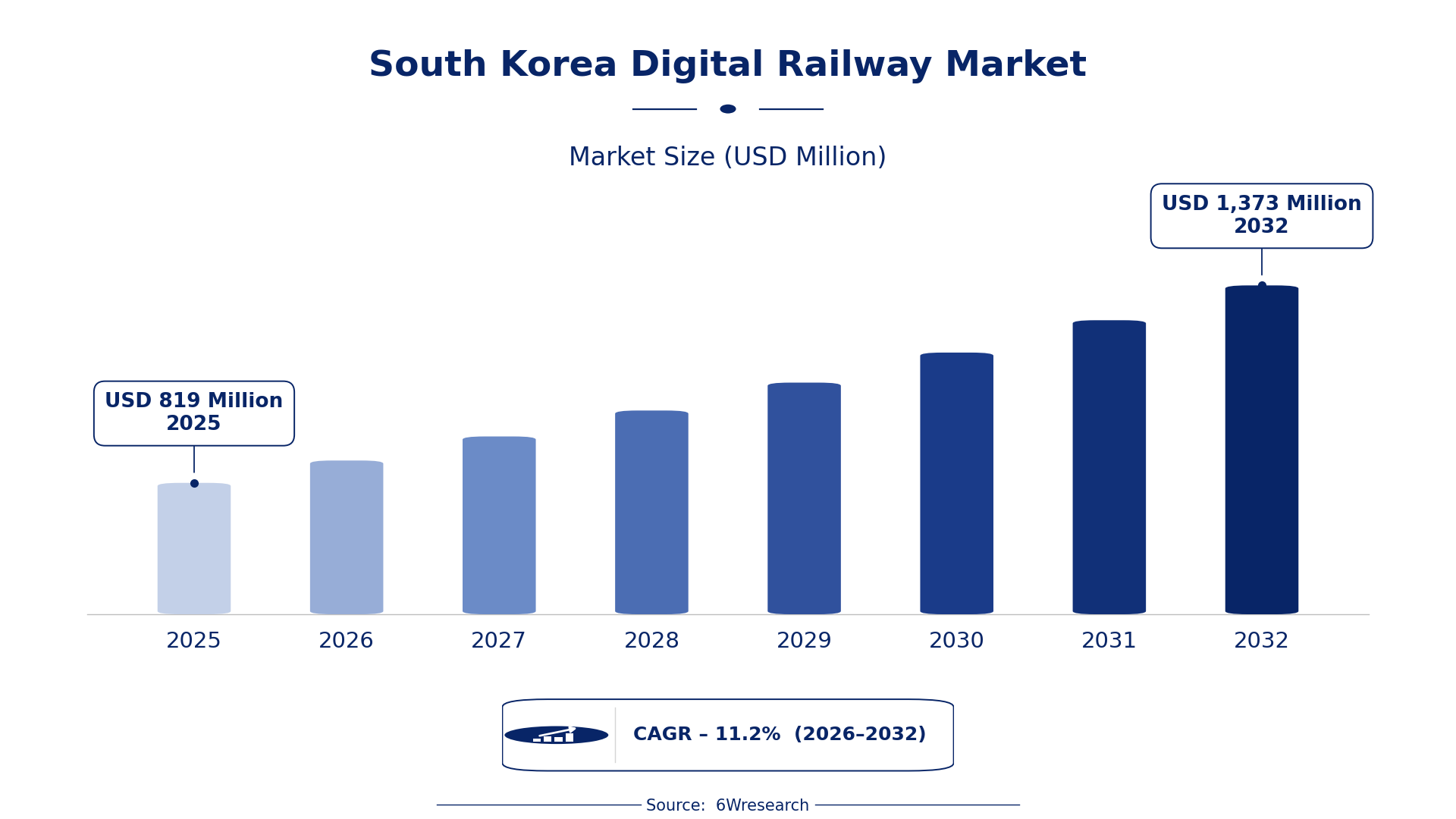
The South Korea Digital Railway Market was estimated at USD 819 Million in 2025 and is projected to reach USD 1373 Million by 2032, growing at a CAGR of 11.2% from 2026 to 2032.
South Korea Digital Railway Market Synopsis
The foremost catalyst driving the South Korea Digital Railway Market is the ongoing modernization of railway infrastructure. Investments are being funneled into advanced digital signaling and train control systems that are critical for safety and efficiency. With urban rail expansion projects gaining momentum, the market is set for substantial growth.
Government support is another key element shaping the market. Regulatory frameworks are evolving to facilitate the integration of innovative technologies while ensuring compliance with safety standards. This push for modernization is not just about upgrading existing systems, but creating a future-ready rail network that meets urban mobility demands.
South Korea Digital Railway Market Year-wise Growth Rate and Key Drivers
This graph illustrates the annual growth rates of the South Korea Digital Railway Market from 2021 to 2032, highlighting a steady upward trajectory and projected expansion over the forecast period.
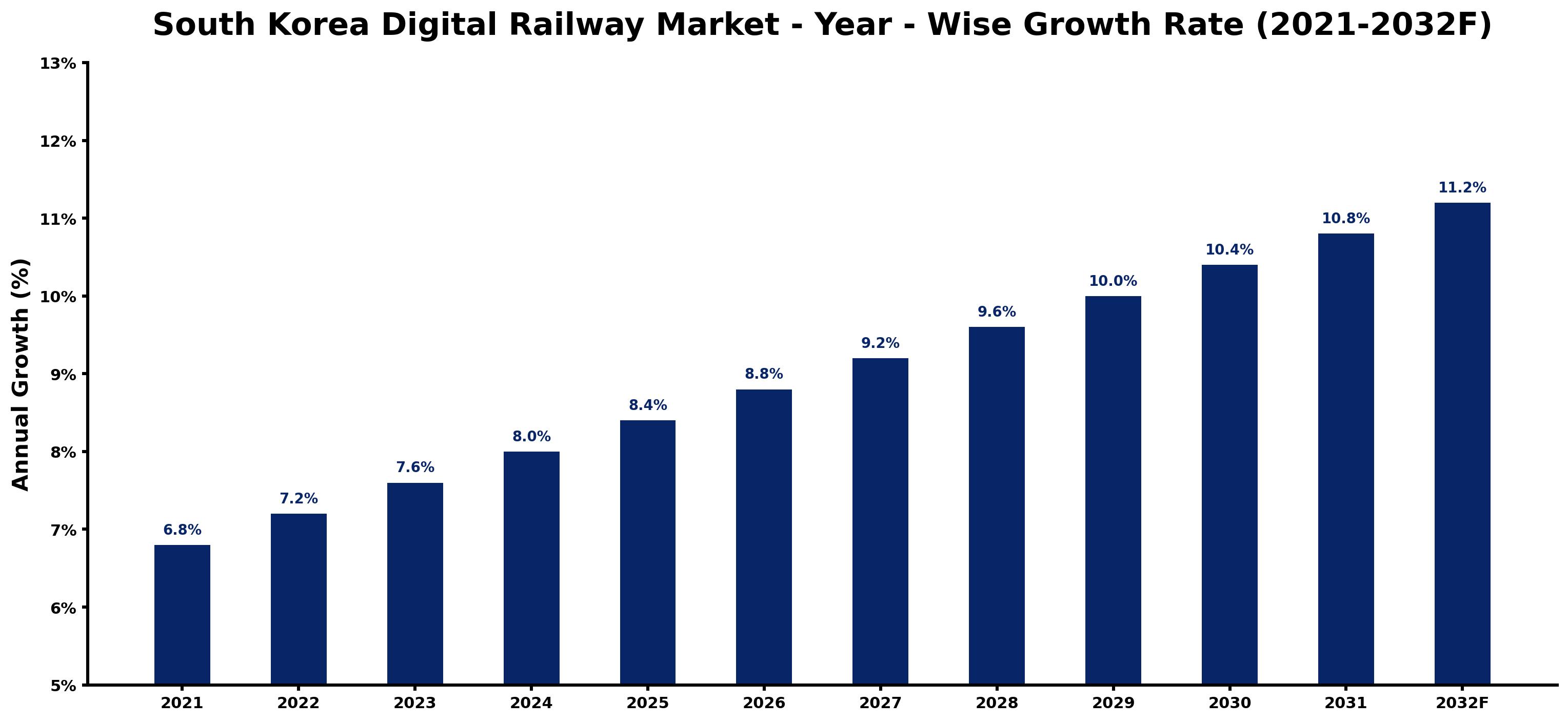
The table below presents the year‑wise growth rates along with the key drivers influencing the market
| Year | Growth Rate | Major Drivers |
| 2021 | 6.8% | Korean Government's Green New Deal investment in railways |
| 2022 | 7.2% | Increased urbanization boosting demand for efficient transit |
| 2023 | 7.6% | Adoption of smart signaling technology enhancing efficiency |
| 2024 | 8.0% | Korea Rail Network Authority expanding high-speed routes |
| 2025 | 8.4% | Investment in IoT for predictive maintenance initiatives |
| 2026 | 8.8% | Growing focus on reducing carbon emissions in transport |
| 2027 | 9.2% | Public-private partnerships enhancing digital railway services |
| 2028 | 9.6% | National policy promoting seamless multi-modal transport solutions |
| 2029 | 10.0% | Advancements in AI for optimizing train scheduling |
| 2030 | 10.4% | Legislation supporting digital ticketing and payment systems |
| 2031 | 10.8% | Rising passenger expectations driving service upgrades |
| 2032 | 11.2% | Government initiatives for improved cross-border rail connections |
Note: Market size estimations and growth projections presented in this report are based on 6Wresearch's proprietary forecasting methodology, utilizing the latest available industry data, government publications, and primary research inputs.
South Korea Digital Railway Market Key Takeaways
Below are some of the specific key takeaways from the market, including:
- The integration of digital signaling and control systems is essential for enhancing railway safety and operational efficiency.
- Urban rail expansion projects are significantly contributing to the market's growth trajectory.
- Investment in predictive maintenance systems is optimizing rail operations and improving passenger experience.
- Cybersecurity remains a pressing concern that needs to be addressed to protect railway operations from potential threats.
- Government policies are increasingly focusing on sustainable transportation solutions and infrastructure modernization.
Evaluation of Restraints in South Korea Digital Railway Market
Despite the promising outlook, the South Korea Digital Railway Market faces notable restraints. Aging infrastructure requires extensive upgrades, which demand considerable investment and time. Interoperability among various railway systems presents another challenge; aligning different technologies and platforms is essential for seamless operations. Lastly, cybersecurity vulnerabilities pose a threat to the integrity and safety of digital railway systems, necessitating robust solutions to mitigate risks.
South Korea Digital Railway Market Trends
A number of trends are emerging in the South Korea Digital Railway Market. The increasing adoption of Internet of Things (IoT) technology is transforming train operations, enabling real-time monitoring and data analytics. Additionally, the focus on sustainable transportation solutions is driving investments in energy-efficient systems. The shift toward automated train control systems is also gaining traction, aimed at improving reliability and safety.
South Korea Digital Railway Market Opportunities
The opportunities for growth in this market are substantial. Urban rail expansion offers a fertile ground for investment, particularly in digital signaling and automated control systems. Additionally, the integration of AI and predictive analytics presents avenues for optimizing operations and enhancing passenger services. As regulatory frameworks continue to evolve, new projects aimed at modernizing existing infrastructure will emerge, inviting further investment.
Government Initiatives in the South Korea Digital Railway Market
Government initiatives are fundamentally shaping the South Korea Digital Railway Market. The focus is on modernizing railway infrastructure while ensuring safety and sustainability in transportation systems. Recent regulatory frameworks have emphasized interoperability among digital railway systems, which is crucial for enhancing operational efficiency. These policies aim to meet the growing urban mobility demands while promoting innovative technologies.
- A recently completed initiative involved upgrading signaling systems across major urban rail lines, enhancing operational efficiency and safety.
- A current program is underway to implement advanced passenger information systems that improve communication and service delivery.
- A planned public-private partnership aims to develop a comprehensive digital railway framework expected to roll out by late 2026.
- The government has introduced a regulatory framework mandating compliance with environmental standards for new railway projects initiated in 2025.
Future Insights of the South Korea Digital Railway Market
Looking ahead to 2026-2032, the South Korea Digital Railway Market is positioned for significant transformation. Continued investment in digital technologies will be key to enhancing safety and operational efficiency. The integration of AI and IoT will likely redefine train operations, making them more efficient and responsive to passenger needs. As urbanization continues to drive demand for public transport, the railway sector will increasingly adapt to meet these challenges through innovative solutions.
South Korea Digital Railway Market Latest Developments
In the past year, the South Korea Digital Railway Market has seen a flurry of activity aimed at enhancing operational efficiency and safety. The focus has been on integrating advanced digital technologies to improve the passenger experience and streamline operations. As stakeholders adapt to evolving market demands, a clear trend toward sustainable and efficient solutions has emerged.
- A major technology vendor launched a new predictive maintenance system in early 2025, which is currently being implemented across multiple railway networks.
- An ongoing initiative to integrate IoT solutions into train operations began in mid-2025, enhancing real-time monitoring capabilities.
- A rollout of enhanced train control systems is expected to begin in Q3 2026, aiming to improve safety protocols across urban rail lines.
- A partnership between railway operators and technology firms to develop smart ticketing solutions has been initiated and is currently underway.
South Korea Digital Railway Market - Key Attractiveness of the Report
- 10 Years of Market Numbers
- Historical Data Starting from 2022 to 2025
- Base Year: 2025
- Forecast Data until 2032
- Key Performance Indicators Impacting the Market
- Major Upcoming Developments and Projects
Key Highlights of the Report:
- South Korea Digital Railway Market Outlook
- Market Size of South Korea Digital Railway Market, 2025
- Forecast of South Korea Digital Railway Market, 2032
- Historical Data and Forecast of South Korea Digital Railway Revenues & Volume for the Period 2022-2032F
- South Korea Digital Railway Market Trend Evolution
- South Korea Digital Railway Market Drivers and Challenges
- South Korea Digital Railway Price Trends
- South Korea Digital Railway Porter's Five Forces
- South Korea Digital Railway Industry Life Cycle
- Historical Data and Forecast of South Korea Digital Railway Market Revenues & Volume By Application for the Period 2022-2032F
- Historical Data and Forecast of South Korea Digital Railway Market Revenues & Volume By Rail operations management for the Period 2022-2032F
- Historical Data and Forecast of South Korea Digital Railway Market Revenues & Volume By Passenger Information System for the Period 2022-2032F
- Historical Data and Forecast of South Korea Digital Railway Market Revenues & Volume By Asset Management for the Period 2022-2032F
- Historical Data and Forecast of South Korea Digital Railway Market Revenues & Volume By Other Applications (other aplications includes connectivity and communication) for the Period 2022-2032F
- Historical Data and Forecast of South Korea Digital Railway Market Revenues & Volume By Services for the Period 2022-2032F
- Historical Data and Forecast of South Korea Digital Railway Market Revenues & Volume By Managed Services for the Period 2022-2032F
- Historical Data and Forecast of South Korea Digital Railway Market Revenues & Volume By Professional Service for the Period 2022-2032F
- Historical Data and Forecast of South Korea Digital Railway Market Revenues & Volume By Solutions for the Period 2022-2032F
- Historical Data and Forecast of South Korea Digital Railway Market Revenues & Volume By Remote Monitoring for the Period 2022-2032F
- Historical Data and Forecast of South Korea Digital Railway Market Revenues & Volume By Route Optimization And Scheduling for the Period 2022-2032F
- Historical Data and Forecast of South Korea Digital Railway Market Revenues & Volume By Analytics for the Period 2022-2032F
- Historical Data and Forecast of South Korea Digital Railway Market Revenues & Volume By Network management for the Period 2022-2032F
- Historical Data and Forecast of South Korea Digital Railway Market Revenues & Volume By Predictive maintenance for the Period 2022-2032F
- Historical Data and Forecast of South Korea Digital Railway Market Revenues & Volume By Security for the Period 2022-2032F
- Historical Data and Forecast of South Korea Digital Railway Market Revenues & Volume By Other Solutions for the Period 2022-2032F
- South Korea Digital Railway Import Export Trade Statistics
- Market Opportunity Assessment By Application
- Market Opportunity Assessment By Services
- Market Opportunity Assessment By Solutions
- South Korea Digital Railway Top Companies Market Share
- South Korea Digital Railway Competitive Benchmarking By Technical and Operational Parameters
- South Korea Digital Railway Company Profiles
- South Korea Digital Railway Key Strategic Recommendations






































