South Korea Digital Twin Market Size, Share & Growth Rate
The South Korea Digital Twin Market was estimated at USD 468 Million in 2025 and is projected to reach USD 627 Million by 2032, growing at a CAGR of 4.3% from 2026 to 2032. This growth trajectory is being fueled by a surge in the adoption of advanced technologies such as IoT and AI across various sectors. In particular, industries like manufacturing and healthcare are increasingly leveraging digital twins for enhanced operational efficiency and predictive maintenance.
South Korea Digital Twin Market Year-wise Growth Rate and Key Drivers
This graph highlights how the South Korea Digital Twin Market has steadily grown over the years, supported by major growth factors.
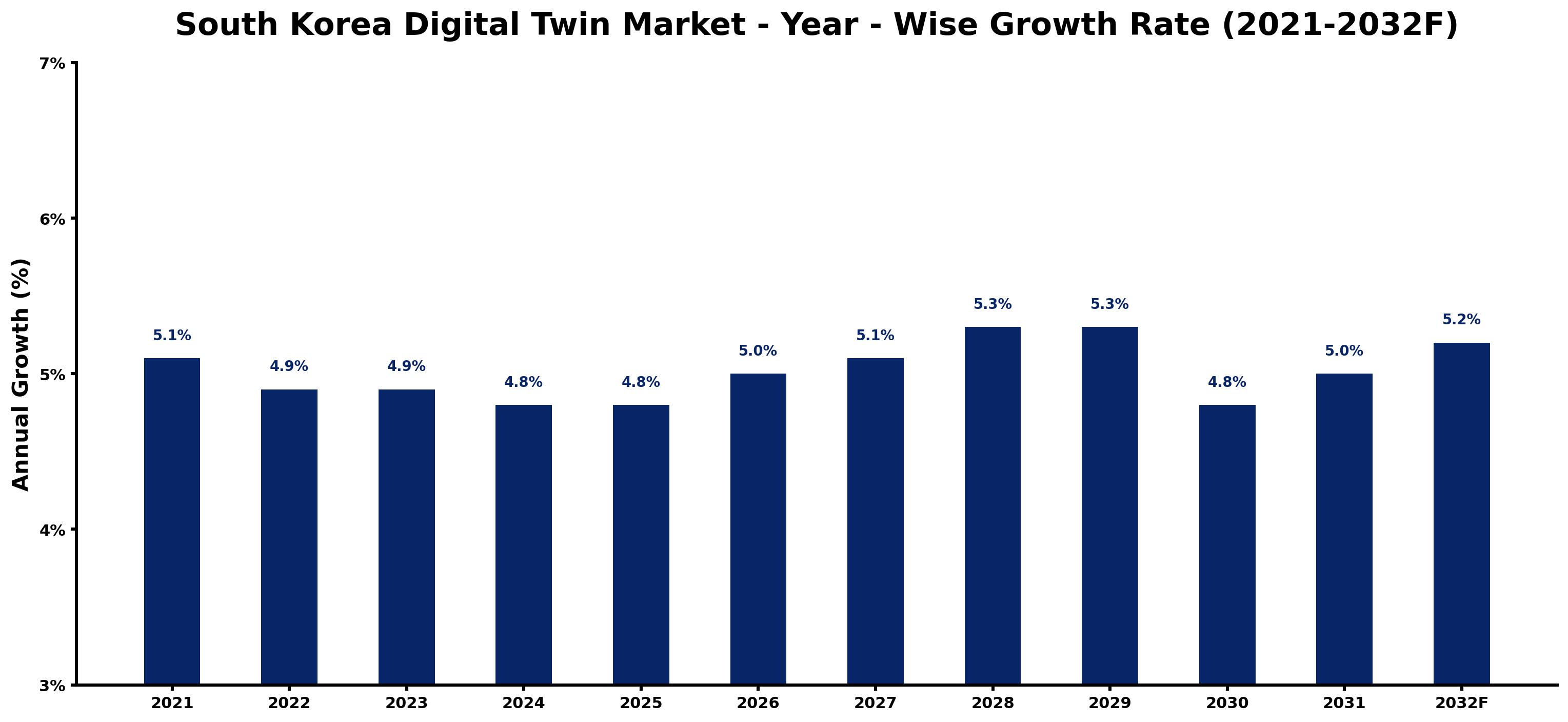
The table below presents the year‑wise growth rates along with the key drivers influencing the market
| Year | Growth Rate | Major Drivers |
| 2021 | 5.1% | Increasing adoption of advanced technologies |
| 2022 | 4.9% | Rapid growth in telecom and data center sectors |
| 2023 | 4.9% | Increasing industrial automation investments |
| 2024 | 4.8% | Expansion of manufacturing activities |
| 2025 | 4.8% | Rapid growth in telecom and data center sectors |
| 2026 | 5.0% | Rising electricity demand across industries |
| 2027 | 5.1% | Government infrastructure modernization initiatives |
| 2028 | 5.3% | Expansion of commercial construction activities |
| 2029 | 5.3% | Expansion of transportation and logistics networks |
| 2030 | 4.8% | Increasing industrial automation investments |
| 2031 | 5.0% | Increasing industrial infrastructure investments |
| 2032 | 5.2% | Increasing industrial infrastructure investments |
Note - Market size estimations and growth projections presented in this report are based on 6Wresearch’s advanced forecasting approach, validated with industry datasets as of June 2026.
South Korea Digital Twin Market Synopsis
Recently, the South Korea Digital Twin Market has witnessed robust momentum driven by advancements in cloud computing and machine learning, propelling real-time monitoring and decision-making capabilities. However, as industries strive for greater digital transformation, the market is poised for further evolution, particularly with the rise of 5G technology enabling even more complex applications.
The intersection of sustainability and digital innovation stands as a critical focal point for the future of the market. Organizations are beginning to realize the value of eco-friendly digital twins, which are designed to enhance energy efficiency and minimize environmental impact. As such, this emerging direction is expected to shape the landscape of digital twin solutions in South Korea.
South Korea Digital Twin Market Key Takeaways
- The market is experiencing significant growth due to the increasing integration of AI and IoT technologies.
- Cloud-based solutions are becoming increasingly popular, offering scalability and flexibility for various applications.
- Sustainability concerns are driving the development of eco-friendly digital twins across industries.
- The government actively promotes digital transformation initiatives, which support market growth.
- Investment opportunities abound in sectors such as healthcare, manufacturing, and smart cities.
Evaluation of Restraints in South Korea Digital Twin Market
Despite the promising outlook, the South Korea Digital Twin Market faces several significant restraints. Data privacy and security remain a major concern, as organizations must protect sensitive information while creating virtual replicas of physical assets. Moreover, the integration of diverse systems and data sources presents technical challenges that can hinder accurate updates and functionality of digital twins. Additionally, the shortage of skilled professionals adept at implementing these technologies adds another layer of complexity for companies looking to adopt digital twin solutions effectively.
South Korea Digital Twin Market Trends
Current trends in the South Korea Digital Twin Market are being shaped by advancements in AI and machine learning, which enhance the capabilities of digital twins. Furthermore, the emergence of 5G technology is set to revolutionize real-time data processing, facilitating more sophisticated applications. The focus on sustainable practices is also gaining traction, with companies investing in eco-friendly digital solutions that aim to improve energy efficiency and reduce carbon footprints.
South Korea Digital Twin Market Opportunities
The South Korea Digital Twin Market presents ample investment opportunities, especially in manufacturing, healthcare, and smart city developments. Companies offering digital twin software and IoT devices stand to benefit as demand increases for advanced solutions. Moreover, collaborations with South Korean organizations to implement digital twin projects can unlock new avenues for growth, leveraging the country's robust technological infrastructure.
Government Initiatives in the South Korea Digital Twin Market
The South Korean government is actively fostering the adoption of digital twin technologies across various industries. Through initiatives like the Digital Twin Convergence Alliance, launched by the Ministry of SMEs and Startups, efforts are being made to accelerate implementation in sectors such as manufacturing and smart cities. The government is also allocating resources for research and development projects aimed at advancing digital twin applications, further solidifying its commitment to digital transformation.
Future Insights of the South Korea Digital Twin Market
Looking ahead to 2026-2032, the South Korea Digital Twin Market is expected to continue its upward trajectory, driven by a growing emphasis on real-time insights and predictive maintenance capabilities. As industries embrace digital transformation, the demand for sophisticated digital twin solutions is likely to surge, particularly in sectors heavily reliant on operational efficiency. This alignment of technology, market needs, and government support is set to create a robust ecosystem for sustained growth and innovation.
South Korea Digital Twin Market Latest Developments (May 2025 - June 2026)
In the past year, significant advancements in the South Korea Digital Twin Market have been observed. Companies are increasingly focusing on enhancing their digital twin solutions to accommodate the growing need for real-time data processing and predictive analytics. Collaborative projects between government entities and private firms have also emerged, aimed at creating more integrated digital twin frameworks that improve operational efficiency across various sectors. Additionally, the emphasis on sustainable practices continues to influence the development of eco-friendly digital twin technologies.
South Korea Digital Twin Market - Key Attractiveness of the Report
- 10 Years of Market Numbers
- Historical Data Starting from 2022 to 2025
- Base Year: 2025
- Forecast Data until 2032
- Key Performance Indicators Impacting the Market
- Major Upcoming Developments and Projects
Key Highlights of the Report:
- South Korea Digital Twin Market Outlook
- Market Size of South Korea Digital Twin Market, 2025
- Forecast of South Korea Digital Twin Market, 2032
- Historical Data and Forecast of South Korea Digital Twin Revenues & Volume for the Period 2022-2032F
- South Korea Digital Twin Market Trend Evolution
- South Korea Digital Twin Market Drivers and Challenges
- South Korea Digital Twin Price Trends
- South Korea Digital Twin Porter's Five Forces
- South Korea Digital Twin Industry Life Cycle
- Historical Data and Forecast of South Korea Digital Twin Market Revenues & Volume By End-users for the Period 2022-2032F
- Historical Data and Forecast of South Korea Digital Twin Market Revenues & Volume By Automotive & Defense for the Period 2022-2032F
- Historical Data and Forecast of South Korea Digital Twin Market Revenues & Volume By Home & Commercial for the Period 2022-2032F
- Historical Data and Forecast of South Korea Digital Twin Market Revenues & Volume By Healthcare for the Period 2022-2032F
- Historical Data and Forecast of South Korea Digital Twin Market Revenues & Volume By Energy & Utilities for the Period 2022-2032F
- Historical Data and Forecast of South Korea Digital Twin Market Revenues & Volume By Electronics & Electrical Manufacturing for the Period 2022-2032F
- Historical Data and Forecast of South Korea Digital Twin Market Revenues & Volume By Others for the Period 2022-2032F
- Historical Data and Forecast of South Korea Digital Twin Market Revenues & Volume By Applications for the Period 2022-2032F
- Historical Data and Forecast of South Korea Digital Twin Market Revenues & Volume By Product Design and Development for the Period 2022-2032F
- Historical Data and Forecast of South Korea Digital Twin Market Revenues & Volume By Machine and Equipment Health Monitoring for the Period 2022-2032F
- Historical Data and Forecast of South Korea Digital Twin Market Revenues & Volume By Predictive Maintenance for the Period 2022-2032F
- Historical Data and Forecast of South Korea Digital Twin Market Revenues & Volume By Dynamic Optimization for the Period 2022-2032F
- South Korea Digital Twin Import Export Trade Statistics
- Market Opportunity Assessment By End-users
- Market Opportunity Assessment By Applications
- South Korea Digital Twin Top Companies Market Share
- South Korea Digital Twin Competitive Benchmarking By Technical and Operational Parameters
- South Korea Digital Twin Company Profiles
- South Korea Digital Twin Key Strategic Recommendations






































