South Korea Electrical Testing Equipment Market Size, Share & Growth Rate
The South Korea Electrical Testing Equipment Market was estimated at USD 191 Million in 2025 and is projected to reach USD 255 Million by 2032, growing at a CAGR of 4.2% from 2026 to 2032. This upward trajectory is driven by the surging demand for sophisticated testing solutions across key sectors such as electronics, automotive, and energy. The increasing emphasis on safety standards and compliance, combined with technological advancements, is further propelling market growth as industries strive for efficiency and reliability.
South Korea Electrical Testing Equipment Market Year-wise Growth Rate and Key Drivers
This graph highlights how the South Korea Electrical Testing Equipment Market has steadily grown over the years, supported by major growth factors.
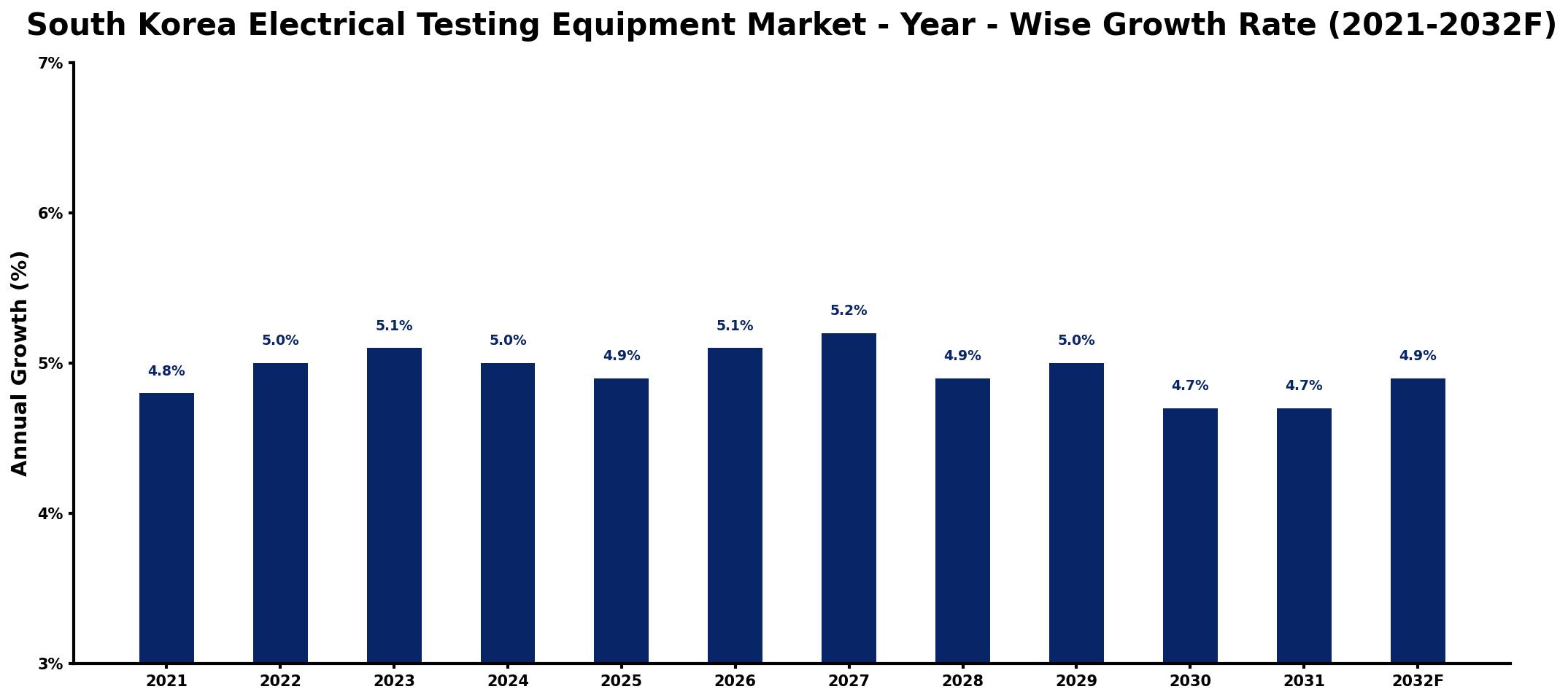
The table below presents the year‑wise growth rates along with the key drivers influencing the market
| Year | Growth Rate | Major Drivers |
| 2021 | 4.8% | Rising construction sector investments |
| 2022 | 5.0% | Increased regulatory compliance requirements |
| 2023 | 5.1% | Growth in renewable energy projects |
| 2024 | 5.0% | Expansion of manufacturing capabilities |
| 2025 | 4.9% | Boost in infrastructure development projects |
| 2026 | 5.1% | Surge in technological innovations |
| 2027 | 5.2% | Growing demand for safety standards |
| 2028 | 4.9% | Increase in automation adoption rate |
| 2029 | 5.0% | Enhanced focus on sustainability initiatives |
| 2030 | 4.7% | Shift towards digital transformation |
| 2031 | 4.7% | Growing importance of energy efficiency |
| 2032 | 4.9% | Rise in smart grid investments |
Note: Market size estimations and growth projections presented in this report are based on 6Wresearch's proprietary forecasting methodology, utilizing the latest available industry data, government publications, and primary research inputs.
South Korea Electrical Testing Equipment Market Synopsis
In recent years, the South Korea Electrical Testing Equipment Market has witnessed steady growth, largely supported by innovations and a growing awareness of safety in various industries. As businesses increasingly adopt advanced technologies, the demand for reliable testing solutions is projected to intensify, positioning the market for robust expansion.
Looking ahead, the market stands at a pivotal point where the integration of digital technologies, such as IoT and cloud-based monitoring, will reshape testing practices. These innovations are expected to meet the evolving demands of sectors reliant on electrical equipment, allowing for enhanced performance and reliability.
South Korea Electrical Testing Equipment Market Key Takeaways
- The market is poised for substantial growth driven by technological advancements and safety compliance.
- Portable and handheld devices are gaining traction, providing flexibility for on-site testing.
- Integration of digital solutions enhances data analysis capabilities, supporting predictive maintenance.
- Investment opportunities are flourishing due to infrastructure development and automation needs.
- Government regulations are increasingly promoting energy-efficient and eco-friendly testing equipment.
Evaluation of Restraints in South Korea Electrical Testing Equipment Market
The South Korea Electrical Testing Equipment Market faces several restraints that could impede its growth. Chief among these is the intense competition among both domestic and international manufacturers, which can pressure profit margins and push companies to innovate continually. Additionally, the rapidly evolving nature of technology necessitates frequent upgrades and adaptations of testing equipment to stay relevant. Economic uncertainties may also dampen investments in critical infrastructure projects, which are significant consumers of electrical testing equipment. Lastly, cultural preferences for established brands can pose challenges for new entrants trying to penetrate this competitive landscape.
South Korea Electrical Testing Equipment Market Trends
Current trends in the South Korea Electrical Testing Equipment Market indicate a strong shift towards advanced testing solutions that ensure the safety and reliability of electrical systems. The rise in demand for portable devices underscores the need for convenience in on-site testing, making these tools essential for immediate troubleshooting. Furthermore, the adoption of IoT and cloud technology is creating a new paradigm in electrical testing, allowing for more sophisticated data management and analysis, crucial for predictive maintenance.
South Korea Electrical Testing Equipment Market Opportunities
The South Korea Electrical Testing Equipment Market presents a wealth of investment opportunities driven by infrastructural growth and heightened focus on technological innovation. Companies that can deliver high-quality, advanced testing equipment—such as voltage testers, insulation testers, and power quality analyzers—are well-positioned to tap into the burgeoning demand for reliable electrical systems across industries such as manufacturing, energy, and construction. With increasing government support for innovation and sustainability, the market is ripe for organizations that can align their offerings with these evolving priorities.
Government Initiatives in the South Korea Electrical Testing Equipment Market
The South Korean government plays a vital role in regulating the Electrical Testing Equipment Market to ensure product safety and compliance with international standards. The Korean Agency for Technology and Standards (KATS) oversees the certification process, focusing on quality assurance. Moreover, the Ministry of Trade, Industry, and Energy (MOTIE) actively promotes R&D initiatives, fostering collaborations between industry stakeholders and research institutions. This synergy aims to enhance technological advancements and competitiveness while also prioritizing eco-friendly practices in electrical testing equipment.
Future Insights of the South Korea Electrical Testing Equipment Market
As we look towards the years 2026 to 2032, the South Korea Electrical Testing Equipment Market is projected to experience steady expansion. The ongoing investments in infrastructure development and the continued growth of the electronics and electrical manufacturing sectors will drive demand. Moreover, the integration of advanced technologies, including AI and automation, will further enhance testing methodologies. As industries increasingly prioritize compliance and quality assurance, the demand for sophisticated electrical testing equipment is expected to rise significantly, making it an attractive sector for investment and innovation.
South Korea Electrical Testing Equipment Market Latest Developments (2025 - 2026)
In the recent months leading up to mid-2026, the South Korea Electrical Testing Equipment Market has witnessed numerous advancements aimed at improving testing accuracy and efficiency. Companies are increasingly focusing on integrating smart technologies into their devices, enabling enhanced user experiences and remote functionalities. Furthermore, industry events and trade shows have highlighted emerging innovations in portable testing solutions, showcasing a trend towards more flexible and adaptable equipment for field applications. Collaborative efforts between manufacturers and tech firms are also shaping the future landscape of this market.
South Korea Electrical Testing Equipment Market - Key Attractiveness of the Report
- 10 Years of Market Numbers
- Historical Data Starting from 2022 to 2025
- Base Year: 2025
- Forecast Data until 2032
- Key Performance Indicators Impacting the Market
- Major Upcoming Developments and Projects
Key Highlights of the Report:
- South Korea Electrical Testing Equipment Market Outlook
- Market Size of South Korea Electrical Testing Equipment Market, 2025
- Forecast of South Korea Electrical Testing Equipment Market, 2032
- Historical Data and Forecast of South Korea Electrical Testing Equipment Revenues & Volume for the Period 2022-2032F
- South Korea Electrical Testing Equipment Market Trend Evolution
- South Korea Electrical Testing Equipment Market Drivers and Challenges
- South Korea Electrical Testing Equipment Price Trends
- South Korea Electrical Testing Equipment Porter's Five Forces
- South Korea Electrical Testing Equipment Industry Life Cycle
- Historical Data and Forecast of South Korea Electrical Testing Equipment Market Revenues & Volume By Service Type for the Period 2022-2032F
- Historical Data and Forecast of South Korea Electrical Testing Equipment Market Revenues & Volume By Electrical Testing Equipment Calibration Services for the Period 2022-2032F
- Historical Data and Forecast of South Korea Electrical Testing Equipment Market Revenues & Volume By Electrical Testing Equipment Repair Services or After Sales Services for the Period 2022-2032F
- Historical Data and Forecast of South Korea Electrical Testing Equipment Market Revenues & Volume By Product Type for the Period 2022-2032F
- Historical Data and Forecast of South Korea Electrical Testing Equipment Market Revenues & Volume By General Purpose Electrical Testing Equipment for the Period 2022-2032F
- Historical Data and Forecast of South Korea Electrical Testing Equipment Market Revenues & Volume By Mechanical Electrical Test Equipment for the Period 2022-2032F
- Historical Data and Forecast of South Korea Electrical Testing Equipment Market Revenues & Volume By End User for the Period 2022-2032F
- Historical Data and Forecast of South Korea Electrical Testing Equipment Market Revenues & Volume By Aerospace and Defense for the Period 2022-2032F
- Historical Data and Forecast of South Korea Electrical Testing Equipment Market Revenues & Volume By Telecommunications for the Period 2022-2032F
- Historical Data and Forecast of South Korea Electrical Testing Equipment Market Revenues & Volume By Semiconductor and Electronics for the Period 2022-2032F
- South Korea Electrical Testing Equipment Import Export Trade Statistics
- Market Opportunity Assessment By Service Type
- Market Opportunity Assessment By Product Type
- Market Opportunity Assessment By End User
- South Korea Electrical Testing Equipment Top Companies Market Share
- South Korea Electrical Testing Equipment Competitive Benchmarking By Technical and Operational Parameters
- South Korea Electrical Testing Equipment Company Profiles
- South Korea Electrical Testing Equipment Key Strategic Recommendations






































