South Korea End User Computing Market Size & Growth Rate (2026-2032)
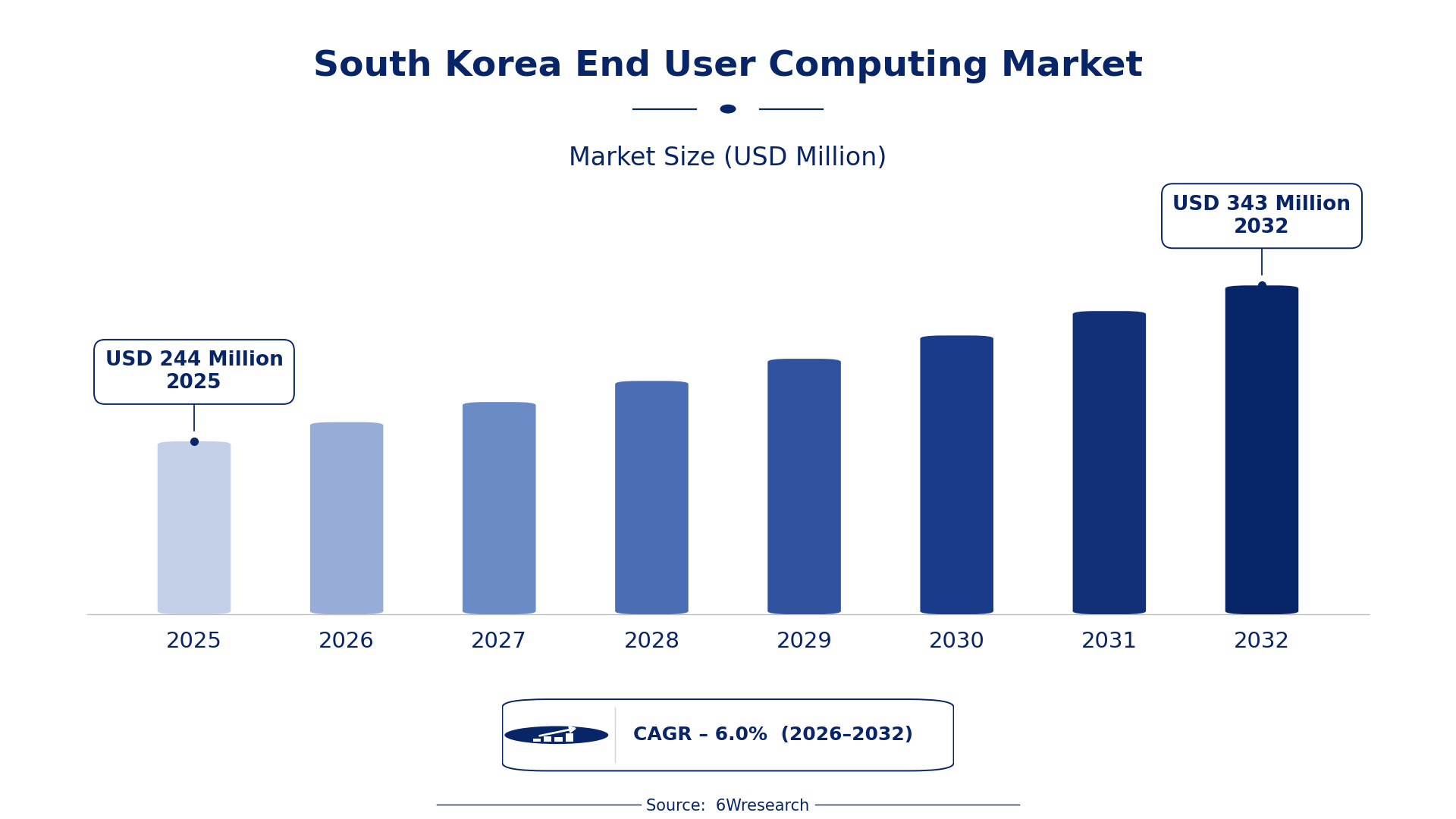
The South Korea End User Computing Market was estimated at USD 244 Million in 2025 and is projected to reach USD 343 Million by 2032, growing at a CAGR of 6.0% from 2026 to 2032.
South Korea End User Computing Market Synopsis
The demand for end user computing solutions in South Korea is accelerating, driven by the increasing reliance on remote work and digital collaboration. Businesses are investing heavily in modern devices and advanced technologies to ensure their workforce remains efficient and connected, leading to a surge in the adoption of laptops, tablets, and other mobile devices.
Cloud computing and virtualization technologies are becoming staples in corporate IT strategies, further pushing the growth of this market. As South Korean companies aim for greater productivity, the need for secure and reliable end user computing environments continues to rise, creating ample opportunities for innovation and investment.
South Korea End User Computing Market Year-wise Growth Rate and Key Drivers
This graph illustrates the annual growth rates of the South Korea End User Computing Market from 2021 to 2032, highlighting a steady upward trajectory and projected expansion over the forecast period.
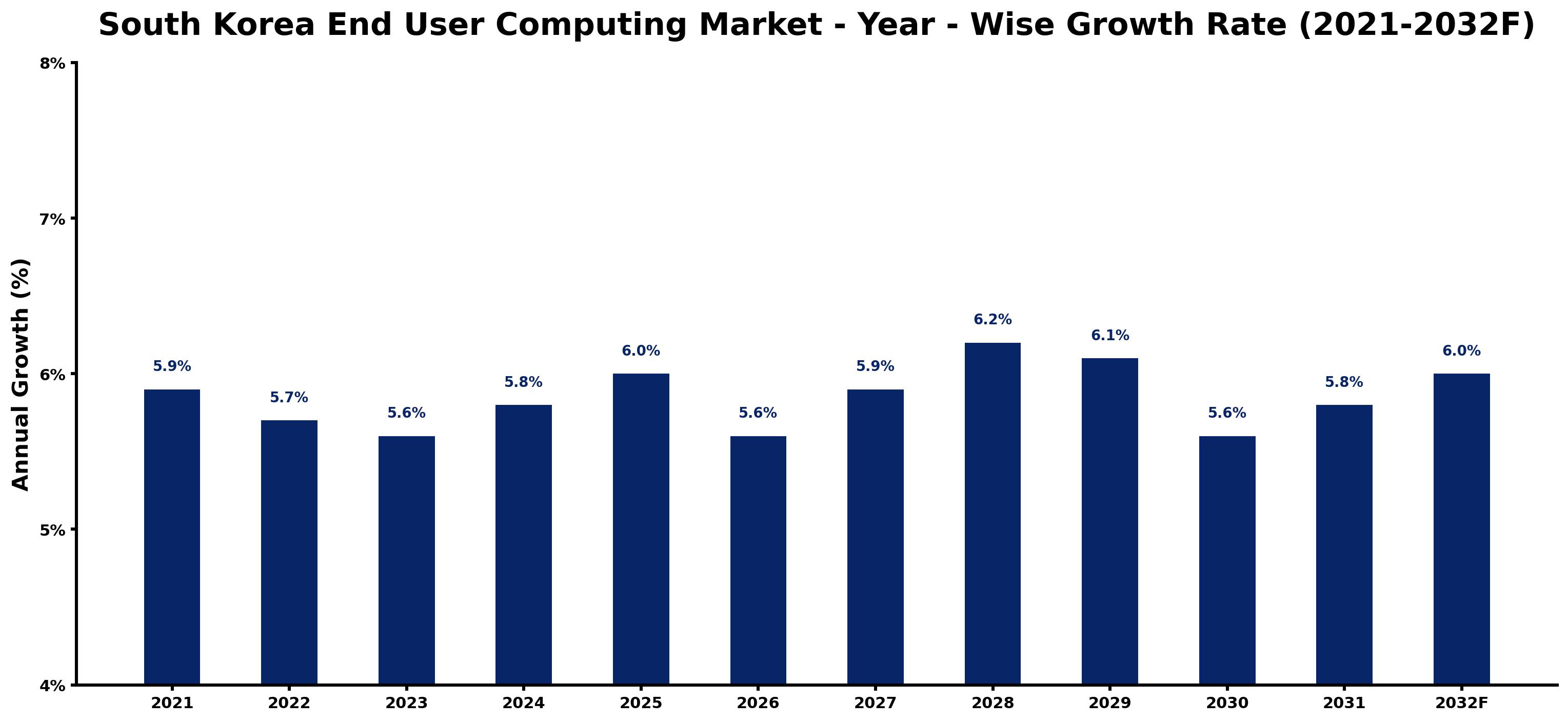
The table below presents the year‑wise growth rates along with the key drivers influencing the market
| Year | Growth Rate | Major Drivers |
| 2021 | 5.9% | Increased adoption of cloud-based applications in education. |
| 2022 | 5.7% | Growing interest in virtual collaboration tools by enterprises. |
| 2023 | 5.6% | Emerging AI-driven analytics for end user productivity. |
| 2024 | 5.8% | Government funding for smart education initiatives boosting demand. |
| 2025 | 6.0% | Rise in mobile computing requirements among millennials. |
| 2026 | 5.6% | Strong demand for cybersecurity solutions in remote work. |
| 2027 | 5.9% | South Korea's digital currency initiatives driving technology upgrades. |
| 2028 | 6.2% | Cultural shift towards hybrid workplace models increasing usage. |
| 2029 | 6.1% | Continued investment in LG U+ smart workspace technologies. |
| 2030 | 5.6% | Development of localized software solutions enhancing user experience. |
| 2031 | 5.8% | Increased IT budgets towards digital workplace enhancements. |
| 2032 | 6.0% | Adoption of low-code platforms for faster deployment solutions. |
Note: Market size estimations and growth projections presented in this report are based on 6Wresearch's proprietary forecasting methodology, utilizing the latest available industry data, government publications, and primary research inputs.
South Korea End User Computing Market Key Takeaways
Below are some of the specific key takeaways from the market, including:
- The market is experiencing a shift towards mobile devices, with increasing demand for lightweight options that support remote work.
- Cloud-based solutions and virtual desktop infrastructure (VDI) are gaining traction, helping businesses adapt to new working environments.
- Security remains a top priority, driving investments in endpoint security and data protection technologies.
- The government is actively promoting innovation through policies aimed at enhancing digital transformation across sectors.
- Investment opportunities are expanding, particularly in software-as-a-service (SaaS) platforms and collaboration tools.
Evaluation of Restraints in South Korea End User Computing Market
While the South Korea End User Computing Market is on a growth trajectory, several factors are constraining its full potential. The rapid pace of technological advancements often leads to shorter product life cycles, which can challenge companies trying to keep up with consumer expectations. Additionally, the increasing frequency of cyber threats requires ongoing investment in security measures, adding financial pressure on businesses. Competition in the market is fierce, resulting in price wars that can erode profit margins. Companies must also navigate complex government regulations, which can slow down product development and deployment.
South Korea End User Computing Market Trends
The market is currently shifting toward a greater emphasis on mobility and flexibility. Organizations are favoring devices that support remote collaboration and enhance productivity, such as lightweight laptops and tablets with strong performance capabilities. Alongside this, the trend towards cloud adoption is growing, with businesses increasingly relying on virtual desktop infrastructure to provide secure access to applications and data from anywhere. on top of that, the demand for enhanced security solutions is on the rise as companies seek to protect sensitive information in a digital-first environment.
South Korea End User Computing Market Opportunities
Opportunities abound in the South Korea End User Computing Market, especially for companies focused on cloud solutions and mobility. With the ongoing push for digital transformation, organizations are keen to invest in innovative computing solutions that can improve operational efficiency. The growing trend of remote work opens doors for software-as-a-service (SaaS) providers and collaboration tools. Additionally, as cybersecurity concerns intensify, there is substantial demand for advanced security products that protect end-user devices and data.
Government Initiatives in the South Korea End User Computing Market
The South Korean government is committed to fostering innovation and supporting digital transformation within the End User Computing Market. Policies aimed at promoting cloud adoption and enhancing data security are critical in shaping the market’s future. The government's focus on collaboration between private and public sectors aims to drive technological advancements, ensuring South Korea maintains its competitive edge in global technology.
- A recently completed initiative focused on enhancing cloud infrastructure, facilitating wider access for businesses to adopt cloud-based services.
- Currently underway is a government program that supports the integration of artificial intelligence in end user computing solutions.
- Upcoming regulations are expected to strengthen data privacy protections, aligning with global standards and enhancing user trust.
- A planned public-private partnership initiative aims to expand digital skills training programs, targeting workforce readiness for emerging technologies.
Future Insights of the South Korea End User Computing Market
Looking ahead, the South Korea End User Computing Market is expected to continue its upward trajectory. As organizations increasingly embrace digital transformation, the demand for innovative solutions will only grow. The expansion of cloud services, coupled with advancements in artificial intelligence, will reshape how businesses operate. Companies that adapt to the evolving landscape will find themselves well-positioned to capture new market opportunities, particularly in sectors like healthcare and finance, where technology adoption is critical.
South Korea End User Computing Market Latest Developments
In the last 12-14 months, the South Korea End User Computing Market has witnessed a flurry of activity as companies ramp up their digital strategies. The focus has been primarily on enhancing remote work capabilities and improving security measures to combat rising cyber threats. This environment of innovation is likely to drive further developments in the coming years.
- A major technology vendor launched a new line of high-performance laptops specifically designed for remote work in early 2025, gaining positive market feedback.
- An initiative that began in mid-2025 focuses on expanding the availability of virtual desktop solutions for small to medium-sized enterprises, addressing growing demand.
- A rollout expected to begin in the second half of 2026 aims to introduce advanced endpoint security solutions tailored for mobile devices.
- Plans are underway for a new collaboration platform that integrates with existing cloud services, slated for release by late 2025.
South Korea End User Computing Market - Key Attractiveness of the Report
- 10 Years of Market Numbers
- Historical Data Starting from 2022 to 2025
- Base Year: 2025
- Forecast Data until 2032
- Key Performance Indicators Impacting the Market
- Major Upcoming Developments and Projects
Key Highlights of the Report:
- South Korea End User Computing Market Outlook
- Market Size of South Korea End User Computing Market, 2025
- Forecast of South Korea End User Computing Market, 2032
- Historical Data and Forecast of South Korea End User Computing Revenues & Volume for the Period 2022-2032F
- South Korea End User Computing Market Trend Evolution
- South Korea End User Computing Market Drivers and Challenges
- South Korea End User Computing Price Trends
- South Korea End User Computing Porter's Five Forces
- South Korea End User Computing Industry Life Cycle
- Historical Data and Forecast of South Korea End User Computing Market Revenues & Volume By Solution for the Period 2022-2032F
- Historical Data and Forecast of South Korea End User Computing Market Revenues & Volume By Virtual Desktop Infrastructure for the Period 2022-2032F
- Historical Data and Forecast of South Korea End User Computing Market Revenues & Volume By Device Management for the Period 2022-2032F
- Historical Data and Forecast of South Korea End User Computing Market Revenues & Volume By Unified Communication for the Period 2022-2032F
- Historical Data and Forecast of South Korea End User Computing Market Revenues & Volume By Software Asset Management for the Period 2022-2032F
- Historical Data and Forecast of South Korea End User Computing Market Revenues & Volume By Service for the Period 2022-2032F
- Historical Data and Forecast of South Korea End User Computing Market Revenues & Volume By Consulting for the Period 2022-2032F
- Historical Data and Forecast of South Korea End User Computing Market Revenues & Volume By Support for the Period 2022-2032F
- Historical Data and Forecast of South Korea End User Computing Market Revenues & Volume By Maintenance for the Period 2022-2032F
- Historical Data and Forecast of South Korea End User Computing Market Revenues & Volume By Training for the Period 2022-2032F
- Historical Data and Forecast of South Korea End User Computing Market Revenues & Volume By Education for the Period 2022-2032F
- Historical Data and Forecast of South Korea End User Computing Market Revenues & Volume By Managed Services for the Period 2022-2032F
- Historical Data and Forecast of South Korea End User Computing Market Revenues & Volume By Industry Vertical for the Period 2022-2032F
- Historical Data and Forecast of South Korea End User Computing Market Revenues & Volume By IT and telecom for the Period 2022-2032F
- Historical Data and Forecast of South Korea End User Computing Market Revenues & Volume By Banking, Financial Services, and Insurance (BFSI) for the Period 2022-2032F
- Historical Data and Forecast of South Korea End User Computing Market Revenues & Volume By Education for the Period 2022-2032F
- Historical Data and Forecast of South Korea End User Computing Market Revenues & Volume By Healthcare for the Period 2022-2032F
- Historical Data and Forecast of South Korea End User Computing Market Revenues & Volume By Government for the Period 2022-2032F
- Historical Data and Forecast of South Korea End User Computing Market Revenues & Volume By Retail for the Period 2022-2032F
- Historical Data and Forecast of South Korea End User Computing Market Revenues & Volume By Media and entertainment for the Period 2022-2032F
- Historical Data and Forecast of South Korea End User Computing Market Revenues & Volume By Manufacturing for the Period 2022-2032F
- South Korea End User Computing Import Export Trade Statistics
- Market Opportunity Assessment By Solution
- Market Opportunity Assessment By Service
- Market Opportunity Assessment By Industry Vertical
- South Korea End User Computing Top Companies Market Share
- South Korea End User Computing Competitive Benchmarking By Technical and Operational Parameters
- South Korea End User Computing Company Profiles
- South Korea End User Computing Key Strategic Recommendations






































