South Korea Energy Security Market Size & Growth Rate (2026-2032)
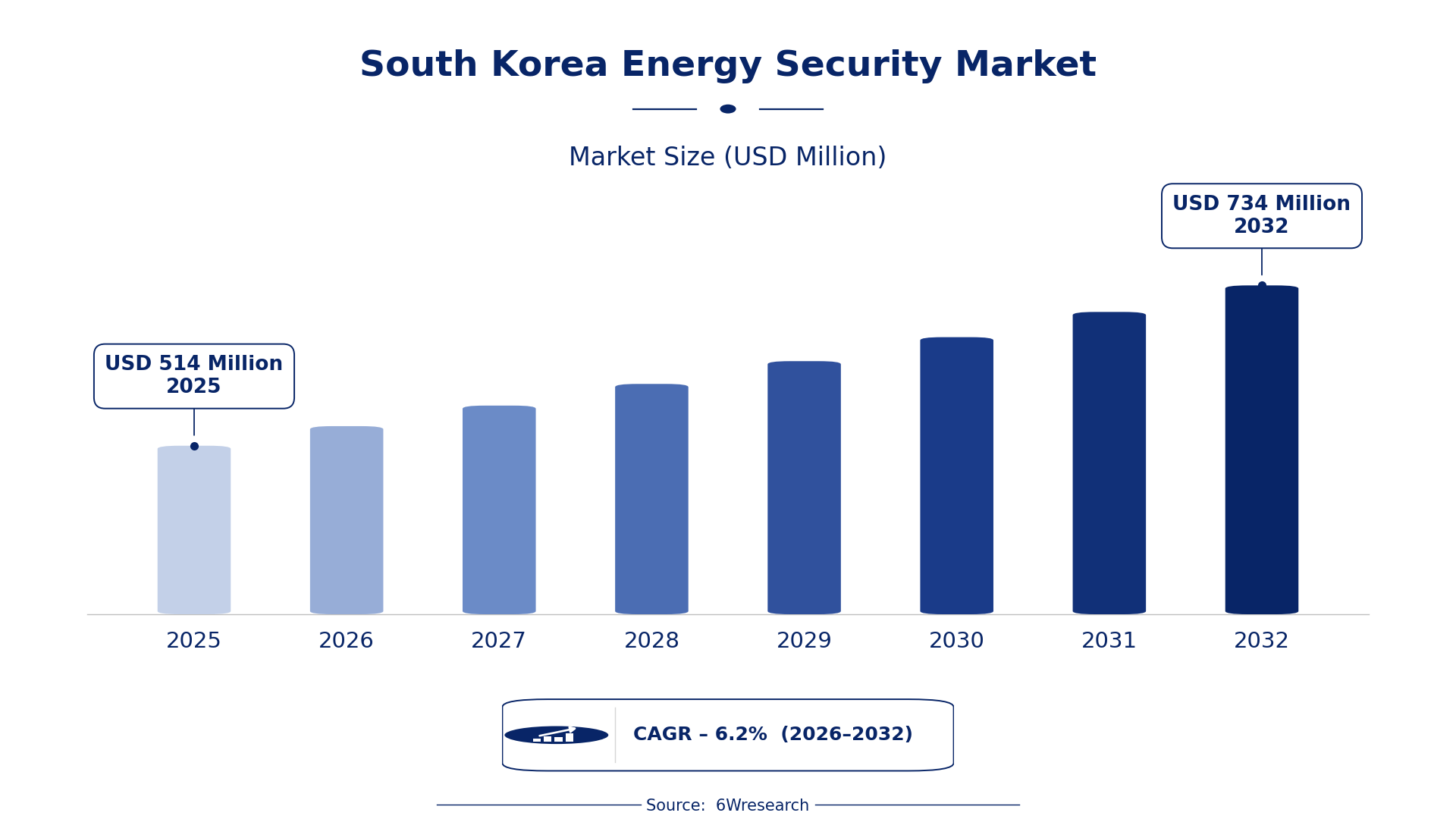
The South Korea Energy Security Market was estimated at USD 514 Million in 2025 and is projected to reach USD 734 Million by 2032, growing at a CAGR of 6.2% from 2026 to 2032.
South Korea Energy Security Market Synopsis
At the forefront of the South Korea Energy Security Market is a governmental push towards reducing dependency on imported fossil fuels. This movement is not merely about energy efficiency; it's about establishing a robust framework for energy independence, particularly given the geopolitical tensions surrounding energy supply chains.
With a clear commitment to renewable energy, South Korea is shifting its focus primarily towards solar and wind technologies. As the nation invests heavily in these sectors, it simultaneously works to modernize its energy infrastructure, aiming for a future marked by sustainability and resilience in energy supply.
South Korea Energy Security Market Year-wise Growth Rate and Key Drivers
This graph illustrates the annual growth rates of the South Korea Energy Security Market from 2021 to 2032, highlighting a steady upward trajectory and projected expansion over the forecast period.
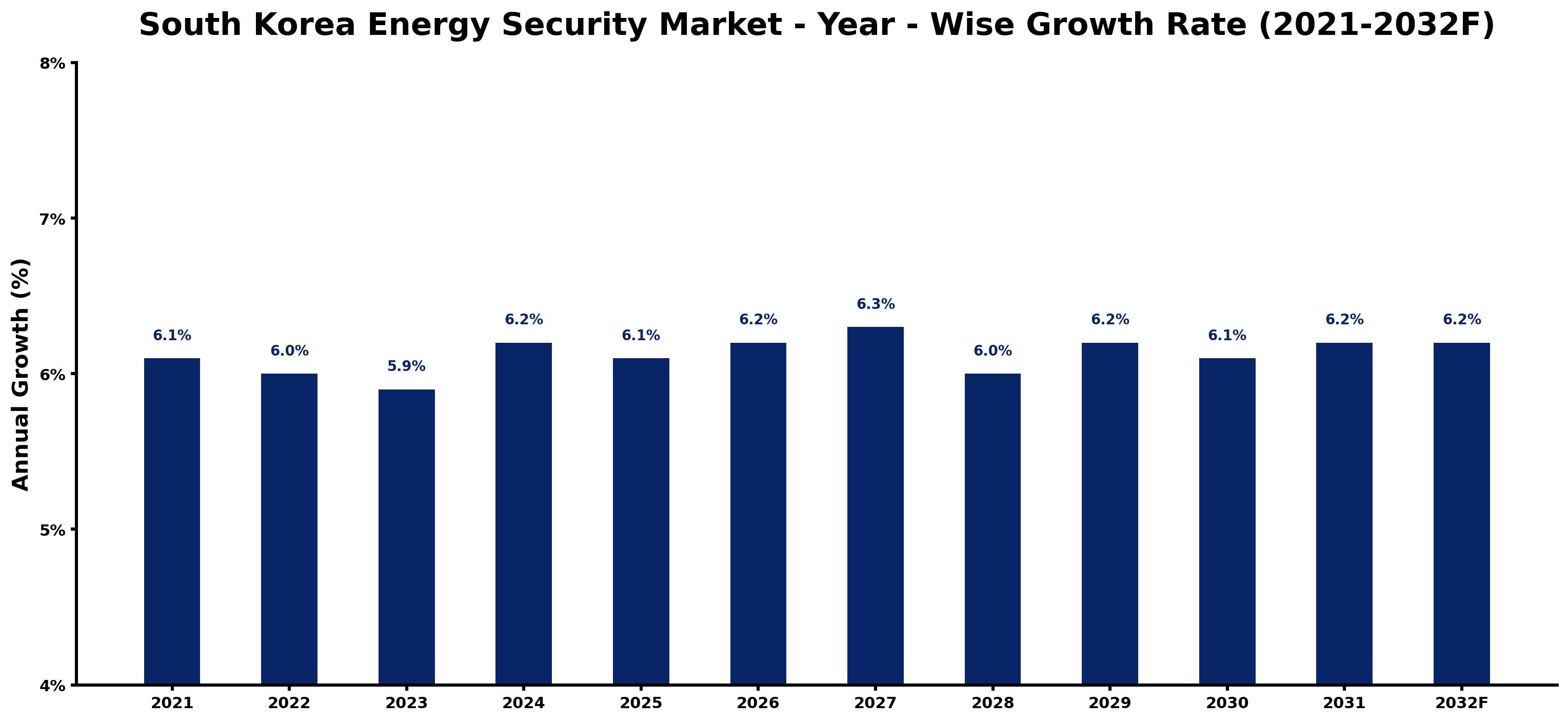
The table below presents the year‑wise growth rates along with the key drivers influencing the market
| Year | Growth Rate | Major Drivers |
| 2021 | 6.1% | Government subsidies for renewable energy installations |
| 2022 | 6.0% | Increased investment in smart grid technologies by KEPCO |
| 2023 | 5.9% | Rise in public-private partnerships for energy resilience |
| 2024 | 6.2% | Launch of the Green New Deal initiative enhancements |
| 2025 | 6.1% | Surge in urban nuclear power facility approvals |
| 2026 | 6.2% | Advancements in battery storage technology for energy security |
| 2027 | 6.3% | Strong public demand for climate change mitigation policies |
| 2028 | 6.0% | Initiatives for energy diversification after energy crisis |
| 2029 | 6.2% | Growing focus on energy security in national policy |
| 2030 | 6.1% | Private sector investments in solar energy technologies |
| 2031 | 6.2% | Increased government funding for sustainable energy projects |
| 2032 | 6.2% | Enhanced energy cooperation agreements with neighboring countries |
Note: Market size estimations and growth projections presented in this report are based on 6Wresearch's proprietary forecasting methodology, utilizing the latest available industry data, government publications, and primary research inputs.
South Korea Energy Security Market Key Takeaways
Below are some of the specific key takeaways from the market, including:
- The market is transitioning towards increased renewable energy adoption.
- Government policies are driving the diversification of energy sources.
- Investment opportunities are predominantly found in solar and wind projects.
- Energy efficiency and storage solutions are gaining traction.
- Strategic partnerships with energy producers are being established to stabilize supply.
Evaluation of Restraints in South Korea Energy Security Market
A significant restraint in the South Korea Energy Security Market is the nation's heavy reliance on imported energy sources. This dependence renders South Korea vulnerable to global supply disruptions and price volatility. The lack of ample domestic energy resources and stringent environmental regulations further complicate efforts to diversify the energy mix. Aging infrastructure in the energy sector necessitates substantial investments for modernization, creating additional hurdles for achieving a stable and secure energy supply.
South Korea Energy Security Market Trends
A shift towards renewable energy sources is the most significant trend currently reshaping the South Korea Energy Security Market. The government’s commitment to cutting greenhouse gas emissions has amplified investments in solar and wind power generation. There is a heightened focus on energy storage solutions that bolster grid stability, reflecting a growing awareness of the need for reliability as renewables become a larger part of the energy mix.
South Korea Energy Security Market Opportunities
There are lucrative opportunities for investment in the renewable energy sector, especially in solar and wind technologies. As South Korea strives to mitigate its reliance on fossil fuels, the demand for innovative renewable technologies will continue to rise. With government incentives creating a favorable environment for investment, projects in renewable energy infrastructure are not just financially attractive; they also align with national energy security goals.
Government Initiatives in the South Korea Energy Security Market
Government policies are instrumental in shaping the South Korea Energy Security Market, driving efforts to diversify energy sources and promote renewable energy development. With a focus on sustainability, these initiatives are designed to reduce reliance on imports and enhance energy efficiency. The emphasis on collaboration with energy-producing nations is critical for ensuring a stable energy supply in an unpredictable global market.
- A recently completed regulatory framework introduced in 2025 mandates the increased use of renewable energy in public infrastructure projects.
- Currently ongoing is the Renewable Energy 3020 Plan, which aims for a significant increase in renewable energy generation by 2030.
- A planned public-private partnership set to launch in 2026 will focus on expanding the country's LNG infrastructure.
- Ongoing efforts to modernize energy transmission networks are being supported by recent government funding initiatives.
- A regulatory reform initiative aimed at enhancing billing transparency and energy conservation measures is under review as of late 2025.
Future Insights of the South Korea Energy Security Market
Looking forward to 2026-2032, the South Korea Energy Security Market is expected to continue its positive trajectory, driven by an ongoing commitment to diversify energy sources. The government's focus on the Renewable Energy 3020 Plan, combined with advancements in energy efficiency and smart grid technologies, positions South Korea to enhance its energy security significantly. The market's evolution will increasingly prioritize sustainability, aiming for a secure energy future that meets national demands.
South Korea Energy Security Market Latest Developments
In the past 12-14 months, the South Korea Energy Security Market has witnessed a notable surge in activity, particularly in renewable energy investments. This flurry of developments aligns with the government's overarching goal of fostering a sustainable energy future. With increased funding and regulatory support, projects aimed at enhancing energy efficiency and expanding renewable capacity are now at the forefront.
- A major technology vendor announced plans for a new solar panel manufacturing facility, expected to commence operations in mid-2026.
- In late 2025, a leading regional operator launched a pilot project for an advanced energy storage system currently underway.
- Ongoing discussions regarding a strategic partnership with several ASEAN countries aim to bolster regional energy security through collaborative projects.
- A government-backed initiative, expected to kick off in early 2026, will focus on modernizing existing energy transmission infrastructure.
- A successful technology rollout for grid optimization software is now being integrated into utilities across the country, with implementation completed in late 2025.
South Korea Energy Security Market - Key Attractiveness of the Report
- 10 Years of Market Numbers
- Historical Data Starting from 2022 to 2025
- Base Year: 2025
- Forecast Data until 2032
- Key Performance Indicators Impacting the Market
- Major Upcoming Developments and Projects
Key Highlights of the Report:
- South Korea Energy Security Market Outlook
- Market Size of South Korea Energy Security Market, 2025
- Forecast of South Korea Energy Security Market, 2032
- Historical Data and Forecast of South Korea Energy Security Revenues & Volume for the Period 2022-2032F
- South Korea Energy Security Market Trend Evolution
- South Korea Energy Security Market Drivers and Challenges
- South Korea Energy Security Price Trends
- South Korea Energy Security Porter's Five Forces
- South Korea Energy Security Industry Life Cycle
- Historical Data and Forecast of South Korea Energy Security Market Revenues & Volume By Power Plants for the Period 2022-2032F
- Historical Data and Forecast of South Korea Energy Security Market Revenues & Volume By Nuclear for the Period 2022-2032F
- Historical Data and Forecast of South Korea Energy Security Market Revenues & Volume By Thermal for the Period 2022-2032F
- Historical Data and Forecast of South Korea Energy Security Market Revenues & Volume By Hydro for the Period 2022-2032F
- Historical Data and Forecast of South Korea Energy Security Market Revenues & Volume By Oil for the Period 2022-2032F
- Historical Data and Forecast of South Korea Energy Security Market Revenues & Volume By Gas for the Period 2022-2032F
- Historical Data and Forecast of South Korea Energy Security Market Revenues & Volume By Renewable Energy for the Period 2022-2032F
- Historical Data and Forecast of South Korea Energy Security Market Revenues & Volume By Technologies for the Period 2022-2032F
- Historical Data and Forecast of South Korea Energy Security Market Revenues & Volume By Physical for the Period 2022-2032F
- Historical Data and Forecast of South Korea Energy Security Market Revenues & Volume By Network Security for the Period 2022-2032F
- South Korea Energy Security Import Export Trade Statistics
- Market Opportunity Assessment By Power Plants
- Market Opportunity Assessment By Technologies
- South Korea Energy Security Top Companies Market Share
- South Korea Energy Security Competitive Benchmarking By Technical and Operational Parameters
- South Korea Energy Security Company Profiles
- South Korea Energy Security Key Strategic Recommendations






































