South Korea Enterprise Application Integration Market Size & Growth Rate (2026-2032)
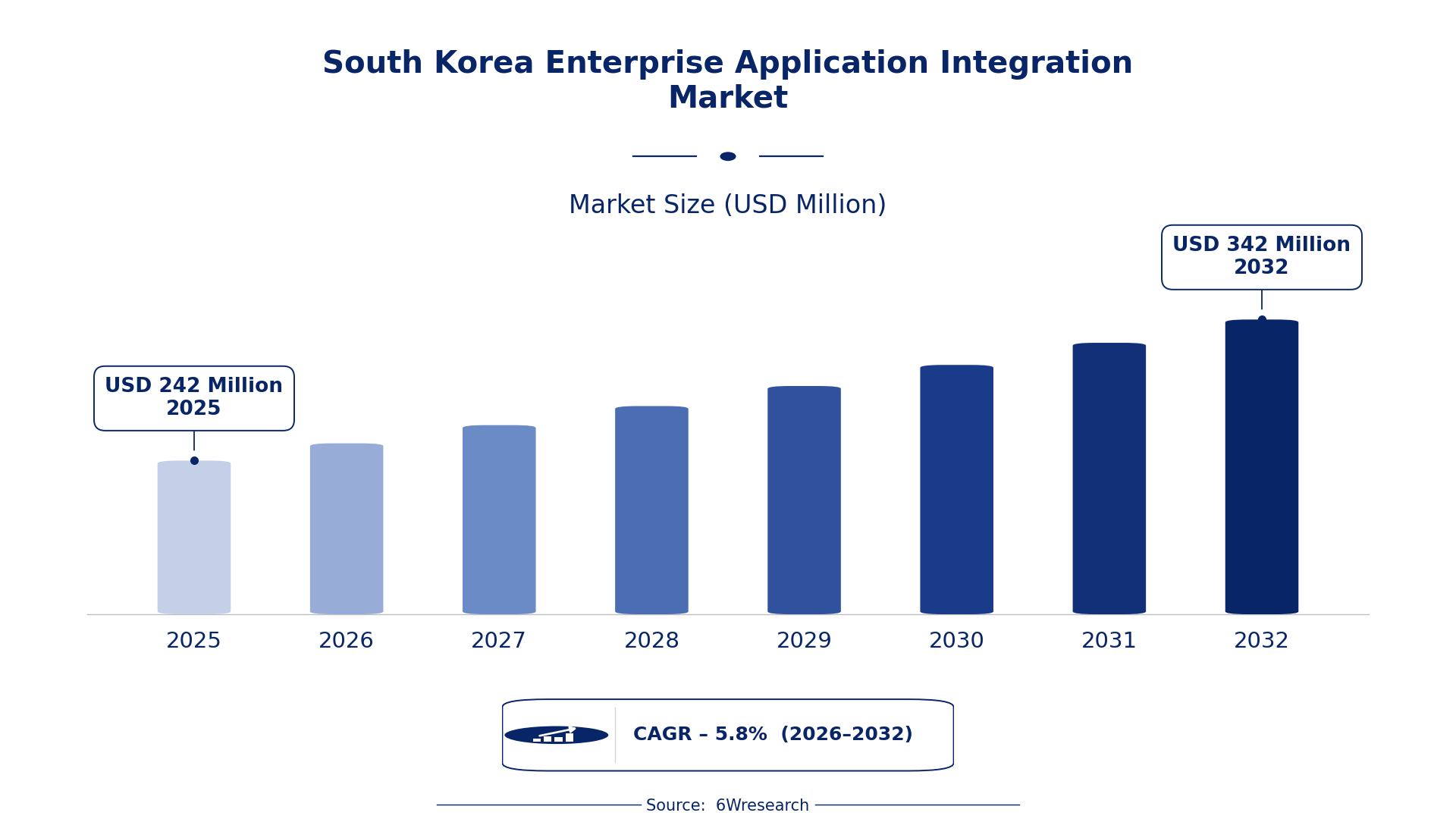
The South Korea Enterprise Application Integration Market was estimated at USD 242 Million in 2025 and is projected to reach USD 342 Million by 2032, growing at a CAGR of 5.8% from 2026 to 2032.
South Korea Enterprise Application Integration Market Synopsis
The driving force behind the South Korea Enterprise Application Integration Market is the urgent need for organizations to adopt cloud-based solutions. As businesses undergo digital transformation, integrating various applications and systems has become crucial for operational efficiency and data-driven decision-making.
With an emphasis on real-time data access and improved connectivity, companies are increasingly seeking EAI solutions. This growing dependency on technology underscores the importance of ensuring smooth interactions between disparate systems while maintaining data integrity and security.
South Korea Enterprise Application Integration Market Year-wise Growth Rate and Key Drivers
This graph illustrates the annual growth rates of the South Korea Enterprise Application Integration Market from 2021 to 2032, highlighting a steady upward trajectory and projected expansion over the forecast period.
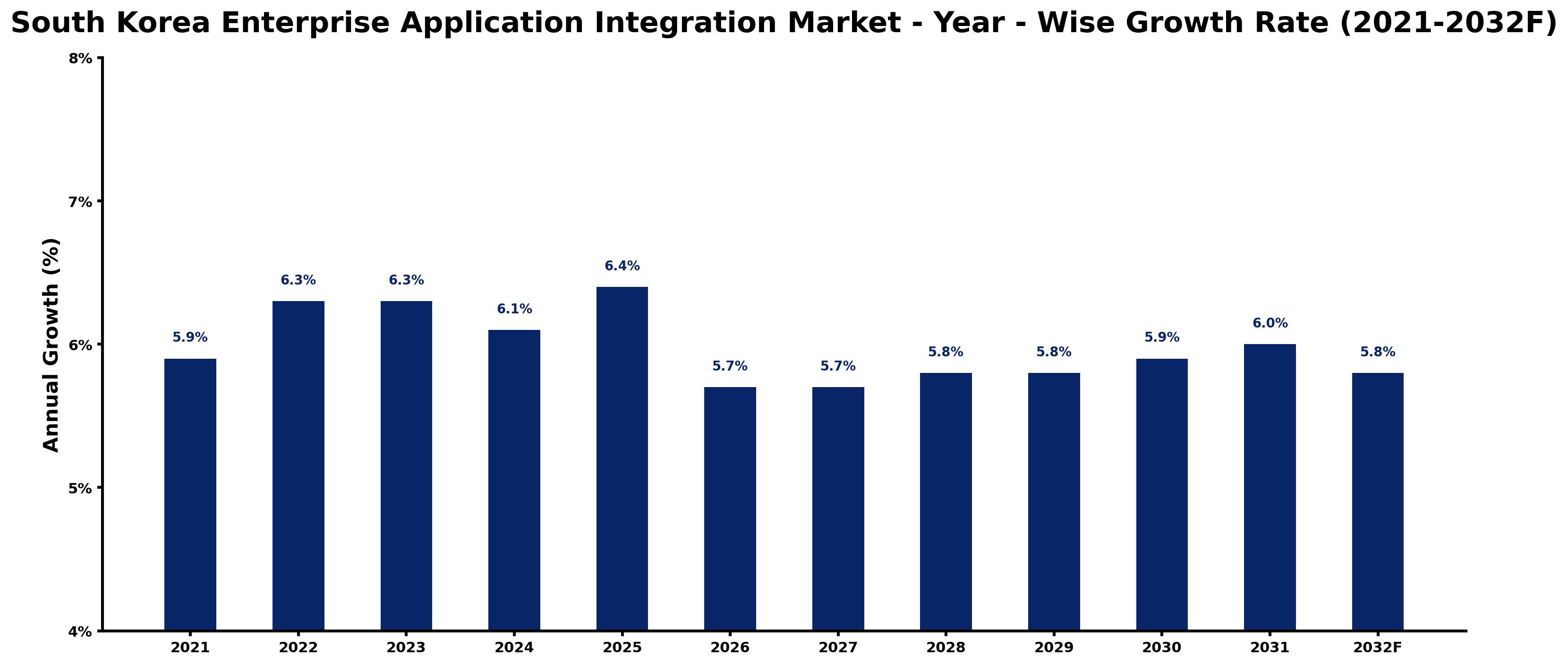
The table below presents the year‑wise growth rates along with the key drivers influencing the market
| Year | Growth Rate | Major Drivers |
| 2021 | 5.9% | Rising adoption of cloud-based ERP systems in enterprises. |
| 2022 | 6.3% | Surge in remote work driving integration of applications. |
| 2023 | 6.3% | Increased cybersecurity regulations mandating integrated security solutions. |
| 2024 | 6.1% | Growing emphasis on data analytics driving integration needs. |
| 2025 | 6.4% | Focus on enhancing customer experience through app interoperability. |
| 2026 | 5.7% | Investments in smart factory solutions boosting system integration. |
| 2027 | 5.7% | Regulatory push for efficient data management in industries. |
| 2028 | 5.8% | Healthcare sector digitization requires robust application integration. |
| 2029 | 5.8% | Emergence of 5G technology enhancing data integration capabilities. |
| 2030 | 5.9% | Corporate ESG initiatives driving software integration for compliance. |
| 2031 | 6.0% | Government incentives for tech startups enhancing integration demands. |
| 2032 | 5.8% | Growing competition among enterprises demanding streamlined operations. |
Note: Market size estimations and growth projections presented in this report are based on 6Wresearch's proprietary forecasting methodology, utilizing the latest available industry data, government publications, and primary research inputs.
South Korea Enterprise Application Integration Market Key Takeaways
Below are some of the specific key takeaways from the market, including:
- Growing adoption of hybrid integration platforms that connect on-premise and cloud applications.
- Increased emphasis on data security and compliance in EAI solutions.
- Rising demand for real-time data integration capabilities among enterprises.
- Significant investments by organizations to modernize IT infrastructure.
- Continued focus on leveraging emerging technologies like AI and IoT within EAI frameworks.
Evaluation of Restraints in South Korea Enterprise Application Integration Market
Despite its growth, the South Korea Enterprise Application Integration Market faces notable constraints. A prominent challenge is the complex IT environments that many organizations manage, which often combine legacy systems with modern applications. This diversity complicates integration efforts and can result in inefficiencies.
Cultural barriers within businesses can also impede communication and collaboration necessary for successful integration. on top of that, security risks associated with data sharing across different applications add another layer of complexity that businesses must navigate cautiously.
South Korea Enterprise Application Integration Market Trends
Currently, the South Korea Enterprise Application Integration Market is witnessing a shift towards hybrid integration models. These platforms allow organizations to effectively bridge their on-premise systems with cloud applications, enhancing flexibility and scalability.
The integration of advanced technologies such as artificial intelligence and the Internet of Things is becoming increasingly prevalent. Businesses are looking to incorporate these innovations into their existing systems to improve operational performance and customer experiences.
South Korea Enterprise Application Integration Market Opportunities
The South Korea Enterprise Application Integration Market holds substantial growth potential, especially as digital transformation initiatives gain momentum across industries. Organizations are prioritizing the need for efficient integration solutions that can unify diverse applications and data sources.
Investing in EAI software providers or consultancy firms specializing in integration services presents lucrative opportunities. The focus on custom solutions tailored to the unique requirements of the South Korean market further enhances the attractiveness of investment in this sector.
Government Initiatives in the South Korea Enterprise Application Integration Market
The South Korean government is actively fostering the Enterprise Application Integration Market through various initiatives aimed at encouraging digital transformation. Regulatory measures focusing on data security and compliance are shaping the framework within which enterprises operate, making policy a critical factor for market growth.
- A recently completed funding program aimed at promoting EAI solutions among small and medium-sized enterprises to enhance their digital capabilities.
- A currently ongoing initiative to develop a national digital infrastructure upgrade, facilitating better connectivity and integration across sectors.
- A planned public-private partnership expected to launch by 2026, focused on advancing innovation in EAI technologies and enhancing collaborative projects.
- A regulatory framework introduced in 2025 to ensure data privacy compliance, which directly impacts how businesses approach EAI implementation.
Future Insights of the South Korea Enterprise Application Integration Market
Looking ahead, the South Korea Enterprise Application Integration Market is likely to expand as organizations increasingly prioritize integration solutions. The push for real-time data access and streamlined operations will drive further investments in EAI technologies.
As digital transformation continues to reshape business models, the demand for innovative EAI solutions that can address complex integration challenges will remain strong. This trajectory suggests a promising future for both enterprises and EAI solution providers in South Korea.
South Korea Enterprise Application Integration Market Latest Developments
Recent activity in the South Korea Enterprise Application Integration Market highlights a surge in innovative solutions and strategic collaborations. Companies are increasingly focused on enhancing their offerings to meet the evolving demands of the market.
- A leading regional technology vendor launched an updated EAI platform in Q1 2025, featuring enhanced API management tools for better system integration.
- An initiative to integrate AI capabilities into existing EAI solutions is currently underway, expected to enhance operational efficiencies by mid-2026.
- Plans for a major service upgrade to a hybrid integration platform are set to begin in the second half of 2025, focusing on user-friendly interfaces and improved performance.
- A recent collaboration between a technology firm and a major consultancy aims to deliver tailored EAI solutions to the finance sector, currently in the rollout phase.
South Korea Enterprise Application Integration Market - Key Attractiveness of the Report
- 10 Years of Market Numbers
- Historical Data Starting from 2022 to 2025
- Base Year: 2025
- Forecast Data until 2032
- Key Performance Indicators Impacting the Market
- Major Upcoming Developments and Projects
Key Highlights of the Report:
- South Korea Enterprise Application Integration Market Outlook
- Market Size of South Korea Enterprise Application Integration Market, 2025
- Forecast of South Korea Enterprise Application Integration Market, 2032
- Historical Data and Forecast of South Korea Enterprise Application Integration Revenues & Volume for the Period 2022-2032F
- South Korea Enterprise Application Integration Market Trend Evolution
- South Korea Enterprise Application Integration Market Drivers and Challenges
- South Korea Enterprise Application Integration Price Trends
- South Korea Enterprise Application Integration Porter's Five Forces
- South Korea Enterprise Application Integration Industry Life Cycle
- Historical Data and Forecast of South Korea Enterprise Application Integration Market Revenues & Volume By Deployment type for the Period 2022-2032F
- Historical Data and Forecast of South Korea Enterprise Application Integration Market Revenues & Volume By Hosted for the Period 2022-2032F
- Historical Data and Forecast of South Korea Enterprise Application Integration Market Revenues & Volume By On-Premise for the Period 2022-2032F
- Historical Data and Forecast of South Korea Enterprise Application Integration Market Revenues & Volume By Hybrid for the Period 2022-2032F
- Historical Data and Forecast of South Korea Enterprise Application Integration Market Revenues & Volume By Organization size for the Period 2022-2032F
- Historical Data and Forecast of South Korea Enterprise Application Integration Market Revenues & Volume By Small for the Period 2022-2032F
- Historical Data and Forecast of South Korea Enterprise Application Integration Market Revenues & Volume By Medium for the Period 2022-2032F
- Historical Data and Forecast of South Korea Enterprise Application Integration Market Revenues & Volume By Enterprises for the Period 2022-2032F
- Historical Data and Forecast of South Korea Enterprise Application Integration Market Revenues & Volume By Large Enterprises for the Period 2022-2032F
- Historical Data and Forecast of South Korea Enterprise Application Integration Market Revenues & Volume By Industry Vertical for the Period 2022-2032F
- Historical Data and Forecast of South Korea Enterprise Application Integration Market Revenues & Volume By Banking, financial services and insurance(BFSI) for the Period 2022-2032F
- Historical Data and Forecast of South Korea Enterprise Application Integration Market Revenues & Volume By Business services for the Period 2022-2032F
- Historical Data and Forecast of South Korea Enterprise Application Integration Market Revenues & Volume By IT and telecom for the Period 2022-2032F
- Historical Data and Forecast of South Korea Enterprise Application Integration Market Revenues & Volume By Manufacturing for the Period 2022-2032F
- Historical Data and Forecast of South Korea Enterprise Application Integration Market Revenues & Volume By Retail and wholesale for the Period 2022-2032F
- Historical Data and Forecast of South Korea Enterprise Application Integration Market Revenues & Volume By Healthcare for the Period 2022-2032F
- Historical Data and Forecast of South Korea Enterprise Application Integration Market Revenues & Volume By Government for the Period 2022-2032F
- Historical Data and Forecast of South Korea Enterprise Application Integration Market Revenues & Volume By Other verticals( education, entertainment and media, power and utilities) for the Period 2022-2032F
- South Korea Enterprise Application Integration Import Export Trade Statistics
- Market Opportunity Assessment By Deployment type
- Market Opportunity Assessment By Organization size
- Market Opportunity Assessment By Industry Vertical
- South Korea Enterprise Application Integration Top Companies Market Share
- South Korea Enterprise Application Integration Competitive Benchmarking By Technical and Operational Parameters
- South Korea Enterprise Application Integration Company Profiles
- South Korea Enterprise Application Integration Key Strategic Recommendations






































