South Korea Enterprise Data Management Market Size & Growth Rate (2026-2032)
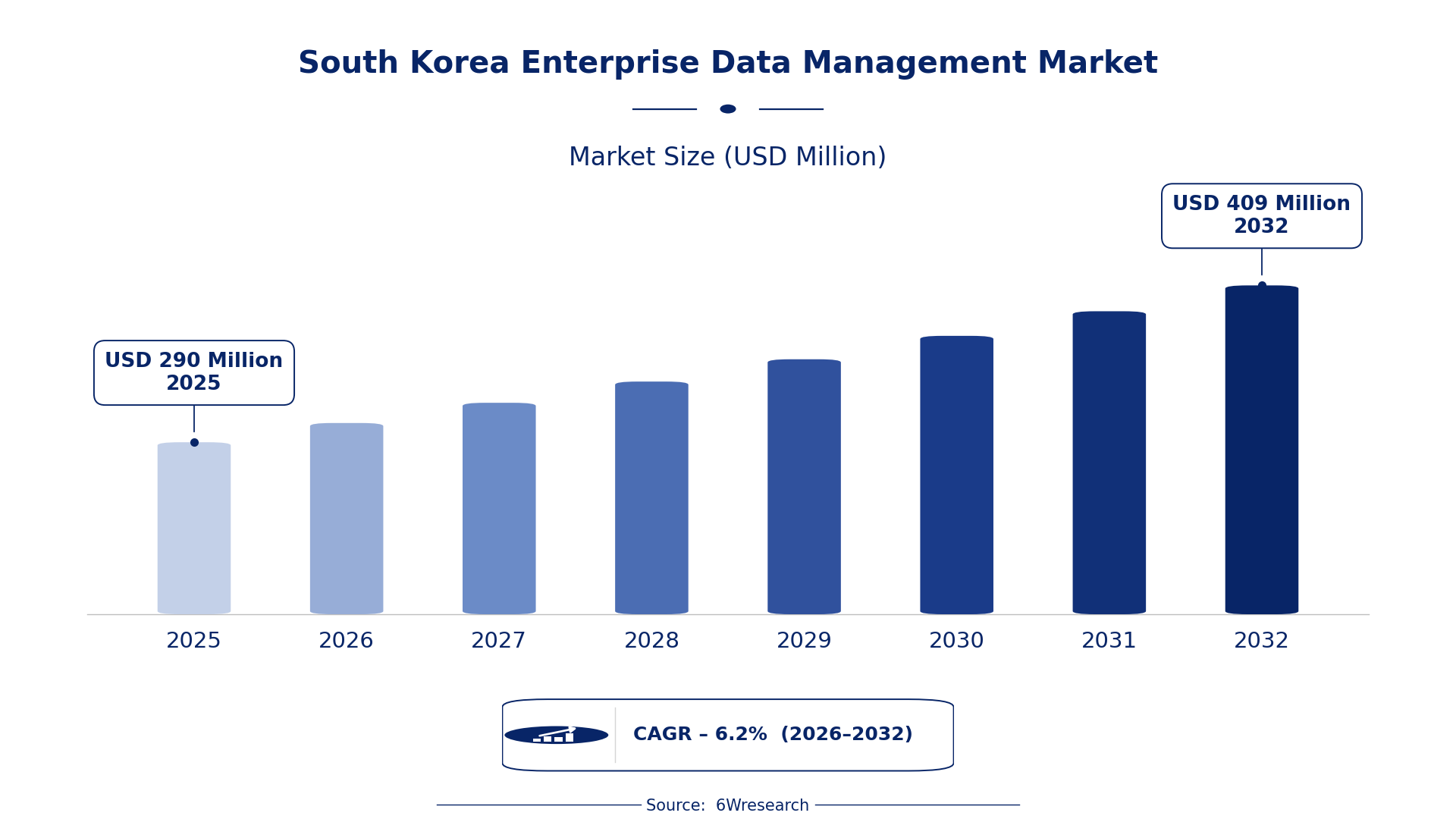
The South Korea Enterprise Data Management Market was estimated at USD 290 Million in 2025 and is projected to reach USD 409 Million by 2032, growing at a CAGR of 6.2% from 2026 to 2032.
South Korea Enterprise Data Management Market Synopsis
The surge in data-driven decision-making is the strongest force currently shaping the South Korea Enterprise Data Management Market. As organizations recognize the value of their data assets, there is a heightened focus on implementing advanced data management strategies to enhance operational efficiency.
Cloud computing and big data analytics are at the forefront of this transformation, allowing businesses to harness vast amounts of data. Enterprises are prioritizing data governance and quality management to ensure compliance with stringent regulations, driving demand for comprehensive data management solutions.
South Korea Enterprise Data Management Market Year-wise Growth Rate and Key Drivers
This graph illustrates the annual growth rates of the South Korea Enterprise Data Management Market from 2021 to 2032, highlighting a steady upward trajectory and projected expansion over the forecast period.
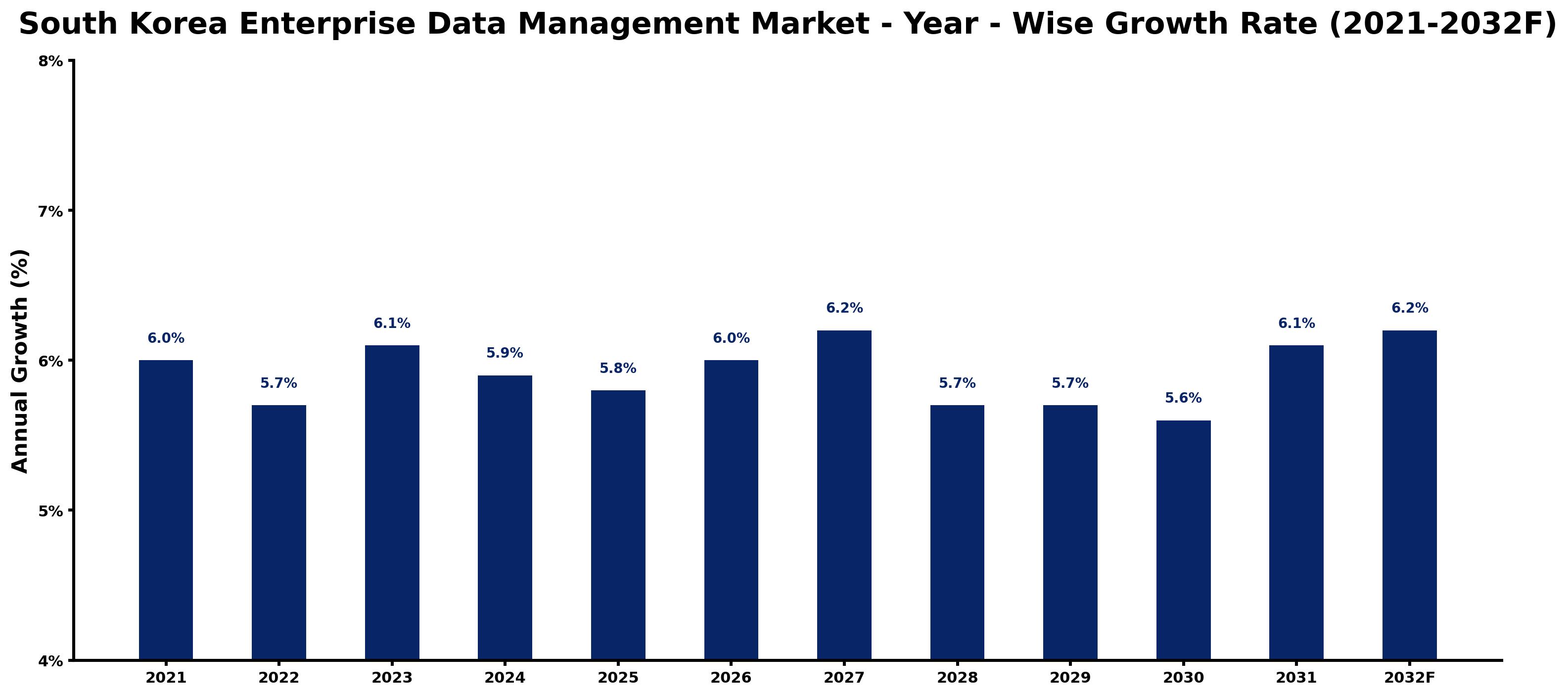
The table below presents the year‑wise growth rates along with the key drivers influencing the market
| Year | Growth Rate | Major Drivers |
| 2021 | 6.0% | Rise of data privacy regulations by KISA |
| 2022 | 5.7% | Increased adoption of cloud services among enterprises |
| 2023 | 6.1% | Government push for 'Smart Factory' initiatives |
| 2024 | 5.9% | Surge in IoT devices driving data management needs |
| 2025 | 5.8% | Strong growth in remote work culture and data reliance |
| 2026 | 6.0% | Enhancements in data governance frameworks by MIC |
| 2027 | 6.2% | Increased investment in cybersecurity measures post-breach |
| 2028 | 5.7% | Corporate focus on improving data-driven decision making |
| 2029 | 5.7% | Emergence of advanced analytics tools adoption |
| 2030 | 5.6% | Boost in venture capital for data startups |
| 2031 | 6.1% | Push for interoperability standards in enterprise data |
| 2032 | 6.2% | Commitment to sustainable data practices by corporations |
Note: Market size estimations and growth projections presented in this report are based on 6Wresearch's proprietary forecasting methodology, utilizing the latest available industry data, government publications, and primary research inputs.
South Korea Enterprise Data Management Market Key Takeaways
Below are some of the specific key takeaways from the market, including:
- Increased investment in cloud-based data management solutions is enhancing accessibility and scalability for organizations.
- The focus on data privacy compliance is leading businesses to adopt more stringent data governance frameworks.
- AI and machine learning technologies are being integrated into data management systems to improve decision-making processes.
- Data integration services are becoming essential as companies seek to unify disparate data sources for a comprehensive view.
- Government initiatives are creating a favorable environment for digital transformation and data management innovations.
Evaluation of Restraints in South Korea Enterprise Data Management Market
Several factors hinder the growth of the South Korea Enterprise Data Management Market. The increasing complexity of managing data from diverse sources presents significant challenges for organizations. Ensuring data quality and accuracy remains a persistent concern, particularly as businesses navigate rigorous compliance requirements. Additionally, the integration of various data management systems can be cumbersome, often leading to inefficiencies and operational setbacks. Cultural barriers to data sharing further complicate efforts to foster collaboration within organizations, impeding the full utilization of data assets.
South Korea Enterprise Data Management Market Trends
The market is witnessing a shift towards cloud-based solutions, driven by the need to manage increasing data volumes and complexity. Advanced analytics capabilities are becoming indispensable as organizations seek real-time insights from their data. on top of that, there is a growing demand for integrated platforms that can streamline data management processes, allowing for better oversight and control. The adoption of AI and machine learning is not just a trend; it's a necessity for organizations looking to enhance their data processing capabilities and drive innovation.
South Korea Enterprise Data Management Market Opportunities
With the rapid growth of data generation, the South Korea Enterprise Data Management Market presents numerous investment opportunities. Key areas for growth include data governance and quality management, where businesses are actively seeking robust solutions to improve their data practices. Additionally, the ongoing digital transformation initiatives by the South Korean government and the presence of major technology firms are bolstering the market potential. Companies that can deliver innovative, tailored data management solutions stand to gain significantly in this evolving landscape.
Government Initiatives in the South Korea Enterprise Data Management Market
The South Korean government plays an active role in shaping the Enterprise Data Management Market through various initiatives aimed at promoting data-driven innovation and enhancing regulatory compliance. Recent policies focus on advancing digital transformation across sectors, ensuring that businesses adopt effective data management practices. Such governmental support creates an environment conducive to growth in this sector.
- A recently completed initiative involved the implementation of the Personal Information Protection Act (PIPA), which enhances consumer data privacy protections.
- Currently, the government is rolling out the Digital New Deal initiative, aimed at accelerating digital infrastructure upgrades across industries.
- A planned public-private partnership is expected to launch in 2026, focusing on developing advanced data management technologies for small and medium enterprises.
- Ongoing efforts include the establishment of a regulatory framework to ensure transparency and security in data management practices.
- Future policies are anticipated to promote artificial intelligence and machine learning technologies within data management frameworks by 2027.
Future Insights of the South Korea Enterprise Data Management Market
Looking ahead to 2026-2032, the South Korea Enterprise Data Management Market is set for substantial growth. As organizations continue to adopt digital transformation initiatives, the demand for effective data governance and compliance solutions will intensify. The rising complexity of data and the need for real-time processing will drive investments in advanced data management technologies. Companies that innovate and adapt to these changing requirements will emerge as leaders in this dynamic market.
South Korea Enterprise Data Management Market Latest Developments
In the past 12-14 months, the South Korea Enterprise Data Management Market has seen a flurry of activity, marked by a significant focus on integrating advanced technologies into data management solutions. Companies are increasingly exploring partnerships and collaborations to enhance their offerings, while also investing in research and development to stay ahead of the curve.
- A major technology vendor launched a new cloud-based data management platform in early 2025, aimed at simplifying data governance for businesses.
- An initiative that began in mid-2025 focuses on enhancing data quality management practices across various sectors, with ongoing workshops and training sessions.
- A partnership between leading firms was announced in late 2025 to develop AI-driven analytics tools for real-time data processing.
- Upcoming regulatory changes are expected to be implemented by Q3 2026, further emphasizing compliance and data protection measures.
- A rollout of advanced data integration solutions is planned for early 2026, targeting small and medium enterprises to help streamline their data management efforts.
South Korea Enterprise Data Management Market - Key Attractiveness of the Report
- 10 Years of Market Numbers
- Historical Data Starting from 2022 to 2025
- Base Year: 2025
- Forecast Data until 2032
- Key Performance Indicators Impacting the Market
- Major Upcoming Developments and Projects
Key Highlights of the Report:
- South Korea Enterprise Data Management Market Outlook
- Market Size of South Korea Enterprise Data Management Market, 2025
- Forecast of South Korea Enterprise Data Management Market, 2032
- Historical Data and Forecast of South Korea Enterprise Data Management Revenues & Volume for the Period 2022-2032F
- South Korea Enterprise Data Management Market Trend Evolution
- South Korea Enterprise Data Management Market Drivers and Challenges
- South Korea Enterprise Data Management Price Trends
- South Korea Enterprise Data Management Porter's Five Forces
- South Korea Enterprise Data Management Industry Life Cycle
- Historical Data and Forecast of South Korea Enterprise Data Management Market Revenues & Volume By Component for the Period 2022-2032F
- Historical Data and Forecast of South Korea Enterprise Data Management Market Revenues & Volume By Software for the Period 2022-2032F
- Historical Data and Forecast of South Korea Enterprise Data Management Market Revenues & Volume By Services for the Period 2022-2032F
- Historical Data and Forecast of South Korea Enterprise Data Management Market Revenues & Volume By Professional Services for the Period 2022-2032F
- Historical Data and Forecast of South Korea Enterprise Data Management Market Revenues & Volume By Consulting for the Period 2022-2032F
- Historical Data and Forecast of South Korea Enterprise Data Management Market Revenues & Volume By Deployment and Integration for the Period 2022-2032F
- Historical Data and Forecast of South Korea Enterprise Data Management Market Revenues & Volume By Support and Maintenance for the Period 2022-2032F
- Historical Data and Forecast of South Korea Enterprise Data Management Market Revenues & Volume By Industry Vertical for the Period 2022-2032F
- Historical Data and Forecast of South Korea Enterprise Data Management Market Revenues & Volume By Healthcare and Life science for the Period 2022-2032F
- Historical Data and Forecast of South Korea Enterprise Data Management Market Revenues & Volume By Banking, Financial Services and Insurance (BFSI) for the Period 2022-2032F
- Historical Data and Forecast of South Korea Enterprise Data Management Market Revenues & Volume By Telecom and Information Technology (IT) for the Period 2022-2032F
- Historical Data and Forecast of South Korea Enterprise Data Management Market Revenues & Volume By Retail and Consumer goods for the Period 2022-2032F
- Historical Data and Forecast of South Korea Enterprise Data Management Market Revenues & Volume By Media and Entertainment for the Period 2022-2032F
- Historical Data and Forecast of South Korea Enterprise Data Management Market Revenues & Volume By Manufacturing for the Period 2022-2032F
- Historical Data and Forecast of South Korea Enterprise Data Management Market Revenues & Volume By Energy and Utilities for the Period 2022-2032F
- Historical Data and Forecast of South Korea Enterprise Data Management Market Revenues & Volume By Transportation and Logistics for the Period 2022-2032F
- Historical Data and Forecast of South Korea Enterprise Data Management Market Revenues & Volume By Organization Size for the Period 2022-2032F
- Historical Data and Forecast of South Korea Enterprise Data Management Market Revenues & Volume By Small and Medium-sized Enterprises for the Period 2022-2032F
- Historical Data and Forecast of South Korea Enterprise Data Management Market Revenues & Volume By Large enterprises for the Period 2022-2032F
- Historical Data and Forecast of South Korea Enterprise Data Management Market Revenues & Volume By Deployment Mode for the Period 2022-2032F
- Historical Data and Forecast of South Korea Enterprise Data Management Market Revenues & Volume By Cloud for the Period 2022-2032F
- Historical Data and Forecast of South Korea Enterprise Data Management Market Revenues & Volume By On-premises for the Period 2022-2032F
- South Korea Enterprise Data Management Import Export Trade Statistics
- Market Opportunity Assessment By Component
- Market Opportunity Assessment By Industry Vertical
- Market Opportunity Assessment By Organization Size
- Market Opportunity Assessment By Deployment Mode
- South Korea Enterprise Data Management Top Companies Market Share
- South Korea Enterprise Data Management Competitive Benchmarking By Technical and Operational Parameters
- South Korea Enterprise Data Management Company Profiles
- South Korea Enterprise Data Management Key Strategic Recommendations






































