South Korea Enterprise Firewall Market Size & Growth Rate (2026-2032)
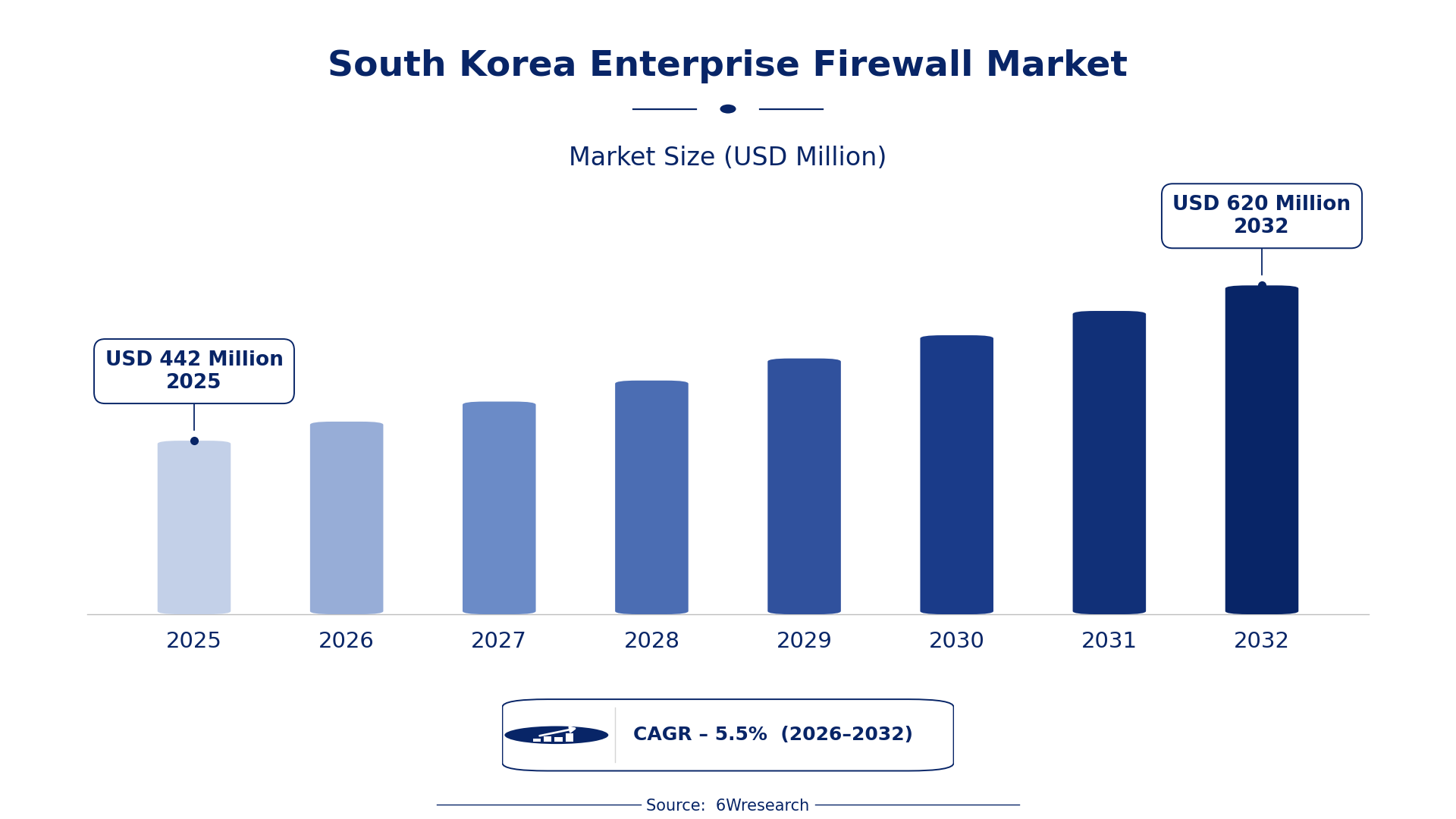
The South Korea Enterprise Firewall Market was estimated at USD 442 Million in 2025 and is projected to reach USD 620 Million by 2032, growing at a CAGR of 5.5% from 2026 to 2032.
South Korea Enterprise Firewall Market Synopsis
The South Korea Enterprise Firewall Market has gained momentum recently, propelled by the rising cybersecurity threats that companies face daily. As organizations seek to safeguard their data and networks, investments in firewall solutions have become a necessity rather than a luxury.
Looking ahead, the market is on track for sustained growth driven by the rapid digitization of enterprises. With businesses increasingly moving towards cloud-based operations, the demand for sophisticated firewall technologies designed to combat advanced threats will continue to expand.
South Korea Enterprise Firewall Market Year-wise Growth Rate and Key Drivers
This graph illustrates the annual growth rates of the South Korea Enterprise Firewall Market from 2021 to 2032, highlighting a steady upward trajectory and projected expansion over the forecast period.
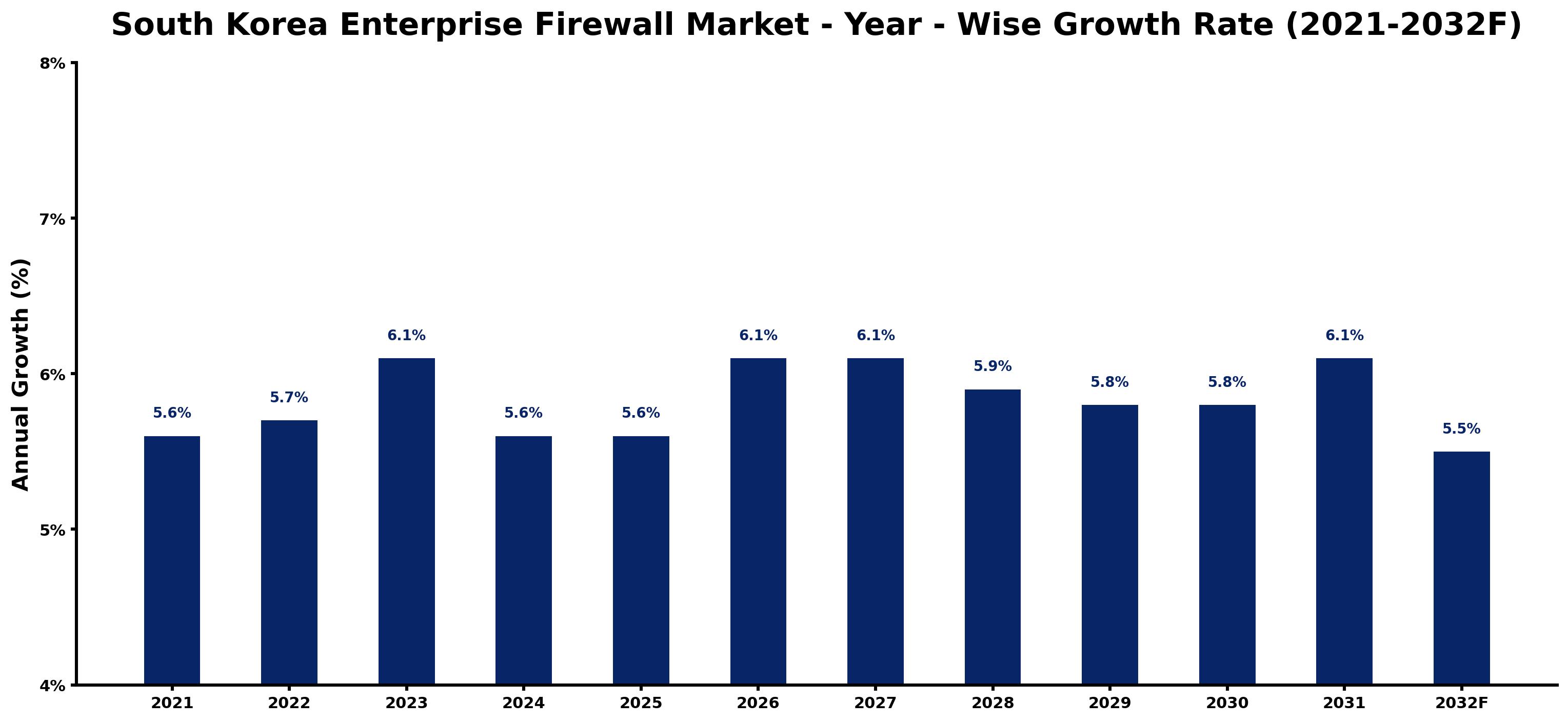
The table below presents the year‑wise growth rates along with the key drivers influencing the market
| Year | Growth Rate | Major Drivers |
| 2021 | 5.6% | Cybersecurity Strategy 2021 enhancing enterprise protection standards |
| 2022 | 5.7% | Growth in remote work increasing vulnerability to cyber threats |
| 2023 | 6.1% | Rising ransomware attacks pushing firewall adoption rates up |
| 2024 | 5.6% | Increased regulatory scrutiny on data privacy and protection |
| 2025 | 5.6% | Local tech firms boosting cybersecurity investments for compliance |
| 2026 | 6.1% | Surge in IoT devices driving advanced firewall solutions |
| 2027 | 6.1% | Growing awareness of cyber threats elevating enterprise priorities |
| 2028 | 5.9% | Digital banking expansion necessitating stronger security measures |
| 2029 | 5.8% | Increased cloud adoption requiring robust firewall capabilities |
| 2030 | 5.8% | Increased government contracts for cybersecurity in public sectors |
| 2031 | 6.1% | Emergence of advanced persistent threats prompting upgrades |
| 2032 | 5.5% | Tech-savvy workforce prioritizing cybersecurity in business strategies |
Note: Market size estimations and growth projections presented in this report are based on 6Wresearch's proprietary forecasting methodology, utilizing the latest available industry data, government publications, and primary research inputs.
South Korea Enterprise Firewall Market Key Takeaways
Below are some of the specific key takeaways from the market, including:
- Increased focus on next-generation firewalls with integrated threat protection capabilities.
- Cloud-based firewall solutions are becoming more prevalent as companies secure virtual environments.
- The adoption of AI and machine learning technologies in firewalls is on the rise.
- Regulatory pressures are compelling organizations to enhance their cybersecurity frameworks.
- Investments in intrusion prevention and unified threat management platforms are gaining traction.
Evaluation of Restraints in South Korea Enterprise Firewall Market
One of the main challenges restraining the South Korea Enterprise Firewall Market is the increasingly sophisticated nature of cyber threats. Advanced Persistent Threats (APTs) and targeted attacks force organizations to constantly adapt their firewall solutions to maintain effective defenses. Additionally, the competitive landscape is crowded, leaving many companies uncertain about the best options for their specific needs. Adhering to strict compliance standards and integrating with existing security infrastructures are also hurdles enterprises must navigate.
South Korea Enterprise Firewall Market Trends
A marked shift toward next-generation firewalls (NGFW) is reshaping the South Korea Enterprise Firewall Market. These firewalls are equipped with advanced features like intrusion prevention, application control, and real-time threat intelligence. As organizations face increasingly sophisticated attacks, there's a strong preference for solutions that prioritize these capabilities.
Another trend is the growing demand for cloud-based firewall services. As enterprises move operations online, securing these environments has become paramount. on top of that, integrating AI and machine learning into firewall solutions is gaining traction, enhancing their ability to detect and respond to emerging threats.
South Korea Enterprise Firewall Market Opportunities
The South Korea Enterprise Firewall Market is ripe with opportunities as organizations ramp up investments in cybersecurity. With escalating cyber threats and increasing regulatory requirements, companies offering innovative firewall solutions can expect considerable growth. There's also room for investment in intrusion detection and prevention systems tailored to local needs. Collaboration with South Korean tech firms can help new entrants penetrate the market more effectively.
Government Initiatives in the South Korea Enterprise Firewall Market
The South Korean government is actively shaping the Enterprise Firewall Market through stringent cybersecurity regulations and initiatives. Authorities like the National Intelligence Service (NIS) and the Korea Internet & Security Agency (KISA) have implemented measures to enhance cybersecurity resilience across sectors. By promoting advanced firewall technologies, the government aims to protect critical infrastructure and sensitive data.
- A regulatory framework established in 2025 mandates the adoption of robust cybersecurity protocols, including enterprise firewalls.
- A national initiative focused on improving digital infrastructure security is currently underway, aimed at better protecting against cyber threats.
- The government has launched certification programs for firewall technologies to ensure compliance with security standards.
- Plans for a public-private collaboration aimed at enhancing cybersecurity awareness and resources are expected to roll out in late 2026.
Future Insights of the South Korea Enterprise Firewall Market
In the coming years, the South Korea Enterprise Firewall Market is anticipated to continue its upward trajectory, driven by an uptick in cyber threats and the proliferation of cloud services. Organizations are expected to prioritize investments in next-generation firewalls that offer enhanced capabilities such as intrusion prevention and application control. As threats evolve, there will be an increasing emphasis on integrating firewall solutions with broader cybersecurity frameworks to maintain comprehensive protection.
South Korea Enterprise Firewall Market Latest Developments
Recent activity in the South Korea Enterprise Firewall Market reflects a dynamic environment, with organizations actively upgrading their cybersecurity measures. The focus has been on deploying advanced firewall solutions that are resilient against evolving threats while ensuring compliance with regulatory standards.
- A major technology vendor launched an upgraded next-generation firewall solution in early 2025, focusing on enhanced threat detection features.
- A collaborative initiative between several leading South Korean firms to develop a unified threat management platform is currently underway and expected to conclude by mid-2026.
- An expansion of cloud-based firewall services by a leading regional operator is ongoing, targeting businesses transitioning to digital infrastructures.
- A planned regulatory audit program scheduled for late 2026 aims to assess compliance with new cybersecurity standards among enterprises.
South Korea Enterprise Firewall Market - Key Attractiveness of the Report
- 10 Years of Market Numbers
- Historical Data Starting from 2022 to 2025
- Base Year: 2025
- Forecast Data until 2032
- Key Performance Indicators Impacting the Market
- Major Upcoming Developments and Projects
Key Highlights of the Report:
- South Korea Enterprise Firewall Market Outlook
- Market Size of South Korea Enterprise Firewall Market, 2025
- Forecast of South Korea Enterprise Firewall Market, 2032
- Historical Data and Forecast of South Korea Enterprise Firewall Revenues & Volume for the Period 2022-2032F
- South Korea Enterprise Firewall Market Trend Evolution
- South Korea Enterprise Firewall Market Drivers and Challenges
- South Korea Enterprise Firewall Price Trends
- South Korea Enterprise Firewall Porter's Five Forces
- South Korea Enterprise Firewall Industry Life Cycle
- Historical Data and Forecast of South Korea Enterprise Firewall Market Revenues & Volume By Types for the Period 2022-2032F
- Historical Data and Forecast of South Korea Enterprise Firewall Market Revenues & Volume By Next Generation for the Period 2022-2032F
- Historical Data and Forecast of South Korea Enterprise Firewall Market Revenues & Volume By Application for the Period 2022-2032F
- Historical Data and Forecast of South Korea Enterprise Firewall Market Revenues & Volume By Conventional for the Period 2022-2032F
- Historical Data and Forecast of South Korea Enterprise Firewall Market Revenues & Volume By Industry vertical for the Period 2022-2032F
- Historical Data and Forecast of South Korea Enterprise Firewall Market Revenues & Volume By Government & Public Utilities for the Period 2022-2032F
- Historical Data and Forecast of South Korea Enterprise Firewall Market Revenues & Volume By Healthcare for the Period 2022-2032F
- Historical Data and Forecast of South Korea Enterprise Firewall Market Revenues & Volume By Telecommunication for the Period 2022-2032F
- Historical Data and Forecast of South Korea Enterprise Firewall Market Revenues & Volume By Education for the Period 2022-2032F
- Historical Data and Forecast of South Korea Enterprise Firewall Market Revenues & Volume By Retail for the Period 2022-2032F
- Historical Data and Forecast of South Korea Enterprise Firewall Market Revenues & Volume By Entertainment & Media for the Period 2022-2032F
- Historical Data and Forecast of South Korea Enterprise Firewall Market Revenues & Volume By Manufacturing for the Period 2022-2032F
- Historical Data and Forecast of South Korea Enterprise Firewall Market Revenues & Volume By Education for the Period 2022-2032F
- Historical Data and Forecast of South Korea Enterprise Firewall Market Revenues & Volume By Organization Size for the Period 2022-2032F
- Historical Data and Forecast of South Korea Enterprise Firewall Market Revenues & Volume By Small and Medium Sized Enterprises (SMBs) for the Period 2022-2032F
- Historical Data and Forecast of South Korea Enterprise Firewall Market Revenues & Volume By Large Enterprises for the Period 2022-2032F
- South Korea Enterprise Firewall Import Export Trade Statistics
- Market Opportunity Assessment By Types
- Market Opportunity Assessment By Industry vertical
- Market Opportunity Assessment By Organization Size
- South Korea Enterprise Firewall Top Companies Market Share
- South Korea Enterprise Firewall Competitive Benchmarking By Technical and Operational Parameters
- South Korea Enterprise Firewall Company Profiles
- South Korea Enterprise Firewall Key Strategic Recommendations






































