South Korea Eye Makeup Market Size, Share & Growth Rate
The South Korea Eye Makeup Market was estimated at USD 405 Million in 2025 and is projected to reach USD 568 Million by 2032, growing at a CAGR of 5.0% from 2026 to 2032. This growth trajectory is driven by a vibrant consumer base that values innovative, high-quality beauty products, alongside the influence of K-beauty trends. Increasing disposable incomes and a heightened emphasis on personal grooming further stimulate demand for eye makeup, making this market a dynamic and attractive segment of the broader beauty industry.
South Korea Eye Makeup Market Year-wise Growth Rate and Key Drivers
This graph highlights how the South Korea Eye Makeup Market has steadily grown over the years, supported by major growth factors.
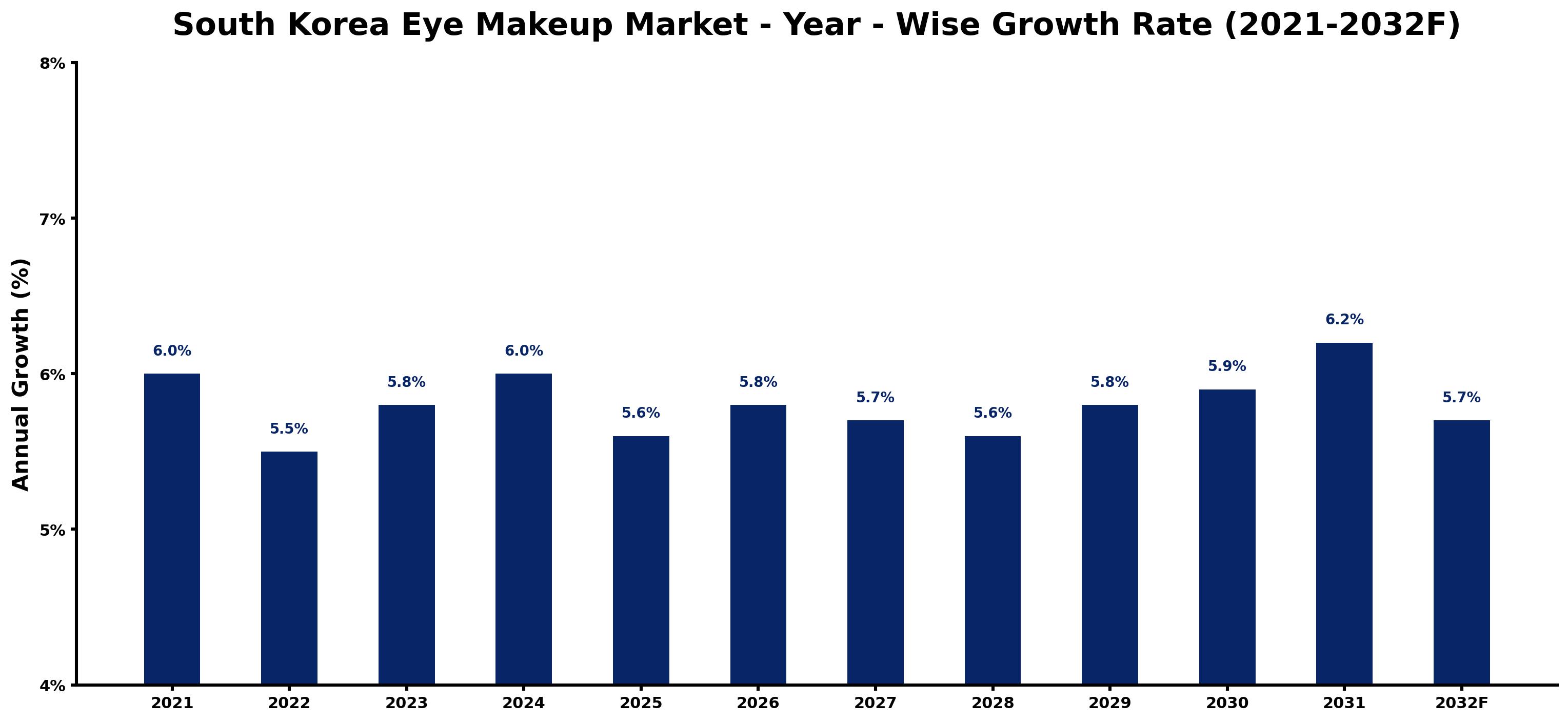
The table below presents the year‑wise growth rates along with the key drivers influencing the market
| Year | Growth Rate | Major Drivers |
| 2021 | 6.0% | Increasing industrial automation investments |
| 2022 | 5.5% | Growing urbanization and commercial development |
| 2023 | 5.8% | Growing urbanization and commercial development |
| 2024 | 6.0% | Growing urbanization and commercial development |
| 2025 | 5.6% | Rapid growth in telecom and data center sectors |
| 2026 | 5.8% | Increasing industrial automation investments |
| 2027 | 5.7% | Expansion of commercial construction activities |
| 2028 | 5.6% | Government infrastructure modernization initiatives |
| 2029 | 5.8% | Increasing industrial infrastructure investments |
| 2030 | 5.9% | Expansion of manufacturing activities |
| 2031 | 6.2% | Increasing industrial infrastructure investments |
| 2032 | 5.7% | Expansion of manufacturing activities |
Note - Market size estimations and growth projections presented in this report are based on 6Wresearch’s advanced forecasting approach, validated with industry datasets as of June 2026.
South Korea Eye Makeup Market Synopsis
The South Korean consumer exhibits a distinct preference for multifunctional eye makeup products that provide versatility and ease of use. As a result, there is a burgeoning demand for items like tinted brow gels and long-lasting eyeliners, which align with the rising trend of natural aesthetics.
Additionally, the influence of social media cannot be overstated; platforms such as Instagram and YouTube have transformed how consumers discover and engage with eye makeup products. Influencers and beauty enthusiasts drive trends, ensuring that the market remains dynamic and responsive to consumer needs.
South Korea Eye Makeup Market Key Takeaways
- The market is increasingly leaning towards natural and minimalist eye makeup styles.
- Online retail channels significantly influence purchasing behaviors and market dynamics.
- Sustainable and cruelty-free products are gaining traction among conscious consumers.
- K-beauty brands are at the forefront of innovation, introducing unique formulations regularly.
- Social media platforms are crucial in shaping consumer preferences and product awareness.
Evaluation of Restraints in South Korea Eye Makeup Market
One of the primary constraints facing the South Korea Eye Makeup Market is the fierce competition among domestic and international brands. This saturation complicates brand differentiation, compelling companies to innovate continually to meet consumer expectations. Additionally, regulatory compliance poses a challenge, as businesses must navigate stringent guidelines to ensure product safety and accurate marketing. These factors contribute to a highly demanding environment, necessitating agility and strategic foresight for sustained success.
South Korea Eye Makeup Market Trends
The trend towards natural beauty is reshaping the eye makeup landscape in South Korea. Products that enhance individual features, like subtle eyeshadow palettes and lightweight formulas, are becoming increasingly popular. The demand for eco-friendly packaging and ethical sourcing is also on the rise, reflecting a broader consumer shift towards sustainability. Innovations, such as user-friendly applicators and hybrid cosmetics that combine skincare benefits with makeup, are trending as consumers seek efficiency without compromising quality.
South Korea Eye Makeup Market Opportunities
Investment opportunities abound in the South Korea Eye Makeup Market, particularly in brands that focus on high-quality ingredients and innovative formulations. Companies that leverage K-beauty trends to expand into international markets can tap into a growing global interest in Korean beauty products. Additionally, investing in research and development for unique product lines, as well as exploring sustainable practices, can provide businesses with a significant competitive edge in this thriving industry.
Government Initiatives in the South Korea Eye Makeup Market
The South Korean government plays an active role in regulating the eye makeup market to ensure consumer safety and product integrity. Agencies such as the Korea Food and Drug Administration (KFDA) enforce strict guidelines on cosmetic formulations and labeling practices. There is also a concerted effort to promote cruelty-free practices in cosmetics, aligning with global trends and consumer preferences. Such policies contribute to a transparent and trustworthy market environment, fostering consumer confidence in eye makeup products.
Future Insights of the South Korea Eye Makeup Market
Looking ahead to 2026-2032, the South Korea Eye Makeup Market is poised for continued growth. As the global K-beauty phenomenon expands, domestic brands are expected to lead in innovation, capitalizing on trends towards personalization and minimalism. Additionally, the rise of e-commerce is likely to transform shopping experiences, offering consumers unprecedented convenience and access. The future will see a market increasingly defined by informed consumers seeking high-quality, ethical, and sustainable beauty solutions.
South Korea Eye Makeup Market Latest Developments (May 2025 - June 2026)
In recent months, the South Korea Eye Makeup Market has witnessed a surge in product launches focusing on clean beauty and multifunctional cosmetics. Brands are increasingly prioritizing eco-friendly packaging and sustainable ingredients, resonating with the environmentally conscious consumer base. Social media campaigns have also intensified, with influencers promoting new product innovations and application techniques to engage their audiences effectively. This trend illustrates the market's adaptability and responsiveness to evolving consumer preferences.
South Korea Eye Makeup Market - Key Attractiveness of the Report
- 10 Years of Market Numbers
- Historical Data Starting from 2022 to 2025
- Base Year: 2025
- Forecast Data until 2032
- Key Performance Indicators Impacting the Market
- Major Upcoming Developments and Projects
Key Highlights of the Report:
- South Korea Eye Makeup Market Outlook
- Market Size of South Korea Eye Makeup Market, 2025
- Forecast of South Korea Eye Makeup Market, 2032
- Historical Data and Forecast of South Korea Eye Makeup Revenues & Volume for the Period 2022-2032F
- South Korea Eye Makeup Market Trend Evolution
- South Korea Eye Makeup Market Drivers and Challenges
- South Korea Eye Makeup Price Trends
- South Korea Eye Makeup Porter's Five Forces
- South Korea Eye Makeup Industry Life Cycle
- Historical Data and Forecast of South Korea Eye Makeup Market Revenues & Volume By Product Type for the Period 2022-2032F
- Historical Data and Forecast of South Korea Eye Makeup Market Revenues & Volume By Mascara for the Period 2022-2032F
- Historical Data and Forecast of South Korea Eye Makeup Market Revenues & Volume By Shadow for the Period 2022-2032F
- Historical Data and Forecast of South Korea Eye Makeup Market Revenues & Volume By Liner for the Period 2022-2032F
- Historical Data and Forecast of South Korea Eye Makeup Market Revenues & Volume By Pencil for the Period 2022-2032F
- Historical Data and Forecast of South Korea Eye Makeup Market Revenues & Volume By Brow for the Period 2022-2032F
- Historical Data and Forecast of South Korea Eye Makeup Market Revenues & Volume By Others for the Period 2022-2032F
- Historical Data and Forecast of South Korea Eye Makeup Market Revenues & Volume By Distribution Channel for the Period 2022-2032F
- Historical Data and Forecast of South Korea Eye Makeup Market Revenues & Volume By Online for the Period 2022-2032F
- Historical Data and Forecast of South Korea Eye Makeup Market Revenues & Volume By Offline for the Period 2022-2032F
- South Korea Eye Makeup Import Export Trade Statistics
- Market Opportunity Assessment By Product Type
- Market Opportunity Assessment By Distribution Channel
- South Korea Eye Makeup Top Companies Market Share
- South Korea Eye Makeup Competitive Benchmarking By Technical and Operational Parameters
- South Korea Eye Makeup Company Profiles
- South Korea Eye Makeup Key Strategic Recommendations






































