South Korea Facial Recognition Market Size & Growth Rate (2026-2032)
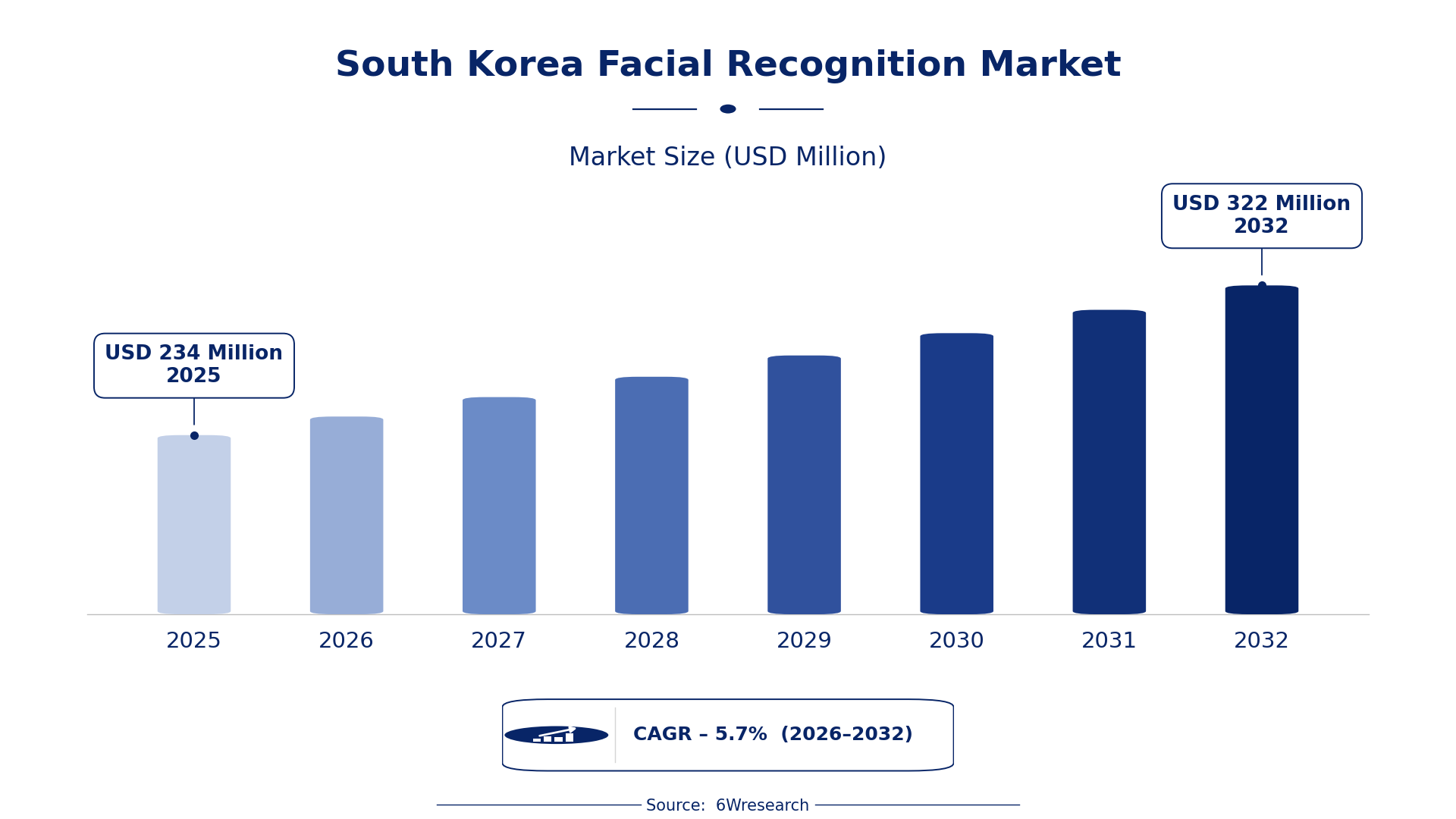
The South Korea Facial Recognition Market was estimated at USD 234 Million in 2025 and is projected to reach USD 322 Million by 2032, growing at a CAGR of 5.7% from 2026 to 2032.
South Korea Facial Recognition Market Synopsis
The South Korea facial recognition market is on a substantial growth trajectory, driven by increasing implementations across security, banking, and retail sectors. The government's push for digital transformation is also a key factor propelling adoption rates. With technology becoming more integrated into daily life, the demand for reliable and efficient biometric solutions is only expected to rise.
In recent years, the focus on privacy and security has heightened, leading to a more cautious approach to the deployment of facial recognition systems. As businesses and consumers alike become more aware of data protection, solutions that meet stringent regulatory requirements are increasingly sought after. This dynamic creates a unique environment where innovation must align closely with public sentiment and legal standards.
South Korea Facial Recognition Market Year-wise Growth Rate and Key Drivers
This graph illustrates the annual growth rates of the South Korea Facial Recognition Market from 2021 to 2032, highlighting a steady upward trajectory and projected expansion over the forecast period.
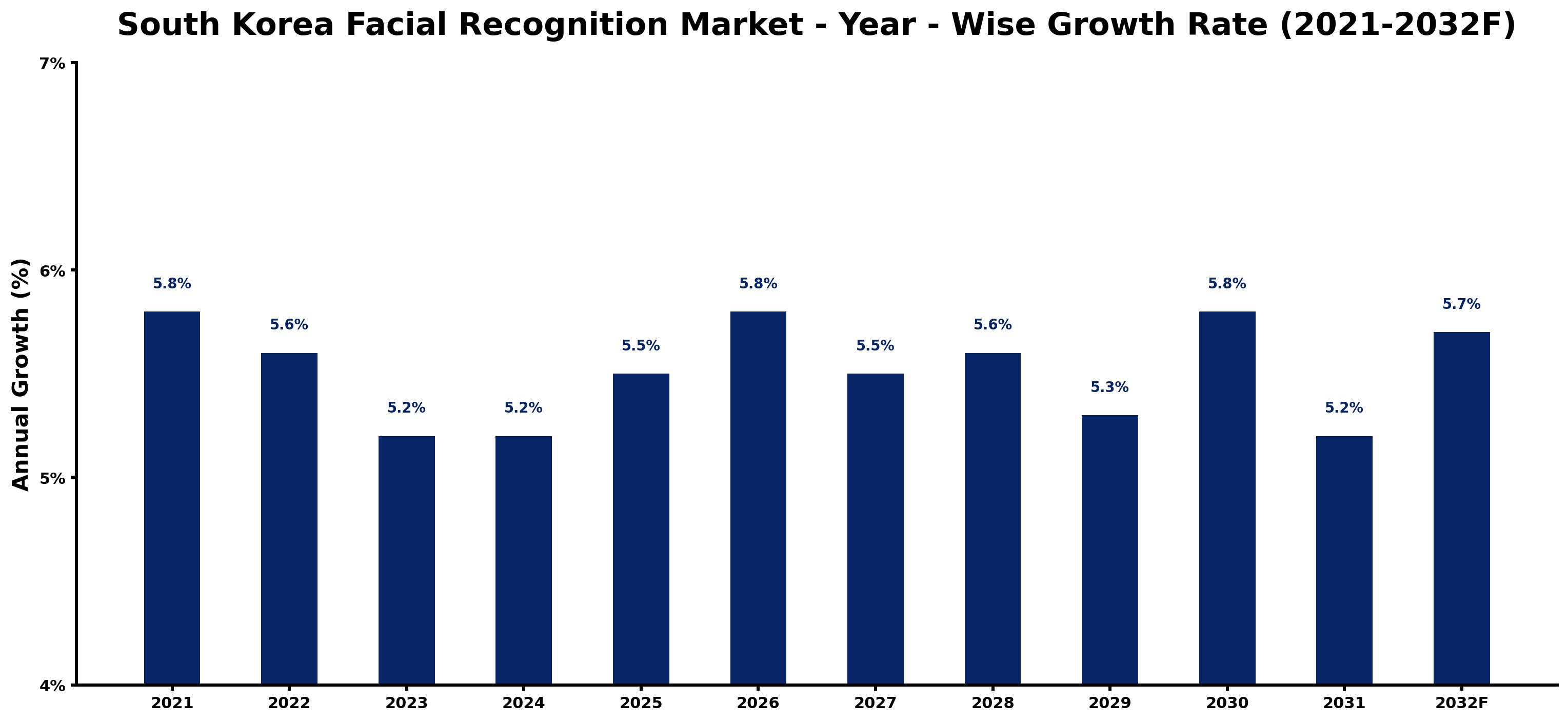
The table below presents the year‑wise growth rates along with the key drivers influencing the market
| Year | Growth Rate | Major Drivers |
| 2021 | 5.8% | Government support for AI and facial recognition technologies. |
| 2022 | 5.6% | Local regulations enhancing security at public venues. |
| 2023 | 5.2% | Growing implementation of facial recognition in retail analytics. |
| 2024 | 5.2% | Advancements in AI algorithms by South Korean startups. |
| 2025 | 5.5% | Increased demand for smart home security systems. |
| 2026 | 5.8% | Surge in public security demand during major events. |
| 2027 | 5.5% | Integration of facial recognition into mobile payment systems. |
| 2028 | 5.6% | Rising focus on health safety measures post-pandemic. |
| 2029 | 5.3% | Enhancements in mobile phone facial unlock features. |
| 2030 | 5.8% | Regulatory push for enhanced identity verification methods. |
| 2031 | 5.2% | Escalating need for personalized marketing strategies. |
| 2032 | 5.7% | Widespread use of facial recognition in transportation hubs. |
Note: Market size estimations and growth projections presented in this report are based on 6Wresearch's proprietary forecasting methodology, utilizing the latest available industry data, government publications, and primary research inputs.
South Korea Facial Recognition Market Key Takeaways
Below are some of the specific key takeaways from the market, including:
- The market is experiencing a surge in demand driven by advancements in technology and increasing applications in various sectors.
- Privacy concerns are shaping consumer attitudes towards facial recognition systems, necessitating solutions that emphasize data security.
- The South Korean government is actively promoting digital initiatives that integrate facial recognition into public services and smart city projects.
- Emerging trends include the integration of AI and machine learning to enhance the accuracy and performance of facial recognition systems.
- Investment opportunities are abundant for firms focusing on R&D to address challenges related to privacy and data protection.
Evaluation of Restraints in South Korea Facial Recognition Market
Despite the promising growth, the South Korea facial recognition market faces significant restraints. Chief among these are privacy concerns and the potential misuse of biometric data. Cultural attitudes towards personal information protection further complicate the acceptance of facial recognition technologies. Additionally, technical hurdles, such as ensuring reliability across various conditions and angles, continue to challenge market players. Addressing these issues through transparent practices and technological innovation is vital for future growth.
South Korea Facial Recognition Market Trends
A few notable trends are shaping the South Korea facial recognition market. The integration of AI and machine learning algorithms stands out as a key factor enhancing the accuracy of facial recognition systems. As industries like healthcare and retail increasingly adopt these technologies for security and customer identification, the demand continues to rise.
Additionally, the ongoing COVID-19 pandemic has accelerated the shift towards contactless biometric solutions. This trend aligns with growing consumer preferences for touchless interactions, further boosting the adoption of facial recognition systems. The government's initiatives aimed at smart city development also play a crucial role in driving market demand for these technologies.
South Korea Facial Recognition Market Opportunities
The landscape of opportunities in the South Korea facial recognition market is expanding. With the increasing need for advanced security solutions across various sectors, there is a growing demand for high-performance facial recognition systems. Companies that specialize in software development, hardware manufacturing, and system integration stand to benefit significantly.
on top of that, investors should focus on R&D initiatives aimed at enhancing the capabilities of facial recognition technology while addressing privacy concerns. This dual approach can help position companies favorably for long-term growth in a market that demands innovation alongside compliance.
Government Initiatives in the South Korea Facial Recognition Market
The South Korean government has established a comprehensive framework regulating the use of facial recognition technology, reflecting a strong emphasis on privacy and data protection. These policies shape the operational environment for businesses and impact consumer acceptance. With ongoing digital initiatives, public sector priorities are clearly aligned with technological advancements in this space.
- A recently completed initiative involved the rollout of a national digital infrastructure upgrade program, enhancing the capability for biometric data processing.
- Currently underway is a pilot program aimed at implementing facial recognition systems in public transport for improved security and user experience.
- Upcoming plans include new regulations expected to be introduced by 2026, focusing on tighter controls over the use of biometric data in commercial applications.
- The government is also promoting smart city projects that integrate facial recognition technology to improve urban management and safety.
- In 2025, guidelines were established to ensure that companies seeking to deploy facial recognition systems comply with strict data protection regulations.
Future Insights of the South Korea Facial Recognition Market
Looking ahead to 2026-2032, the South Korea facial recognition market is set to expand significantly. The convergence of government initiatives aimed at smart city development and the continuous advancement of technology will drive demand. As consumers become more accustomed to integrated biometric solutions, the market will likely see increased applications in everyday life, from public safety to retail experiences.
The ongoing emphasis on privacy and security will continue to shape the market, pushing companies to innovate responsibly. Firms that can effectively balance technological advancements with regulatory compliance will be better positioned to thrive in this dynamic environment.
South Korea Facial Recognition Market Latest Developments
Recent activity in the South Korea facial recognition market reveals a strong trend towards innovation and regulatory alignment. Companies are launching new solutions designed to meet the evolving needs of consumers and businesses while adhering to stringent privacy laws. This period has been marked by significant advancements in technology and strategic partnerships aimed at enhancing service delivery.
- A major technology vendor launched a new facial recognition software in early 2025, focusing on retail applications to enhance customer experience.
- An initiative that began in mid-2025 and remains underway is the integration of AI-driven analytics into facial recognition systems for improved security and operational efficiency.
- In Q2 2025, a collaboration between public agencies and tech firms was established to explore the deployment of facial recognition in urban management systems.
- A rollout expected to begin in the second half of 2026 aims to expand facial recognition capabilities in healthcare settings for patient identification and security.
South Korea Facial Recognition Market - Key Attractiveness of the Report
- 10 Years of Market Numbers
- Historical Data Starting from 2022 to 2025
- Base Year: 2025
- Forecast Data until 2032
- Key Performance Indicators Impacting the Market
- Major Upcoming Developments and Projects
Investors can find opportunities in companies focusing on R&D for advanced facial recognition solutions, as well as those involved in hardware manufacturing and system integration services to meet growing market needs.
Key Highlights of the Report:
- South Korea Facial Recognition Market Outlook
- Market Size of South Korea Facial Recognition Market, 2025
- Forecast of South Korea Facial Recognition Market, 2032
- Historical Data and Forecast of South Korea Facial Recognition Revenues & Volume for the Period 2022-2032F
- South Korea Facial Recognition Market Trend Evolution
- South Korea Facial Recognition Market Drivers and Challenges
- South Korea Facial Recognition Price Trends
- South Korea Facial Recognition Porter's Five Forces
- South Korea Facial Recognition Industry Life Cycle
- Historical Data and Forecast of South Korea Facial Recognition Market Revenues & Volume By Component for the Period 2022-2032F
- Historical Data and Forecast of South Korea Facial Recognition Market Revenues & Volume By Software for the Period 2022-2032F
- Historical Data and Forecast of South Korea Facial Recognition Market Revenues & Volume By Services for the Period 2022-2032F
- Historical Data and Forecast of South Korea Facial Recognition Market Revenues & Volume By Application for the Period 2022-2032F
- Historical Data and Forecast of South Korea Facial Recognition Market Revenues & Volume By Access Control for the Period 2022-2032F
- Historical Data and Forecast of South Korea Facial Recognition Market Revenues & Volume By Attendance Tracking & Monitoring for the Period 2022-2032F
- Historical Data and Forecast of South Korea Facial Recognition Market Revenues & Volume By Emotion Recognition for the Period 2022-2032F
- Historical Data and Forecast of South Korea Facial Recognition Market Revenues & Volume By Security & Surveillance for the Period 2022-2032F
- Historical Data and Forecast of South Korea Facial Recognition Market Revenues & Volume By Others for the Period 2022-2032F
- Historical Data and Forecast of South Korea Facial Recognition Market Revenues & Volume By Vertical for the Period 2022-2032F
- Historical Data and Forecast of South Korea Facial Recognition Market Revenues & Volume By Retail & E-Commerce for the Period 2022-2032F
- Historical Data and Forecast of South Korea Facial Recognition Market Revenues & Volume By Media & Entertainment for the Period 2022-2032F
- Historical Data and Forecast of South Korea Facial Recognition Market Revenues & Volume By BFSI for the Period 2022-2032F
- Historical Data and Forecast of South Korea Facial Recognition Market Revenues & Volume By Automobile & Transportation for the Period 2022-2032F
- Historical Data and Forecast of South Korea Facial Recognition Market Revenues & Volume By Telecom & IT for the Period 2022-2032F
- Historical Data and Forecast of South Korea Facial Recognition Market Revenues & Volume By Government for the Period 2022-2032F
- Historical Data and Forecast of South Korea Facial Recognition Market Revenues & Volume By Healthcare for the Period 2022-2032F
- Historical Data and Forecast of South Korea Facial Recognition Market Revenues & Volume By Others for the Period 2022-2032F
- Historical Data and Forecast of South Korea Facial Recognition Market Revenues & Volume By Technology for the Period 2022-2032F
- Historical Data and Forecast of South Korea Facial Recognition Market Revenues & Volume By 2D for the Period 2022-2032F
- Historical Data and Forecast of South Korea Facial Recognition Market Revenues & Volume By 3D for the Period 2022-2032F
- Historical Data and Forecast of South Korea Facial Recognition Market Revenues & Volume By Facial Analytics for the Period 2022-2032F
- South Korea Facial Recognition Import Export Trade Statistics
- Market Opportunity Assessment By Component
- Market Opportunity Assessment By Application
- Market Opportunity Assessment By Vertical
- Market Opportunity Assessment By Technology
- South Korea Facial Recognition Top Companies Market Share
- South Korea Facial Recognition Competitive Benchmarking By Technical and Operational Parameters
- South Korea Facial Recognition Company Profiles
- South Korea Facial Recognition Key Strategic Recommendations






































