South Korea Facility Management Market Size & Growth Rate (2026-2032)
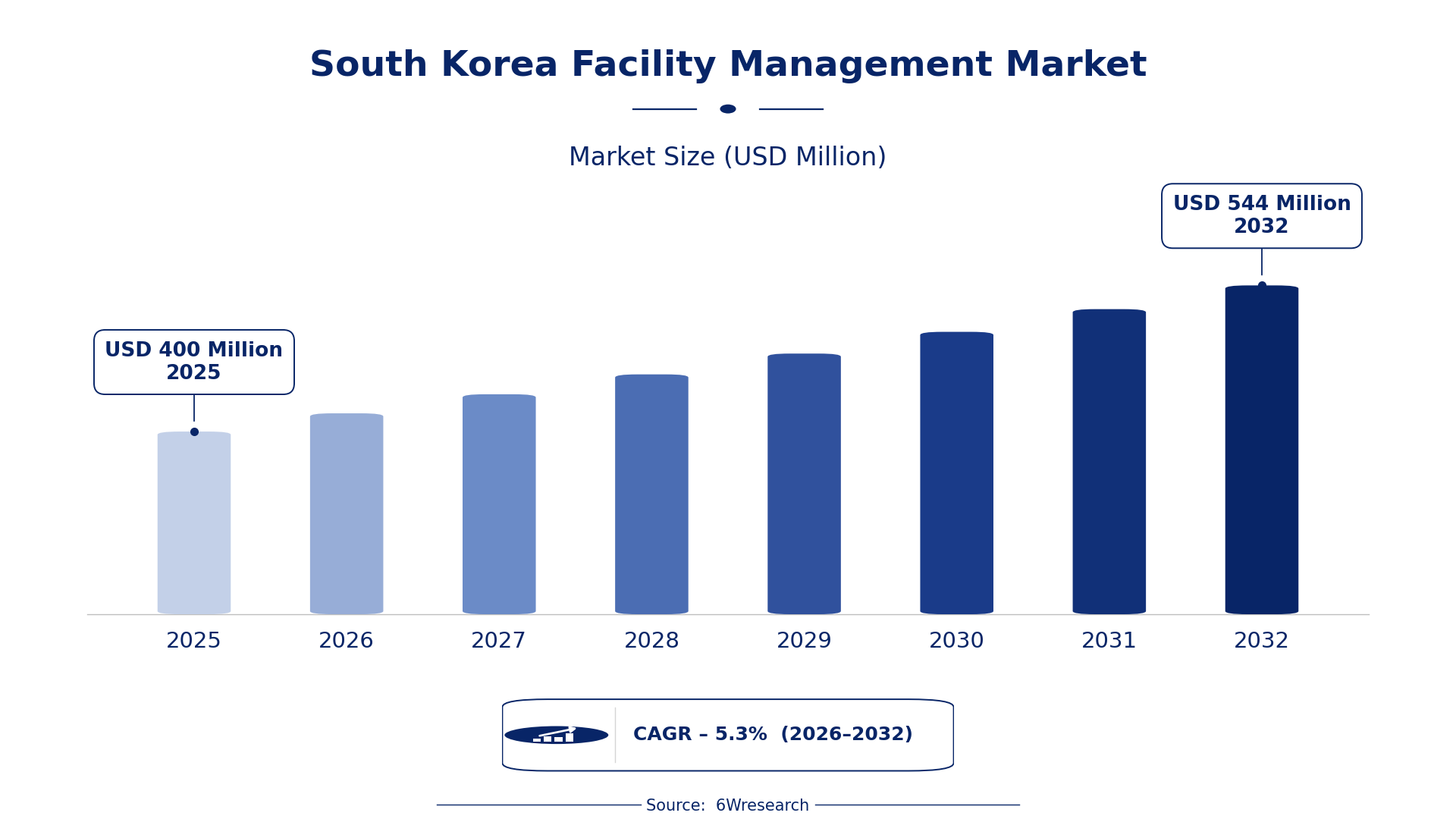
The South Korea Facility Management Market was estimated at USD 400 Million in 2025 and is projected to reach USD 544 Million by 2032, growing at a CAGR of 5.3% from 2026 to 2032.
South Korea Facility Management Market Synopsis
The demand for facility management services in South Korea is on a sharp rise, particularly in commercial and residential sectors. Businesses are increasingly recognizing the value of outsourcing these services to improve operational efficiency and focus on core competencies.
As the country embraces advanced technologies like IoT and AI, facility management is becoming more efficient and data-driven. This shift is not just about maintaining buildings; it’s about integrating smart solutions to optimize resource utilization and enhance tenant experiences.
South Korea Facility Management Market Year-wise Growth Rate and Key Drivers
This graph illustrates the annual growth rates of the South Korea Facility Management Market from 2021 to 2032, highlighting a steady upward trajectory and projected expansion over the forecast period.
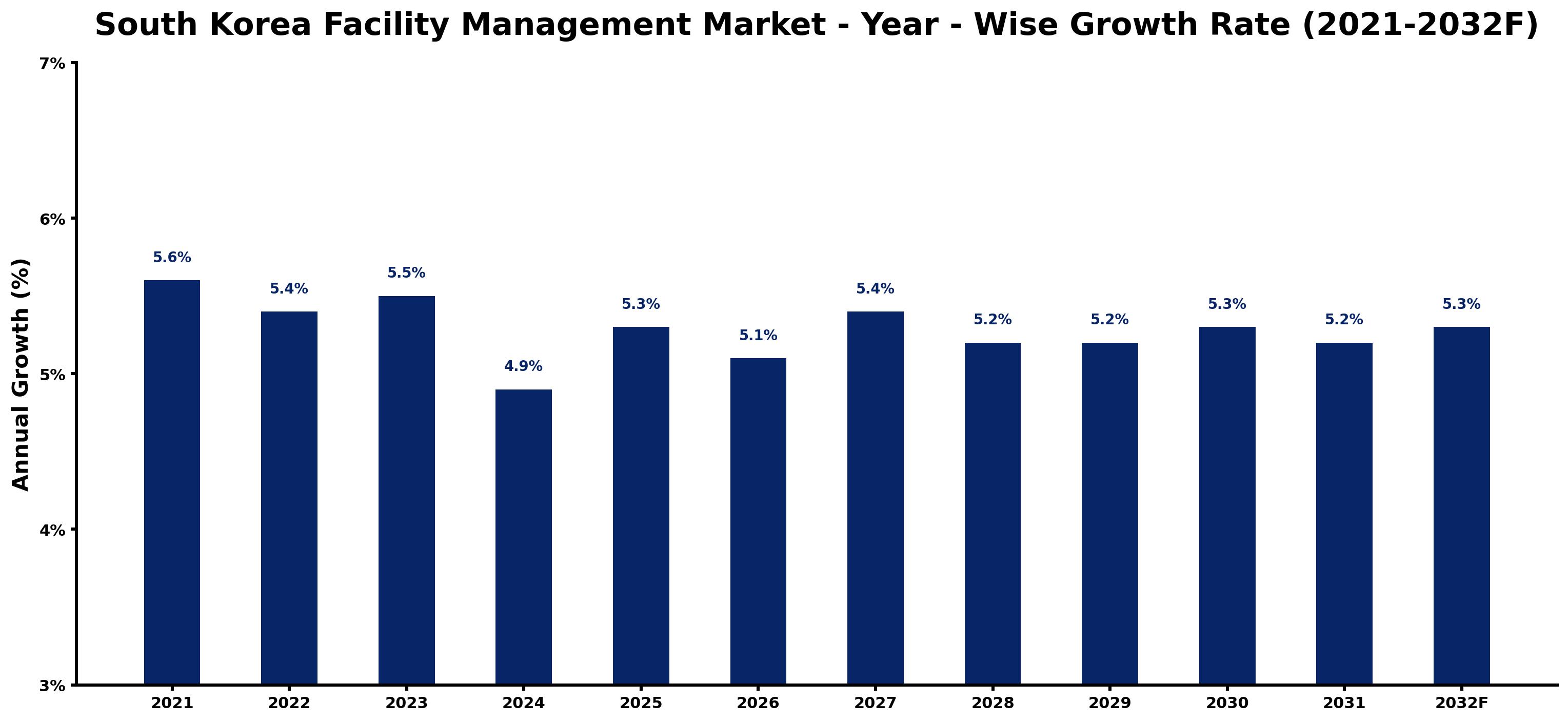
The table below presents the year‑wise growth rates along with the key drivers influencing the market
| Year | Growth Rate | Major Drivers |
| 2021 | 5.6% | Increased demand for smart building technologies adoption. |
| 2022 | 5.4% | Government's Green New Deal enhancing sustainable facility practices. |
| 2023 | 5.5% | Rising emphasis on hygiene due to post-pandemic policies. |
| 2024 | 4.9% | Growing aging population necessitating specialized facility services. |
| 2025 | 5.3% | Surge in real estate development projects in urban areas. |
| 2026 | 5.1% | Enhanced focus on energy efficiency in public facilities. |
| 2027 | 5.4% | Emergence of innovative facility management software solutions. |
| 2028 | 5.2% | Regulatory shifts promoting integrated facility management models. |
| 2029 | 5.2% | Increased outsourcing of facility operations by corporations. |
| 2030 | 5.3% | Strong corporate sustainability commitments driving facility innovations. |
| 2031 | 5.2% | Rising urbanization rates boosting facility service demands. |
| 2032 | 5.3% | Government initiatives supporting digital transformation in facilities. |
Note: Market size estimations and growth projections presented in this report are based on 6Wresearch's proprietary forecasting methodology, utilizing the latest available industry data, government publications, and primary research inputs.
South Korea Facility Management Market Key Takeaways
Below are some of the specific key takeaways from the market, including:
- The market is experiencing robust growth, fueled by increased demand for efficient building operations.
- Integration of smart technologies is transforming traditional facility management practices.
- Outsourcing is becoming a common strategy for companies seeking specialized expertise.
- Government regulations are driving a focus on sustainability and energy efficiency.
- Investments in integrated facility management solutions are gaining traction among service providers.
Evaluation of Restraints in South Korea Facility Management Market
While growth prospects are strong, the South Korea Facility Management Market faces significant challenges. Intense competition among service providers is leading to price wars, which can erode profitability. Rising operational costs, including labor and materials, add pressure on companies trying to maintain quality while managing expenses. on top of that, the demand for advanced technology solutions necessitates substantial investment, which may not be feasible for all players, especially smaller firms. This combination of factors makes strategic planning and innovation critical for long-term success in this competitive environment.
South Korea Facility Management Market Trends
Several trends are currently shaping the South Korea Facility Management Market. The increasing adoption of automation and smart technologies is a clear standout, as organizations seek to enhance operational efficiencies and reduce costs. Sustainability is another pressing focus, with businesses aligning their practices with government regulations aimed at energy conservation.
The trend toward outsourcing facility management services continues to grow, as companies prefer to rely on specialized providers for expertise and improved service delivery. on top of that, the demand for integrated solutions that encompass various aspects of facility management is gaining momentum, reflecting a shift toward more comprehensive service offerings.
South Korea Facility Management Market Opportunities
The South Korea Facility Management Market is ripe with opportunities for growth and investment. With the push for more efficient management of buildings, there is a notable demand for integrated facility management services that streamline operations and enhance tenant satisfaction. Investors should look towards energy management solutions and smart building technologies as key areas for development.
Additionally, the emphasis on sustainability practices offers a pathway for companies willing to innovate and provide eco-friendly solutions. Collaborations with local firms and alignment with government sustainability initiatives can further enhance market attractiveness.
Government Initiatives in the South Korea Facility Management Market
Government policy plays a crucial role in shaping the South Korea Facility Management Market. The South Korean government is actively promoting sustainable practices, which are essential for modern facility management. Recent initiatives focus on energy conservation, smart technology adoption, and compliance with safety and environmental standards, which collectively enhance the efficiency of the sector.
- A recently completed initiative introduced a regulatory framework mandating energy efficiency standards for commercial buildings.
- Current programs focus on incentivizing the adoption of smart building technologies through grants and subsidies.
- A planned public-private partnership aims to develop guidelines for green building certifications expected to roll out by 2027.
- New regulations on waste management practices for facility management companies are currently underway to promote sustainability.
- Future initiatives are being discussed to enhance workforce training in advanced facility management practices and technologies.
Future Insights of the South Korea Facility Management Market
Looking ahead to 2026-2032, the South Korea Facility Management Market is set for continued expansion driven by the increasing demand for efficient operations and sustainable practices. The integration of smart technologies will further streamline processes and enhance service delivery.
As businesses increasingly focus on operational excellence and cost-effectiveness, the shift towards outsourcing facility management services is expected to intensify. The government's ongoing support for green initiatives will also play a pivotal role in shaping the future direction of the market.
South Korea Facility Management Market Latest Developments
In the past year, activity within the South Korea Facility Management Market has accelerated, reflecting the sector's responsiveness to technological advancements and sustainability goals. Companies are increasingly adopting innovative solutions to meet regulatory demands and improve service quality.
- A major technology vendor launched a new IoT-based facility management platform in early 2025, aimed at optimizing resource allocation.
- An ongoing initiative focuses on integrating AI-driven analytics into facility maintenance processes, enhancing predictive capabilities.
- A leading regional operator is expanding its service portfolio to include energy management solutions, with plans set for mid-2026 rollout.
- Collaboration between public and private sectors is currently underway to develop a national framework for sustainable facility management practices.
- A major upgrade to existing cleaning protocols is planned for late 2025, incorporating advanced sanitation technologies in response to health regulations.
South Korea Facility Management Market - Key Attractiveness of the Report
- 10 Years of Market Numbers
- Historical Data Starting from 2022 to 2025
- Base Year: 2025
- Forecast Data until 2032
- Key Performance Indicators Impacting the Market
- Major Upcoming Developments and Projects
Key Highlights of the Report:
- South Korea Facility Management Market Outlook
- Market Size of South Korea Facility Management Market, 2025
- Forecast of South Korea Facility Management Market, 2032
- Historical Data and Forecast of South Korea Facility Management Revenues & Volume for the Period 2022-2032F
- South Korea Facility Management Market Trend Evolution
- South Korea Facility Management Market Drivers and Challenges
- South Korea Facility Management Price Trends
- South Korea Facility Management Porter's Five Forces
- South Korea Facility Management Industry Life Cycle
- Historical Data and Forecast of South Korea Facility Management Market Revenues & Volume By Component for the Period 2022-2032F
- Historical Data and Forecast of South Korea Facility Management Market Revenues & Volume By Solutions for the Period 2022-2032F
- Historical Data and Forecast of South Korea Facility Management Market Revenues & Volume By Services for the Period 2022-2032F
- Historical Data and Forecast of South Korea Facility Management Market Revenues & Volume By Deployment Mode for the Period 2022-2032F
- Historical Data and Forecast of South Korea Facility Management Market Revenues & Volume By Cloud for the Period 2022-2032F
- Historical Data and Forecast of South Korea Facility Management Market Revenues & Volume By On-premises for the Period 2022-2032F
- Historical Data and Forecast of South Korea Facility Management Market Revenues & Volume By Organization Size for the Period 2022-2032F
- Historical Data and Forecast of South Korea Facility Management Market Revenues & Volume By Large enterprises for the Period 2022-2032F
- Historical Data and Forecast of South Korea Facility Management Market Revenues & Volume By Small and medium-sized enterprises (SMEs) for the Period 2022-2032F
- Historical Data and Forecast of South Korea Facility Management Market Revenues & Volume By Vertical for the Period 2022-2032F
- Historical Data and Forecast of South Korea Facility Management Market Revenues & Volume By BFSI for the Period 2022-2032F
- Historical Data and Forecast of South Korea Facility Management Market Revenues & Volume By IT and Telecom for the Period 2022-2032F
- Historical Data and Forecast of South Korea Facility Management Market Revenues & Volume By Government and Public Administration for the Period 2022-2032F
- Historical Data and Forecast of South Korea Facility Management Market Revenues & Volume By Healthcare for the Period 2022-2032F
- Historical Data and Forecast of South Korea Facility Management Market Revenues & Volume By Education for the Period 2022-2032F
- Historical Data and Forecast of South Korea Facility Management Market Revenues & Volume By Retail for the Period 2022-2032F
- Historical Data and Forecast of South Korea Facility Management Market Revenues & Volume By Energy and Utilities for the Period 2022-2032F
- Historical Data and Forecast of South Korea Facility Management Market Revenues & Volume By Manufacturing for the Period 2022-2032F
- South Korea Facility Management Import Export Trade Statistics
- Market Opportunity Assessment By Component
- Market Opportunity Assessment By Deployment Mode
- Market Opportunity Assessment By Organization Size
- Market Opportunity Assessment By Vertical
- South Korea Facility Management Top Companies Market Share
- South Korea Facility Management Competitive Benchmarking By Technical and Operational Parameters
- South Korea Facility Management Company Profiles
- South Korea Facility Management Key Strategic Recommendations






































