South Korea Flat Glass Coatings Market Size, Share & Growth Rate
The South Korea Flat Glass Coatings Market was estimated at USD 379 Million in 2025 and is projected to reach USD 501 Million by 2032, growing at a CAGR of 4.1% from 2026 to 2032. This growth is primarily fueled by the increasing demand for energy-efficient building solutions and the rising adoption of smart glass technologies in various industries. Additionally, the growing emphasis on sustainability and regulatory compliance is further driving market expansion.
South Korea Flat Glass Coatings Market Year-wise Growth Rate and Key Drivers
This graph highlights how the South Korea Flat Glass Coatings Market has steadily grown over the years, supported by major growth factors.
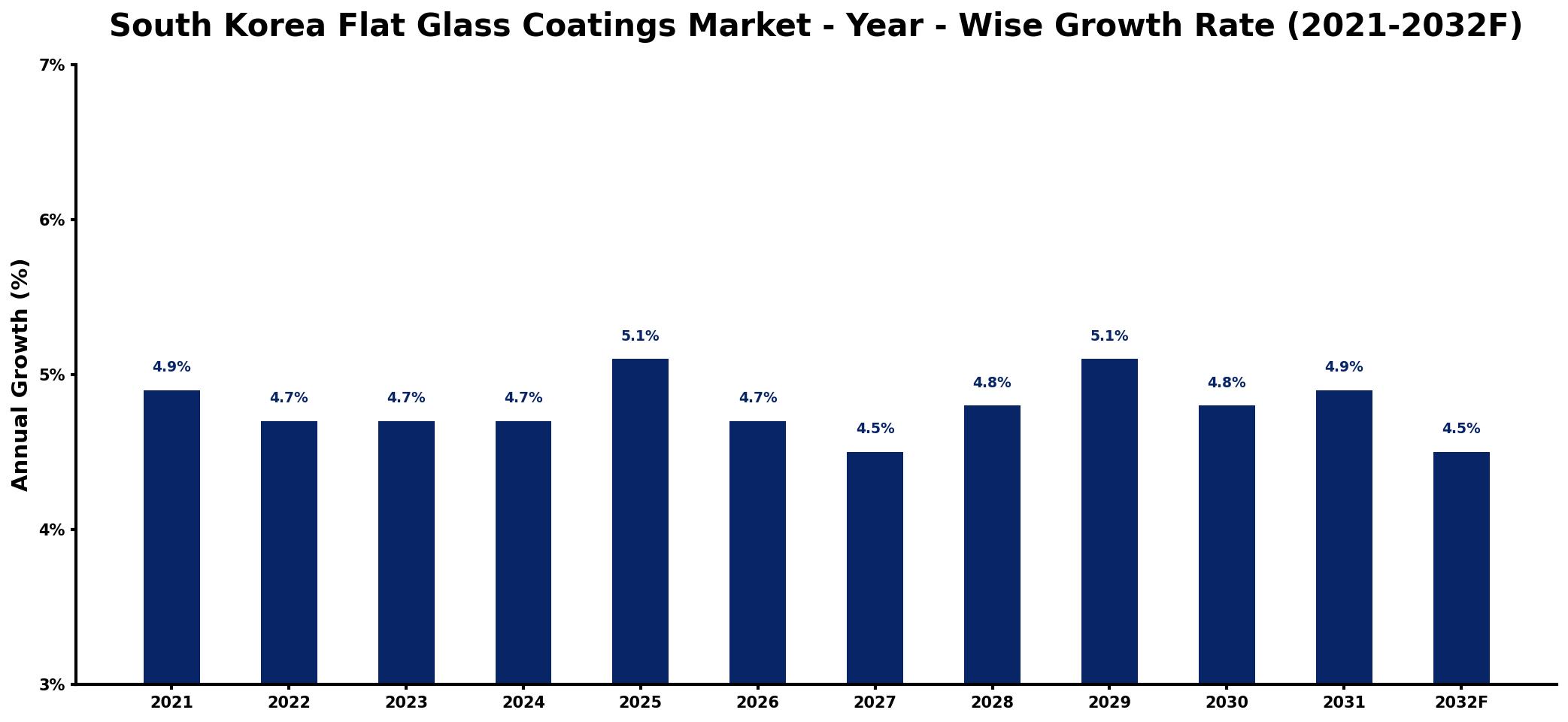
The table below presents the year‑wise growth rates along with the key drivers influencing the market
| Year | Growth Rate | Major Drivers |
| 2021 | 4.9% | Rising construction sector investments |
| 2022 | 4.7% | Increased automotive manufacturing activities |
| 2023 | 4.7% | Growing demand for energy efficiency |
| 2024 | 4.7% | Expansion of renewable energy projects |
| 2025 | 5.1% | Technological advancements in production |
| 2026 | 4.7% | Increased focus on sustainability initiatives |
| 2027 | 4.5% | Emerging markets driving new applications |
| 2028 | 4.8% | Growing interest in aesthetic designs |
| 2029 | 5.1% | Investment in infrastructure development projects |
| 2030 | 4.8% | Expanding residential renovation trends |
| 2031 | 4.9% | Increased urbanization and population growth |
| 2032 | 4.5% | Focus on safety regulations compliance |
Note: Market size estimations and growth projections presented in this report are based on 6Wresearch's proprietary forecasting methodology, utilizing the latest available industry data, government publications, and primary research inputs.
South Korea Flat Glass Coatings Market Synopsis
The South Korea Flat Glass Coatings Market is currently experiencing a vibrant phase of development. With a blend of innovative technological advancements and a strong push towards sustainability, the demand for flat glass coatings is on the rise across multiple sectors, including construction and automotive.
As the country shifts towards energy-efficient solutions, the market is becoming increasingly characterized by the introduction of advanced coatings that enhance the thermal and aesthetic qualities of flat glass. Innovations in self-cleaning and anti-reflective coatings are particularly noteworthy, as they align with consumer preferences for low-maintenance, high-performance products.
South Korea Flat Glass Coatings Market Key Takeaways
- The market is driven by rising demand for energy-efficient and eco-friendly coatings.
- Innovations in coating technologies are enhancing the functional properties of flat glass.
- Strict government regulations are promoting sustainability in the coatings sector.
- Growing adoption of smart glass technologies is expanding application possibilities.
- The automotive industry's demand for coated glass is also a significant growth factor.
Evaluation of Restraints in South Korea Flat Glass Coatings Market
While the South Korea Flat Glass Coatings Market is poised for growth, several restraints limit its full potential. Competitive pressures from both local and international manufacturers create a challenging landscape, often resulting in pricing wars that can erode profit margins. Furthermore, companies face stringent regulatory requirements related to the chemicals used in the coating processes, which may lead to increased compliance costs. Additionally, the need for continuous technological innovation to cater to evolving consumer preferences further complicates market dynamics. Economic uncertainties and fluctuations in raw material prices can also pose challenges, compelling firms to adopt robust strategies to navigate these complexities.
South Korea Flat Glass Coatings Market Trends
A prominent trend in the South Korea Flat Glass Coatings Market is the increasing preference for sustainable and energy-efficient solutions. Low-emissivity coatings are becoming increasingly sought after for their ability to enhance thermal insulation and reduce energy consumption in buildings. Moreover, there is a notable rise in demand for anti-reflective coatings, which improve visibility and minimize glare, particularly in architectural applications. Self-cleaning coatings are gaining traction for their low maintenance requirements, appealing to consumers seeking convenience. The ongoing trend towards product innovation continues to shape market dynamics, as manufacturers develop coatings with enhanced durability and unique functionalities.
South Korea Flat Glass Coatings Market Opportunities
The South Korea Flat Glass Coatings Market offers a wealth of investment opportunities driven by a surge in demand for advanced, energy-efficient coatings. As awareness around sustainability grows, manufacturers are positioned to benefit from innovations that improve thermal insulation, reduce glare, and enhance the aesthetic appeal of coated glass products. Investing in technologies that provide self-cleaning, anti-reflective, or UV-protective features presents lucrative prospects. Collaborations with industry leaders and research institutions focused on cutting-edge developments in coating technologies could also offer significant competitive advantages in this expanding market.
Government Initiatives in the South Korea Flat Glass Coatings Market
The South Korean government has enacted several initiatives aimed at promoting sustainability within the flat glass coatings market. Policies are designed to encourage the development of eco-friendly coatings, setting high standards for performance and environmental impact. Incentives and subsidies are also in place to stimulate innovation among manufacturers, pushing them to explore advanced coating technologies that align with national energy efficiency goals. These government efforts contribute to enhancing competitiveness in the global market while ensuring consumer safety and environmental protection.
Future Insights of the South Korea Flat Glass Coatings Market
Looking ahead to 2026-2032, the South Korea Flat Glass Coatings Market is set to witness substantial growth across various sectors, including construction and automotive. The rising trend of energy-efficient buildings, alongside advancements in automotive production, will drive demand for innovative coatings with enhanced functionalities, such as self-cleaning and anti-fog properties. As environmental regulations become increasingly stringent, the shift towards eco-friendly coatings is expected to gain momentum, further fueling market expansion. Overall, the future landscape of the market appears promising, with ample opportunities for manufacturers and suppliers to innovate and compete effectively.
South Korea Flat Glass Coatings Market Latest Developments (2025 - 2026)
In recent months, the South Korea Flat Glass Coatings Market has witnessed various developments aimed at enhancing product offerings. There has been a notable increase in research and development activities focusing on advanced coating formulations. Companies are actively exploring collaborations to leverage technological advancements that could lead to more efficient manufacturing processes. Additionally, growing interest in sustainable practices has prompted several firms to invest in eco-friendly product lines, responding to both consumer demand and regulatory requirements.
South Korea Flat Glass Coatings Market - Key Attractiveness of the Report
- 10 Years of Market Numbers
- Historical Data Starting from 2022 to 2025
- Base Year: 2025
- Forecast Data until 2032
- Key Performance Indicators Impacting the Market
- Major Upcoming Developments and Projects
Key Highlights of the Report:
- South Korea Flat Glass Coatings Market Outlook
- Market Size of South Korea Flat Glass Coatings Market, 2025
- Forecast of South Korea Flat Glass Coatings Market, 2032
- Historical Data and Forecast of South Korea Flat Glass Coatings Revenues & Volume for the Period 2022-2032F
- South Korea Flat Glass Coatings Market Trend Evolution
- South Korea Flat Glass Coatings Market Drivers and Challenges
- South Korea Flat Glass Coatings Price Trends
- South Korea Flat Glass Coatings Porter's Five Forces
- South Korea Flat Glass Coatings Industry Life Cycle
- Historical Data and Forecast of South Korea Flat Glass Coatings Market Revenues & Volume By Application for the Period 2022-2032F
- Historical Data and Forecast of South Korea Flat Glass Coatings Market Revenues & Volume By Flat Glass Mirror Coatings for the Period 2022-2032F
- Historical Data and Forecast of South Korea Flat Glass Coatings Market Revenues & Volume By Flat Glass Coatings for Solar Power Generation for the Period 2022-2032F
- Historical Data and Forecast of South Korea Flat Glass Coatings Market Revenues & Volume By Flat Glass Coatings for Architectural Applications for the Period 2022-2032F
- Historical Data and Forecast of South Korea Flat Glass Coatings Market Revenues & Volume By Flat Glass Coatings for Automotive Applications for the Period 2022-2032F
- Historical Data and Forecast of South Korea Flat Glass Coatings Market Revenues & Volume By Flat Glass Coatings for Other Applications for the Period 2022-2032F
- Historical Data and Forecast of South Korea Flat Glass Coatings Market Revenues & Volume By Resin for the Period 2022-2032F
- Historical Data and Forecast of South Korea Flat Glass Coatings Market Revenues & Volume By Polyurethane Flat Glass Coatings for the Period 2022-2032F
- Historical Data and Forecast of South Korea Flat Glass Coatings Market Revenues & Volume By Epoxy Flat Glass Coatings for the Period 2022-2032F
- Historical Data and Forecast of South Korea Flat Glass Coatings Market Revenues & Volume By Acrylic Flat Glass Coatings for the Period 2022-2032F
- Historical Data and Forecast of South Korea Flat Glass Coatings Market Revenues & Volume By Other Resin Flat Glass Coatings for the Period 2022-2032F
- Historical Data and Forecast of South Korea Flat Glass Coatings Market Revenues & Volume By Technology for the Period 2022-2032F
- Historical Data and Forecast of South Korea Flat Glass Coatings Market Revenues & Volume By Solvent-based Flat Glass Coatings for the Period 2022-2032F
- Historical Data and Forecast of South Korea Flat Glass Coatings Market Revenues & Volume By Water-based Flat Glass Coatings for the Period 2022-2032F
- Historical Data and Forecast of South Korea Flat Glass Coatings Market Revenues & Volume By Nano Flat Glass Coatings for the Period 2022-2032F
- South Korea Flat Glass Coatings Import Export Trade Statistics
- Market Opportunity Assessment By Application
- Market Opportunity Assessment By Resin
- Market Opportunity Assessment By Technology
- South Korea Flat Glass Coatings Top Companies Market Share
- South Korea Flat Glass Coatings Competitive Benchmarking By Technical and Operational Parameters
- South Korea Flat Glass Coatings Company Profiles
- South Korea Flat Glass Coatings Key Strategic Recommendations






































