South Korea Food And Beverage Vending Machine Market Size, Share & Growth Rate
The South Korea Food And Beverage Vending Machine Market was estimated at USD 1364 Million in 2025 and is projected to reach USD 2403 Million by 2032, growing at a CAGR of 8.4% from 2026 to 2032. This robust growth trajectory is fueled by the rising urban population and increasingly hectic lifestyles that demand convenient food access. Additionally, advancements in vending machine technologies such as cashless payment systems and real-time inventory management are enhancing consumer experiences and driving market expansion.
South Korea Food And Beverage Vending Machine Market Year-wise Growth Rate and Key Drivers
This graph highlights how the South Korea Food And Beverage Vending Machine Market has steadily grown over the years, supported by major growth factors.
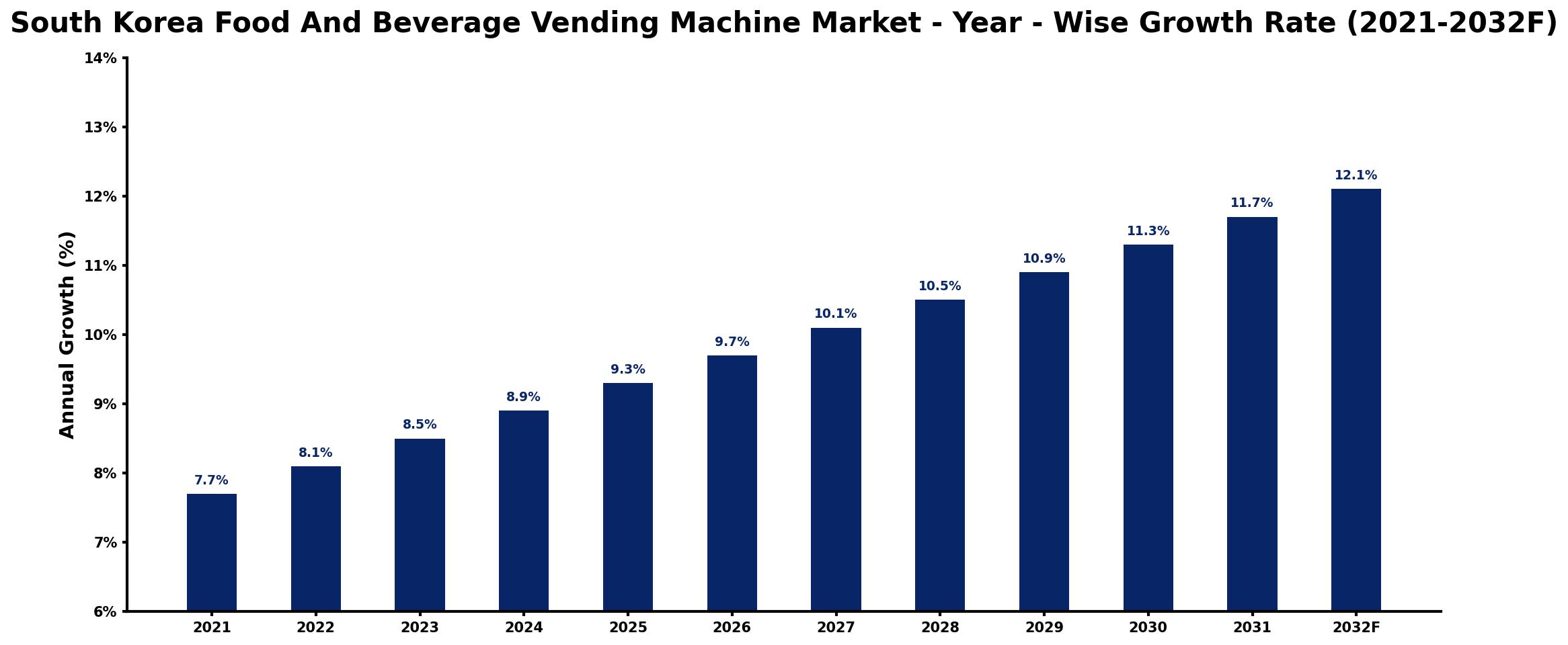
The table below presents the year‑wise growth rates along with the key drivers influencing the market
| Year | Growth Rate | Major Drivers |
| 2021 | 7.7% | Rising consumer demand for convenience |
| 2022 | 8.1% | Technological advancements enhancing functionality |
| 2023 | 8.5% | Increased urbanization and lifestyle changes |
| 2024 | 8.9% | increased production capacity utilization |
| 2025 | 9.3% | Growing interest in contactless transactions |
| 2026 | 9.7% | Investment in smart technology integration |
| 2027 | 10.1% | Heightened focus on health-conscious options |
| 2028 | 10.5% | Emergence of innovative payment solutions |
| 2029 | 10.9% | Expansion of consumer demographics targeting |
| 2030 | 11.3% | Adoption of sustainability initiatives |
| 2031 | 11.7% | Increase in automated service preferences |
| 2032 | 12.1% | Growth in real-time inventory management |
Note: Market size estimations and growth projections presented in this report are based on 6Wresearch's proprietary forecasting methodology, utilizing the latest available industry data, government publications, and primary research inputs.
South Korea Food And Beverage Vending Machine Market Synopsis
While the South Korea Food And Beverage Vending Machine Market has experienced significant momentum recently, it is poised for even greater evolution. The shift in consumer preferences toward healthier and more sustainable options is redefining the landscape, pushing operators to innovate and cater to these demands.
Moreover, the ongoing integration of advanced technology into vending machines suggests a transformative future. As urbanization continues to escalate and consumer habits adapt, the market stands to benefit immensely from these trends.
South Korea Food And Beverage Vending Machine Market Key Takeaways
- Increased demand for convenience drives the rapid expansion of the market.
- Technological advancements are enhancing vending machine functionalities, including cashless payments.
- Consumer preference is shifting towards healthier food options, necessitating machine upgrades.
- Regulatory frameworks are evolving to support food safety and hygiene in vending operations.
- Strategic placement in high-traffic areas maximizes visibility and accessibility for consumers.
Evaluation of Restraints in South Korea Food And Beverage Vending Machine Market
Despite its promising growth, the South Korea Food And Beverage Vending Machine Market faces several restraints. A significant challenge is the increasing consumer demand for fresh, healthier food options, which necessitates the incorporation of advanced refrigeration technology and more sophisticated payment systems into vending machines. These innovations can be costly and pose operational challenges for machine operators. Furthermore, stringent food safety regulations require compliance and routine inspections, adding an extra layer of complexity and potential barriers for new entrants in the market. Maintaining consumer trust while ensuring operational efficiency remains a critical focus for industry players.
South Korea Food And Beverage Vending Machine Market Trends
Current trends indicate a notable shift towards customization in vending machine offerings, allowing consumers to choose from a range of options, including healthier snacks and beverages. Additionally, the advent of artificial intelligence in vending technology is enhancing user interaction, making it easier for consumers to locate their desired items. Furthermore, the rise of smart vending machines, equipped with touchless payment options and remote monitoring capabilities, is becoming increasingly popular in busy urban settings.
South Korea Food And Beverage Vending Machine Market Opportunities
The South Korea Food And Beverage Vending Machine Market presents numerous growth opportunities, particularly in niche segments such as health-focused vending solutions. As consumers increasingly seek nutritious and convenient options, there is a compelling case for vending machines offering organic snacks or locally sourced products. Furthermore, expanding into less saturated markets, such as rural areas or educational institutions, could provide new revenue streams. Collaboration with local food producers and leveraging technology for enhanced user experience will also pave the way for sustainable growth.
Government Initiatives in the South Korea Food And Beverage Vending Machine Market
The South Korean government plays a pivotal role in regulating the Food and Beverage Vending Machine Market, focusing on food safety and consumer protection. Initiatives include the establishment of licensing requirements for vending machine operators, stringent food product labeling, and regular hygiene inspections. These policies are designed to foster an environment of consumer trust while supporting the introduction of innovative vending technologies. Moreover, government incentives encourage the availability of healthier food options, reflecting a commitment to public health and wellness.
Future Insights of the South Korea Food And Beverage Vending Machine Market
Looking towards 2026-2032, the South Korea Food And Beverage Vending Machine Market is expected to continue its upward trajectory, driven by advancements in technology and evolving consumer preferences. As urban areas grow and lifestyles become increasingly fast-paced, the demand for accessible, convenient food solutions will only intensify. Additionally, with a growing emphasis on health and wellness, operators will need to adapt and innovate continuously, aligning product offerings with consumer expectations. The integration of smart technology will further transform traditional vending operations, making them more user-friendly and efficient.
South Korea Food And Beverage Vending Machine Market Latest Developments (2025 - 2026)
In recent months, the market has observed a surge in the deployment of vending machines equipped with advanced touchless payment systems. Companies are increasingly incorporating AI and machine learning to optimize inventory management, enhancing efficiency and reducing waste. Additionally, theres been a notable shift towards vending machines that offer localized food options, responding to consumer demand for regional specialties. Moreover, industry players are investing in marketing campaigns that emphasize the health benefits of their products, aiming to attract a more health-conscious demographic.
South Korea Food And Beverage Vending Machine Market - Key Attractiveness of the Report
- 10 Years of Market Numbers
- Historical Data Starting from 2022 to 2025
- Base Year: 2025
- Forecast Data until 2032
- Key Performance Indicators Impacting the Market
- Major Upcoming Developments and Projects
Key Highlights of the Report:
- South Korea Food And Beverage Vending Machine Market Outlook
- Market Size of South Korea Food And Beverage Vending Machine Market, 2025
- Forecast of South Korea Food And Beverage Vending Machine Market, 2032
- Historical Data and Forecast of South Korea Food And Beverage Vending Machine Revenues & Volume for the Period 2022-2032F
- South Korea Food And Beverage Vending Machine Market Trend Evolution
- South Korea Food And Beverage Vending Machine Market Drivers and Challenges
- South Korea Food And Beverage Vending Machine Price Trends
- South Korea Food And Beverage Vending Machine Porter's Five Forces
- South Korea Food And Beverage Vending Machine Industry Life Cycle
- Historical Data and Forecast of South Korea Food And Beverage Vending Machine Market Revenues & Volume By Product Type for the Period 2022-2032F
- Historical Data and Forecast of South Korea Food And Beverage Vending Machine Market Revenues & Volume By Beverage Vending machine for the Period 2022-2032F
- Historical Data and Forecast of South Korea Food And Beverage Vending Machine Market Revenues & Volume By Food Vending Machine for the Period 2022-2032F
- Historical Data and Forecast of South Korea Food And Beverage Vending Machine Market Revenues & Volume By Payment Mode for the Period 2022-2032F
- Historical Data and Forecast of South Korea Food And Beverage Vending Machine Market Revenues & Volume By Cash for the Period 2022-2032F
- Historical Data and Forecast of South Korea Food And Beverage Vending Machine Market Revenues & Volume By Cashless for the Period 2022-2032F
- Historical Data and Forecast of South Korea Food And Beverage Vending Machine Market Revenues & Volume By Application for the Period 2022-2032F
- Historical Data and Forecast of South Korea Food And Beverage Vending Machine Market Revenues & Volume By Schools for the Period 2022-2032F
- Historical Data and Forecast of South Korea Food And Beverage Vending Machine Market Revenues & Volume By Offices for the Period 2022-2032F
- Historical Data and Forecast of South Korea Food And Beverage Vending Machine Market Revenues & Volume By Shopping Complex for the Period 2022-2032F
- Historical Data and Forecast of South Korea Food And Beverage Vending Machine Market Revenues & Volume By Others for the Period 2022-2032F
- South Korea Food And Beverage Vending Machine Import Export Trade Statistics
- Market Opportunity Assessment By Product Type
- Market Opportunity Assessment By Payment Mode
- Market Opportunity Assessment By Application
- South Korea Food And Beverage Vending Machine Top Companies Market Share
- South Korea Food And Beverage Vending Machine Competitive Benchmarking By Technical and Operational Parameters
- South Korea Food And Beverage Vending Machine Company Profiles
- South Korea Food And Beverage Vending Machine Key Strategic Recommendations






































