South Korea Formwork Market Summary
The south korea formwork market was estimated at USD 426 Million in 2025 and is projected to reach USD 559 Million by 2032, growing at a CAGR of 4.6% from 2026 to 2032.
South Korea Formwork Market Year-wise Growth Rate and Key Drivers
This graph highlights how the South Korea Formwork Market has steadily grown over the past five years, supported by major growth factors.
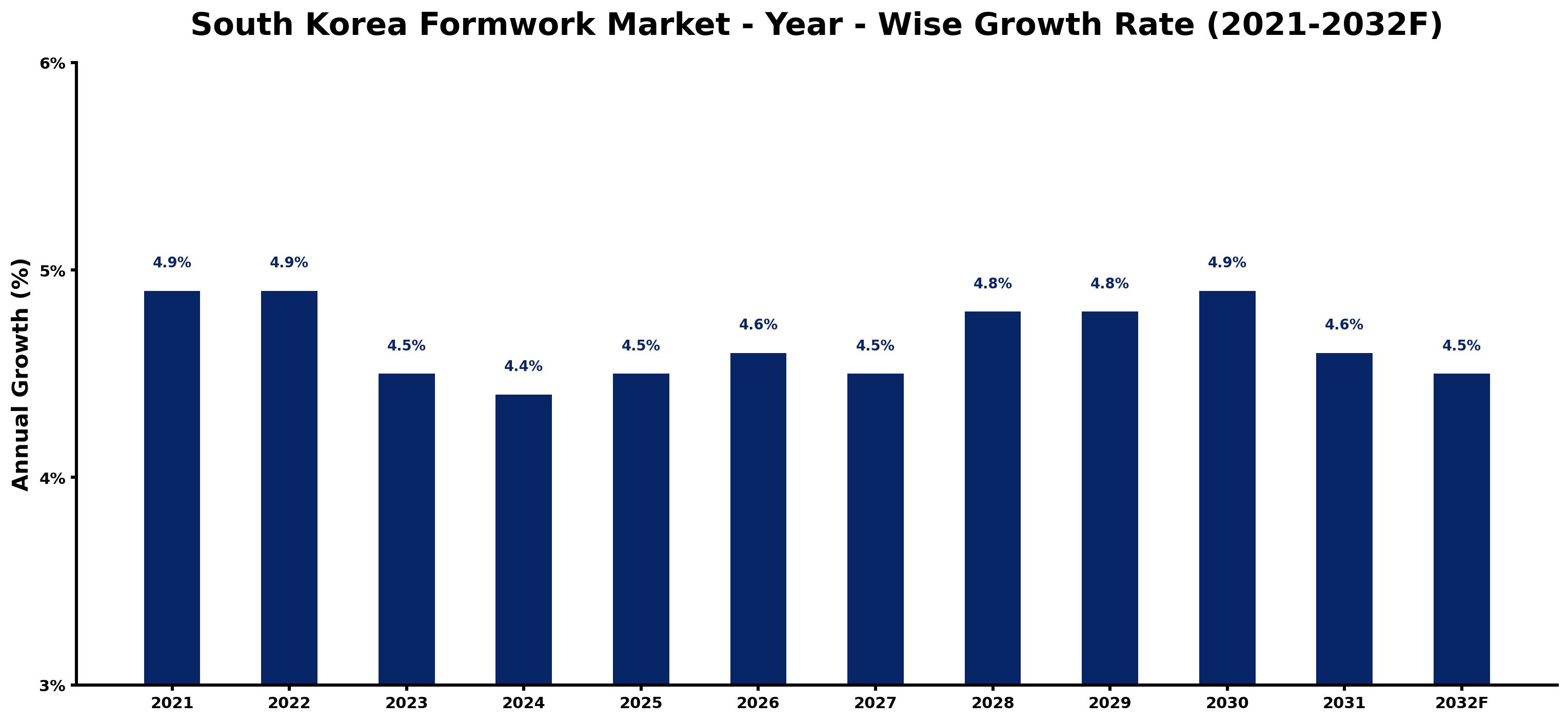
The table below presents the year wise growth rates along with the key drivers influencing the market
| Year | Growth Rate | Major Drivers |
| 2021 | 4.9% | Post-lockdown construction demand surged, revitalizing formwork project pipelines across South Korea. |
| 2022 | 4.9% | Technological integration in prefabrication showcased efficiency, enhancing formwork usage in projects. |
| 2023 | 4.5% | Urbanization trends intensified, prompting advanced formwork solutions for space-constrained sites. |
| 2024 | 4.4% | Sustainable building practices gained traction, pushing manufacturers towards eco-friendly formwork options. |
| 2025 | 4.5% | Rising labor costs shifted focus toward automated formwork systems for operational efficiency. |
| 2026 | 4.6% | Investment in smart infrastructure projects created new opportunities for high-performance formwork materials. |
| 2027 | 4.5% | International collaborations brought innovative formwork technologies into the local market landscape. |
| 2028 | 4.8% | The resurgence of public infrastructure projects fueled heightened demand for versatile formwork systems. |
| 2029 | 4.8% | Increased focus on safety standards drove advancements in formwork design and materials. |
| 2030 | 4.9% | Green construction initiatives incentivized the adoption of reusable and recyclable formwork solutions. |
| 2031 | 4.6% | Emerging trends in modular construction promoted specialized formwork for rapid assembly applications. |
| 2032 | 4.5% | Evolving architectural designs encouraged customized formwork solutions tailored to unique project needs. |
Note - Market size estimations and growth projections presented in this report are based on 6Wresearch's advanced forecasting approach, validated with industry datasets as of June 2026.
South Korea Formwork Market Synopsis
The South Korea Formwork Market is projected to reach 4.6% and witness significant growth during the forecast period (2026-2032). This market is anticipated to register a compound annual growth rate (CAGR) of 8.8%, driven primarily by increasing government investments in the construction sector and a burgeoning demand for infrastructure development. The construction industry in South Korea is experiencing considerable expansion, supported by urbanization trends that necessitate a robust formwork supply across various projects.
South Korea Formwork Market Growth Drivers
The growth trajectory of the South Korea Formwork Market is influenced by several key factors:
- The South Korean government's substantial investments in public infrastructure projects have created a demand for advanced formwork solutions, which are essential for timely and efficient construction.
- Rapid urbanization is pushing municipalities to expand housing and commercial spaces, stimulating demand for formwork as foundational support in construction activities.
- There is an increasing focus on sustainable and efficient building practices, prompting the use of modern formwork technology that improves project delivery and reduces waste.
- The rising population in urban areas is contributing to a housing shortage, driving real estate developers to invest in residential construction, subsequently elevating formwork demand.
- Enhanced government policies, such as tax benefits and financial support initiatives for housing development, are encouraging private sector participation, which in turn escalates formwork procurement.
South Korea Formwork Market Challenges and Restraints
Despite the promising growth outlook, the South Korea Formwork Market faces challenges that may impede its advancement:
- Volatility in raw material prices can lead to increased production costs, affecting profit margins for companies operating within the formwork sector.
- The market is experiencing intense competition, which can pressure prices and impact the financial performance of suppliers.
- Inadequate skilled labor in specialized construction trades can hinder project execution and the effective utilization of advanced formwork technologies.
- Stringent regulatory requirements related to construction safety and environmental sustainability necessitate compliance, which can lead to increased operational complexities for formwork providers.
- Market fluctuations driven by changes in government policy can create uncertainties for stakeholders, affecting long-term investment decisions in the formwork segment.
South Korea Formwork Market Government Investment and Initiatives
Government investment is a significant catalyst in the South Korea Formwork Market, with multiple initiatives aimed at enhancing infrastructure development:
- The South Korean government is focusing on urban renewal projects, which necessitate advanced formwork systems for efficient construction processes.
- Investment in transportation infrastructure, such as roads and bridges, ensures a steady demand for formwork solutions that offer enhanced durability and rapid deployment.
- Financial incentives and grants are increasingly available for construction firms that adopt sustainable practices in their projects, driving the usage of innovative formwork technologies.
- Public-private partnerships are being encouraged to foster collaboration between government entities and construction firms, facilitating the sharing of resources for large-scale construction projects.
- Plans for smart city initiatives are being implemented, which require sophisticated construction methodologies and consequently elevate the demand for specialized formwork systems.
South Korea Formwork Market Latest Developments (May 2025 - June 2026)
The South Korea Formwork Market has seen notable developments between May 2025 and June 2026, reflecting shifts in industry dynamics:
- Adoption of advanced technology, including digital tools for project management, is on the rise, leading to more efficient formwork applications in construction projects.
- Increased collaborations among construction firms are being observed, aimed at sharing best practices and innovative solutions that enhance the application of formwork.
- Industry stakeholders are increasingly focusing on training programs to address the skill gap within the labor force, enhancing the effective use of formwork systems.
- Market players are exploring eco-friendly materials for formwork that align with global sustainability trends, promoting a greener construction industry.
- Investment in research and development to innovate formwork designs continues to prop up competitive advantages in the market, as firms strive to meet evolving customer needs.
South Korea Formwork Market - Key Attractiveness of the Report
- 10 Years of Market Numbers
- Historical Data Starting from 2022 to 2025
- Base Year: 2025
- Forecast Data until 2032
- Key Performance Indicators Impacting the Market
- Major Upcoming Developments and Projects
Key Highlights of the Report:
- South Korea Formwork Market Outlook
- Market Size of South Korea Formwork Market, 2025
- Forecast of South Korea Formwork Market, 2032F
- Historical Data and Forecast of South Korea Formwork Revenues & Volume for the Period 2022-2032F
- South Korea Formwork Market Trend Evolution
- South Korea Formwork Market Drivers and Challenges
- South Korea Formwork Price Trends
- South Korea Formwork Porter's Five Forces
- South Korea Formwork Industry Life Cycle
- Historical Data and Forecast of South Korea Formwork Market Revenues & Volume By Product Type for the Period 2022-2032F
- Historical Data and Forecast of South Korea Formwork Market Revenues & Volume By Traditional timber formwork for the Period 2022-2032F
- Historical Data and Forecast of South Korea Formwork Market Revenues & Volume By Engineered Formwork System for the Period 2022-2032F
- Historical Data and Forecast of South Korea Formwork Market Revenues & Volume By Re-usable plastic formwork for the Period 2022-2032F
- Historical Data and Forecast of South Korea Formwork Market Revenues & Volume By Others for the Period 2022-2032F
- Historical Data and Forecast of South Korea Formwork Market Revenues & Volume By Applications for the Period 2022-2032F
- Historical Data and Forecast of South Korea Formwork Market Revenues & Volume By Buildings for the Period 2022-2032F
- Historical Data and Forecast of South Korea Formwork Market Revenues & Volume By Transportation for the Period 2022-2032F
- Historical Data and Forecast of South Korea Formwork Market Revenues & Volume By Industrial Facilities for the Period 2022-2032F
- South Korea Formwork Import Export Trade Statistics
- Market Opportunity Assessment By Product Type
- Market Opportunity Assessment By Applications
- South Korea Formwork Top Companies Market Share
- South Korea Formwork Competitive Benchmarking By Technical and Operational Parameters
- South Korea Formwork Company Profiles
- South Korea Formwork Key Strategic Recommendations






































