South Korea Frozen Fish Market Size, Share & Growth Rate
The South Korea Frozen Fish Market was estimated at USD 223 Million in 2025 and is projected to reach USD 298 Million by 2032, growing at a CAGR of 4.2% from 2026 to 2032. This growth trajectory is propelled by an increasing consumer shift toward convenient, ready-to-cook seafood products, which align perfectly with todays fast-paced lifestyles. Additionally, the rising disposable incomes of South Korean households further support this trend, alongside heightened awareness of the health benefits associated with fish consumption.
South Korea Frozen Fish Market Year-wise Growth Rate and Key Drivers
This graph highlights how the South Korea Frozen Fish Market has steadily grown over the years, supported by major growth factors.
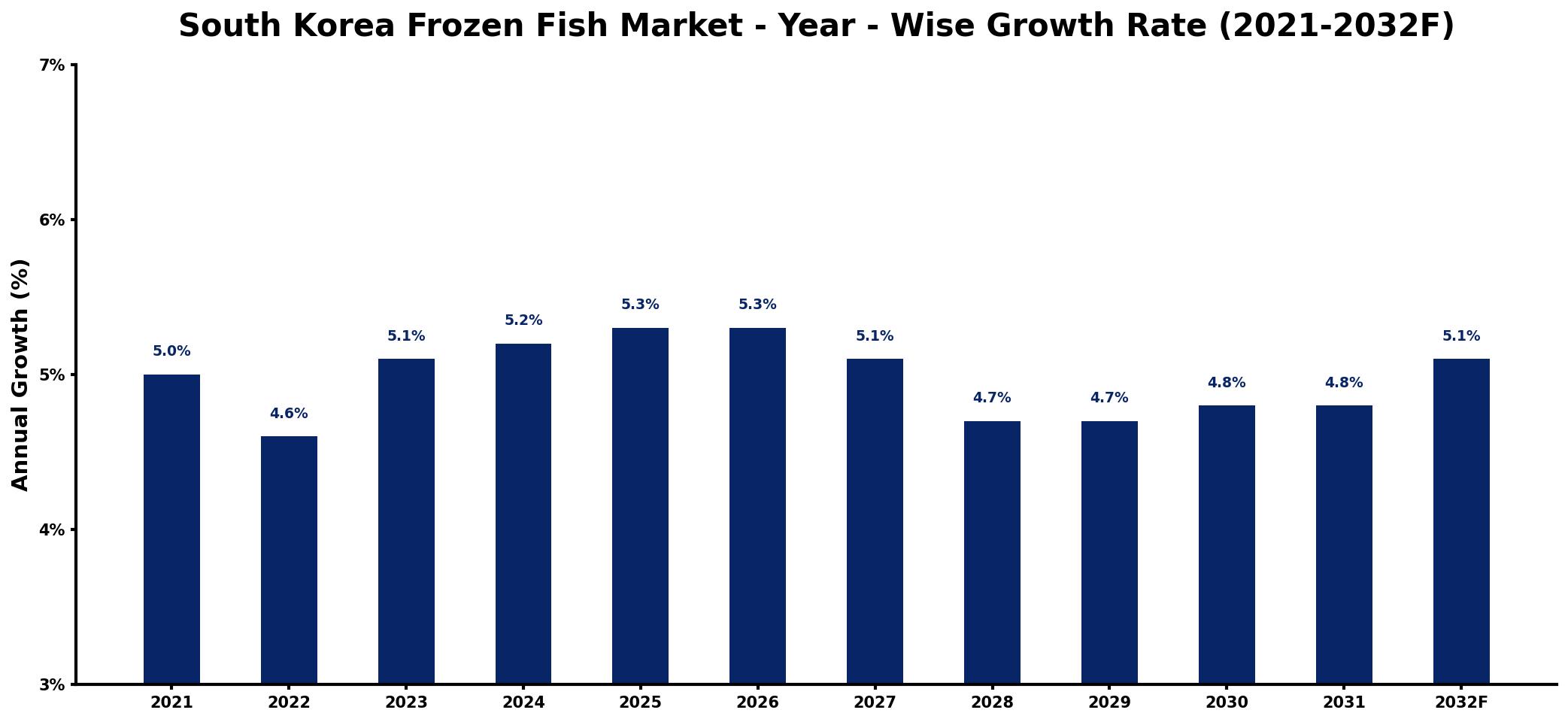
The table below presents the year‑wise growth rates along with the key drivers influencing the market
| Year | Growth Rate | Major Drivers |
| 2021 | 5.0% | Rising demand for convenience meals |
| 2022 | 4.6% | Increased popularity of healthy diets |
| 2023 | 5.1% | Expansion of retail distribution channels |
| 2024 | 5.2% | Growth in online grocery shopping |
| 2025 | 5.3% | Higher consumer disposable income levels |
| 2026 | 5.3% | Surge in seafood consumption trends |
| 2027 | 5.1% | Emergence of innovative packaging solutions |
| 2028 | 4.7% | Diversification of product offerings available |
| 2029 | 4.7% | Strengthening of supply chain networks |
| 2030 | 4.8% | Increased focus on sustainable sourcing |
| 2031 | 4.8% | rising end-use demand growth |
| 2032 | 5.1% | Growing interest in international cuisines |
Note: Market size estimations and growth projections presented in this report are based on 6Wresearch's proprietary forecasting methodology, utilizing the latest available industry data, government publications, and primary research inputs.
South Korea Frozen Fish Market Synopsis
Currently, the South Korea frozen fish market is undergoing a transformation fueled by a consumer base that values convenience and health. As busy lifestyles become more prevalent, the demand for ready-to-cook seafood options has surged, making frozen fish an attractive choice for many households.
Key drivers of this market include not only changing dietary preferences but also initiatives by the government that promote seafood consumption due to its nutritional advantages. With growing concerns around sustainability, consumers are increasingly opting for responsibly sourced frozen fish, further shaping the market landscape.
South Korea Frozen Fish Market Key Takeaways
- The market is shifting towards premium, high-quality frozen fish products.
- Convenience plays a significant role in the increasing popularity of ready-to-cook options.
- Consumers are becoming more environmentally conscious, leading to a preference for sustainably sourced seafood.
- Technological advancements in freezing and packaging are enhancing product quality and shelf life.
- The rise of e-commerce is changing traditional distribution channels, offering new avenues for market players.
Evaluation of Restraints in South Korea Frozen Fish Market
Despite its promising growth, the South Korea frozen fish market faces several constraints. Competition from international suppliers presents challenges for domestic producers striving to distinguish their offerings while remaining price-competitive. Additionally, the fluctuating demand driven by changing consumer preferences and economic conditions poses risks. Quality control during transportation is paramount; any lapses can severely tarnish a brand's reputation. Compliance with stringent regulations for food safety further complicates market dynamics, making adherence to standards a critical focus for businesses.
South Korea Frozen Fish Market Trends
The South Korea frozen fish market is witnessing notable trends shaping its future. A marked shift towards healthier eating habits has amplified the demand for premium frozen fish, with an emphasis on quality and sustainability. Ready-to-cook fish products are gaining traction, catering to the needs of health-conscious consumers seeking quick meal solutions. Innovations in packaging technology are also playing a vital role, providing better preservation methods that enhance both the quality and longevity of frozen products.
South Korea Frozen Fish Market Opportunities
Opportunities within the South Korea frozen fish market are ripe for investment. The growing consumer demand for convenient, healthy options provides fertile ground for new product offerings. The increasing trend towards online grocery shopping complements the market's expansion, allowing businesses to reach a broader audience. Moreover, partnerships with local suppliers and investment in innovative logistics solutions can lead to significant competitive advantages, enabling stakeholders to capitalize on the evolving market landscape.
Government Initiatives in the South Korea Frozen Fish Market
The South Korean government is actively involved in regulating and supporting the frozen fish market. This includes enforcing stringent quality control measures via the Ministry of Food and Drug Safety, aimed at ensuring public safety. Additionally, protective import tariffs and quotas are in place to shield local producers from foreign competition. Subsidies and financial assistance programs are also offered to bolster the competitiveness of domestic fish producers, highlighting the government's commitment to maintaining a stable and thriving market.
Future Insights of the South Korea Frozen Fish Market
Looking ahead to 2026-2032, the South Korea frozen fish market is set for continued growth, driven by evolving consumer preferences for healthy and convenient dining options. The increasing focus on sustainability will likely elevate demand for ethically sourced seafood, propelling further market expansion. Furthermore, advancements in freezing and packaging technologies are expected to improve product quality, while the integration of digital shopping experiences will enhance accessibility for consumers, solidifying the market's positive trajectory.
South Korea Frozen Fish Market Latest Developments (2025 - 2026)
Recent developments in the South Korea frozen fish market showcase a growing emphasis on innovation and sustainability. Players are increasingly investing in new technologies that enhance product freshness and extend shelf life, responding to consumer demand for high-quality options. The expansion of online grocery platforms continues to reshape how consumers access frozen fish products, leading to an evolving retail landscape characterized by improved convenience and availability.
South Korea Frozen Fish Market - Key Attractiveness of the Report
- 10 Years of Market Numbers
- Historical Data Starting from 2022 to 2025
- Base Year: 2025
- Forecast Data until 2032
- Key Performance Indicators Impacting the Market
- Major Upcoming Developments and Projects
Key Highlights of the Report:
- South Korea Frozen Fish Market Outlook
- Market Size of South Korea Frozen Fish Market, 2025
- Forecast of South Korea Frozen Fish Market, 2032
- Historical Data and Forecast of South Korea Frozen Fish Revenues & Volume for the Period 2022-2032F
- South Korea Frozen Fish Market Trend Evolution
- South Korea Frozen Fish Market Drivers and Challenges
- South Korea Frozen Fish Price Trends
- South Korea Frozen Fish Porter's Five Forces
- South Korea Frozen Fish Industry Life Cycle
- Historical Data and Forecast of South Korea Frozen Fish Market Revenues & Volume By Type for the Period 2022-2032F
- Historical Data and Forecast of South Korea Frozen Fish Market Revenues & Volume By Fish Fingers for the Period 2022-2032F
- Historical Data and Forecast of South Korea Frozen Fish Market Revenues & Volume By Fish Cakes for the Period 2022-2032F
- Historical Data and Forecast of South Korea Frozen Fish Market Revenues & Volume By Breaded/Battered Fish for the Period 2022-2032F
- Historical Data and Forecast of South Korea Frozen Fish Market Revenues & Volume By Whole Fish & Drawn Fish for the Period 2022-2032F
- Historical Data and Forecast of South Korea Frozen Fish Market Revenues & Volume By Single Fillet & Butterfly Fillet for the Period 2022-2032F
- Historical Data and Forecast of South Korea Frozen Fish Market Revenues & Volume By Dressed Fish for the Period 2022-2032F
- Historical Data and Forecast of South Korea Frozen Fish Market Revenues & Volume By Steaks Fish for the Period 2022-2032F
- Historical Data and Forecast of South Korea Fish Fingers Frozen Fish Market Revenues & Volume By Others for the Period 2022-2032F
- Historical Data and Forecast of South Korea Frozen Fish Market Revenues & Volume By Application for the Period 2022-2032F
- Historical Data and Forecast of South Korea Frozen Fish Market Revenues & Volume By Direct Consumption for the Period 2022-2032F
- Historical Data and Forecast of South Korea Frozen Fish Market Revenues & Volume By Restaurants for the Period 2022-2032F
- Historical Data and Forecast of South Korea Frozen Fish Market Revenues & Volume By Food Processing Factories for the Period 2022-2032F
- Historical Data and Forecast of South Korea Frozen Fish Market Revenues & Volume By Others for the Period 2022-2032F
- Historical Data and Forecast of South Korea Frozen Fish Market Revenues & Volume By Distribution Channel for the Period 2022-2032F
- Historical Data and Forecast of South Korea Frozen Fish Market Revenues & Volume By Supermarkets & Hypermarkets for the Period 2022-2032F
- Historical Data and Forecast of South Korea Frozen Fish Market Revenues & Volume By Convenience Stores for the Period 2022-2032F
- Historical Data and Forecast of South Korea Frozen Fish Market Revenues & Volume By Speciality Retailers for the Period 2022-2032F
- Historical Data and Forecast of South Korea Frozen Fish Market Revenues & Volume By Online for the Period 2022-2032F
- Historical Data and Forecast of South Korea Frozen Fish Market Revenues & Volume By Others for the Period 2022-2032F
- South Korea Frozen Fish Import Export Trade Statistics
- Market Opportunity Assessment By Type
- Market Opportunity Assessment By Application
- Market Opportunity Assessment By Distribution Channel
- South Korea Frozen Fish Top Companies Market Share
- South Korea Frozen Fish Competitive Benchmarking By Technical and Operational Parameters
- South Korea Frozen Fish Company Profiles
- South Korea Frozen Fish Key Strategic Recommendations






































