South Korea Frozen Processed Meat Market Size, Share & Growth Rate
The South Korea Frozen Processed Meat Market was estimated at USD 686 Million in 2025 and is projected to reach USD 978 Million by 2032, growing at a CAGR of 5.2% from 2026 to 2032. This growth trajectory is primarily driven by a shift in consumer preferences towards convenience foods, particularly among busy urban professionals who favor ready-to-eat meal solutions. As lifestyles evolve, the market is also witnessing an increasing inclination towards higher quality and healthier frozen meat options.
South Korea Frozen Processed Meat Market Year-wise Growth Rate and Key Drivers
This graph highlights how the South Korea Frozen Processed Meat Market has steadily grown over the years, supported by major growth factors.
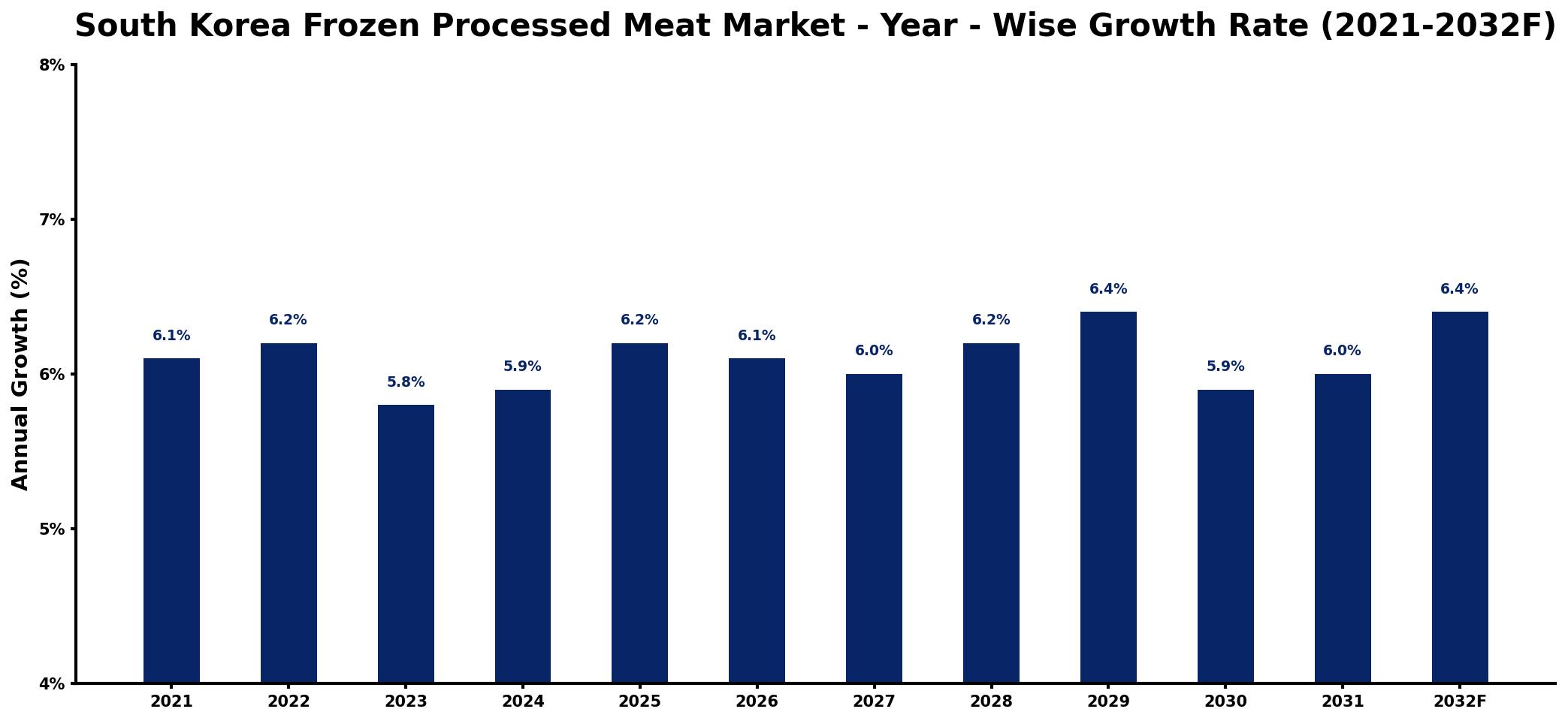
The table below presents the year‑wise growth rates along with the key drivers influencing the market
| Year | Growth Rate | Major Drivers |
| 2021 | 6.1% | Rising demand for convenience foods |
| 2022 | 6.2% | Increased consumer health consciousness |
| 2023 | 5.8% | Expansion of retail distribution channels |
| 2024 | 5.9% | improved raw material availability |
| 2025 | 6.2% | Increased investments in automation technology |
| 2026 | 6.1% | Emergence of new flavor profiles |
| 2027 | 6.0% | Shift towards sustainable sourcing practices |
| 2028 | 6.2% | Growing popularity of meal kits |
| 2029 | 6.4% | rising export shipment volumes |
| 2030 | 5.9% | Increased focus on product innovation |
| 2031 | 6.0% | Rising trend of protein-based diets |
| 2032 | 6.4% | Strengthening of food safety regulations |
Note: Market size estimations and growth projections presented in this report are based on 6Wresearch's proprietary forecasting methodology, utilizing the latest available industry data, government publications, and primary research inputs.
South Korea Frozen Processed Meat Market Synopsis
In South Korea, the demand for frozen processed meat products such as sausages, burgers, and meatballs has surged, driven by the fast-paced lifestyle of consumers. This demand is complemented by the rising trend of online grocery shopping, which enables easier access to frozen food items.
Additionally, a growing middle-class population is leading to an expansion in disposable income, further propelling the appetite for premium, ready-to-eat meat products. The diverse preferences among consumers for both local and international flavors are enhancing the scope of product offerings within the market.
South Korea Frozen Processed Meat Market Key Takeaways
- The market is on a robust growth path, driven by urbanization and changing consumer habits.
- There is a distinct shift towards healthier frozen meat options, with consumers favoring products free from artificial additives.
- Online grocery shopping and food delivery services are key catalysts for increasing market penetration.
- Investment in innovative product development and quality enhancement is crucial for market players.
- Government policies focus on maintaining high safety and quality standards while supporting local production.
Evaluation of Restraints in South Korea Frozen Processed Meat Market
Despite the promising growth outlook, the South Korea Frozen Processed Meat Market faces several constraints. Intense competition from both domestic and international suppliers is a significant hurdle, compelling companies to continually innovate and refine their offerings. Moreover, there is an emerging consumer trend favoring fresh, non-processed foods, which poses a challenge to the frozen meat sector. Additionally, fluctuations in raw material prices and stringent food safety regulations necessitate robust quality control measures and can impact profit margins.
South Korea Frozen Processed Meat Market Trends
Several key trends are shaping the South Korea Frozen Processed Meat Market. Firstly, there is an increasing demand for convenient, ready-to-eat products, aligning with busy lifestyles. Secondly, health-conscious consumers are steering the market towards options that emphasize quality and natural ingredients. Furthermore, the emergence of international flavors and diverse product offerings reflects the dynamic preferences of Korean consumers, making it imperative for companies to diversify their portfolios.
South Korea Frozen Processed Meat Market Opportunities
Investment opportunities abound in the South Korea Frozen Processed Meat Market. Companies can explore the development of premium frozen products that align with health trends, thereby attracting a more discerning consumer base. Moreover, technology enhancements in processing and packaging could lead to better product quality and extended shelf life. Engaging in strategic partnerships with local retailers and utilizing e-commerce platforms will also provide a significant edge in capturing the growing demand for frozen convenience foods.
Government Initiatives in the South Korea Frozen Processed Meat Market
The South Korean government actively supports the Frozen Processed Meat Market through stringent regulations on food safety and quality standards. These policies aim to enhance consumer protection while promoting domestic production. Additionally, the government provides financial assistance and subsidies to local producers to foster innovation in processing techniques and product development, thereby encouraging competitiveness in the market.
Future Insights of the South Korea Frozen Processed Meat Market
Looking ahead to 2026-2032, the South Korea Frozen Processed Meat Market is poised for steady expansion. The continued urbanization and the increasing preference for convenient food solutions will drive demand. Moreover, advancements in technology and shifts in consumer attitudes towards healthier eating will likely lead to the introduction of innovative products. As e-commerce continues to flourish, it will serve as a pivotal channel for market players seeking to broaden their reach.
South Korea Frozen Processed Meat Market Latest Developments (2025 - 2026)
The recent period has seen a surge in product launches, with many companies introducing unique flavors and healthier frozen meat options in response to consumer trends. Additionally, there has been an increase in collaborations between meat producers and tech companies aimed at improving the supply chain and distribution processes. Furthermore, marketing strategies are increasingly focusing on the benefits of convenience and quality, appealing to modern consumers' preferences.
South Korea Frozen Processed Meat Market - Key Attractiveness of the Report
- 10 Years of Market Numbers
- Historical Data Starting from 2022 to 2025
- Base Year: 2025
- Forecast Data until 2032
- Key Performance Indicators Impacting the Market
- Major Upcoming Developments and Projects
Key Highlights of the Report:
- South Korea Frozen Processed Meat Market Outlook
- Market Size of South Korea Frozen Processed Meat Market, 2025
- Forecast of South Korea Frozen Processed Meat Market, 2032
- Historical Data and Forecast of South Korea Frozen Processed Meat Revenues & Volume for the Period 2022-2032F
- South Korea Frozen Processed Meat Market Trend Evolution
- South Korea Frozen Processed Meat Market Drivers and Challenges
- South Korea Frozen Processed Meat Price Trends
- South Korea Frozen Processed Meat Porter's Five Forces
- South Korea Frozen Processed Meat Industry Life Cycle
- Historical Data and Forecast of South Korea Frozen Processed Meat Market Revenues & Volume By Product Type for the Period 2022-2032F
- Historical Data and Forecast of South Korea Frozen Processed Meat Market Revenues & Volume By Beef for the Period 2022-2032F
- Historical Data and Forecast of South Korea Frozen Processed Meat Market Revenues & Volume By Pork for the Period 2022-2032F
- Historical Data and Forecast of South Korea Frozen Processed Meat Market Revenues & Volume By Chicken for the Period 2022-2032F
- Historical Data and Forecast of South Korea Frozen Processed Meat Market Revenues & Volume By Mutton for the Period 2022-2032F
- Historical Data and Forecast of South Korea Frozen Processed Meat Market Revenues & Volume By Others for the Period 2022-2032F
- Historical Data and Forecast of South Korea Frozen Processed Meat Market Revenues & Volume By Application for the Period 2022-2032F
- Historical Data and Forecast of South Korea Frozen Processed Meat Market Revenues & Volume By Retail Store for the Period 2022-2032F
- Historical Data and Forecast of South Korea Frozen Processed Meat Market Revenues & Volume By Online Sale for the Period 2022-2032F
- South Korea Frozen Processed Meat Import Export Trade Statistics
- Market Opportunity Assessment By Product Type
- Market Opportunity Assessment By Application
- South Korea Frozen Processed Meat Top Companies Market Share
- South Korea Frozen Processed Meat Competitive Benchmarking By Technical and Operational Parameters
- South Korea Frozen Processed Meat Company Profiles
- South Korea Frozen Processed Meat Key Strategic Recommendations






































