South Korea Glass Tiles Market Size, Share & Growth Rate
The South Korea Glass Tiles Market was estimated at USD 340 Million in 2025 and is projected to reach USD 469 Million by 2032, growing at a CAGR of 4.7% from 2026 to 2032. This upward trajectory is primarily fueled by the increasing integration of glass tiles in high-end interior designs, as well as growing consumer awareness of sustainable materials. Architectural trends that emphasize aesthetics and functionality are also driving the demand for versatile glass tile solutions across both residential and commercial sectors.
South Korea Glass Tiles Market Year-wise Growth Rate and Key Drivers
This graph highlights how the South Korea Glass Tiles Market has steadily grown over the years, supported by major growth factors.
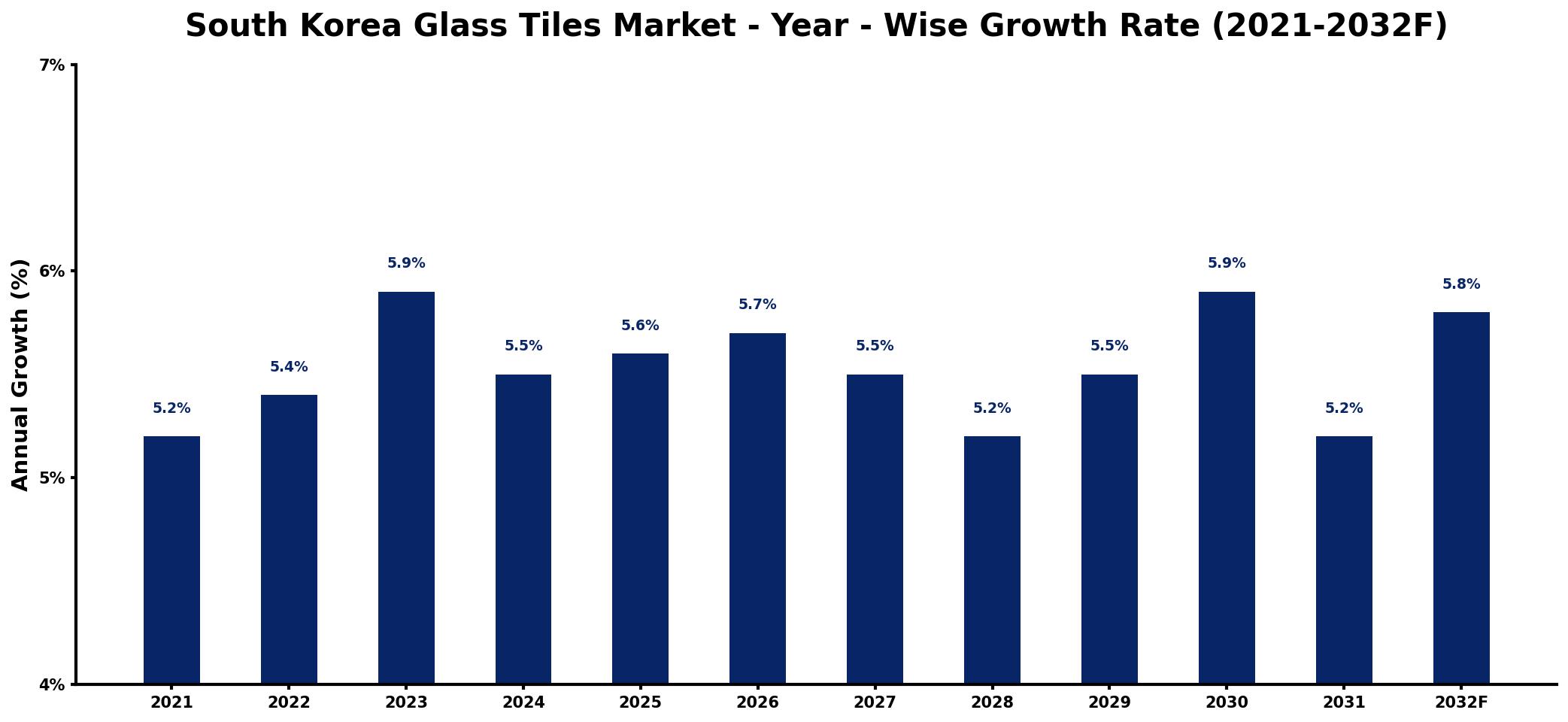
The table below presents the year‑wise growth rates along with the key drivers influencing the market
| Year | Growth Rate | Major Drivers |
| 2021 | 5.2% | Rising residential construction projects |
| 2022 | 5.4% | Increased demand for interior design |
| 2023 | 5.9% | Growing popularity in renovations |
| 2024 | 5.5% | Expansion of eco-friendly materials |
| 2025 | 5.6% | Investment in luxury home upgrades |
| 2026 | 5.7% | Surge in commercial property development |
| 2027 | 5.5% | Innovations in aesthetic applications |
| 2028 | 5.2% | Strengthening hospitality sector growth |
| 2029 | 5.5% | Emerging trends in sustainable architecture |
| 2030 | 5.9% | Boost in urban development initiatives |
| 2031 | 5.2% | Heightened focus on artistic expression |
| 2032 | 5.8% | Rising interest in DIY projects |
Note: Market size estimations and growth projections presented in this report are based on 6Wresearch's proprietary forecasting methodology, utilizing the latest available industry data, government publications, and primary research inputs.
South Korea Glass Tiles Market Synopsis
One notable factor contributing to the South Korea Glass Tiles Market is the rising preference for tiles that enhance both aesthetics and practicality. With options that reflect light and vibrant colors, glass tiles are increasingly being utilized in kitchens and bathrooms, where water resistance and easy maintenance are paramount. Furthermore, the trend towards sustainable building practices has propelled the demand for eco-friendly glass tiles made from recycled materials.
Moreover, advancements in manufacturing technologies have enabled the production of customized glass tiles, allowing for intricate designs and easy installation. These innovations not only cater to changing consumer tastes but also align with the broader architectural movement favoring environmentally responsible materials. As such, the market is primed for growth, driven by a blend of functionality and aesthetic appeal.
South Korea Glass Tiles Market Key Takeaways
- The market's growth is largely driven by the construction industry's embrace of decorative and functional glass tiles.
- Innovations in tile manufacturing enhance design customization and installation efficiency.
- Consumer demand for sustainable building materials is shaping the production of eco-friendly glass tiles.
- Architectural trends that prioritize aesthetics and durability are bolstering market dynamics.
- The availability of diverse color, texture, and finish options contributes to the market's expansion.
Evaluation of Restraints in South Korea Glass Tiles Market
Despite its promising outlook, the South Korea Glass Tiles Market faces several restraints that may temper growth. Notably, competition from ceramic and porcelain tiles presents a challenge, as these alternatives offer various design options at more competitive price points. Furthermore, the increasing consumer emphasis on sustainability has created a demand for building materials that incorporate recycled content and energy-efficient production methods, thus influencing market dynamics. Fluctuating construction activity and evolving regulatory requirements also add layers of complexity, potentially impacting product innovation and market expansion.
South Korea Glass Tiles Market Trends
Current trends indicate a strong movement towards innovative glass tile applications, particularly in commercial spaces where visual impact is crucial. Retail and hospitality sectors are increasingly favoring glass tiles for their ability to enhance light and ambiance. Additionally, the rise of smart homes is leading to a growing interest in tiles that incorporate technology, further driving innovation in this market.
Moreover, as urban living spaces become more compact, the demand for versatile and space-enhancing tile solutions is growing. This has led to an increased focus on multi-functional designs that combine aesthetics with practicality, encouraging manufacturers to push the boundaries of traditional glass tile offerings.
South Korea Glass Tiles Market Opportunities
The South Korea Glass Tiles Market presents numerous growth opportunities, particularly in the realm of sustainability. As regulations promote eco-friendly building practices, companies that can innovate with recycled glass materials are likely to capture a significant market share. Additionally, the expansion of the construction industry, particularly in urban areas, provides a fertile ground for the development and installation of glass tile solutions in both residential and commercial projects.
Furthermore, collaborations between manufacturers and designers could yield unique offerings that meet the evolving preferences of consumers, especially those seeking custom solutions that reflect personal style. This engagement could enhance brand loyalty and drive long-term growth within the market.
Government Initiatives in the South Korea Glass Tiles Market
The South Korean government is actively promoting the use of glass tiles to foster sustainable building practices. Initiatives include regulatory frameworks and incentives that encourage the incorporation of recycled materials in tile production, ensuring quality and performance standards are met. Additionally, government funding for research and development aims to drive innovation in glass tile designs and applications, further enhancing market prospects.
Future Insights of the South Korea Glass Tiles Market
Looking ahead to 2026-2032, the South Korea Glass Tiles Market is poised for a phase of robust growth. The ongoing shift towards sustainable construction practices will likely elevate the demand for glass tiles featuring recycled content. Moreover, as urbanization continues and architectural styles evolve, there will be an increasing need for versatile, innovative tile solutions. The market is expected to become more competitive, with ongoing advancements in technology paving the way for new applications and product offerings.
South Korea Glass Tiles Market Latest Developments (2025 - 2026)
Recent industry developments indicate a growing emphasis on research and development aimed at enhancing the functionality and aesthetics of glass tiles. Various manufacturers are investing in new technologies to improve the durability and design options available, responding to consumer demand for high-quality, eco-friendly solutions. Additionally, collaborations between architects and tile manufacturers are fostering innovative applications that capitalize on glass tiles' unique properties.
South Korea Glass Tiles Market - Key Attractiveness of the Report
- 10 Years of Market Numbers
- Historical Data Starting from 2022 to 2025
- Base Year: 2025
- Forecast Data until 2032
- Key Performance Indicators Impacting the Market
- Major Upcoming Developments and Projects
Key Highlights of the Report:
- South Korea Glass Tiles Market Outlook
- Market Size of South Korea Glass Tiles Market, 2025
- Forecast of South Korea Glass Tiles Market, 2032
- Historical Data and Forecast of South Korea Glass Tiles Revenues & Volume for the Period 2022-2032F
- South Korea Glass Tiles Market Trend Evolution
- South Korea Glass Tiles Market Drivers and Challenges
- South Korea Glass Tiles Price Trends
- South Korea Glass Tiles Porter's Five Forces
- South Korea Glass Tiles Industry Life Cycle
- Historical Data and Forecast of South Korea Glass Tiles Market Revenues & Volume By Manufacturing Process for the Period 2022-2032F
- Historical Data and Forecast of South Korea Glass Tiles Market Revenues & Volume By Smalti Tiles for the Period 2022-2032F
- Historical Data and Forecast of South Korea Glass Tiles Market Revenues & Volume By Fused Tiles for the Period 2022-2032F
- Historical Data and Forecast of South Korea Glass Tiles Market Revenues & Volume By Sintered Tiles for the Period 2022-2032F
- Historical Data and Forecast of South Korea Glass Tiles Market Revenues & Volume By Cast Tiles for the Period 2022-2032F
- Historical Data and Forecast of South Korea Glass Tiles Market Revenues & Volume By Other for the Period 2022-2032F
- Historical Data and Forecast of South Korea Glass Tiles Market Revenues & Volume By Product Type for the Period 2022-2032F
- Historical Data and Forecast of South Korea Glass Tiles Market Revenues & Volume By Matte-finished Glass Tile for the Period 2022-2032F
- Historical Data and Forecast of South Korea Glass Tiles Market Revenues & Volume By Smooth Glass Tile for the Period 2022-2032F
- Historical Data and Forecast of South Korea Glass Tiles Market Revenues & Volume By End-User Industry for the Period 2022-2032F
- Historical Data and Forecast of South Korea Glass Tiles Market Revenues & Volume By Residential for the Period 2022-2032F
- Historical Data and Forecast of South Korea Glass Tiles Market Revenues & Volume By Commercial for the Period 2022-2032F
- Historical Data and Forecast of South Korea Glass Tiles Market Revenues & Volume By Infrastructure for the Period 2022-2032F
- South Korea Glass Tiles Import Export Trade Statistics
- Market Opportunity Assessment By Manufacturing Process
- Market Opportunity Assessment By Product Type
- Market Opportunity Assessment By End-User Industry
- South Korea Glass Tiles Top Companies Market Share
- South Korea Glass Tiles Competitive Benchmarking By Technical and Operational Parameters
- South Korea Glass Tiles Company Profiles
- South Korea Glass Tiles Key Strategic Recommendations






































