South Korea Hafnium Market Size, Share & Growth Rate
The South Korea Hafnium Market was estimated at USD 419 Million in 2025 and is projected to reach USD 584 Million by 2032, growing at a CAGR of 4.9% from 2026 to 2032. This growth trajectory is primarily driven by the surging demand from the electronics and aerospace sectors, which increasingly rely on hafnium for its unique properties. Moreover, technological innovations and a robust focus on R&D initiatives are bolstering hafnium's applications, contributing further to market expansion in South Korea.
South Korea Hafnium Market Year-wise Growth Rate and Key Drivers
This graph highlights how the South Korea Hafnium Market has steadily grown over the years, supported by major growth factors.
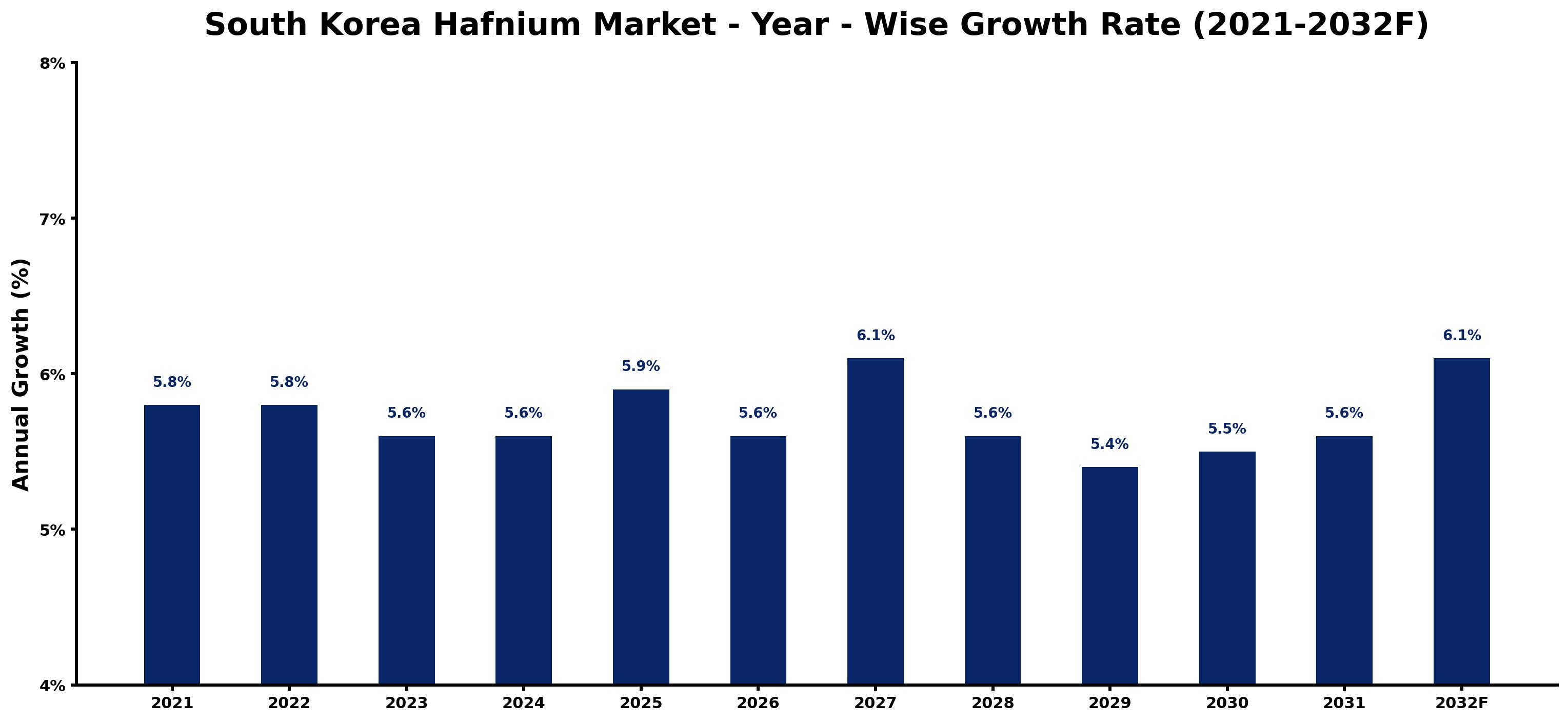
The table below presents the year‑wise growth rates along with the key drivers influencing the market
| Year | Growth Rate | Major Drivers |
| 2021 | 5.8% | Rising demand for electronics manufacturing |
| 2022 | 5.8% | Increased investments in aerospace technologies |
| 2023 | 5.6% | Expansion of renewable energy projects |
| 2024 | 5.6% | Growth in advanced materials sector |
| 2025 | 5.9% | Surge in semiconductor production capacity |
| 2026 | 5.6% | Developments in nuclear energy applications |
| 2027 | 6.1% | Increase in defense sector requirements |
| 2028 | 5.6% | rising procurement volume requirements |
| 2029 | 5.4% | Emergence of new industrial applications |
| 2030 | 5.5% | Enhanced demand for automotive components |
| 2031 | 5.6% | Expansion in medical technology innovations |
| 2032 | 6.1% | Rising interest in green technologies |
Note: Market size estimations and growth projections presented in this report are based on 6Wresearch's proprietary forecasting methodology, utilizing the latest available industry data, government publications, and primary research inputs.
South Korea Hafnium Market Synopsis
The most potent force currently shaping the South Korea Hafnium market is the escalating requirement for hafnium in semiconductor manufacturing. As South Korea solidifies its position as a global leader in electronics, the need for advanced materials like hafnium has become critical for maintaining competitive advantage.
In tandem with the electronics sector, the aerospace industry's rapid advancements are propelling hafnium demand. With its remarkable heat resistance and structural stability, hafnium is becoming increasingly indispensable in developing high-performance aerospace components.
South Korea Hafnium Market Key Takeaways
- The South Korea Hafnium market is witnessing significant growth due to robust demand from both electronics and aerospace sectors.
- Technological innovations in hafnium applications are expanding its use beyond traditional industries, including nuclear energy and renewable technologies.
- Government policies aimed at enhancing domestic production capabilities are set to bolster market stability.
- Research and development investments are critical for discovering new applications and improving existing hafnium production processes.
- Supply chain dynamics remain influenced by global price fluctuations and regulatory measures concerning hafnium's strategic importance.
Evaluation of Restraints in South Korea Hafnium Market
While the South Korea Hafnium market exhibits promising growth prospects, several restraints exist that could hinder its full potential. The reliance on imports for hafnium raw materials creates vulnerabilities, especially given the volatility in global pricing. Additionally, stringent regulations on hafnium exports, primarily due to its significance in nuclear applications, can pose operational challenges. Furthermore, the competitive landscape includes alternative materials that may threaten hafnium's market share, necessitating continuous innovation and development strategies to maintain a competitive edge.
South Korea Hafnium Market Trends
Current trends in the South Korea Hafnium market include the increasing adoption of hafnium-based coatings across various industries. These coatings are prized for their high-temperature resistance and exceptional corrosion protection, making them particularly valuable in automotive and medical applications. Moreover, ongoing R&D activities are exploring new frontiers for hafnium, such as in energy storage solutions, which are becoming increasingly relevant as the global focus shifts toward renewable energy.
South Korea Hafnium Market Opportunities
The South Korea Hafnium market presents myriad investment opportunities, particularly within the electronics and aerospace industries. Companies focusing on hafnium production and refining stand to benefit from the increasing demand in semiconductor and superalloy production. Additionally, the emergence of hafniums applications in renewable energy technologies, like solar and wind power, provides a promising avenue for growth and diversification in investment portfolios.
Government Initiatives in the South Korea Hafnium Market
The South Korean government has enacted several initiatives to regulate and support the hafnium market. These include financial incentives for domestic hafnium producers aimed at reducing import dependency and enhancing local production capabilities. Regulatory frameworks also promote sustainable mining practices to minimize environmental impact, reflecting a commitment to responsible resource management. Furthermore, government-sponsored programs are fostering innovation in hafnium-related technologies, reinforcing the market's competitive landscape.
Future Insights of the South Korea Hafnium Market
Looking ahead, the South Korea Hafnium market is positioned for steady growth from 2026 to 2032. The anticipated rise in hafnium's application within the electronics sector, particularly in semiconductor technology, coupled with a growing emphasis on nuclear energy, will sustain demand. Additionally, ongoing technological advancements and substantial investments in R&D efforts will likely create new avenues for hafnium use, further solidifying its role in high-performance applications across various industries.
South Korea Hafnium Market Latest Developments (2025 - 2026)
Recent developments within the South Korea Hafnium market indicate a trend toward greater collaboration among industry stakeholders to enhance hafnium production processes. There is an increasing focus on sustainability, with initiatives geared toward environmentally friendly extraction methods and reducing the carbon footprint of hafnium applications. Furthermore, companies are ramping up efforts in R&D to explore advanced hafnium alloys and composites that can meet the rigorous demands of modern applications, signaling an exciting phase of innovation ahead.
South Korea Hafnium Market - Key Attractiveness of the Report
- 10 Years of Market Numbers
- Historical Data Starting from 2022 to 2025
- Base Year: 2025
- Forecast Data until 2032
- Key Performance Indicators Impacting the Market
- Major Upcoming Developments and Projects
Key Highlights of the Report:
- South Korea Hafnium Market Outlook
- Market Size of South Korea Hafnium Market, 2025
- Forecast of South Korea Hafnium Market, 2032
- Historical Data and Forecast of South Korea Hafnium Revenues & Volume for the Period 2022-2032F
- South Korea Hafnium Market Trend Evolution
- South Korea Hafnium Market Drivers and Challenges
- South Korea Hafnium Price Trends
- South Korea Hafnium Porter's Five Forces
- South Korea Hafnium Industry Life Cycle
- Historical Data and Forecast of South Korea Hafnium Market Revenues & Volume By Type for the Period 2022-2032F
- Historical Data and Forecast of South Korea Hafnium Market Revenues & Volume By Hafnium Oxide for the Period 2022-2032F
- Historical Data and Forecast of South Korea Hafnium Market Revenues & Volume By Hafnium Carbide for the Period 2022-2032F
- Historical Data and Forecast of South Korea Hafnium Market Revenues & Volume By Other for the Period 2022-2032F
- Historical Data and Forecast of South Korea Hafnium Market Revenues & Volume By Application for the Period 2022-2032F
- Historical Data and Forecast of South Korea Hafnium Market Revenues & Volume By Super Alloy for the Period 2022-2032F
- Historical Data and Forecast of South Korea Hafnium Market Revenues & Volume By Optical Coating for the Period 2022-2032F
- Historical Data and Forecast of South Korea Hafnium Market Revenues & Volume By Nuclear for the Period 2022-2032F
- Historical Data and Forecast of South Korea Hafnium Market Revenues & Volume By Plasma Cutting for the Period 2022-2032F
- Historical Data and Forecast of South Korea Hafnium Market Revenues & Volume By Other for the Period 2022-2032F
- South Korea Hafnium Import Export Trade Statistics
- Market Opportunity Assessment By Type
- Market Opportunity Assessment By Application
- South Korea Hafnium Top Companies Market Share
- South Korea Hafnium Competitive Benchmarking By Technical and Operational Parameters
- South Korea Hafnium Company Profiles
- South Korea Hafnium Key Strategic Recommendations






































