South Korea Hand Carts & Trolleys Market Summary
The south korea hand carts & trolleys market was estimated at USD 568 Million in 2025 and is projected to reach USD 812 Million by 2032, growing at a CAGR of 6.1% from 2026 to 2032.
South Korea Hand Carts & Trolleys Market Year-wise Growth Rate and Key Drivers
This graph highlights how the South Korea Hand Carts & Trolleys Market has steadily grown over the past five years, supported by major growth factors.
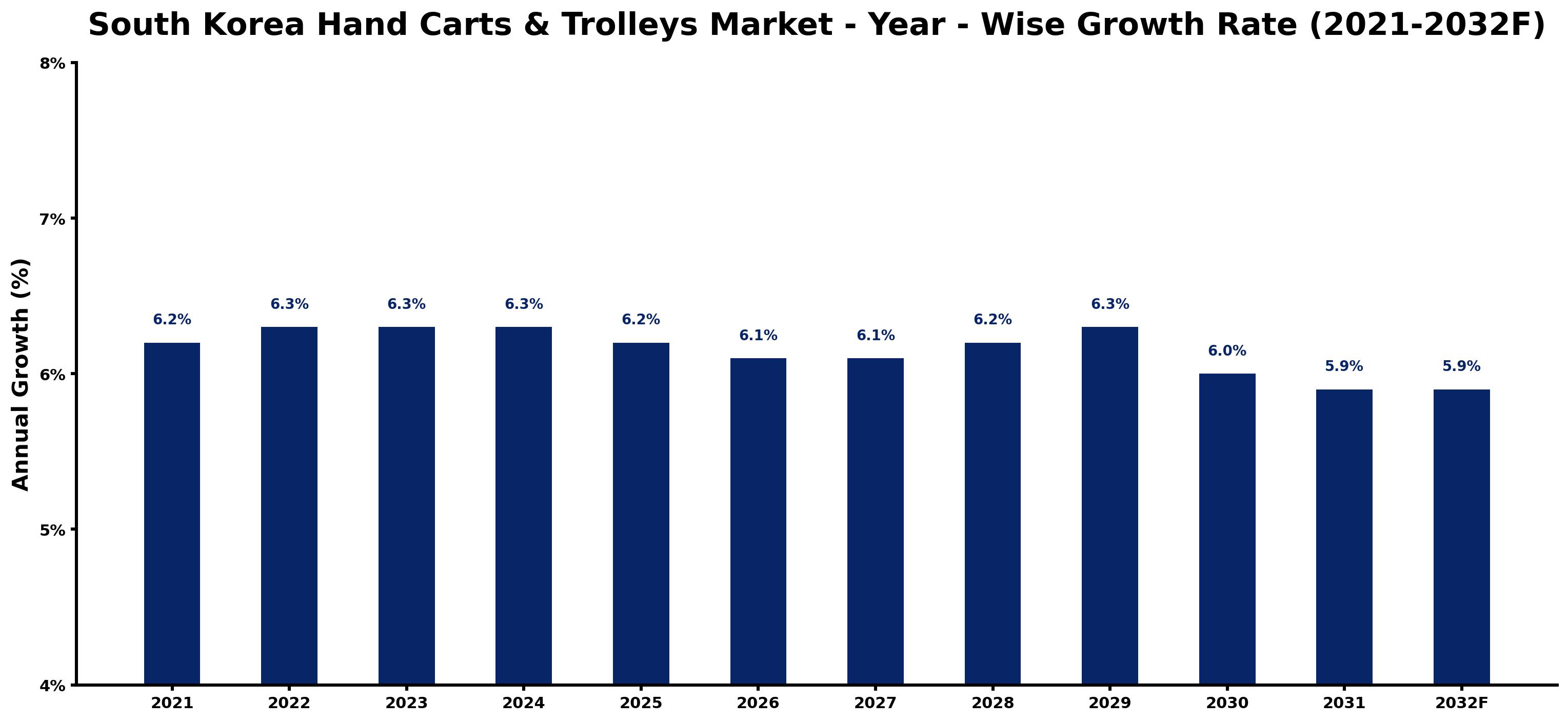
The table below presents the year wise growth rates along with the key drivers influencing the market
| Year | Growth Rate | Major Drivers |
| 2021 | 6.2% | Post-pandemic recovery led to an uptick in logistics and delivery services. |
| 2022 | 6.3% | Online grocery shopping trends prompted increased demand for efficient transport solutions. |
| 2023 | 6.3% | Urbanization in South Korea heightened the need for mobile transportation equipment. |
| 2024 | 6.3% | Sustainable material preferences boosted demand for eco-friendly hand carts and trolleys. |
| 2025 | 6.2% | Technological integration in retail operations enhanced efficiency of transport tools. |
| 2026 | 6.1% | Construction sector developments expanded opportunities for heavy-duty trolley applications. |
| 2027 | 6.1% | Rising labor costs necessitated ergonomic designs for better workforce productivity. |
| 2028 | 6.2% | Emergence of shared economy models influenced trolley rental market growth. |
| 2029 | 6.3% | Increased health and safety regulations underscored the importance of reliable transport solutions. |
| 2030 | 6.0% | Aging population in South Korea created a demand for more accessible transport options. |
| 2031 | 5.9% | E-commerce competitiveness led companies to invest in enhanced logistics infrastructure. |
| 2032 | 5.9% | Sustainability trends in consumerism resulted in higher demand for recyclable transport solutions. |
Note - Market size estimations and growth projections presented in this report are based on 6Wresearch's advanced forecasting approach, validated with industry datasets as of June 2026.
South Korea Hand Carts & Trolleys Market Synopsis
The South Korea Hand Carts Trolleys Market is projected to reach 6.1% and witness significant growth during the forecast period (2026-2032). This growth is driven by several key factors, including a surge in online shopping, which has led to an increased demand for efficient goods transport solutions. Moreover, the rising disposable incomes among consumers have further contributed to the market's expansion, as both individuals and businesses seek convenient options for transporting their goods.
South Korea Hand Carts & Trolleys Market Growth Drivers
Several factors are propelling the growth of the South Korea Hand Carts & Trolleys Market. The increasing popularity of online shopping is paramount, fundamentally changing consumer behavior and intensifying the demand for more efficient delivery methods. Additionally, a growing emphasis on convenience has pushed individuals and businesses to invest in hand carts and trolleys to streamline their logistics processes.
Furthermore, investments by industry players are on the rise, as companies aim to capitalize on the flourishing e-commerce landscape. The introduction of technologically advanced products with features such as foldable designs and auto-braking systems is attracting attention. These innovations not only enhance the usability of hand carts and trolleys but also address safety and space-saving needs.
In addition, there is an observable shift towards eco-friendly products, with consumers demanding solutions that reduce environmental impact. This trend encourages manufacturers to explore sustainable materials and practices for their hand carts and trolleys.
South Korea Hand Carts & Trolleys Market Challenges and Restraints
While the South Korea Hand Carts & Trolleys Market is poised for growth, it faces several challenges. One major restraint is the competition from alternative transport solutions, such as electric scooters and delivery drones, which may appeal to consumers looking for faster and more technologically advanced options.
Additionally, fluctuating raw material costs pose a challenge to manufacturers, potentially impacting pricing strategies and profit margins. Supply chain disruptions, exacerbated by global events, can also hinder production timelines and availability of products in the market.
Furthermore, consumer preferences are continually evolving, which requires manufacturers to adapt quickly to maintain market relevance. A lack of awareness regarding the benefits of hand carts and trolleys could also restrain adoption rates, particularly in traditional retail sectors.
South Korea Hand Carts & Trolleys Market Trends and Opportunities
The South Korea Hand Carts & Trolleys Market is witnessing notable trends that signal opportunities for stakeholders. One significant trend is the integration of technology within hand carts and trolleys, such as smart features that enhance user experience. For instance, IoT-enabled devices can provide real-time tracking and data analytics, catering to businesses looking to optimize their logistics operations.
Moreover, as urbanization continues to rise in South Korea, there is a growing demand for compact and lightweight designs that can navigate densely populated areas. This trend presents opportunities for manufacturers to develop innovative products that align with urban lifestyle needs.
The increasing focus on sustainability further amplifies opportunities, as consumers become more discerning regarding environmental impact. Manufacturers can explore biodegradable materials or recyclable components, appealing to eco-conscious consumers.
South Korea Hand Carts & Trolleys Market Regional Analysis
Geographically, the South Korea Hand Carts & Trolleys Market is influenced by urban centers where e-commerce and retail activities are concentrated. The metropolitan areas demonstrate a higher demand for these products due to the rising volume of deliveries and the challenges associated with urban logistics.
In contrast, rural regions might display lower demand, although they are not immune to the trends of online shopping, particularly as rural consumers increasingly adopt e-commerce practices. The government's infrastructure development initiatives also create opportunities for improved logistics across the country.
South Korea Hand Carts & Trolleys Market Government Investment and Initiatives
The South Korean government has been actively investing in logistics infrastructure, which is instrumental in supporting the growth of the hand carts and trolleys market. Policies aimed at enhancing transportation efficiency and reducing carbon emissions have garnered significant attention, as the government seeks innovative solutions to modernize logistics operations.
Public spending initiatives focused on upgrading urban transport systems also indirectly benefit the hand cart and trolley sector. By promoting efficient urban mobility, these initiatives create a conducive environment for increased use of hand carts in public spaces.
Furthermore, government incentives aimed at fostering innovation in logistics solutions foster opportunities for manufacturers to develop new products that align with market demands. This support is pivotal for sustaining competitiveness within the sector.
South Korea Hand Carts & Trolleys Market Latest Developments (May 2025 - June 2026)
In recent months, the South Korea Hand Carts & Trolleys Market has undergone several notable developments. Industry players are increasingly emphasizing advanced features such as user-friendly designs and enhanced durability, which are critical to meeting the evolving needs of consumers.
Innovation has been a focal point during this period, with efforts directed towards creating products that are not only functional but also environmentally sustainable. Many manufacturers are exploring eco-friendly materials to align with the growing consumer preference for sustainable solutions.
Additionally, market players are investing in targeted marketing strategies aimed at educating consumers about the advantages of hand carts and trolleys over alternative transport solutions. This approach is expected to increase adoption rates and expand the overall market presence.
South Korea Hand Carts & Trolleys Market - Key Attractiveness of the Report
- 10 Years of Market Numbers
- Historical Data Starting from 2022 to 2025
- Base Year: 2025
- Forecast Data until 2032
- Key Performance Indicators Impacting the Market
- Major Upcoming Developments and Projects
Key Highlights of the Report:
- South Korea Hand Carts & Trolleys Market Outlook
- Market Size of South Korea Hand Carts & Trolleys Market, 2025
- Forecast of South Korea Hand Carts & Trolleys Market, 2032F
- Historical Data and Forecast of South Korea Hand Carts & Trolleys Revenues & Volume for the Period 2022-2032F
- South Korea Hand Carts & Trolleys Market Trend Evolution
- South Korea Hand Carts & Trolleys Market Drivers and Challenges
- South Korea Hand Carts & Trolleys Price Trends
- South Korea Hand Carts & Trolleys Porter's Five Forces
- South Korea Hand Carts & Trolleys Industry Life Cycle
- Historical Data and Forecast of South Korea Hand Carts & Trolleys Market Revenues & Volume By Types for the Period 2022-2032F
- Historical Data and Forecast of South Korea Hand Carts & Trolleys Market Revenues & Volume By Steel Hand Truck for the Period 2022-2032F
- Historical Data and Forecast of South Korea Hand Carts & Trolleys Market Revenues & Volume By Aluminium Hand Truck for the Period 2022-2032F
- Historical Data and Forecast of South Korea Hand Carts & Trolleys Market Revenues & Volume By Applications for the Period 2022-2032F
- Historical Data and Forecast of South Korea Hand Carts & Trolleys Market Revenues & Volume By Online Sales for the Period 2022-2032F
- Historical Data and Forecast of South Korea Hand Carts & Trolleys Market Revenues & Volume By Offline Sales for the Period 2022-2032F
- South Korea Hand Carts & Trolleys Import Export Trade Statistics
- Market Opportunity Assessment By Types
- Market Opportunity Assessment By Applications
- South Korea Hand Carts & Trolleys Top Companies Market Share
- South Korea Hand Carts & Trolleys Competitive Benchmarking By Technical and Operational Parameters
- South Korea Hand Carts & Trolleys Company Profiles
- South Korea Hand Carts & Trolleys Key Strategic Recommendations






































