South Korea Hotel Furniture Market Summary
The south korea hotel furniture market was estimated at USD 321 Million in 2025 and is projected to reach USD 429 Million by 2032, growing at a CAGR of 4.9% from 2026 to 2032.
South Korea Hotel Furniture Market Year-wise Growth Rate and Key Drivers
This graph highlights how the South Korea Hotel Furniture Market has steadily grown over the past five years, supported by major growth factors.
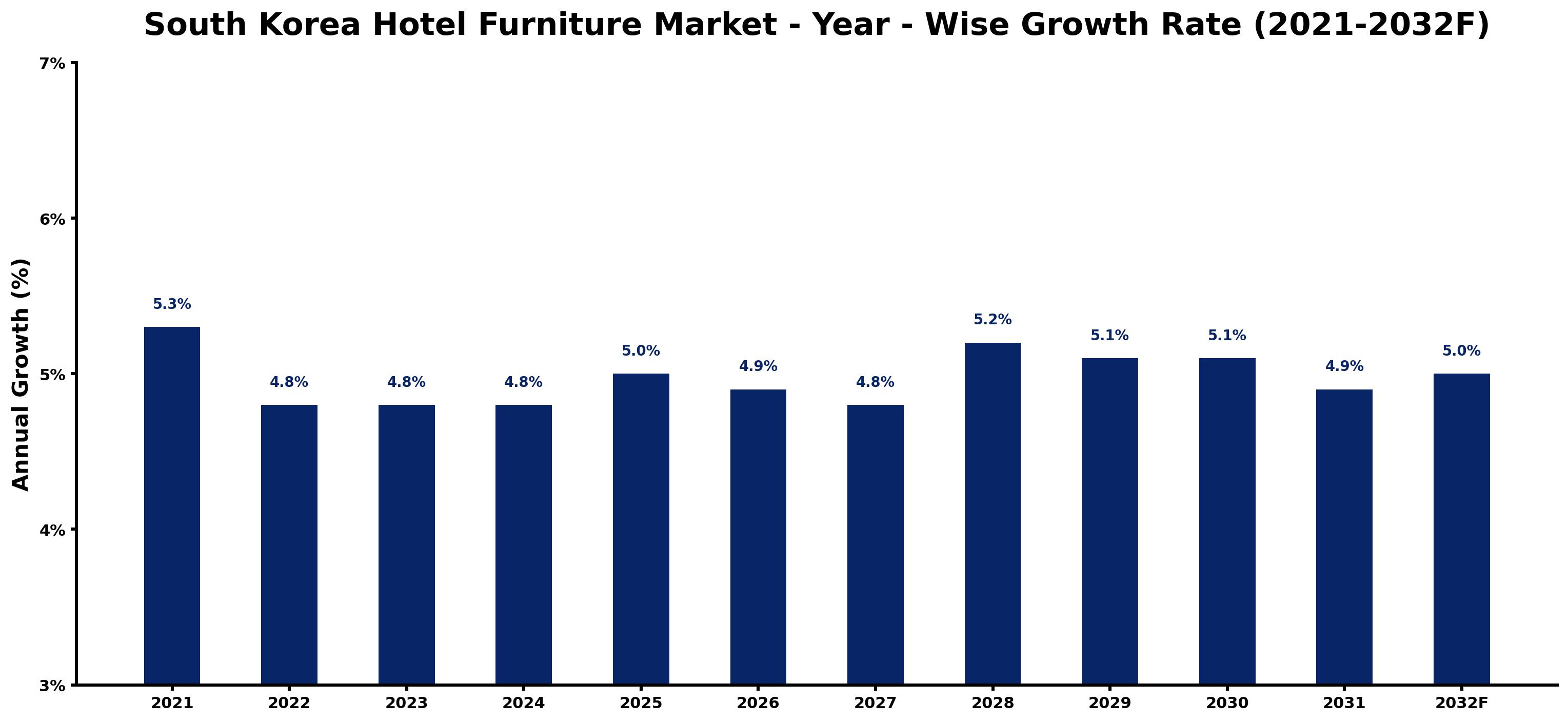
The table below presents the year wise growth rates along with the key drivers influencing the market
| Year | Growth Rate | Major Drivers |
| 2021 | 5.3% | Post-lockdown retail projects rejuvenate hotel aesthetics with bespoke furniture solutions. |
| 2022 | 4.8% | Increased international tourism highlights demand for luxury and modern hotel interiors. |
| 2023 | 4.8% | Sustainable materials gain popularity as hotels emphasize eco-friendly designs and offerings. |
| 2024 | 4.8% | Technological innovations integrate smart furniture into hotel environments, enhancing guest experiences. |
| 2025 | 5.0% | The influx of business travelers fuels demand for functional yet stylish workspaces. |
| 2026 | 4.9% | Urbanization trends influence hotel designs, leading to compact, multifunctional furniture solutions. |
| 2027 | 4.8% | Economic recovery boosts hotel renovation budgets, prioritizing contemporary and local designs. |
| 2028 | 5.2% | Collaborations with local artisans create unique furnishings reflecting South Korean culture. |
| 2029 | 5.1% | Emerging boutique hotels prioritize personalized furniture to differentiate themselves in the market. |
| 2030 | 5.1% | Sustainability trends compel hotels to reassess their furniture supply chains and sourcing. |
| 2031 | 4.9% | The rise of wellness tourism encourages hotels to invest in calming, restorative furniture. |
| 2032 | 5.0% | Data-driven insights enable tailored furniture solutions, enhancing guest satisfaction and loyalty. |
Note - Market size estimations and growth projections presented in this report are based on 6Wresearch's advanced forecasting approach, validated with industry datasets as of June 2026.
South Korea Hotel Furniture Market Synopsis
The South Korea Hotel Furniture Market is projected to reach 4.9% and witness significant growth during the forecast period (2026-2032). This expansion is primarily driven by the rapid growth of the hospitality sector in South Korea, fueled by an increase in both domestic and international tourism. The market is characterized by a heightened demand for high-quality, stylish, and functional furniture that aligns with modern aesthetics while promoting comfort and sustainability.
South Korea Hotel Furniture Market Growth Drivers
Several key factors contribute to the growth of the South Korea Hotel Furniture Market. Firstly, the booming tourism industry, enhanced by government initiatives to attract more visitors, is significantly increasing the demand for hotel accommodations, subsequently driving the need for modern furniture solutions. Additionally, hotels are increasingly focused on offering unique guest experiences, necessitating innovative and customizable furniture designs.
- The rising trend towards sustainable practices is encouraging hotels to invest in eco-friendly furniture options, which can differentiate their offerings in a competitive market.
- There is a growing inclination among travelers for aesthetic and functional hotel interiors, pushing hoteliers to upgrade their furniture to attract discerning guests.
- Advances in technology are influencing furniture design, with hotels looking to integrate smart solutions that enhance guest comfort and convenience, such as charging stations and adjustable furnishings.
- The competitive landscape of the hospitality sector necessitates constant innovation in furniture design and functionality, which propels continuous investment in new furniture solutions.
- Government incentives aimed at supporting the hospitality industry further bolster the demand for high-quality hotel furnishings, as establishments seek to enhance their appeal.
South Korea Hotel Furniture Market Trends and Opportunities
In recent years, the South Korea Hotel Furniture Market has experienced notable trends reshaping its landscape. One prominent trend is the increasing preference for minimalist and contemporary furniture designs that align with modern architectural aesthetics. Alongside this, sustainability remains a critical theme, with hotels actively seeking out eco-friendly materials that not only meet operational needs but also resonate with environmentally conscious guests.
- Customization is becoming a priority as hotels aim to reflect local culture and identity through unique furniture pieces, enhancing guest experiences.
- The integration of technology into furniture is another growing trend, leading to innovations such as smart beds and interactive furnishings designed to enhance convenience for guests.
- There is an emerging focus on space-saving furniture designs, catering to the growing trend of urban hospitality spaces with limited square footage.
- A shift towards multi-functional furniture that can adapt to various uses and settings is gaining traction, enabling hotels to optimize their space effectively.
- Investment in sustainability-driven furniture solutions presents a lucrative opportunity for the market, aligning with both consumer demand and regulatory trends.
South Korea Hotel Furniture Market Challenges and Restraints
Despite its promising outlook, the South Korea Hotel Furniture Market faces several challenges that stakeholders must navigate. Intense competition from both local and international manufacturers presents a significant hurdle for companies striving to differentiate their products. Fluctuations in raw material prices can lead to increased manufacturing costs, impacting overall profitability.
- The requirement for compliance with stringent safety standards and import/export regulations adds complexity to operational processes for manufacturers.
- Shifts in consumer preferences demand constant innovation, requiring companies to invest in research and development to remain relevant.
- Economic fluctuations and changing tourism dynamics could impact hotel occupancy rates, influencing furniture investment decisions.
- The emphasis on sustainable practices introduces challenges in sourcing eco-friendly materials that meet both aesthetic and functional requirements.
- Navigating the complexities of customization and personalization while maintaining cost efficiency represents an ongoing challenge for manufacturers.
South Korea Hotel Furniture Market Government Investment and Initiatives
The South Korean government has been proactive in supporting the hotel furniture market through various policies and investment initiatives. These efforts are aimed at bolstering the overall tourism industry by promoting sustainable practices within the furniture manufacturing sector. Standards have been established to ensure the safety and quality of furniture materials, fostering consumer confidence and market integrity.
- The government has introduced grants and subsidies aimed at encouraging local manufacturers to invest in innovative and sustainable furniture solutions.
- Tax incentives for environmentally friendly businesses are being implemented to facilitate the growth of sustainable practices within the hotel furniture sector.
- Programs aimed at enhancing design excellence in the furniture industry support the development of unique products that cater to the hospitality sector's evolving needs.
- The government has invested in infrastructure projects that enhance the overall tourism experience, which indirectly supports demand for upgraded hotel furnishings.
- Public policies are increasingly focused on innovation to propel the growth of the hotel furniture market in alignment with international standards.
South Korea Hotel Furniture Market Latest Developments (May 2025 - June 2026)
The period from May 2025 to June 2026 has witnessed several developments in the South Korea Hotel Furniture Market that highlight its dynamic nature. Industry players are increasingly focusing on integrating technology into furniture designs, responding to the growing demand for smart hotel solutions. Additionally, there has been an uptick in collaborations between furniture manufacturers and local hotels seeking tailor-made furniture that reflects their unique brand identity.
- The focus on sustainability has led to the introduction of new eco-friendly furniture lines, with several manufacturers launching products made from reclaimed materials.
- Innovative design exhibitions showcasing the latest trends in hotel furniture have gained traction, allowing manufacturers to connect directly with potential buyers.
- Collaborative projects aimed at enhancing hotel aesthetics through innovative furniture solutions have emerged as a key strategy among industry stakeholders.
- Consumer awareness regarding sustainable practices in the hospitality sector is rising, prompting hotels to prioritize eco-friendly furniture choices.
- The government's continued investment in tourism-related infrastructure is expected to positively impact the demand for upgraded hotel interiors and associated furnishings.
South Korea Hotel Furniture Market - Key Attractiveness of the Report
- 10 Years of Market Numbers
- Historical Data Starting from 2022 to 2025
- Base Year: 2025
- Forecast Data until 2032
- Key Performance Indicators Impacting the Market
- Major Upcoming Developments and Projects
Key Highlights of the Report:
- South Korea Hotel Furniture Market Outlook
- Market Size of South Korea Hotel Furniture Market, 2025
- Forecast of South Korea Hotel Furniture Market, 2032F
- Historical Data and Forecast of South Korea Hotel Furniture Revenues & Volume for the Period 2022-2032F
- South Korea Hotel Furniture Market Trend Evolution
- South Korea Hotel Furniture Market Drivers and Challenges
- South Korea Hotel Furniture Price Trends
- South Korea Hotel Furniture Porter's Five Forces
- South Korea Hotel Furniture Industry Life Cycle
- Historical Data and Forecast of South Korea Hotel Furniture Market Revenues & Volume By Product Types for the Period 2022-2032F
- Historical Data and Forecast of South Korea Hotel Furniture Market Revenues & Volume By Table and Chairs for the Period 2022-2032F
- Historical Data and Forecast of South Korea Hotel Furniture Market Revenues & Volume By Hotel Beds for the Period 2022-2032F
- Historical Data and Forecast of South Korea Hotel Furniture Market Revenues & Volume By Hotel Casegoods for the Period 2022-2032F
- Historical Data and Forecast of South Korea Hotel Furniture Market Revenues & Volume By Other for the Period 2022-2032F
- Historical Data and Forecast of South Korea Hotel Furniture Market Revenues & Volume By Applications for the Period 2022-2032F
- Historical Data and Forecast of South Korea Hotel Furniture Market Revenues & Volume By Business Hotel for the Period 2022-2032F
- Historical Data and Forecast of South Korea Hotel Furniture Market Revenues & Volume By Luxury Hotel for the Period 2022-2032F
- Historical Data and Forecast of South Korea Hotel Furniture Market Revenues & Volume By Boutique Hotel for the Period 2022-2032F
- Historical Data and Forecast of South Korea Hotel Furniture Market Revenues & Volume By Other for the Period 2022-2032F
- South Korea Hotel Furniture Import Export Trade Statistics
- Market Opportunity Assessment By Product Types
- Market Opportunity Assessment By Applications
- South Korea Hotel Furniture Top Companies Market Share
- South Korea Hotel Furniture Competitive Benchmarking By Technical and Operational Parameters
- South Korea Hotel Furniture Company Profiles
- South Korea Hotel Furniture Key Strategic Recommendations






































