South Korea Hydrogen Fluoride Gas Detection Market Size, Share & Growth Rate
The South Korea Hydrogen Fluoride Gas Detection Market was estimated at USD 223 Million in 2025 and is projected to reach USD 296 Million by 2032, growing at a CAGR of 4.1% from 2026 to 2032. This upward trajectory is largely driven by increasing regulatory pressures aimed at ensuring workplace safety and environmental protection. As awareness of the health hazards associated with hydrogen fluoride gas escalates, industries are increasingly investing in advanced detection solutions to mitigate risks and comply with stringent safety standards.
South Korea Hydrogen Fluoride Gas Detection Market Year-wise Growth Rate and Key Drivers
This graph highlights how the South Korea Hydrogen Fluoride Gas Detection Market has steadily grown over the years, supported by major growth factors.
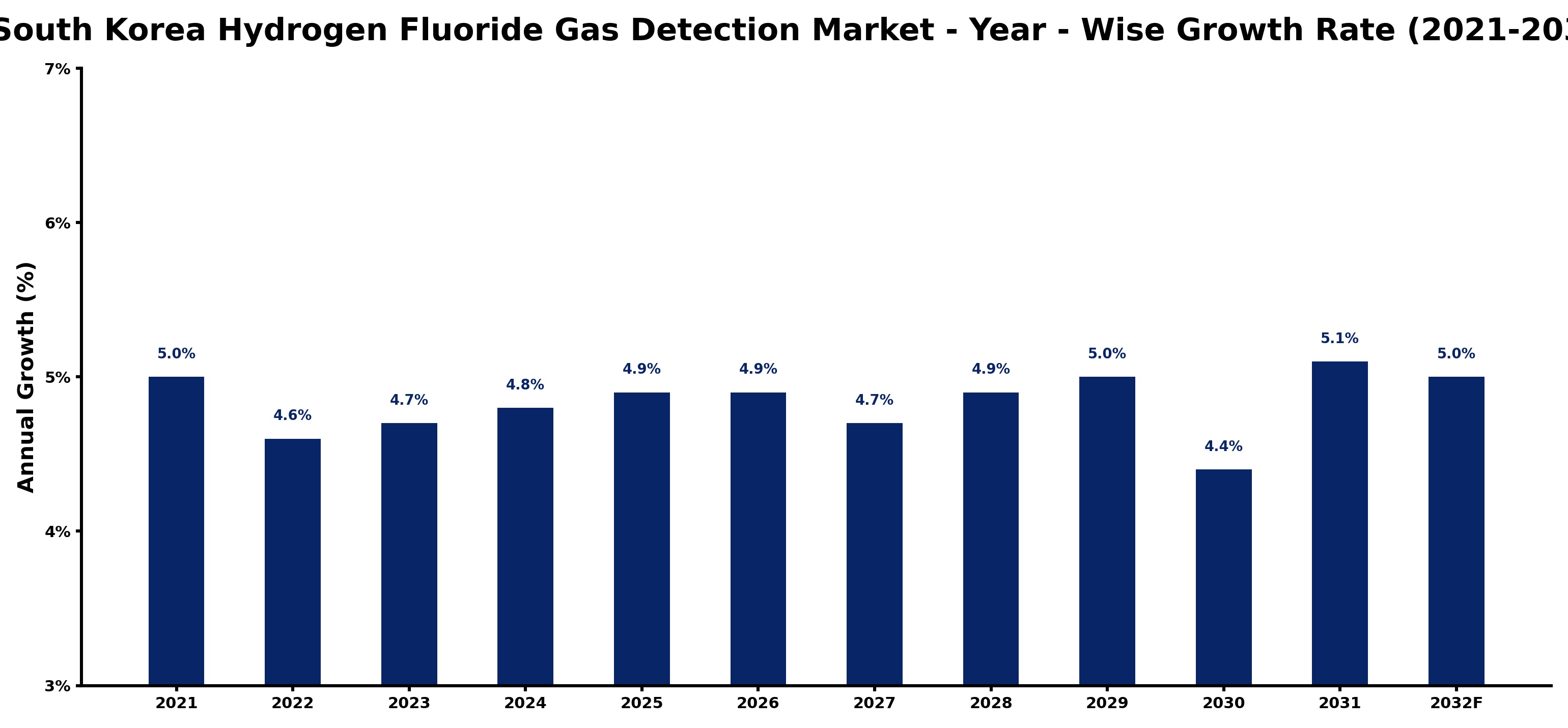
The table below presents the year‑wise growth rates along with the key drivers influencing the market
| Year | Growth Rate | Major Drivers |
| 2021 | 5.0% | Increased industrial safety regulations |
| 2022 | 4.6% | Technological advancements improved detection |
| 2023 | 4.7% | Growing semiconductor manufacturing demand |
| 2024 | 4.8% | Rising awareness of chemical hazards |
| 2025 | 4.9% | Expansion of electronics manufacturing sector |
| 2026 | 4.9% | Enhanced environmental protection initiatives |
| 2027 | 4.7% | Investment in renewable energy projects |
| 2028 | 4.9% | Growth in chemical processing industries |
| 2029 | 5.0% | Rising demand for clean technologies |
| 2030 | 4.4% | Focus on workplace safety standards |
| 2031 | 5.1% | Emerging markets driving innovation |
| 2032 | 5.0% | Increased government funding for research |
Note - Market size estimations and growth projections presented in this report are based on 6Wresearch’s advanced forecasting approach, validated with industry datasets as of June 2026.
South Korea Hydrogen Fluoride Gas Detection Market Synopsis
The paramount force currently shaping the South Korea Hydrogen Fluoride Gas Detection Market is the stringent regulatory framework that governs industrial safety. These regulations compel companies across sectors such as chemical manufacturing and semiconductor production to adopt comprehensive gas detection systems, thereby bolstering market demand.
Additionally, the growing emphasis on workplace safety and environmental responsibility has led to increased investments in innovative gas detection technologies. As industries prioritize employee health and sustainable practices, there is a palpable shift toward solutions that enhance the accuracy and reliability of hydrogen fluoride detection.
South Korea Hydrogen Fluoride Gas Detection Market Key Takeaways
- The market is driven by heightened awareness of the dangers posed by hydrogen fluoride gas.
- Advanced technologies, including IoT-enabled and wireless detection systems, are gaining traction.
- Continuous monitoring and regulatory compliance are key growth factors in the market.
- The trend toward portable and real-time monitoring devices is reshaping the landscape.
- Investment in R&D for innovative detection solutions remains a focal point for market players.
Evaluation of Restraints in South Korea Hydrogen Fluoride Gas Detection Market
Despite the positive growth outlook, the South Korea Hydrogen Fluoride Gas Detection Market is hindered by several factors. One significant restraint is the high cost associated with advanced detection technologies, which can be prohibitive for smaller enterprises. Additionally, limited awareness among certain end-users regarding the importance of hydrogen fluoride detection further curtails market expansion. Continuous monitoring and maintenance requirements can also pose challenges, necessitating a skilled workforce and leading to increased operational costs. The highly competitive market landscape, characterized by established players, creates barriers for new entrants aiming for market share.
South Korea Hydrogen Fluoride Gas Detection Market Trends
Several current and emerging trends are shaping the South Korea Hydrogen Fluoride Gas Detection Market. There is a marked shift towards the adoption of wireless and portable gas detection solutions, enabling real-time monitoring in various industrial applications. The integration of data analytics and cloud-based platforms enhances operational efficiency, allowing for remote access and control over detection systems. Furthermore, advancements in sensor technology are resulting in heightened sensitivity and accuracy, coupled with improved durability and reliability of detection equipment, which are vital for effective monitoring in industrial environments.
South Korea Hydrogen Fluoride Gas Detection Market Opportunities
The South Korea Hydrogen Fluoride Gas Detection Market presents numerous investment opportunities, particularly due to the growing emphasis on workplace safety and adherence to environmental regulations. Industries such as semiconductor manufacturing, chemical processing, and metal finishing represent high-demand segments that necessitate robust gas detection solutions. Innovative technologies, such as portable analyzers and real-time monitoring systems, offer lucrative avenues for investment. Collaborating with local manufacturers and distributors can facilitate efficient market penetration, ultimately yielding significant returns in this expanding sector.
Government Initiatives in the South Korea Hydrogen Fluoride Gas Detection Market
The South Korean government has been proactive in regulating the Hydrogen Fluoride Gas Detection Market, implementing various policies to ensure public safety and environmental integrity. The Ministry of Environment has established stringent standards and guidelines pertaining to the handling and detection of hydrogen fluoride gas. Moreover, government support for research and development initiatives in advanced detection technologies underscores the commitment to enhancing monitoring capabilities. Such measures not only protect public health but also contribute to sustainable industrial practices within the country.
Future Insights of the South Korea Hydrogen Fluoride Gas Detection Market
Looking ahead to the period from 2026 to 2032, the South Korea Hydrogen Fluoride Gas Detection Market is expected to experience robust growth, fueled by increasing demand for detection systems across several industries. Factors driving this expansion include the tightening of safety regulations, heightened awareness surrounding the detrimental effects of hydrogen fluoride exposure, and the continuous innovation in detection technologies. Additionally, the growing integration of automation and IoT technologies is likely to create new opportunities for market players, positioning the industry for sustained advancement in the coming years.
South Korea Hydrogen Fluoride Gas Detection Market Latest Developments (May 2025 - June 2026)
Recent developments in the South Korea Hydrogen Fluoride Gas Detection Market indicate a heightened focus on integrating advanced technologies into detection systems. There is a noticeable trend toward the deployment of portable devices that allow for on-site monitoring, which addresses the urgent need for real-time data in industrial settings. Furthermore, collaborations between technology firms and industry stakeholders are becoming more prevalent, aiming to enhance system capabilities and broaden market reach. These directions signal a dynamic evolution of the market landscape in response to emerging safety requirements and technological advancements.
South Korea Hydrogen Fluoride Gas Detection Market - Key Attractiveness of the Report
- 10 Years of Market Numbers
- Historical Data Starting from 2022 to 2025
- Base Year: 2025
- Forecast Data until 2032
- Key Performance Indicators Impacting the Market
- Major Upcoming Developments and Projects
Key Highlights of the Report:
- South Korea Hydrogen Fluoride Gas Detection Market Outlook
- Market Size of South Korea Hydrogen Fluoride Gas Detection Market, 2025
- Forecast of South Korea Hydrogen Fluoride Gas Detection Market, 2032
- Historical Data and Forecast of South Korea Hydrogen Fluoride Gas Detection Revenues & Volume for the Period 2022-2032F
- South Korea Hydrogen Fluoride Gas Detection Market Trend Evolution
- South Korea Hydrogen Fluoride Gas Detection Market Drivers and Challenges
- South Korea Hydrogen Fluoride Gas Detection Price Trends
- South Korea Hydrogen Fluoride Gas Detection Porter's Five Forces
- South Korea Hydrogen Fluoride Gas Detection Industry Life Cycle
- Historical Data and Forecast of South Korea Hydrogen Fluoride Gas Detection Market Revenues & Volume By Form for the Period 2022-2032F
- Historical Data and Forecast of South Korea Hydrogen Fluoride Gas Detection Market Revenues & Volume By Gas Hydrogen Fluoride for the Period 2022-2032F
- Historical Data and Forecast of South Korea Hydrogen Fluoride Gas Detection Market Revenues & Volume By Liquid Hydrogen Fluoride for the Period 2022-2032F
- Historical Data and Forecast of South Korea Hydrogen Fluoride Gas Detection Market Revenues & Volume By Type for the Period 2022-2032F
- Historical Data and Forecast of South Korea Hydrogen Fluoride Gas Detection Market Revenues & Volume By Fixed Devices for the Period 2022-2032F
- Historical Data and Forecast of South Korea Hydrogen Fluoride Gas Detection Market Revenues & Volume By Portable Devices for the Period 2022-2032F
- Historical Data and Forecast of South Korea Hydrogen Fluoride Gas Detection Market Revenues & Volume By End-user Industry for the Period 2022-2032F
- Historical Data and Forecast of South Korea Hydrogen Fluoride Gas Detection Market Revenues & Volume By Introduction for the Period 2022-2032F
- Historical Data and Forecast of South Korea Hydrogen Fluoride Gas Detection Market Revenues & Volume By Chemical for the Period 2022-2032F
- Historical Data and Forecast of South Korea Hydrogen Fluoride Gas Detection Market Revenues & Volume By Mining and Metallurgical for the Period 2022-2032F
- Historical Data and Forecast of South Korea Hydrogen Fluoride Gas Detection Market Revenues & Volume By Pharmaceutical for the Period 2022-2032F
- Historical Data and Forecast of South Korea Hydrogen Fluoride Gas Detection Market Revenues & Volume By Glass Etching for the Period 2022-2032F
- Historical Data and Forecast of South Korea Hydrogen Fluoride Gas Detection Market Revenues & Volume By Others for the Period 2022-2032F
- South Korea Hydrogen Fluoride Gas Detection Import Export Trade Statistics
- Market Opportunity Assessment By Form
- Market Opportunity Assessment By Type
- Market Opportunity Assessment By End-user Industry
- South Korea Hydrogen Fluoride Gas Detection Top Companies Market Share
- South Korea Hydrogen Fluoride Gas Detection Competitive Benchmarking By Technical and Operational Parameters
- South Korea Hydrogen Fluoride Gas Detection Company Profiles
- South Korea Hydrogen Fluoride Gas Detection Key Strategic Recommendations






































