South Korea Immunology Market Size, Share & Growth Rate
The South Korea Immunology Market was estimated at USD 293 Million in 2025 and is projected to reach USD 397 Million by 2032, growing at a CAGR of 4.4% from 2026 to 2032. This growth is propelled by an increasing awareness of immunological diseases among the public and healthcare professionals alike. Coupled with rising healthcare expenditures and significant advancements in biotechnology, these factors create a robust environment for innovation and the introduction of novel therapies.
South Korea Immunology Market Year-wise Growth Rate and Key Drivers
This graph highlights how the South Korea Immunology Market has steadily grown over the years, supported by major growth factors.
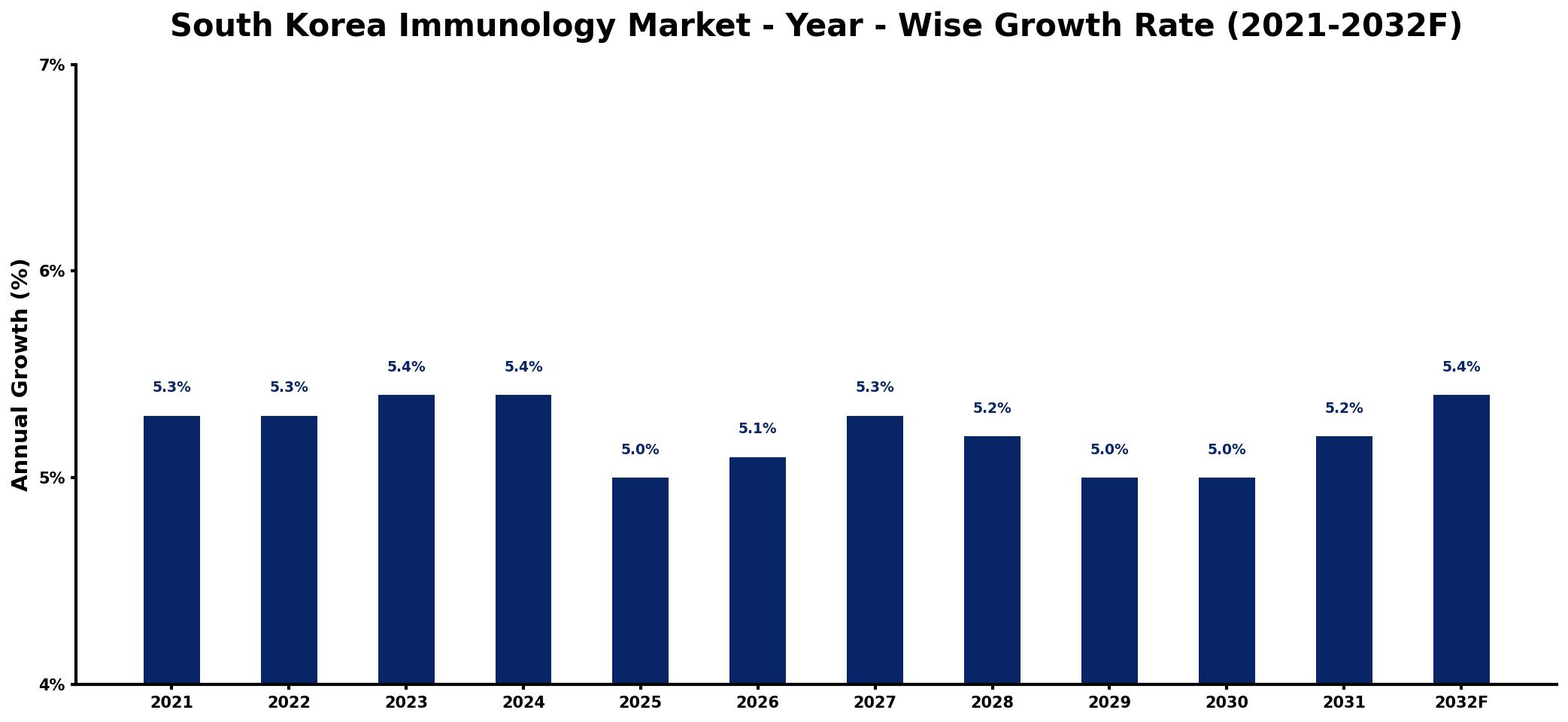
The table below presents the year‑wise growth rates along with the key drivers influencing the market
| Year | Growth Rate | Major Drivers |
| 2021 | 5.3% | Increased healthcare spending initiatives |
| 2022 | 5.3% | Growing prevalence of autoimmune disorders |
| 2023 | 5.4% | Advancements in biotechnology research |
| 2024 | 5.4% | Rising public awareness campaigns |
| 2025 | 5.0% | Expansion of clinical trial networks |
| 2026 | 5.1% | Investment in digital health technologies |
| 2027 | 5.3% | Enhanced collaboration among researchers |
| 2028 | 5.2% | Emerging markets attracting investments |
| 2029 | 5.0% | Strengthening regulatory frameworks supporting |
| 2030 | 5.0% | Focus on personalized medicine approaches |
| 2031 | 5.2% | Innovations in therapeutic development |
| 2032 | 5.4% | Increased global health partnerships |
Note: Market size estimations and growth projections presented in this report are based on 6Wresearch's proprietary forecasting methodology, utilizing the latest available industry data, government publications, and primary research inputs.
South Korea Immunology Market Synopsis
In South Korea, the demand for immunology products is significantly influenced by the high prevalence of autoimmune diseases and the growing elderly population. This demographic shift is further intensifying the need for effective immunological therapies and diagnostics to manage chronic conditions.
Additionally, the countrys healthcare infrastructure, marked by its advanced technologies and skilled professionals, ensures that patients have access to the latest treatments. The collaboration between local and international pharmaceutical entities enhances the market's competitive landscape, leading to increased innovation and improved patient outcomes.
South Korea Immunology Market Key Takeaways
- The South Korea Immunology Market is on a growth trajectory fueled by rising awareness and advancements in treatment modalities.
- Investment in research and development is crucial for the introduction of innovative therapies targeting chronic conditions.
- Government initiatives support the expansion of healthcare infrastructure and promote research collaboration.
- A notable shift towards personalized medicine and immunotherapy is changing the treatment landscape.
- Access to specialized care and therapies remains a focal point for enhancing patient outcomes in the region.
Evaluation of Restraints in South Korea Immunology Market
Despite the promising growth, the South Korea Immunology Market faces several restraints. Intense competition among pharmaceutical companies has led to pricing pressures, which can affect market stability. Additionally, navigating regulatory hurdles for new drug approvals presents a significant challenge. The healthcare system's conservative nature may also impede the swift adoption of innovative therapies. Consequently, companies must be proactive in addressing these limitations to fully leverage the market's potential.
South Korea Immunology Market Trends
A clear trend in the South Korea Immunology Market is the growing demand for personalized medicine and targeted therapies. As healthcare providers increasingly recognize the benefits of tailoring treatments to individual patients, the market is adapting accordingly. There is also a notable shift towards immunotherapy as a preferred treatment modality for various forms of cancer. Furthermore, the adoption of innovative diagnostic technologies is improving early diagnosis rates, further influencing treatment efficacy.
South Korea Immunology Market Opportunities
Investment opportunities abound in the South Korea Immunology Market, particularly in developing novel treatments for prevalent autoimmune diseases like rheumatoid arthritis and lupus. The rise in chronic inflammatory conditions presents a lucrative avenue for companies focused on immunomodulatory drugs. Collaborations with local research institutions can enhance market entry strategies, streamline regulatory compliance, and ultimately boost product availability for patients in need.
Government Initiatives in the South Korea Immunology Market
The South Korean government plays a pivotal role in shaping the immunology landscape through various policies designed to improve treatment access and healthcare quality. Initiatives such as the Health Insurance Review and Assessment Service (HIRA) ensure that immunology products undergo rigorous evaluations for clinical efficacy and cost-effectiveness. Additionally, the Ministry of Food and Drug Safety (MFDS) governs the approval and monitoring processes for immunology products, reinforcing safety and effectiveness standards across the sector.
Future Insights of the South Korea Immunology Market
Looking ahead to 2026-2032, the South Korea Immunology Market is anticipated to undergo significant evolution. Ongoing research and advancements in technology are expected to yield innovative immunological therapies and biologics, addressing unmet patient needs. The aging population, coupled with increasing incidences of autoimmune diseases and cancer, will further amplify demand for sophisticated treatment options. Furthermore, governmental support for healthcare infrastructure will enhance accessibility, setting the stage for robust market growth.
South Korea Immunology Market Latest Developments (2025 - 2026)
Recent developments in the South Korea Immunology Market include advancements in diagnostic technologies, which have significantly improved early detection capabilities for immunological diseases. Additionally, collaborations among research institutions and pharmaceutical companies are fostering innovation, leading to the launch of several new therapies targeting autoimmune disorders. These trends suggest a dynamic market environment, committed to enhancing patient care and treatment efficacy.
South Korea Immunology Market - Key Attractiveness of the Report
- 10 Years of Market Numbers
- Historical Data Starting from 2022 to 2025
- Base Year: 2025
- Forecast Data until 2032
- Key Performance Indicators Impacting the Market
- Major Upcoming Developments and Projects
Key Highlights of the Report:
- South Korea Immunology Market Outlook
- Market Size of South Korea Immunology Market, 2025
- Forecast of South Korea Immunology Market, 2032
- Historical Data and Forecast of South Korea Immunology Revenues & Volume for the Period 2022-2032F
- South Korea Immunology Market Trend Evolution
- South Korea Immunology Market Drivers and Challenges
- South Korea Immunology Price Trends
- South Korea Immunology Porter's Five Forces
- South Korea Immunology Industry Life Cycle
- Historical Data and Forecast of South Korea Immunology Market Revenues & Volume By Drug Class for the Period 2022-2032F
- Historical Data and Forecast of South Korea Immunology Market Revenues & Volume By Monoclonal Antibody (mAb) for the Period 2022-2032F
- Historical Data and Forecast of South Korea Immunology Market Revenues & Volume By Fusion Proteins for the Period 2022-2032F
- Historical Data and Forecast of South Korea Immunology Market Revenues & Volume By Immunosuppressants for the Period 2022-2032F
- Historical Data and Forecast of South Korea Immunology Market Revenues & Volume By Polyclonal Antibody (pAb) for the Period 2022-2032F
- Historical Data and Forecast of South Korea Immunology Market Revenues & Volume By Others for the Period 2022-2032F
- Historical Data and Forecast of South Korea Immunology Market Revenues & Volume By Disease Indication for the Period 2022-2032F
- Historical Data and Forecast of South Korea Immunology Market Revenues & Volume By Rheumatoid Arthritis for the Period 2022-2032F
- Historical Data and Forecast of South Korea Immunology Market Revenues & Volume By Psoriatic Arthritis for the Period 2022-2032F
- Historical Data and Forecast of South Korea Immunology Market Revenues & Volume By Plaque Psoriasis for the Period 2022-2032F
- Historical Data and Forecast of South Korea Immunology Market Revenues & Volume By Ankylosing Spondylitis for the Period 2022-2032F
- Historical Data and Forecast of South Korea Immunology Market Revenues & Volume By Inflammatory Bowel Disease for the Period 2022-2032F
- Historical Data and Forecast of South Korea Immunology Market Revenues & Volume By Prophylaxis of Organ Rejection for the Period 2022-2032F
- Historical Data and Forecast of South Korea Immunology Market Revenues & Volume By Others for the Period 2022-2032F
- Historical Data and Forecast of South Korea Immunology Market Revenues & Volume By Distribution Channel for the Period 2022-2032F
- Historical Data and Forecast of South Korea Immunology Market Revenues & Volume By Hospital Pharmacies for the Period 2022-2032F
- Historical Data and Forecast of South Korea Immunology Market Revenues & Volume By Retail Pharmacies for the Period 2022-2032F
- Historical Data and Forecast of South Korea Immunology Market Revenues & Volume By Online Pharmacies for the Period 2022-2032F
- South Korea Immunology Import Export Trade Statistics
- Market Opportunity Assessment By Drug Class
- Market Opportunity Assessment By Disease Indication
- Market Opportunity Assessment By Distribution Channel
- South Korea Immunology Top Companies Market Share
- South Korea Immunology Competitive Benchmarking By Technical and Operational Parameters
- South Korea Immunology Company Profiles
- South Korea Immunology Key Strategic Recommendations






































