South Korea Industrial Burner Market Size, Share & Growth Rate
The South Korea Industrial Burner Market was estimated at USD 838 Million in 2025 and is projected to reach USD 1214 Million by 2032, growing at a CAGR of 5.4% from 2026 to 2032. This growth trajectory is primarily driven by increasing demand for energy-efficient and low-emission burner technologies across key sectors, including food processing, chemicals, and power generation. As industries strive to meet stringent emission regulations and enhance fuel efficiency, advanced burner solutions are becoming indispensable.
South Korea Industrial Burner Market Year-wise Growth Rate and Key Drivers
This graph highlights how the South Korea Industrial Burner Market has steadily grown over the years, supported by major growth factors.
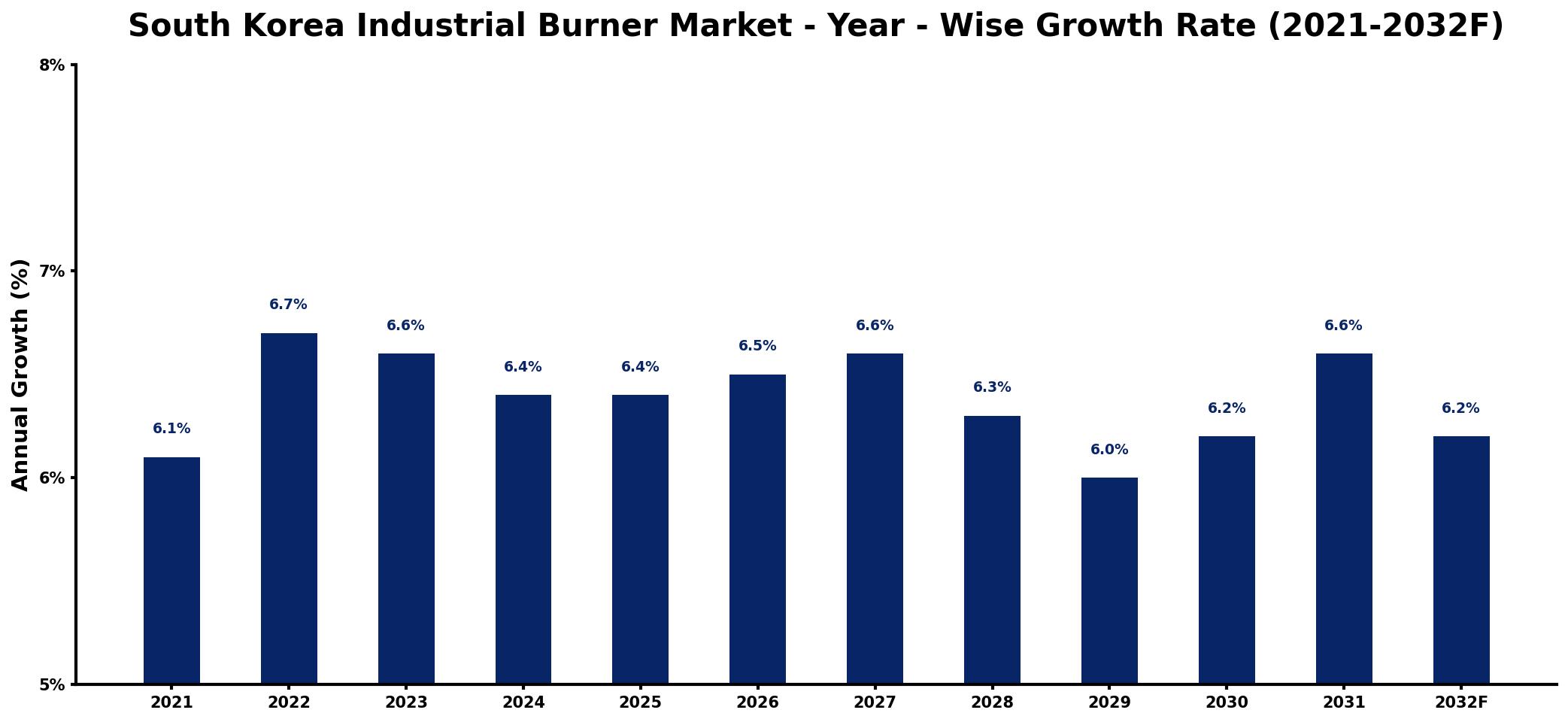
The table below presents the year‑wise growth rates along with the key drivers influencing the market
| Year | Growth Rate | Major Drivers |
| 2021 | 6.1% | Increased manufacturing sector activities |
| 2022 | 6.7% | Rising energy efficiency regulations |
| 2023 | 6.6% | Growing renewable energy initiatives |
| 2024 | 6.4% | Expansion in construction projects |
| 2025 | 6.4% | Higher investments in infrastructure |
| 2026 | 6.5% | rising procurement volume requirements |
| 2027 | 6.6% | Demand from food processing industries |
| 2028 | 6.3% | Emergence of advanced technologies |
| 2029 | 6.0% | Growth in chemical processing facilities |
| 2030 | 6.2% | Increased focus on sustainability practices |
| 2031 | 6.6% | Expansion of logistics and warehousing |
| 2032 | 6.2% | Rising demand from power generation |
Note: Market size estimations and growth projections presented in this report are based on 6Wresearch's proprietary forecasting methodology, utilizing the latest available industry data, government publications, and primary research inputs.
South Korea Industrial Burner Market Synopsis
The strongest force shaping the South Korea Industrial Burner Market today is the pressing need for compliance with environmental regulations. As companies face tightening emission standards, the demand for technologically advanced, efficient burners continues to surge. This shift not only addresses regulatory requirements but also aligns with the broader movement towards cleaner energy practices.
Moreover, the increasing focus on sustainability within the manufacturing sector is propelling innovation in burner technologies. The integration of renewable energy sources and advanced combustion processes is gradually reshaping the landscape, compelling manufacturers to adapt and invest in more efficient systems to meet changing consumer preferences and legislative mandates.
South Korea Industrial Burner Market Key Takeaways
- The market is experiencing robust growth driven by demand for low-emission combustion technologies.
- Key sectors such as food processing, chemicals, and power generation are crucial for market expansion.
- Innovations focused on energy efficiency and compliance with emission regulations are paramount.
- Government initiatives provide financial support for adopting advanced burner technologies.
- Future growth opportunities lie in integrating renewable fuels and enhancing operational efficiencies.
Evaluation of Restraints in South Korea Industrial Burner Market
Despite the overall positive outlook, the South Korea Industrial Burner Market faces significant challenges. Regulatory compliance remains a significant barrier, as companies must navigate stringent emission standards that vary across industries. Additionally, the high operational costs associated with maintaining advanced burner systems can deter some businesses from transitioning to newer technologies. The complexity of integrating sophisticated control systems into existing infrastructures also poses a considerable challenge, necessitating ongoing research and development efforts to streamline implementation processes.
South Korea Industrial Burner Market Trends
The market is currently witnessing several key trends, particularly the rise of digitalization and automation in industrial burner operations. Manufacturers are increasingly incorporating IoT technology to monitor burner performance and optimize fuel usage in real-time. Additionally, there is a growing preference for modular burner systems that offer flexibility and scalability to meet varying industrial needs. Another notable trend is the increased collaboration between burner manufacturers and research institutions focused on developing innovative combustion solutions that further reduce emissions.
South Korea Industrial Burner Market Opportunities
Opportunities for growth in the South Korea Industrial Burner Market are abundant, particularly in the realm of renewable energy integration. As businesses seek to reduce their carbon footprint, there is a significant push towards utilizing biofuels and other alternative energy sources in burner applications. Additionally, advancements in technology present avenues for developing highly efficient burner systems that are not only cost-effective but also environmentally sustainable. This opens up new avenues for investment and innovation, particularly in R&D focused on hybrid systems and fuel flexibility.
Government Initiatives in the South Korea Industrial Burner Market
The South Korean government has implemented several policies to support the industrial burner market, emphasizing energy efficiency and emissions reduction. Financial incentives are available for companies that invest in advanced burner technologies and environmentally friendly combustion systems. Moreover, public spending initiatives focus on upgrading industrial processes to comply with stringent air quality standards, promoting the adoption of cleaner combustion practices, and supporting the research and development of renewable fuel applications.
Future Insights of the South Korea Industrial Burner Market
Looking ahead to 2026-2032, the South Korea Industrial Burner Market is poised for significant transformation. Continued emphasis on sustainability and regulatory compliance will drive the development of advanced burner technologies. As industries adapt to changing energy dynamics, the incorporation of renewable fuels and innovative combustion methods will likely become standard practice. Furthermore, emerging technologies such as AI and machine learning will enhance efficiency and reliability, shaping the future landscape of the market.
South Korea Industrial Burner Market Latest Developments (2025 - 2026)
Recent developments in the South Korea Industrial Burner Market indicate a strong shift towards innovation and compliance. Companies are actively exploring partnerships with tech firms to integrate smart technologies into their burner systems. Additionally, there is a noticeable increase in R&D investment focused on developing low-emission burners that meet stricter environmental regulations. The emphasis on clean combustion practices and renewable fuels continues to influence product development across various industrial sectors.
South Korea Industrial Burner Market - Key Attractiveness of the Report
- 10 Years of Market Numbers
- Historical Data Starting from 2022 to 2025
- Base Year: 2025
- Forecast Data until 2032
- Key Performance Indicators Impacting the Market
- Major Upcoming Developments and Projects
Key Highlights of the Report:
- South Korea Industrial Burner Market Outlook
- Market Size of South Korea Industrial Burner Market, 2025
- Forecast of South Korea Industrial Burner Market, 2032
- Historical Data and Forecast of South Korea Industrial Burner Revenues & Volume for the Period 2022-2032F
- South Korea Industrial Burner Market Trend Evolution
- South Korea Industrial Burner Market Drivers and Challenges
- South Korea Industrial Burner Price Trends
- South Korea Industrial Burner Porter's Five Forces
- South Korea Industrial Burner Industry Life Cycle
- Historical Data and Forecast of South Korea Industrial Burner Market Revenues & Volume By Type for the Period 2022-2032F
- Historical Data and Forecast of South Korea Industrial Burner Market Revenues & Volume By Cold Chamber Die Casting Machine for the Period 2022-2032F
- Historical Data and Forecast of South Korea Industrial Burner Market Revenues & Volume By Hot Chamber Die Casting Machine for the Period 2022-2032F
- Historical Data and Forecast of South Korea Industrial Burner Market Revenues & Volume By Gravity Die Casting Machine for the Period 2022-2032F
- Historical Data and Forecast of South Korea Industrial Burner Market Revenues & Volume By Material for the Period 2022-2032F
- Historical Data and Forecast of South Korea Industrial Burner Market Revenues & Volume By Aluminum for the Period 2022-2032F
- Historical Data and Forecast of South Korea Industrial Burner Market Revenues & Volume By Zinc for the Period 2022-2032F
- Historical Data and Forecast of South Korea Industrial Burner Market Revenues & Volume By Magnesium for the Period 2022-2032F
- Historical Data and Forecast of South Korea Industrial Burner Market Revenues & Volume By End User for the Period 2022-2032F
- Historical Data and Forecast of South Korea Industrial Burner Market Revenues & Volume By Transportation for the Period 2022-2032F
- Historical Data and Forecast of South Korea Industrial Burner Market Revenues & Volume By Mechanical & Manufacturing Equipment for the Period 2022-2032F
- Historical Data and Forecast of South Korea Industrial Burner Market Revenues & Volume By Building & Construction for the Period 2022-2032F
- South Korea Industrial Burner Import Export Trade Statistics
- Market Opportunity Assessment By Type
- Market Opportunity Assessment By Material
- Market Opportunity Assessment By End User
- South Korea Industrial Burner Top Companies Market Share
- South Korea Industrial Burner Competitive Benchmarking By Technical and Operational Parameters
- South Korea Industrial Burner Company Profiles
- South Korea Industrial Burner Key Strategic Recommendations






































