South Korea Insecticide Market Size, Share & Growth Rate
The South Korea Insecticide Market was estimated at USD 391 Million in 2025 and is projected to reach USD 527 Million by 2032, growing at a CAGR of 4.4% from 2026 to 2032. This growth trajectory is primarily driven by the increasing need for effective pest management solutions to safeguard agricultural productivity and enhance food security. Additionally, advancements in formulation technologies and the rising adoption of integrated pest management practices are further propelling this market forward.
South Korea Insecticide Market Year-wise Growth Rate and Key Drivers
This graph highlights how the South Korea Insecticide Market has steadily grown over the years, supported by major growth factors.
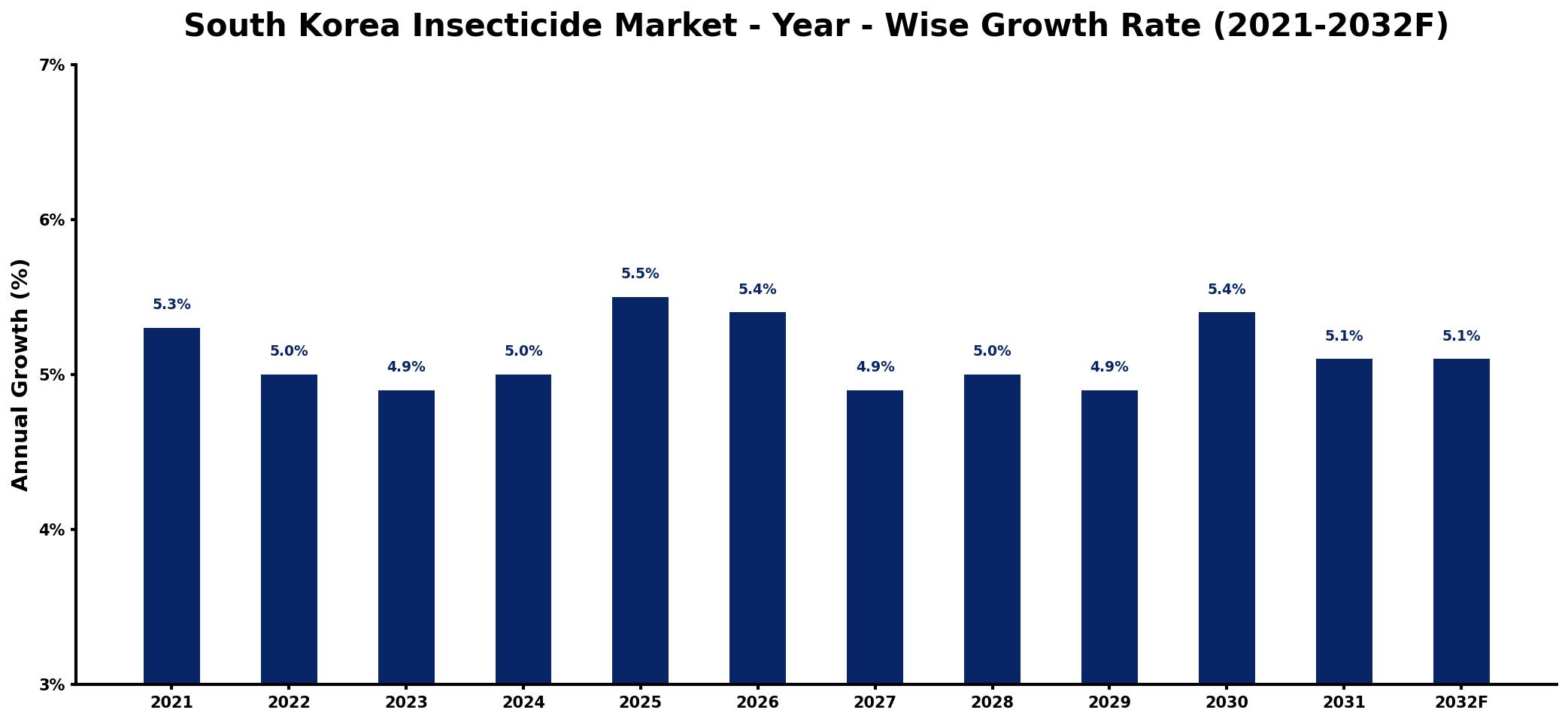
The table below presents the year‑wise growth rates along with the key drivers influencing the market
| Year | Growth Rate | Major Drivers |
| 2021 | 5.3% | Rising agricultural sector investments |
| 2022 | 5.0% | Increased focus on pest control |
| 2023 | 4.9% | Growing awareness of crop health |
| 2024 | 5.0% | Expansion of urban gardening practices |
| 2025 | 5.5% | Higher demand for sustainable farming |
| 2026 | 5.4% | Technological advancements in agriculture |
| 2027 | 4.9% | Emergence of new pest species |
| 2028 | 5.0% | Increase in organic farming initiatives |
| 2029 | 4.9% | Strengthened regulations on pesticide usage |
| 2030 | 5.4% | Growth in commercial farming operations |
| 2031 | 5.1% | growing emerging market penetration |
| 2032 | 5.1% | Enhanced research on pest management |
Note: Market size estimations and growth projections presented in this report are based on 6Wresearch's proprietary forecasting methodology, utilizing the latest available industry data, government publications, and primary research inputs.
South Korea Insecticide Market Synopsis
In South Korea, the demand for insecticides is heightened due to an increase in pest populations exacerbated by climate change. Farmers are increasingly turning to these chemical solutions to protect their crops from infestations that threaten yields and, by extension, the nations food supply.
Furthermore, the public health sector plays a significant role in driving demand, particularly in urban areas where the risk of vector-borne diseases looms large. As pest control becomes a priority for both agricultural and municipal sectors, the market is poised for substantial growth.
South Korea Insecticide Market Key Takeaways
- Innovations in insecticide formulations are enhancing effectiveness and reducing environmental impact.
- Government policies are increasingly supportive of sustainable pest management practices.
- There is a growing demand for integrated pest management solutions across agricultural sectors.
- South Koreas commitment to food security significantly impacts the insecticide market's expansion.
- Technological advancements in production and application are essential for maintaining market competitiveness.
Evaluation of Restraints in South Korea Insecticide Market
While the South Korea insecticide market shows promising growth, it faces restraints that could hinder its full potential. Compliance with stringent safety and environmental regulations poses a challenge for manufacturers aiming to innovate. Additionally, the demand for sustainable solutions is driving pressure to reduce reliance on traditional chemical insecticides, necessitating investment in research and development for safer alternatives. The balancing act between effective pest control and environmental responsibility requires ongoing adaptation from industry players.
South Korea Insecticide Market Trends
A notable trend in the South Korean insecticide market is the increasing focus on biopesticides, which are perceived as a more environmentally friendly alternative. This shift is not only driven by consumer preferences for sustainable agriculture but also by regulatory encouragement for reduced chemical usage. Moreover, digital agriculture and smart farming technologies are beginning to reshape the pest control landscape, enabling more precise applications of insecticides.
The integration of Internet of Things (IoT) solutions into pest management practices is becoming increasingly prevalent, allowing for real-time monitoring of pest populations and optimizing the timing and quantity of insecticide application. This trend indicates a move towards more tailored and effective pest control strategies.
South Korea Insecticide Market Opportunities
Opportunities abound in the South Korea insecticide market, especially in the realm of biopesticides and integrated pest management strategies. Companies that can innovate to develop low-residue formulations stand to gain a competitive edge. Furthermore, partnerships with agricultural research institutions can enhance product development and address emerging pest challenges effectively. The ongoing commitment to food security and sustainable agricultural practices also positions this market for robust investment opportunities.
Government Initiatives in the South Korea Insecticide Market
The South Korean government actively supports the insecticide market through policies aimed at enhancing agricultural productivity and fostering environmentally sustainable pest control measures. Financial incentives are in place to encourage the development of biopesticides and integrated pest management solutions. Additionally, the government promotes R&D initiatives that facilitate collaborations between industry players and academic institutions, driving innovation and efficiency in pest management practices.
Future Insights of the South Korea Insecticide Market
Looking ahead, the South Korea insecticide market is set to evolve significantly between 2026 and 2032. As regulatory frameworks tighten, a shift towards sustainable and effective pest management solutions will likely intensify. Companies that prioritize innovation in product formulation and application technology are expected to thrive. Moreover, the convergence of agriculture with advanced technologies like AI and IoT will reshape how pest control is approached, improving both efficiency and efficacy.
South Korea Insecticide Market Latest Developments (2025 - 2026)
Recent developments in the South Korea insecticide market indicate a notable push towards sustainable practices. Emerging startups are beginning to introduce innovative biopesticides, gaining traction among environmentally conscious farmers. Moreover, major players are investing heavily in R&D to create low-impact formulations that adhere to tightening regulations, reflecting an industry-wide commitment to balancing efficacy with environmental stewardship. Collaborative efforts between government bodies and agricultural organizations are also becoming more pronounced, aimed at addressing the challenges of new pest invasions.
South Korea Insecticide Market - Key Attractiveness of the Report
- 10 Years of Market Numbers
- Historical Data Starting from 2022 to 2025
- Base Year: 2025
- Forecast Data until 2032
- Key Performance Indicators Impacting the Market
- Major Upcoming Developments and Projects
Key Highlights of the Report:
- South Korea Insecticide Market Outlook
- Market Size of South Korea Insecticide Market, 2025
- Forecast of South Korea Insecticide Market, 2032
- Historical Data and Forecast of South Korea Insecticide Revenues & Volume for the Period 2022-2032F
- South Korea Insecticide Market Trend Evolution
- South Korea Insecticide Market Drivers and Challenges
- South Korea Insecticide Price Trends
- South Korea Insecticide Porter's Five Forces
- South Korea Insecticide Industry Life Cycle
- Historical Data and Forecast of South Korea Insecticide Market Revenues & Volume By Type for the Period 2022-2032F
- Historical Data and Forecast of South Korea Insecticide Market Revenues & Volume By Pyrethroids for the Period 2022-2032F
- Historical Data and Forecast of South Korea Insecticide Market Revenues & Volume By Organophosphorus for the Period 2022-2032F
- Historical Data and Forecast of South Korea Insecticide Market Revenues & Volume By Carbamates for the Period 2022-2032F
- Historical Data and Forecast of South Korea Insecticide Market Revenues & Volume By Organochlorine for the Period 2022-2032F
- Historical Data and Forecast of South Korea Insecticide Market Revenues & Volume By Botanicals for the Period 2022-2032F
- Historical Data and Forecast of South Korea Insecticide Market Revenues & Volume By Other Types for the Period 2022-2032F
- Historical Data and Forecast of South Korea Insecticide Market Revenues & Volume By Crop Type for the Period 2022-2032F
- Historical Data and Forecast of South Korea Insecticide Market Revenues & Volume By Cereals & Grains for the Period 2022-2032F
- Historical Data and Forecast of South Korea Insecticide Market Revenues & Volume By Oilseeds & Pulses for the Period 2022-2032F
- Historical Data and Forecast of South Korea Insecticide Market Revenues & Volume By Fruits & Vegetables for the Period 2022-2032F
- Historical Data and Forecast of South Korea Insecticide Market Revenues & Volume By Other Crop Types for the Period 2022-2032F
- Historical Data and Forecast of South Korea Insecticide Market Revenues & Volume By Formulation for the Period 2022-2032F
- Historical Data and Forecast of South Korea Insecticide Market Revenues & Volume By Wettable Powder for the Period 2022-2032F
- Historical Data and Forecast of South Korea Insecticide Market Revenues & Volume By Emulsifiable Concentrate for the Period 2022-2032F
- Historical Data and Forecast of South Korea Insecticide Market Revenues & Volume By Suspension Concentrate for the Period 2022-2032F
- Historical Data and Forecast of South Korea Insecticide Market Revenues & Volume By Oil Emulsion In Water for the Period 2022-2032F
- Historical Data and Forecast of South Korea Insecticide Market Revenues & Volume By Microencapsulated Suspension for the Period 2022-2032F
- Historical Data and Forecast of South Korea Insecticide Market Revenues & Volume By Granules for the Period 2022-2032F
- Historical Data and Forecast of South Korea Insecticide Market Revenues & Volume By Other Formulations for the Period 2022-2032F
- Historical Data and Forecast of South Korea Insecticide Market Revenues & Volume By Form for the Period 2022-2032F
- Historical Data and Forecast of South Korea Insecticide Market Revenues & Volume By Sprays for the Period 2022-2032F
- Historical Data and Forecast of South Korea Insecticide Market Revenues & Volume By Baits for the Period 2022-2032F
- Historical Data and Forecast of South Korea Insecticide Market Revenues & Volume By Strips for the Period 2022-2032F
- South Korea Insecticide Import Export Trade Statistics
- Market Opportunity Assessment By Type
- Market Opportunity Assessment By Crop Type
- Market Opportunity Assessment By Formulation
- Market Opportunity Assessment By Form
- South Korea Insecticide Top Companies Market Share
- South Korea Insecticide Competitive Benchmarking By Technical and Operational Parameters
- South Korea Insecticide Company Profiles
- South Korea Insecticide Key Strategic Recommendations






































