South Korea IoT Security Market Size & Growth Rate (2026-2032)
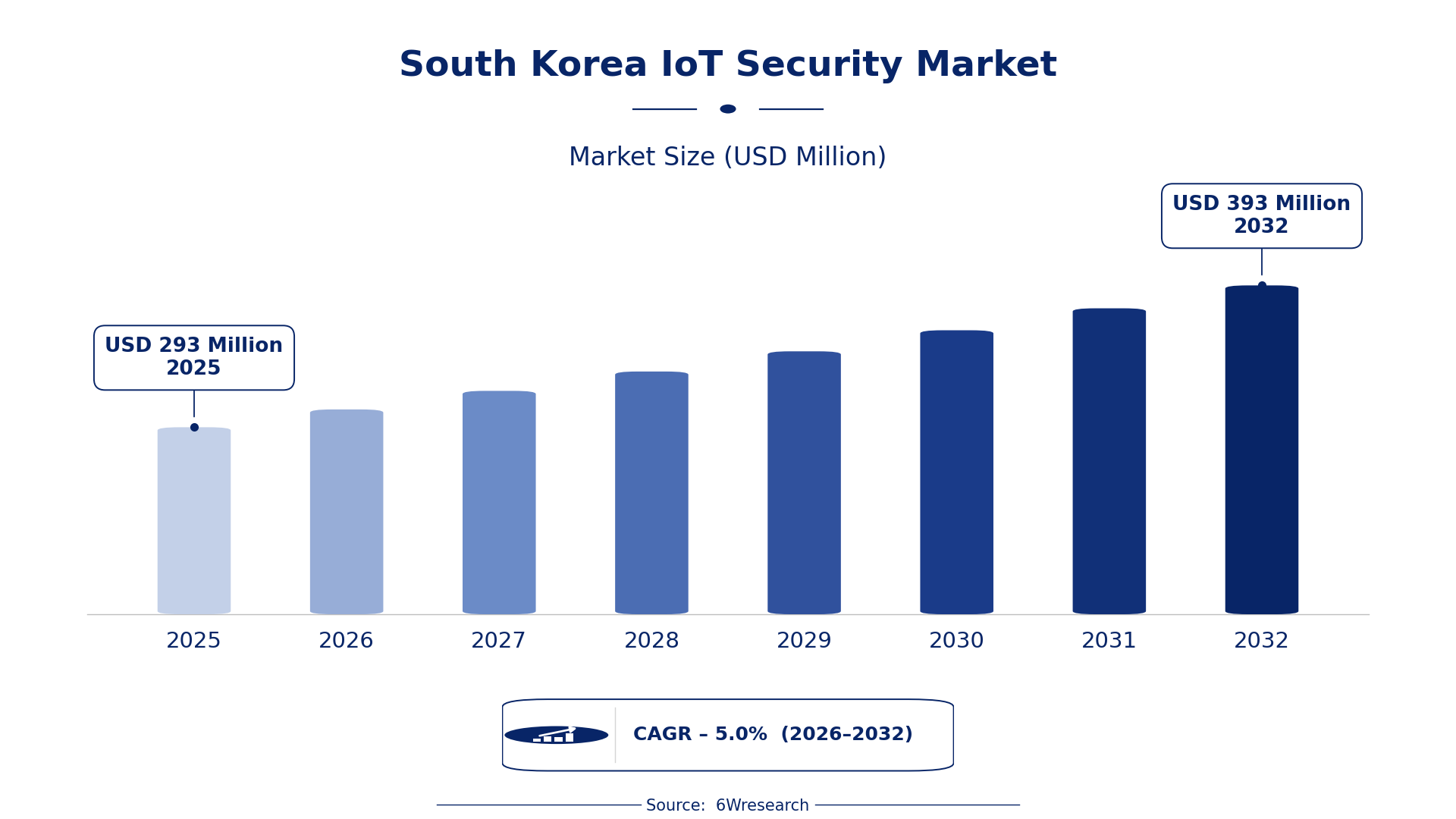
The South Korea IoT Security Market was estimated at USD 293 Million in 2025 and is projected to reach USD 393 Million by 2032, growing at a CAGR of 5.0% from 2026 to 2032.
South Korea IoT Security Market Synopsis
The IoT security market in South Korea is at a critical juncture, driven by increasing cyber threats that target connected devices. As the number of IoT deployments expands across various sectors, so does the urgency for implementing robust security measures to protect sensitive data and infrastructure.
With significant investments in smart cities and industrial automation, the demand for specialized IoT security solutions is surging. Companies are focusing on encryption, authentication, and advanced threat detection systems to safeguard their networks, making this market a vital component of South Korea's technological ecosystem.
South Korea IoT Security Market Year-wise Growth Rate and Key Drivers
This graph illustrates the annual growth rates of the South Korea IoT Security Market from 2021 to 2032, highlighting a steady upward trajectory and projected expansion over the forecast period.
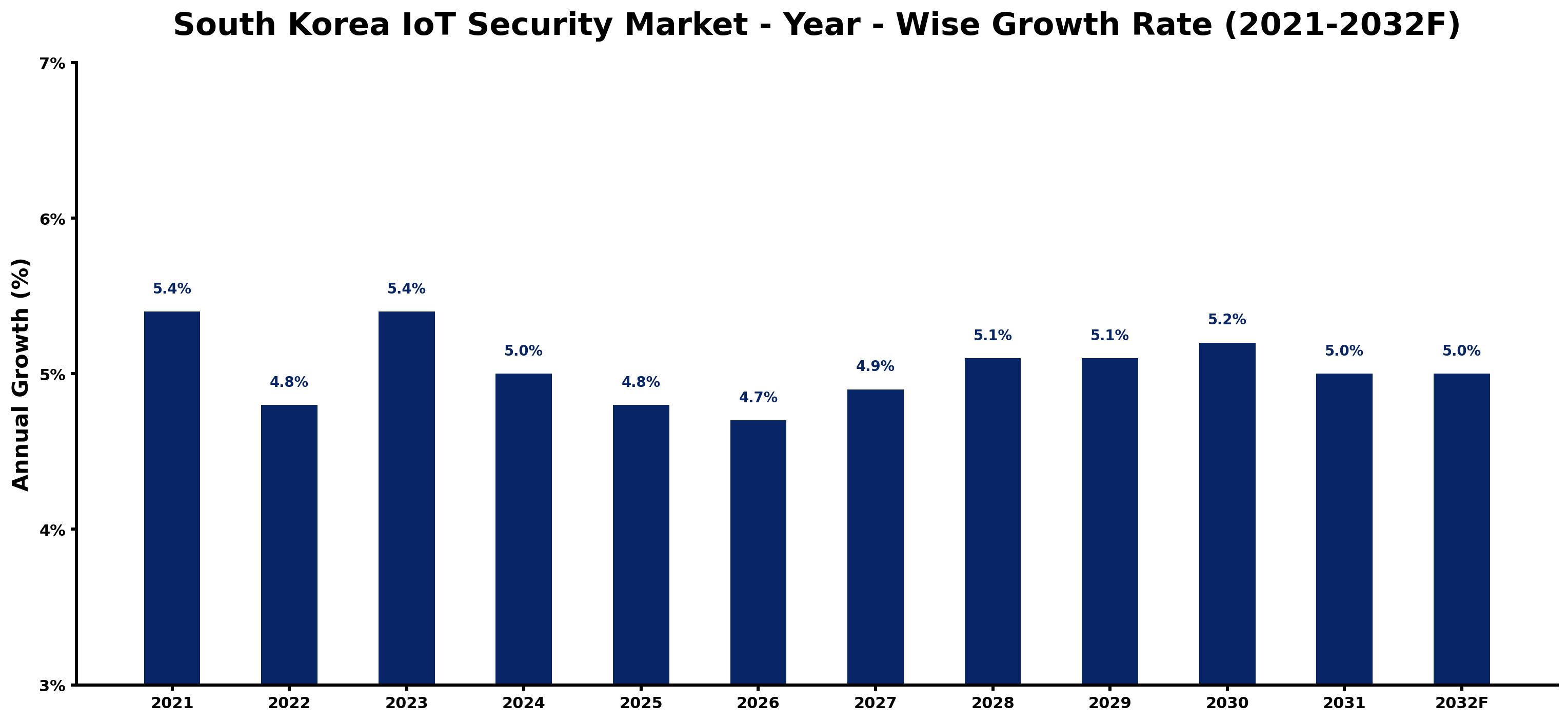
The table below presents the year‑wise growth rates along with the key drivers influencing the market
| Year | Growth Rate | Major Drivers |
| 2021 | 5.4% | KISA mandates stricter IoT device security regulations. |
| 2022 | 4.8% | Rising data privacy concerns drive IoT security investments. |
| 2023 | 5.4% | Increased smart home adoption boosts security service demand. |
| 2024 | 5.0% | Government initiative promotes IoT cybersecurity awareness programs. |
| 2025 | 4.8% | Growing awareness of IoT vulnerabilities fuels market growth. |
| 2026 | 4.7% | Local startups innovate IoT security solutions for consumers. |
| 2027 | 4.9% | Telecom partnerships enhance IoT security ecosystem development. |
| 2028 | 5.1% | Digital transformation in enterprises drives security solution demand. |
| 2029 | 5.1% | Government funding for cybersecurity research supports IoT efforts. |
| 2030 | 5.2% | Public sector adoption of IoT sharpens security focus. |
| 2031 | 5.0% | Rise in connected medical devices increases security requirements. |
| 2032 | 5.0% | Corporate compliance with data protection laws boosts sector growth. |
Note: Market size estimations and growth projections presented in this report are based on 6Wresearch's proprietary forecasting methodology, utilizing the latest available industry data, government publications, and primary research inputs.
South Korea IoT Security Market Key Takeaways
Below are some of the specific key takeaways from the market, including:
- The proliferation of connected devices is significantly driving the need for advanced IoT security solutions.
- Government regulations are increasingly focused on establishing cybersecurity standards for IoT deployments.
- Investments in R&D are crucial for developing innovative security technologies tailored to IoT environments.
- Enterprises are prioritizing integrated security frameworks that ensure data integrity and compliance with regulations.
- The market is evolving towards comprehensive solutions that address both hardware and software vulnerabilities.
Evaluation of Restraints in South Korea IoT Security Market
Despite its promising trajectory, the South Korea IoT security market faces notable restraints. One significant barrier is the complexity associated with managing diverse IoT security solutions. Organizations often struggle to implement comprehensive security measures that align with varying regulatory requirements. on top of that, maintaining operational costs while ensuring the reliability and scalability of IoT security systems presents a persistent challenge. The demand for customized solutions adds another layer of difficulty, requiring continuous innovation and strategic investment from providers.
South Korea IoT Security Market Trends
A key trend in this market is the shift towards integrated security frameworks that encompass both physical and digital aspects of IoT devices. Organizations are increasingly adopting AI-driven analytics for improved threat detection and response times. Additionally, there is a growing emphasis on end-to-end encryption and data privacy, influenced by consumer expectations and regulatory standards. The rise of edge computing also necessitates localized security solutions that can operate in real-time, further shaping the market's evolution.
South Korea IoT Security Market Opportunities
There are ample opportunities for growth in the South Korea IoT security market, particularly in sectors like healthcare, manufacturing, and smart cities. The ongoing digital transformation initiatives present a unique chance for security firms to offer tailored solutions that address specific industry needs. on top of that, partnerships between technology providers and government entities can foster innovation in IoT security technologies, paving the way for new market entrants and expansions. As the focus on data privacy intensifies, companies that prioritize compliance and robust security measures are well-positioned for success.
Government Initiatives in the South Korea IoT Security Market
The South Korean government plays a vital role in shaping the IoT security market through proactive policies and regulations. By establishing cybersecurity standards and promoting data protection measures, authorities aim to bolster public confidence in IoT technologies. Current initiatives focus on enhancing threat mitigation strategies across critical infrastructure while encouraging collaboration between public and private sectors.
- A regulatory framework introduced in 2025 mandating encryption standards for IoT devices in critical sectors.
- Ongoing public-private partnerships to develop advanced threat detection systems for smart city projects.
- A recently completed national cybersecurity awareness campaign aimed at educating businesses on IoT risks.
- Planned funding initiatives to support R&D in IoT security technologies through 2026.
- Current assessments of IoT device vulnerabilities across public sector applications, with findings expected by mid-2026.
Future Insights of the South Korea IoT Security Market
Looking ahead to 2026-2032, the South Korea IoT security market is set to expand significantly. The integration of advanced technologies like AI and machine learning into security frameworks will enhance threat detection capabilities, making it easier to respond to emerging risks. As regulatory pressures increase, companies will need to adopt more sophisticated compliance strategies, further driving demand for specialized security solutions. The emphasis on securing critical infrastructure will continue to shape investments and innovations in this space.
South Korea IoT Security Market Latest Developments
In the past year, the South Korea IoT security market has seen a surge in activity, reflecting the heightened focus on cybersecurity amid rising threats. Companies are launching innovative solutions and forming strategic alliances to strengthen their market position. This dynamic environment is indicative of the urgent need for robust security measures in the face of evolving cyber threats.
- A major technology vendor announced the rollout of a new cloud-based IoT security platform aimed at small and medium-sized enterprises, currently underway and expected to enhance security protocols.
- In early 2025, a leading regional operator launched an initiative to integrate AI-driven analytics into existing IoT security frameworks, completed by late 2025.
- An ongoing collaboration between several universities and cybersecurity firms to develop next-generation IoT security technologies, currently in its research phase.
- A planned conference in Q2 2026 will focus on emerging trends in IoT security, bringing together industry leaders and policymakers.
- Implementation of a pilot program in smart cities to test advanced threat detection systems, expected to begin in mid-2026.
South Korea IoT Security Market - Key Attractiveness of the Report
- 10 Years of Market Numbers
- Historical Data Starting from 2022 to 2025
- Base Year: 2025
- Forecast Data until 2032
- Key Performance Indicators Impacting the Market
- Major Upcoming Developments and Projects
Government policies are establishing critical cybersecurity standards and encouraging R&D investments, which are essential for fostering a secure IoT ecosystem. Recent initiatives focus on encryption standards and data protection measures across various sectors.
Key Highlights of the Report:
- South Korea IoT Security Market Outlook
- Market Size of South Korea IoT Security Market, 2025
- Forecast of South Korea IoT Security Market, 2032
- Historical Data and Forecast of South Korea IoT Security Revenues & Volume for the Period 2022-2032F
- South Korea IoT Security Market Trend Evolution
- South Korea IoT Security Market Drivers and Challenges
- South Korea IoT Security Price Trends
- South Korea IoT Security Porter's Five Forces
- South Korea IoT Security Industry Life Cycle
- Historical Data and Forecast of South Korea IoT Security Market Revenues & Volume By Type for the Period 2022-2032F
- Historical Data and Forecast of South Korea IoT Security Market Revenues & Volume By Network Security for the Period 2022-2032F
- Historical Data and Forecast of South Korea IoT Security Market Revenues & Volume By Endpoint Security for the Period 2022-2032F
- Historical Data and Forecast of South Korea IoT Security Market Revenues & Volume By Application Security for the Period 2022-2032F
- Historical Data and Forecast of South Korea IoT Security Market Revenues & Volume By Cloud Security for the Period 2022-2032F
- Historical Data and Forecast of South Korea IoT Security Market Revenues & Volume By Other Security Types for the Period 2022-2032F
- Historical Data and Forecast of South Korea IoT Security Market Revenues & Volume By Deployment Mode for the Period 2022-2032F
- Historical Data and Forecast of South Korea IoT Security Market Revenues & Volume By Small and Medium Enterprises for the Period 2022-2032F
- Historical Data and Forecast of South Korea IoT Security Market Revenues & Volume By Large Enterprises for the Period 2022-2032F
- Historical Data and Forecast of South Korea IoT Security Market Revenues & Volume By Component for the Period 2022-2032F
- Historical Data and Forecast of South Korea IoT Security Market Revenues & Volume By Solutions for the Period 2022-2032F
- Historical Data and Forecast of South Korea IoT Security Market Revenues & Volume By Services for the Period 2022-2032F
- Historical Data and Forecast of South Korea IoT Security Market Revenues & Volume By Solution for the Period 2022-2032F
- Historical Data and Forecast of South Korea IoT Security Market Revenues & Volume By Identity and Access Management for the Period 2022-2032F
- Historical Data and Forecast of South Korea IoT Security Market Revenues & Volume By Data Encryption and Tokenization for the Period 2022-2032F
- Historical Data and Forecast of South Korea IoT Security Market Revenues & Volume By Intrusion Detection System/Intrusion Prevention System for the Period 2022-2032F
- Historical Data and Forecast of South Korea IoT Security Market Revenues & Volume By Device Authentication and Management for the Period 2022-2032F
- Historical Data and Forecast of South Korea IoT Security Market Revenues & Volume By Secure Communications for the Period 2022-2032F
- Historical Data and Forecast of South Korea IoT Security Market Revenues & Volume By PKI Lifecycle Management for the Period 2022-2032F
- Historical Data and Forecast of South Korea IoT Security Market Revenues & Volume By Distributed Denial of Service Protection for the Period 2022-2032F
- Historical Data and Forecast of South Korea IoT Security Market Revenues & Volume By Security Analytics for the Period 2022-2032F
- Historical Data and Forecast of South Korea IoT Security Market Revenues & Volume By Application Area for the Period 2022-2032F
- Historical Data and Forecast of South Korea IoT Security Market Revenues & Volume By Smart Manufacturing for the Period 2022-2032F
- Historical Data and Forecast of South Korea IoT Security Market Revenues & Volume By Smart Energy and Utilities for the Period 2022-2032F
- Historical Data and Forecast of South Korea IoT Security Market Revenues & Volume By Connected Logistics for the Period 2022-2032F
- Historical Data and Forecast of South Korea IoT Security Market Revenues & Volume By Smart Home and Consumer Electronics for the Period 2022-2032F
- Historical Data and Forecast of South Korea IoT Security Market Revenues & Volume By Connected Healthcare for the Period 2022-2032F
- Historical Data and Forecast of South Korea IoT Security Market Revenues & Volume By Smart Government and Defense for the Period 2022-2032F
- Historical Data and Forecast of South Korea IoT Security Market Revenues & Volume By Smart Retail for the Period 2022-2032F
- Historical Data and Forecast of South Korea IoT Security Market Revenues & Volume By Other Application Areas for the Period 2022-2032F
- Historical Data and Forecast of South Korea IoT Security Market Revenues & Volume By Organization Size for the Period 2022-2032F
- Historical Data and Forecast of South Korea IoT Security Market Revenues & Volume By Small and Medium-sized Enterprises for the Period 2022-2032F
- Historical Data and Forecast of South Korea IoT Security Market Revenues & Volume By Large Enterprises for the Period 2022-2032F
- Historical Data and Forecast of South Korea IoT Security Market Revenues & Volume By Service for the Period 2022-2032F
- Historical Data and Forecast of South Korea IoT Security Market Revenues & Volume By Professional Services for the Period 2022-2032F
- Historical Data and Forecast of South Korea IoT Security Market Revenues & Volume By Managed Services for the Period 2022-2032F
- South Korea IoT Security Import Export Trade Statistics
- Market Opportunity Assessment By Type
- Market Opportunity Assessment By Deployment Mode
- Market Opportunity Assessment By Component
- Market Opportunity Assessment By Solution
- Market Opportunity Assessment By Application Area
- Market Opportunity Assessment By Organization Size
- Market Opportunity Assessment By Service
- South Korea IoT Security Top Companies Market Share
- South Korea IoT Security Competitive Benchmarking By Technical and Operational Parameters
- South Korea IoT Security Company Profiles
- South Korea IoT Security Key Strategic Recommendations






































