South Korea IPTV Market Size, Share & Growth Rate
The South Korea IPTV Market was estimated at USD 384 Million in 2025 and is projected to reach USD 503 Million by 2032, growing at a CAGR of 3.9% from 2026 to 2032. This growth trajectory is bolstered by the widespread adoption of high-speed internet and the increasing consumer preference for on-demand viewing. Furthermore, advancements in broadband infrastructure are enabling service providers to offer superior quality and personalized content, aligning with the evolving expectations of South Korean viewers.
South Korea IPTV Market Year-wise Growth Rate and Key Drivers
This graph highlights how the South Korea IPTV Market has steadily grown over the years, supported by major growth factors.
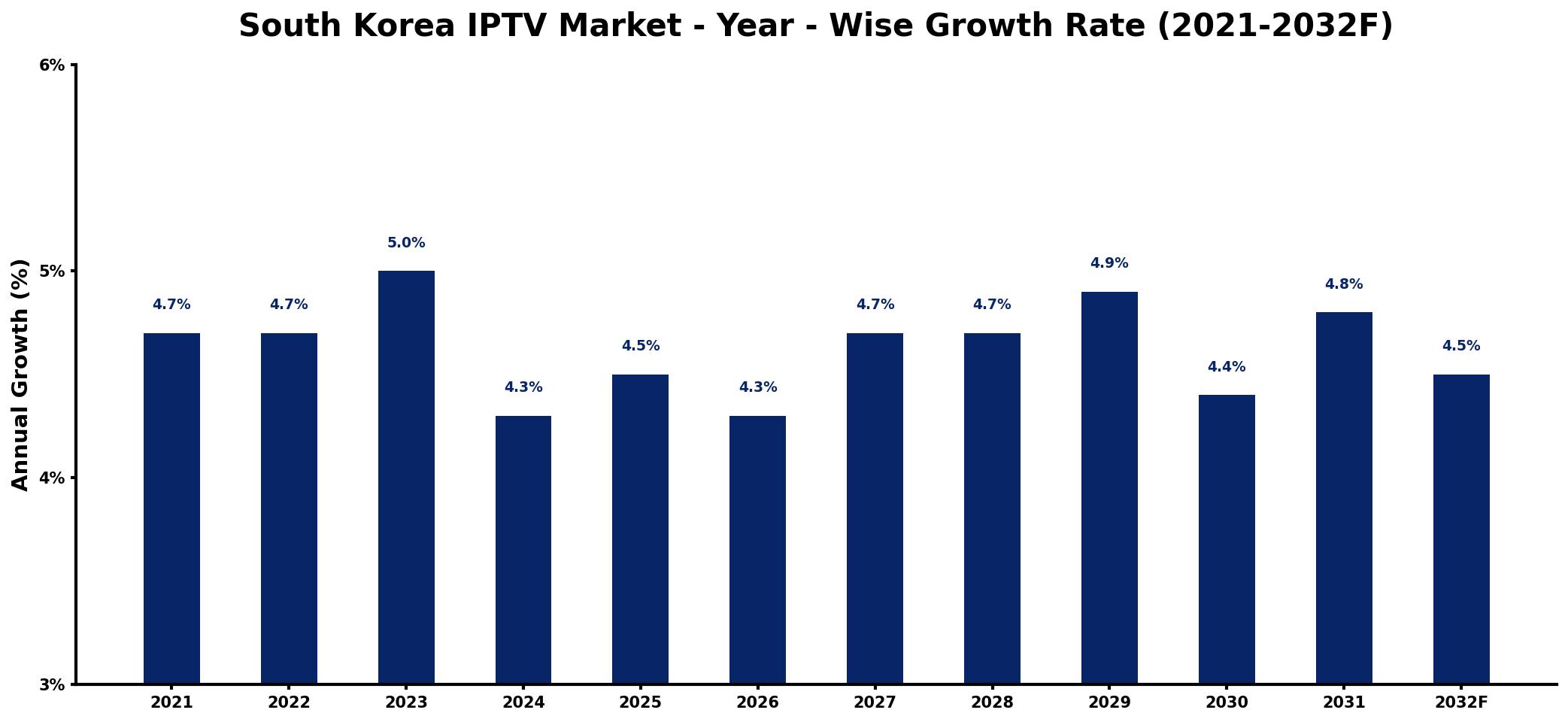
The table below presents the year‑wise growth rates along with the key drivers influencing the market
| Year | Growth Rate | Major Drivers |
| 2021 | 4.7% | Rising demand for streaming content |
| 2022 | 4.7% | Increased investments in broadband infrastructure |
| 2023 | 5.0% | Growth in mobile viewing habits |
| 2024 | 4.3% | Expansion of content partnerships |
| 2025 | 4.5% | Enhanced user experience technologies |
| 2026 | 4.3% | Development of original programming |
| 2027 | 4.7% | Emergence of niche content channels |
| 2028 | 4.7% | Adoption of interactive viewing features |
| 2029 | 4.9% | Integration with smart home devices |
| 2030 | 4.4% | Launch of competitive pricing models |
| 2031 | 4.8% | expanding manufacturing base activity |
| 2032 | 4.5% | expanding industrial usage applications |
Note: Market size estimations and growth projections presented in this report are based on 6Wresearch's proprietary forecasting methodology, utilizing the latest available industry data, government publications, and primary research inputs.
South Korea IPTV Market Synopsis
The South Korean IPTV landscape is experiencing a transformative shift as more consumers opt for internet-based television services that deliver interactive and customizable viewing experiences. The proliferation of streaming options and smart devices is significantly influencing how viewers access and engage with media.
Market participants are responding to this trend by enhancing their service offerings, providing a blend of live, on-demand, and premium content that caters to diverse consumer preferences. This not only enriches the viewing experience but also fosters a competitive environment that drives innovation across the sector.
South Korea IPTV Market Key Takeaways
- Growing demand for digital content and interactive television drives market expansion.
- High-speed internet adoption and enhanced streaming technologies are pivotal growth enablers.
- Government policies support infrastructure investment, ensuring regulatory compliance and consumer protection.
- Personalized content and advanced advertising solutions are reshaping viewer engagement strategies.
- Increased collaboration between media, technology firms, and government enhances R&D efforts.
Evaluation of Restraints in South Korea IPTV Market
Despite the vibrant growth in the South Korea IPTV market, several restraints persist that could hinder full potential realization. The complexity of service delivery remains a significant challenge, as operators must navigate intricate regulations while ensuring compliance with content licensing requirements. Additionally, the ongoing demand for high-quality viewing experiences places pressure on service providers to consistently innovate. Operational cost management, coupled with the integration of advanced technologies, requires strategic foresight and substantial investment. Thus, market players must continually adapt to maintain their competitive edge.
South Korea IPTV Market Trends
Current trends indicate a marked shift towards personalization and interactivity in content delivery. The South Korean audience increasingly seeks tailored viewing experiences, prompting providers to leverage data analytics for content recommendations. Additionally, the rise of multi-screen viewing habits has influenced service designs, enabling seamless transitions between devices. Furthermore, the increasing integration of artificial intelligence in content curation is becoming more prevalent, enhancing engagement through smarter user interfaces.
South Korea IPTV Market Opportunities
Significant growth opportunities lie within the development of niche content tailored for specific demographics and interests. As the market diversifies, services that cater to unique viewer preferences can carve out substantial market segments. Additionally, the push for high-definition and immersive viewing experiences, including virtual and augmented reality, presents exciting avenues for investment. Collaborations across the tech and entertainment sectors to explore innovative advertising solutions are also poised to redefine monetization strategies in the IPTV landscape.
Government Initiatives in the South Korea IPTV Market
The South Korean government plays a crucial role in fostering the IPTV ecosystem through supportive policies and regulatory frameworks. Initiatives aimed at enhancing broadband infrastructure and promoting content licensing create a conducive environment for market growth. Financial incentives are offered to telecommunications providers and content creators to encourage investment in innovative IPTV technologies. Moreover, government-led collaborations with media companies are essential for advancing research and development in interactive TV services, ultimately benefiting the consumer experience.
Future Insights of the South Korea IPTV Market
Looking ahead to 2026-2032, the South Korea IPTV market is expected to evolve rapidly, influenced by technological advancements and shifting consumer behaviors. Continued investment in high-speed internet and innovative streaming solutions will be paramount. The integration of personalized content delivery, AI-driven analytics, and enhanced interactivity will likely position IPTV services as the preferred choice for consumers. As the landscape continues to mature, providers that prioritize user engagement and adapt to emerging technologies will be well-positioned to thrive in this dynamic market.
South Korea IPTV Market Latest Developments (2025 - 2026)
Recent developments within the South Korea IPTV market indicate a significant shift towards enhanced user interactivity and content customization. Providers are increasingly focusing on integrating advanced analytics to optimize user experiences. Concurrently, partnerships between technology companies and content producers are being established to innovate in content delivery methods. Additionally, the regulatory environment continues to evolve, with new guidelines being implemented to ensure fair competition and consumer protection.
South Korea IPTV Market - Key Attractiveness of the Report
- 10 Years of Market Numbers
- Historical Data Starting from 2022 to 2025
- Base Year: 2025
- Forecast Data until 2032
- Key Performance Indicators Impacting the Market
- Major Upcoming Developments and Projects
Key Highlights of the Report:
- South Korea IPTV Market Outlook
- Market Size of South Korea IPTV Market, 2025
- Forecast of South Korea IPTV Market, 2032
- Historical Data and Forecast of South Korea IPTV Revenues & Volume for the Period 2022-2032F
- South Korea IPTV Market Trend Evolution
- South Korea IPTV Market Drivers and Challenges
- South Korea IPTV Price Trends
- South Korea IPTV Porter's Five Forces
- South Korea IPTV Industry Life Cycle
- Historical Data and Forecast of South Korea IPTV Market Revenues & Volume By Component for the Period 2022-2032F
- Historical Data and Forecast of South Korea IPTV Market Revenues & Volume By Hardware (Router, Set-top Box, Receiver, Encoder) for the Period 2022-2032F
- Historical Data and Forecast of South Korea IPTV Market Revenues & Volume By Services (In-house services, Managed services) for the Period 2022-2032F
- Historical Data and Forecast of South Korea IPTV Market Revenues & Volume By Software for the Period 2022-2032F
- Historical Data and Forecast of South Korea IPTV Market Revenues & Volume By Transmission Type for the Period 2022-2032F
- Historical Data and Forecast of South Korea IPTV Market Revenues & Volume By Wired for the Period 2022-2032F
- Historical Data and Forecast of South Korea IPTV Market Revenues & Volume By Wireless for the Period 2022-2032F
- Historical Data and Forecast of South Korea IPTV Market Revenues & Volume By Streaming Type for the Period 2022-2032F
- Historical Data and Forecast of South Korea IPTV Market Revenues & Volume By Non-Video Television for the Period 2022-2032F
- Historical Data and Forecast of South Korea IPTV Market Revenues & Volume By Video Television for the Period 2022-2032F
- Historical Data and Forecast of South Korea IPTV Market Revenues & Volume By Subscription Type for the Period 2022-2032F
- Historical Data and Forecast of South Korea IPTV Market Revenues & Volume By Subscription-based IPTV for the Period 2022-2032F
- Historical Data and Forecast of South Korea IPTV Market Revenues & Volume By Subscription free IPTV for the Period 2022-2032F
- Historical Data and Forecast of South Korea IPTV Market Revenues & Volume By Device Type for the Period 2022-2032F
- Historical Data and Forecast of South Korea IPTV Market Revenues & Volume By Smartphones and tablets for the Period 2022-2032F
- Historical Data and Forecast of South Korea IPTV Market Revenues & Volume By Smart TVs for the Period 2022-2032F
- Historical Data and Forecast of South Korea IPTV Market Revenues & Volume By Desktops and laptops for the Period 2022-2032F
- Historical Data and Forecast of South Korea IPTV Market Revenues & Volume By Application for the Period 2022-2032F
- Historical Data and Forecast of South Korea IPTV Market Revenues & Volume By Linear Television for the Period 2022-2032F
- Historical Data and Forecast of South Korea IPTV Market Revenues & Volume By Non-linear Television for the Period 2022-2032F
- Historical Data and Forecast of South Korea IPTV Market Revenues & Volume By End User for the Period 2022-2032F
- Historical Data and Forecast of South Korea IPTV Market Revenues & Volume By SMEs for the Period 2022-2032F
- Historical Data and Forecast of South Korea IPTV Market Revenues & Volume By Large Enterprises for the Period 2022-2032F
- Historical Data and Forecast of South Korea IPTV Market Revenues & Volume By Residential customers for the Period 2022-2032F
- Historical Data and Forecast of South Korea IPTV Market Revenues & Volume By Vertical for the Period 2022-2032F
- Historical Data and Forecast of South Korea IPTV Market Revenues & Volume By Advertising and marketing for the Period 2022-2032F
- Historical Data and Forecast of South Korea IPTV Market Revenues & Volume By Media and entertainment for the Period 2022-2032F
- Historical Data and Forecast of South Korea IPTV Market Revenues & Volume By Gaming for the Period 2022-2032F
- Historical Data and Forecast of South Korea IPTV Market Revenues & Volume By Online stores for the Period 2022-2032F
- Historical Data and Forecast of South Korea IPTV Market Revenues & Volume By Telecom and IT for the Period 2022-2032F
- Historical Data and Forecast of South Korea IPTV Market Revenues & Volume By Healthcare and medical for the Period 2022-2032F
- Historical Data and Forecast of South Korea IPTV Market Revenues & Volume By Other Verticals (education and manufacturing). for the Period 2022-2032F
- South Korea IPTV Import Export Trade Statistics
- Market Opportunity Assessment By Component
- Market Opportunity Assessment By Transmission Type
- Market Opportunity Assessment By Streaming Type
- Market Opportunity Assessment By Subscription Type
- Market Opportunity Assessment By Device Type
- Market Opportunity Assessment By Application
- Market Opportunity Assessment By End User
- Market Opportunity Assessment By Vertical
- South Korea IPTV Top Companies Market Share
- South Korea IPTV Competitive Benchmarking By Technical and Operational Parameters
- South Korea IPTV Company Profiles
- South Korea IPTV Key Strategic Recommendations






































