South Korea Iron Powder Market Size, Share & Growth Rate
The South Korea Iron Powder Market was estimated at USD 234 Million in 2025 and is projected to reach USD 324 Million by 2032, growing at a CAGR of 4.8% from 2026 to 2032. This growth is primarily fueled by the rising demand for lightweight and high-strength materials in the automotive and electronics sectors. Moreover, advancements in manufacturing technologies and the increased adoption of iron powder in additive manufacturing are further propelling market expansion.
South Korea Iron Powder Market Year-wise Growth Rate and Key Drivers
This graph highlights how the South Korea Iron Powder Market has steadily grown over the years, supported by major growth factors.
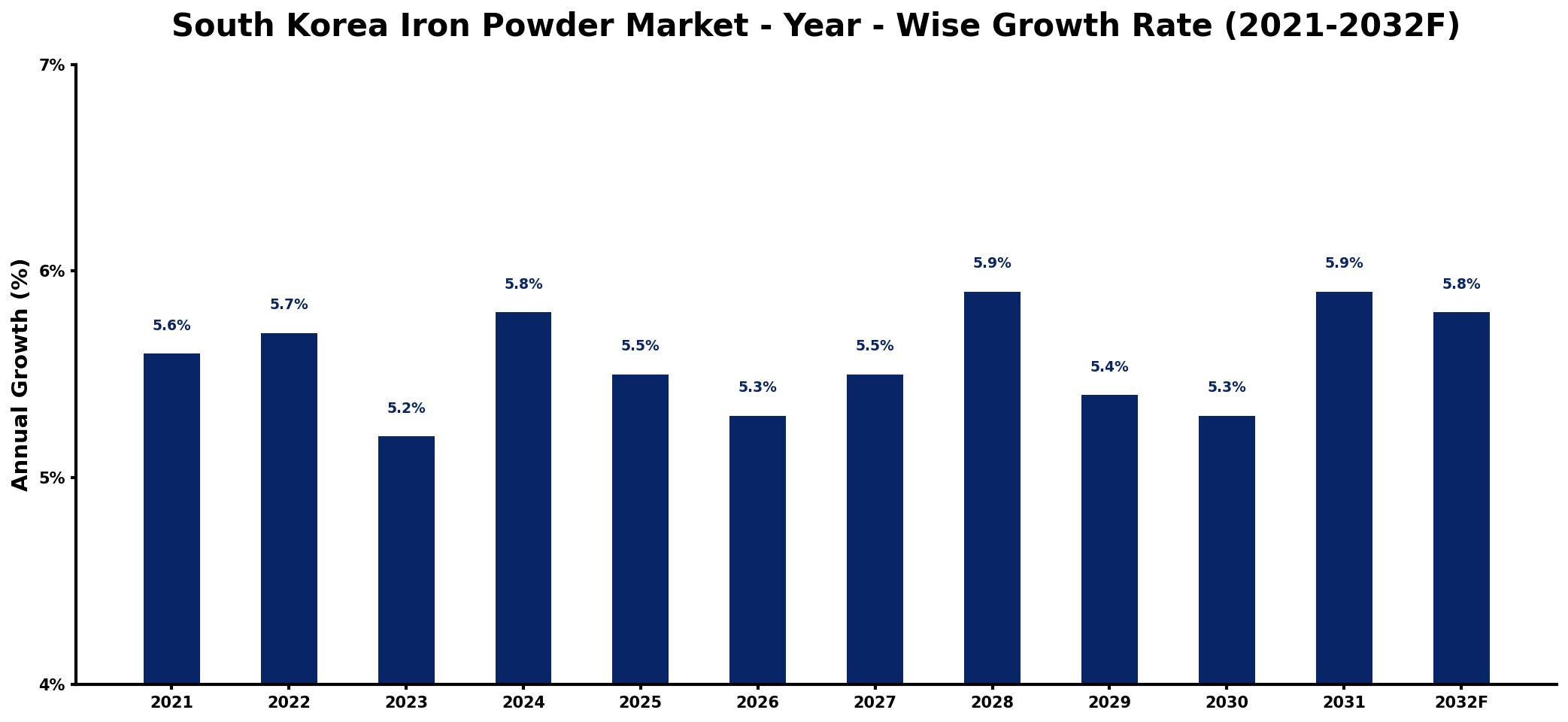
The table below presents the year‑wise growth rates along with the key drivers influencing the market
| Year | Growth Rate | Major Drivers |
| 2021 | 5.6% | Rising automotive manufacturing demand |
| 2022 | 5.7% | Growing electronics sector investments |
| 2023 | 5.2% | Increased construction project initiatives |
| 2024 | 5.8% | Surge in renewable energy applications |
| 2025 | 5.5% | Expansion of aerospace industry needs |
| 2026 | 5.3% | Higher demand from medical devices |
| 2027 | 5.5% | Boost in consumer goods production |
| 2028 | 5.9% | Increased focus on sustainable materials |
| 2029 | 5.4% | Growth in defense sector spending |
| 2030 | 5.3% | Rising demand for advanced technologies |
| 2031 | 5.9% | expanding healthcare application demand |
| 2032 | 5.8% | Growing interest in recycling initiatives |
Note: Market size estimations and growth projections presented in this report are based on 6Wresearch's proprietary forecasting methodology, utilizing the latest available industry data, government publications, and primary research inputs.
South Korea Iron Powder Market Synopsis
In South Korea, the iron powder market is witnessing a significant transformation as industries embrace innovative applications of iron powder. Key sectors, including powder metallurgy and magnetic materials, are increasingly relying on high-quality iron powder to enhance product performance and durability.
This market is underpinned by the growing trend towards additive manufacturing, which is reshaping traditional manufacturing processes. As companies strive for efficiency and cost-effectiveness, the demand for iron powder products tailored to specific applications continues to rise, positioning South Korea as a critical player in the global iron powder landscape.
South Korea Iron Powder Market Key Takeaways
- The market is driven by increasing demand in automotive, electronics, and metallurgy applications.
- Advancements in powder production technologies are enhancing product quality and performance.
- Growth in additive manufacturing is opening new avenues for iron powder utilization.
- Government policies favor industrial innovation and technology adoption, promoting market competitiveness.
- R&D initiatives are fostering collaboration to develop sustainable manufacturing solutions in iron powder production.
Evaluation of Restraints in South Korea Iron Powder Market
Despite the positive outlook, the South Korea iron powder market faces several restraints. Fluctuations in raw material prices can impact production costs, leading to instability in pricing for end-users. Furthermore, stringent compliance with safety and environmental regulations presents an ongoing challenge for manufacturers striving to meet high quality and sustainability standards. The need for continuous innovation to keep pace with evolving market demands adds another layer of complexity to this dynamic landscape.
South Korea Iron Powder Market Trends
One of the most significant trends in the South Korea iron powder market is the growing adoption of additive manufacturing technologies, which allow for the production of complex geometries and lightweight components. This trend is transforming traditional manufacturing methods, pushing industries to seek innovative solutions that enhance material performance.
Additionally, there is a rising focus on sustainable practices, leading to the development of eco-friendly iron powder products. Manufacturers are investing in research to create materials that not only meet performance standards but also adhere to environmental guidelines, aligning with global sustainability goals.
South Korea Iron Powder Market Opportunities
The South Korea iron powder market is poised for robust growth, driven by opportunities in emerging technologies such as 3D printing and advanced metallurgy. Companies can capitalize on the increasing demand for customized iron powder solutions across diverse applications, including automotive components and magnetic materials. Additionally, there is significant potential for innovation in product development, especially in creating sustainable and high-performance materials, which can open new revenue streams and enhance market competitiveness.
Government Initiatives in the South Korea Iron Powder Market
Government policies in South Korea are playing a crucial role in fostering the iron powder market through support for industrial innovation and technology advancement. Initiatives aimed at enhancing product quality standards and safety certifications are in place to ensure competitiveness in the market. Financial incentives are also being directed toward producers and innovators focusing on powder metallurgy and advanced manufacturing techniques, thereby boosting R&D efforts and collaborations between industry and academic institutions.
Future Insights of the South Korea Iron Powder Market
Looking forward to the period from 2026 to 2032, the South Korea iron powder market is expected to continue its upward trajectory, driven by ongoing technological advancements and industry demand for high-performance materials. The integration of smart manufacturing solutions and automation in production processes will likely enhance efficiency and reduce costs. Furthermore, as the global push for sustainability intensifies, the market will increasingly focus on developing iron powder products that meet stringent environmental criteria, ensuring that South Korea maintains its competitive edge in the global arena.
South Korea Iron Powder Market Latest Developments (2025 - 2026)
Recent developments in the South Korea iron powder market indicate a shift towards more sustainable and technologically advanced production methods. Companies are increasingly exploring partnerships and collaborations to enhance their capabilities in additive manufacturing. Additionally, there has been a notable increase in investments aimed at improving the efficiency of iron powder production processes, responding to the growing demand for high-quality, customized products.
South Korea Iron Powder Market - Key Attractiveness of the Report
- 10 Years of Market Numbers
- Historical Data Starting from 2022 to 2025
- Base Year: 2025
- Forecast Data until 2032
- Key Performance Indicators Impacting the Market
- Major Upcoming Developments and Projects
Key Highlights of the Report:
- South Korea Iron Powder Market Outlook
- Market Size of South Korea Iron Powder Market, 2025
- Forecast of South Korea Iron Powder Market, 2032
- Historical Data and Forecast of South Korea Iron Powder Revenues & Volume for the Period 2022-2032F
- South Korea Iron Powder Market Trend Evolution
- South Korea Iron Powder Market Drivers and Challenges
- South Korea Iron Powder Price Trends
- South Korea Iron Powder Porter's Five Forces
- South Korea Iron Powder Industry Life Cycle
- Historical Data and Forecast of South Korea Iron Powder Market Revenues & Volume By End Use for the Period 2022-2032F
- Historical Data and Forecast of South Korea Iron Powder Market Revenues & Volume By Aerospace & defense for the Period 2022-2032F
- Historical Data and Forecast of South Korea Iron Powder Market Revenues & Volume By Automotive for the Period 2022-2032F
- Historical Data and Forecast of South Korea Iron Powder Market Revenues & Volume By Oil & Gas for the Period 2022-2032F
- Historical Data and Forecast of South Korea Iron Powder Market Revenues & Volume By Medical for the Period 2022-2032F
- Historical Data and Forecast of South Korea Iron Powder Market Revenues & Volume By Others for the Period 2022-2032F
- Historical Data and Forecast of South Korea Iron Powder Market Revenues & Volume By Product Type for the Period 2022-2032F
- Historical Data and Forecast of South Korea Iron Powder Market Revenues & Volume By Unalloyed for the Period 2022-2032F
- Historical Data and Forecast of South Korea Iron Powder Market Revenues & Volume By Alloyed for the Period 2022-2032F
- Historical Data and Forecast of South Korea Iron Powder Market Revenues & Volume By Insulated Iron powder for the Period 2022-2032F
- Historical Data and Forecast of South Korea Iron Powder Market Revenues & Volume By Manufacturing Process for the Period 2022-2032F
- Historical Data and Forecast of South Korea Iron Powder Market Revenues & Volume By Physical for the Period 2022-2032F
- Historical Data and Forecast of South Korea Iron Powder Market Revenues & Volume By Atomization for the Period 2022-2032F
- Historical Data and Forecast of South Korea Iron Powder Market Revenues & Volume By Electro deposition for the Period 2022-2032F
- Historical Data and Forecast of South Korea Iron Powder Market Revenues & Volume By Chemical for the Period 2022-2032F
- Historical Data and Forecast of South Korea Iron Powder Market Revenues & Volume By Reduction for the Period 2022-2032F
- Historical Data and Forecast of South Korea Iron Powder Market Revenues & Volume By Decomposition for the Period 2022-2032F
- Historical Data and Forecast of South Korea Iron Powder Market Revenues & Volume By Mechanical for the Period 2022-2032F
- Historical Data and Forecast of South Korea Iron Powder Market Revenues & Volume By Pulverization for the Period 2022-2032F
- South Korea Iron Powder Import Export Trade Statistics
- Market Opportunity Assessment By End Use
- Market Opportunity Assessment By Product Type
- Market Opportunity Assessment By Manufacturing Process
- South Korea Iron Powder Top Companies Market Share
- South Korea Iron Powder Competitive Benchmarking By Technical and Operational Parameters
- South Korea Iron Powder Company Profiles
- South Korea Iron Powder Key Strategic Recommendations






































